Aug 11, 2022
Ligation (Instructor Protocol)
This protocol is a draft, published without a DOI.
- 1University of Wisconsin - Stout
- Yeast ORFans CURE



Protocol Citation: Brian Teague 2022. Ligation (Instructor Protocol). protocols.io https://dx.doi.org/
License: This is an open access protocol distributed under the terms of the Creative Commons Attribution License, which permits unrestricted use, distribution, and reproduction in any medium, provided the original author and source are credited
Protocol status: Working
We use this protocol and it's working
Created: August 05, 2022
Last Modified: August 11, 2022
Protocol Integer ID: 68257
Keywords: ligase, ligation, oligonucleotides, student ligation protocol, instructor protocol for the student ligation protocol, ligase buffer, kind of ligation, student protocol, expensive master reagent tube, abstract for the student protocol, reagent tube, instructor protocol, gel, small tube, pcr tube, beginning student screws something, enzyme, student screws something, student, digest, tube
Abstract
This is the instructor protocol for the student Ligation protocol.
The abstract for the student protocol explains the basics. I pre-digest the L2-01 backbone for my students, but I generally do not gel-purify it. I find that the ligation is generally pretty robust, with three caveats:
- Because I don't gel-purify, we need to bias the ligation towards ligating the annealed oligos (not the GFP that was digested out). To do so, I dilute the backbone to 10 fmol/ul and instruct the students to dilute their annealed oligos to 200 fmol/ul (which is 200 nanomolar (nM) ).
- Ligase is EXPENSIVE, and this kind of ligation does not need much -- so I dilute 1:5 into small tubes. Thus, if a beginning student screws something up (throws the tube away, or contaminates it, etc), the expensive master reagent tube isn't lost.
- The ligase buffer contains ATP, which is heat-labile. (When a ligation fails, it's often because the buffer is bad, not the enzyme!) Thawing and re-freezing is not good for it. So, I aliquot the ligase buffer into single-use 5 ul aliquots in PCR tubes.
Image Attribution
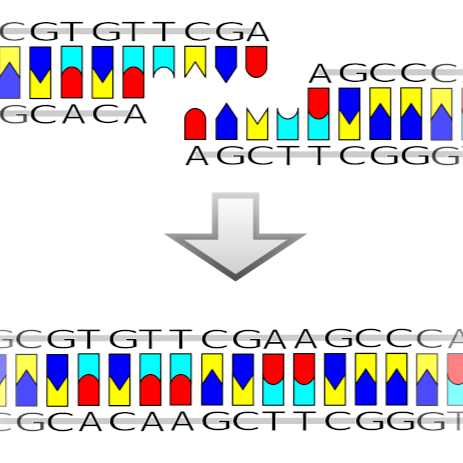
By Madprime - Own work, CC BY-SA 3.0, https://commons.wikimedia.org/w/index.php?curid=2161789
Materials
- E. coli freezer stock transformed with the L2-01 plasmid
- LB agar + 50 µg/ml KanamycinResearch Products International Corp (RPI)Catalog #K22000-25.0
- LB Broth + 50 µg/ml KanamycinResearch Products International Corp (RPI)Catalog #K22000-25.0
- Monarch Plasmid Miniprep KitNEBCatalog #T1010
- Nuclease-free Water
- Esp3INew England BiolabsCatalog # R0734S
- CutSmart® BufferNew England BiolabsCatalog #B7204S
- Monarch DNA Elution Buffer - 25 mlNew England BiolabsCatalog #T1016L (optional)
- 10X NEB T4 DNA ligase bufferNew England Biolabs
- T4 DNA Ligase - 20,000 unitsNew England BiolabsCatalog #M0202S
- Diluent A - 5.0 mlNew England BiolabsCatalog #B8001S
Protocol materials
10X NEB T4 DNA ligase bufferNew England Biolabs
KanamycinResearch Products International Corp (RPI)Catalog #K22000-25.0
Monarch DNA Elution Buffer - 25 mlNew England BiolabsCatalog #T1016L
LB Broth
Monarch Plasmid Miniprep KitNEBCatalog #T1010
Nuclease-free Water
Esp3INew England BiolabsCatalog #
R0734S
CutSmart® BufferNew England BiolabsCatalog #B7204S
LB agar
T4 DNA Ligase - 20,000 unitsNew England BiolabsCatalog #M0202S
Diluent A - 5.0 mlNew England BiolabsCatalog #B8001S
Monarch DNA Gel Extraction KitNew England BiolabsCatalog #T1020S
Safety warnings
Some components of the miniprep kit are hazardous; wear appropriate PPE.
TE, oligos, ligase & buffer, etc. are not hazardous. HOWEVER, we are shedding nucleases -- enzymes that degrade DNA -- all the time. Wear lab coats and gloves to keep your samples nuclease-free.
Grow & miniprep L2-01
At least 48 hours before the lab, strike out the L2-01 E. coli strain from a frozen stock on an LB+Kan plate.
Expected result
Sanity check -- because the L2-01 plasmid has a GFP cassette, the colonies should be bright green!
At least 24 hours before the lab: pick a colony of L2-01 into 5 mL LB+Kan liquid media. Grow in a round-bottomed test-tube overnight on a shaker, 200 rpm, 37°C, 16:00:00
Expected result
This is a pretty big plasmid, so the culture may not be as turbid as you're used to.
Expected result
Sanity check -- the culture should be bright green!
Miniprep the culture using the Monarch Plasmid Miniprep KitNEBCatalog #T1010 or another suitable miniprep kit.
Analyze the eluate on a Nanodrop for DNA concentration and purity.
Expected result
Typical elution: 50 ul @ 130 ng/ul (20 fmol/ul)
Linearize L2-01
3h 20m
We're going to linearize the ENTIRE miniprep. To a 200 ul PCR tube, add:
- 50 µL miniprep
- 38 µL Nuclease-free Water
- 10 µL CutSmart® BufferNew England BiolabsCatalog #B7204S
- 2 µL Esp3INew England BiolabsCatalog # R0734S
Flick several times to mix well, then pulse down in a microcentrifuge.
Incubate 37 °C for 03:00:00 , then inactivate the reaction at 65 °C for 00:20:00
3h 20m
Optional: gel-purify the backbone. Run the entire miniprep on a preparative agarose gel, then use a kit such as the Monarch DNA Gel Extraction KitNew England BiolabsCatalog #T1020S to purify the larger band.
Optional: dilute with Monarch DNA Elution Buffer - 25 mlNew England BiolabsCatalog #T1016L to a final concentration of 10 fmol/µl.
Aliquot / dilute reagents
Aliquot 1 mL of Nuclease-free Water per 4 students. Store at Room temperature .
Aliquot 10X NEB T4 DNA ligase bufferNew England Biolabs into 5 µL single-use aliquots in 200 ul PCR strip tubes. Store at -20 °C .
Note
I like to store these in a 200 µl tip box.
Dilute T4 DNA Ligase - 20,000 unitsNew England BiolabsCatalog #M0202S 1:5 in Diluent A - 5.0 mlNew England BiolabsCatalog #B8001S . I make tubes containing 2 µL of ligase and 8 µL of buffer, one per 4 students. Store at -20 °C .
Instructor Tips & Common Student Errors
Instructor Tips
- The first step of the student protocol requires another dilution. Again, I'm hands-off for this one. A common student question is "what is the concentration of my annealed oligos?" and I suggest that they might be able to figure it out by reviewing the annealing protocol.
- I usually instruct students to run this protocol and the URA3 PCR protocol at the same time: set up the ligation, then while the ligation is incubating, set up their PCR.
Common Student Errors
- Omitting the dilution step (particularly if they need to retry the protocol.)
- Small-volume pipetting.