Jan 23, 2026
Leukocyte Isolation and Chemotaxis Assay Using Zymosan-Opsonized Plasma and Agarose Spots
- 1University of the Philippines Manila



Protocol Citation: Brian Andrich Pollo 2026. Leukocyte Isolation and Chemotaxis Assay Using Zymosan-Opsonized Plasma and Agarose Spots. protocols.io https://dx.doi.org/10.17504/protocols.io.kxygx8yykv8j/v1
License: This is an open access protocol distributed under the terms of the Creative Commons Attribution License, which permits unrestricted use, distribution, and reproduction in any medium, provided the original author and source are credited
Protocol status: Working
We use this protocol and it's working
Created: January 22, 2026
Last Modified: January 23, 2026
Protocol Integer ID: 239208
Keywords: leukocytes, RBC lysis, HBSS, chemotaxis, agarose spot, zymosan, WBC, leukocyte isolation, isolation of leukocyte, leukocyte, agarose spot assay, zymosan activation, chemotaxis assay, agarose spots this protocol, using zymosan, agarose spot, assessment of chemotaxi, opsonized plasma, chemotaxi, immunology, studies in immunology, zymosan, inflammation, human whole blood, rbc lysi, activated plasma
Funders Acknowledgements:
DOST-PCHRD
Grant ID: MD-PhD Dissertation Grant
Disclaimer
DISCLAIMER – FOR INFORMATIONAL PURPOSES ONLY; USE AT YOUR OWN RISK
The protocol content here is for informational purposes only and does not constitute legal, medical, clinical, or safety advice, or otherwise; content added to protocols.io is not peer reviewed and may not have undergone a formal approval of any kind. Information presented in this protocol should not substitute for independent professional judgment, advice, diagnosis, or treatment. Any action you take or refrain from taking using or relying upon the information presented here is strictly at your own risk. You agree that neither the Company nor any of the authors, contributors, administrators, or anyone else associated with protocols.io, can be held responsible for your use of the information contained in or linked to this protocol or any of our Sites/Apps and Services.
Abstract
This protocol describes the isolation of leukocytes from human whole blood, opsonization of targets with zymosan-activated plasma, and assessment of chemotaxis using an agarose spot assay. The method integrates established RBC lysis, zymosan activation, and quantitative image analysis, and can be adapted for studies in immunology and inflammation.
Attachments

Image Attribution
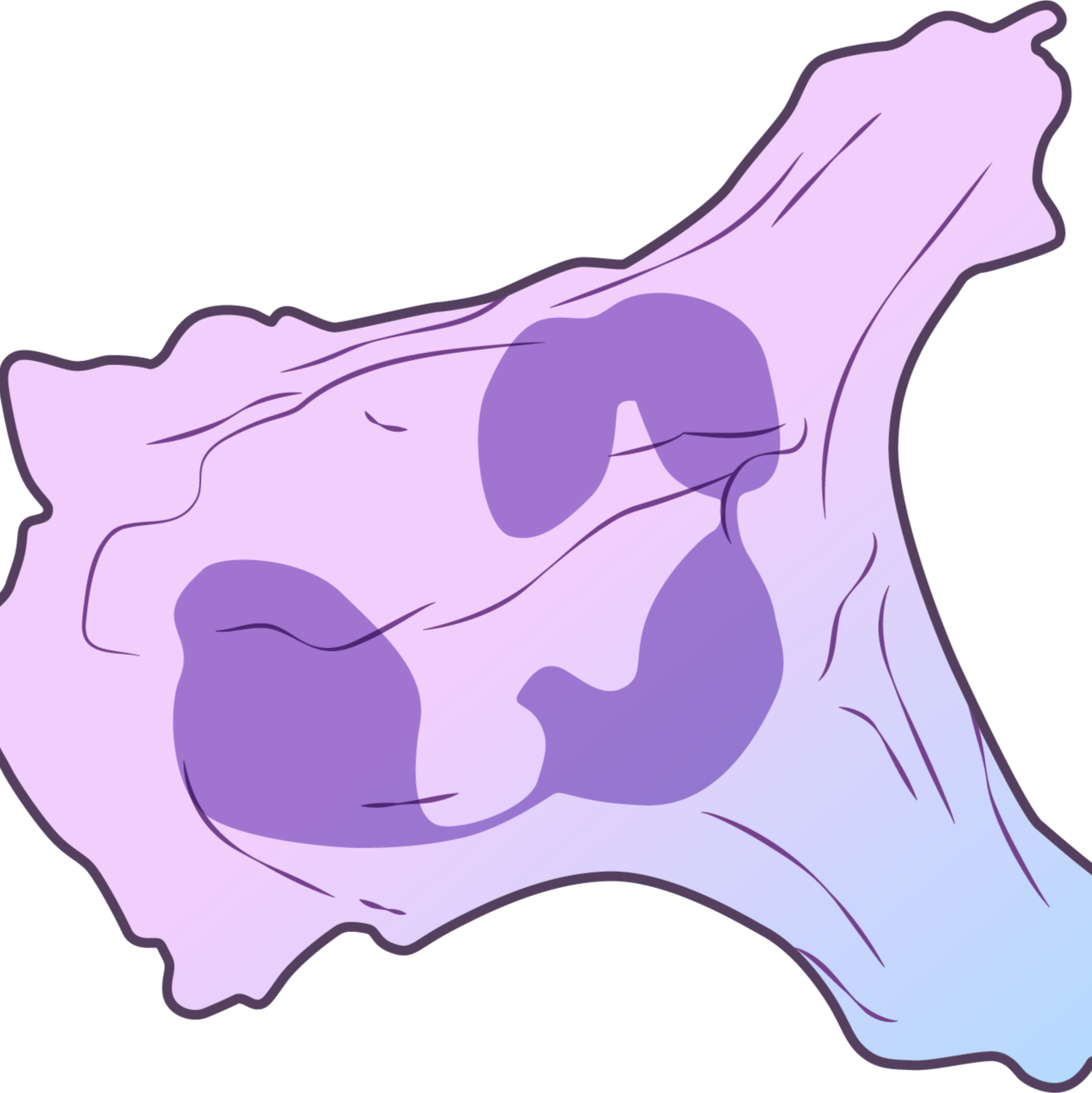
Courtesy of NIAIDRyan Kissinger, Public domain, via Wikimedia Commons
Materials
RBC lysis buffer, HBSS, zymosan (yeast cell walls), low-melt agarose, CPDA-1 blood collection supplies, trypan blue, PBS, distilled water. Equipment: Centrifuge capable of 300–350×g, water bath (40 °C), hemocytometer, microscope with imaging, microscope slides, cover slip.
Troubleshooting
Problem
Low migration
Solution
check leukocyte viability, confirm zymosan opsonization.
Problem
High backgund
Solution
ensure purity of WBC prep and verify agarose spot integrity.
Before start
Timing: Total ≈ 4–5 h
Critical: Work at room temperature unless otherwise specified.
Critical Points:
• Ensure complete RBC lysis; if RBCs persist, repeat step.
• Maintain agarose at 40 °C to prevent premature solidification.
• Normalize migration to positive control for comparability.
A. Reagent Preparation
Add all reagents to ~80 mL distilled water in a clean beaker.
Stir until fully dissolved.
Bring volume to 100 mL with distilled water.
Store at 4 °C for up to 6 months.
Add all reagents to ~400 mL distilled water.
Stir until dissolved.
Bring volume to 500 mL with distilled water.
Store at 4 °C for up to 1 month.
B. Preparation of Leukocyte Suspension
Collect whole blood in CPDA-1 tubes.
Perform a light centrifugation at (placeholder: 300 × g, 5 min) to separate plasma.
Remove plasma and retain red cell pack + buffy coat.
Add RBC lysis buffer to the red cell pack at a 1:10 ratio (v/v).
Incubate 10 min at room temperature with gentle rocking.
Centrifuge at 300 × g for 5 min; discard supernatant.
Repeat lysis if RBCs remain visible.
Resuspend WBC pellet in HBSS and wash once.
Resuspend cells in assay-appropriate medium.
Mix 1:1 WBC suspension with 0.4% trypan blue.
Incubate for 3 min at room temperature.
Load 100 µL onto hemocytometer.
Count viable (unstained) and non-viable (blue) cells.
Suspend 20 mg zymosan in 500 µL distilled water.
Centrifuge at 300 × g for 5 min; discard supernatant.
Wash pellet twice with HBSS (pH 7.4).
Resuspend final pellet in 10 mL HBSS.
Aliquot 1 mL per tube; centrifuge at 350 × g for 5 min.
E. Agarose Spot Chemotaxis Assay
Prepare 0.5% low-gelling agarose in PBS (pH 7.4).
Keep melted agarose at 40 °C.
Mix 20 µL plasma sample with 180 µL agarose.
Spot 10 µL of mixture microscope slide.
Place coverslip.
Add 50 µL WBC suspension (5 × 10^6 cells/mL) in between cover slip and slide.
Incubate at 37 °C for 1 h.
Observe spots under binocular microscope at 40× magnification.
Capture images of four quadrants per spot.
Analyze in ImageJ:
- Subtract background.
- Adjust threshold to isolate cells (3e20 pixels, circularity 0–1).
Count migrated cells.
Normalize counts to positive control as 100%.
(Optional) Measure migration distance from spot edge using coordinate geometry in ImageJ.
Centrifuge at 300 × g for 5 min; repeat if RBCs remain.
Wash leukocytes in HBSS and resuspend for downstream assays.
Mix 1:1 leukocyte suspension with 0.4% trypan blue.
Incubate 3 min at RT.
Count cells on hemocytometer; calculate viable cell percentage.
Suspend 20 mg zymosan in 500 µL distilled water; centrifuge at 300 × g for 5 min.
Wash pellet twice with HBSS (pH 7.4).
Resuspend pellet in 10 mL HBSS.
Aliquot and centrifuge at 350 × g for 5 min.
Prepare 0.5% agarose in PBS; keep at 40 °C.
Mix 20 µL plasma (activated or control) with 180 µL agarose.
Spot 10 µL in each well of a 96-well plate; allow to solidify.
Add 50 µL leukocyte suspension (5 × 10^6 cells/mL) to each well.
Incubate at 37 °C for 1 h.
Image four quadrants of each spot at 100× magnification.
Process images in ImageJ: background subtraction, thresholding, particle counting (3e20 pixels).
Normalize migration counts to positive control (=100%).
(Optional) Determine migration distances from spot edge via coordinate geometry.
Expected Results
• Positive control (zymosan-activated plasma) should yield robust migration (∼100% baseline).
• Negative controls (unactivated plasma, buffer) should show minimal cell infiltration.
• Distance analyses provide additional metric of chemotactic strength.
Protocol references
[1] Dagur PK, McCoy JP. Collection, Storage,
and Preparation of Human Blood Cells. Curr Protoc Cytom 2015;73:5.1.1-5.1.16.
https://doi.org/10.1002/0471142956.CY0501S73.
[2] Denk S, Taylor RP, Wiegner R, Cook EM, Lindorfer MA, Pfeiffer K, et al. Complement C5a-Induced Changes in Neutrophil Morphology During Inflammation. Scand J Immunol 2017;86:143–55. https://doi.org/10.1111/SJI.12580.
[3] Clos-Sansalvador M, Monguió-Tortajada M, Grau-Leal F, Ruiz de Porras V, Garcia SG, Sanroque-Muñoz M, et al. Agarose spot migration assay to measure the chemoattractant potential of extracellular vesicles: applications in regenerative medicine and cancer metastasis. BMC Biol 2023;21:236. https://doi.org/10.1186/S12915-023-01729-5.
[4] King RAN, Climacosa FMM, Santos BMM, Caoili SEC. A Human Erythrocyte-based Haemolysis Assay for the Evaluation of Human Complement Activity: Https://DoiOrg/101177/0261192920953170 2020;48:127–35. https://doi.org/10.1177/0261192920953170.
[5] Climacosa FMM, King RAN, Santos BMM, Caoili SEC. Development and Characterization of Polymeric Peptides for Antibody Tagging of Bacterial Targets. Protein Pept Lett 2020;27:962–70. https://doi.org/10.2174/0929866527666200427212940.
[6] Strober W. Trypan blue exclusion test of cell viability. Current Protocols in Immunology / Edited by John E Coligan . [et Al] 2001;Appendix 3. https://doi.org/10.1002/0471142735.IMA03BS21.