Dec 18, 2025
Landscape model of the Baduy Dalam tribe settlement based on the local culture
- andi_gunawan 1,
- Sholihin Nafar1,
- Maya Dewi Dyah Oktiviana1
- 1IPB University
- IPB University



Protocol Citation: andi_gunawan , Sholihin Nafar, Maya Dewi Dyah Oktiviana 2025. Landscape model of the Baduy Dalam tribe settlement based on the local culture. protocols.io https://dx.doi.org/10.17504/protocols.io.261ge1p2wv47/v1
License: This is an open access protocol distributed under the terms of the Creative Commons Attribution License, which permits unrestricted use, distribution, and reproduction in any medium, provided the original author and source are credited
Protocol status: Working
We use this protocol and it's working
Created: December 18, 2025
Last Modified: December 18, 2025
Protocol Integer ID: 235306
Keywords: Baduy Dalam, design concept, landscape pattern, sustainable landscape, traditional settlement, landscape model of the baduy dalam tribe settlement, settlement landscape model of the baduy dalam tribe, settlement landscape of the baduy dalam tribe, landscape elements of the baduy dalam settlement, spatial organization of the baduy dalam tribe, local culture the baduy dalam tribe, baduy dalam tribe settlement, model of the traditional settlement landscape, traditional settlement landscape, baduy dalam tribe, settlement landscape model, settlement landscape, baduy dalam settlement, baduy dalam community, local culture, sacred forest area, landscape element, ancestral custom, landscape model, vegetation, settlement pattern, culture, cultural influence, own cultural identity, natural feature, regarding nature, kanekes village, nature, leuwidamar district, spatial organization
Disclaimer
This protocol forms an integral part of the research methods applied in the study entitled “Landscape Model of the Baduy Dalam Tribe Settlement Based on Local Culture,” guiding the data collection and analysis processes.
Abstract
The Baduy Dalam Tribe resides in Kanekes Village, Leuwidamar District, Province of Banten. The Baduy Dalam community strictly adheres to ancestral customs, forming a group isolated from the outside world. Their local wisdom regarding nature, simplicity, and environmental tolerance influences the formation of their own cultural identity. The spatial organization of the Baduy Dalam Tribe is shaped by cultural influences, resulting in a settlement pattern governed by steadfast rules. This study aims to analyze the character elements that make up the traditional settlement landscape, and formulate a model of the traditional settlement landscape of the Baduy Dalam tribe based on local culture. The research methodology is a descriptive method, utilizing literature review, interviews, and field observations to explore the culture and landscape elements of the Baduy Dalam settlement. The study reveals that their cultural wisdom forms the settlement landscape of the Baduy Dalam Tribe. Natural features and artificial elements form the character of their settlement landscape. The fundamental elements identified include buildings, open spaces, water features, and vegetation. The settlement landscape model exhibits a nucleus pattern where the settlement forms the central hub surrounded by the hamlet forest area, the upland ricefield area, and the sacred forest area. Community compliance with these customary rules makes this landscape model sustainable. The important research finding is the settlement landscape model of the Baduy Dalam tribe, which was shaped by their cultural wisdom and coexists in harmony with nature.
Attachments
Picture2.jpg
83KB
Guidelines
This protocol uses interviews as a validation method to confirm and contextualize landscape elements identified during the previous literature review stage. Interviews are conducted with traditional figures (pu’un and jaro) and selected members of the Baduy Dalam community to validate the relevance and interpretation of cultural and spatial landscape elements. The interviews do not collect personal, physical, or psychological information from participants. All discussions focus solely on collective knowledge, cultural practices, and settlement landscape characteristics.
Before conducting the interviews, the researcher must:
- Obtain ethical approval from the Ethics Committee for Research Involving Human Subjects, Institut Pertanian Bogor (IPB University).
- Secure permission from the Baduy Dalam traditional authorities, either directly from the pu’un or through the officially delegated representative (jaro).
- Explain the purpose, procedures, and outcomes of the research clearly to all participants.
- Obtain informed consent from all participants prior to data collection.
- Ensure that the research approach respects local customs, traditions, and communication norms of the Baduy Dalam community.
Materials
1. Traditional manuscript
2. Reference book
3. Journal article
4. Archive document
Table 1.
Basic elements shaping the landscape of the Baduy Dalam community
Safety warnings
- This protocol involves human participants and must comply with established ethical research standards.
- Participation is voluntary, and participants may withdraw at any time without consequence.
- The researcher must avoid actions that could violate cultural norms, misrepresent traditional values, or disrupt community harmony.
- Sensitive cultural information shared during interviews must be handled with confidentiality and used solely for academic purposes.
- The researcher must ensure that data interpretation and presentation accurately reflect the perspectives of the Baduy Dalam community.
Materials and Method
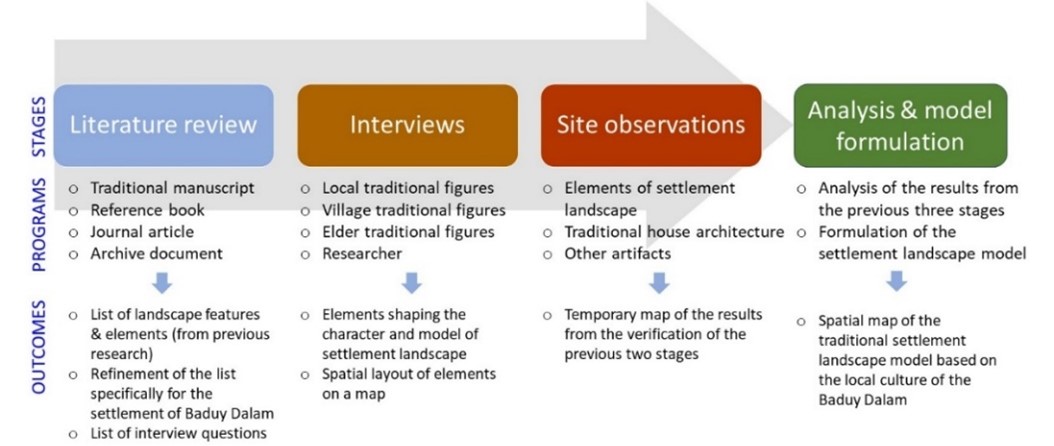
Literature review.
The research begins with a desk study, reviewing customary documents, books, scholarly articles, journals, and similar references. This activity aims to gain a deeper understanding of the Baduy Dalam community and is the basis for formulating interview questions.
Expected outcomes
- List of landscape features & elements (from previous research)
- Refinement of the list specifically for the settlement of Baduy Dalam
- List of interview questions
Interviews.
Interviews were conducted to gather data from key informants such as traditional figures of the Baduy community, namely pu’un and jaro, and other members of the Baduy community. The custom leader of the Baduy Dalam community, known as pu’un, delegates authority to a deputy known as jaro. During the research visit, the community leader was unavailable and delegated representation to Jaro; in this case, Ayah Mursyid (the name of Jaro) was appointed. Additionally, interviews were conducted with several members of the Baduy Dalam community.
- Local traditional figures
- Village traditional figures
- Elder traditional figures
- Researcher
Expected outcomes
- Elements shaping the character and model of settlement landscape
- Spatial layout of elements on a map
Site Observation
Field observations compared data obtained through desk study (literature review) and interviews with the actual conditions in the studied settlement. In this research, field observation involved recording the presence of landscape elements, describing their locations, and sketching these elements. This activity was necessary because the customary rules of the Baduy Dalam community prohibit outsiders from documenting anything within their villages, whether through cameras, videos, or audio recording devices. The literature review yielded important elements that shape traditional landscapes (buildings, open spaces, accessibility, water, and plants/vegetation), which were tabulated following methods used in previous studies on indigenous communities such as the Minangkabau Tribe. In addition to tabulation, maps illustrating the layout of these landscape elements were also presented.
Expected outcomes: Temporary map of the results from the verification of the previous two stages
Analysis and model formulation
The analysis and model formulation stage involves a systematic synthesis of the results obtained from the literature review, interviews, and site observations. This stage focuses on interpreting and integrating qualitative and spatial data to formulate a traditional settlement landscape model. The expected outcome of this stage is a spatial map representing the traditional settlement landscape model, which is developed based on the local cultural values and spatial practices of the Baduy Dalam community.
Protocol references
1. Booth, N.K. (1983). Basic elements of landscape architectural design. Illinois (US): Waveland Press.
2. Gunawan, A., Edison, F.M., Mugnisjah, W.Q., & Utami, F.N.H. (2019). Indonesian cultural landscape diversity:
culture-based landscape elements of Minangkabau traditional settlement. Int.J. Conserv. Sci. 10(4):701-710 https://ijcs.ro/public/IJCS-19-63_Gunawan.pdf
3. Gunawan, A., & Mugnisjah, W.Q. (2024). Landscape model of the Uma Lengge traditional settlement, West Nusa Tenggara. Int. J. Conserv.Sci. 15(4):1899-1912. https://ijcs.ro/public/IJCS-24-04_96_Gunawan.pdf
4. Liantono, P., Gunawan, A., & Fatimah, I.S. (2024). Model lanskap permukiman tradisional masyarakat adat Rejang Provinsi Bengkulu berbasis budaya lokal (Landscape model of traditional settlements of the Rejang indigenous people of Bengkulu Province based on the local culture). J. Lanskap Indones. 16(2):208-216. DOI:https://doi.org/10.29244/jli.v16i2.54294