Oct 23, 2025
Version 3
Knockout of bla from pBlue in E. coli V.3
- Felix Hausmann1,
- Karin Mink2
- 1Staffelsee Gymnasium Murnau;
- 2TU Munic - Institute for Medical Microbiology and Immunology
- W-Seminar AR



Protocol Citation: Felix Hausmann, Karin Mink 2025. Knockout of bla from pBlue in E. coli. protocols.io https://dx.doi.org/10.17504/protocols.io.n92ld62n9g5b/v3Version created by Felix Hausmann
License: This is an open access protocol distributed under the terms of the Creative Commons Attribution License, which permits unrestricted use, distribution, and reproduction in any medium, provided the original author and source are credited
Protocol status: Working
We use this protocol and it's working
Created: October 22, 2025
Last Modified: October 23, 2025
Protocol Integer ID: 230508
Keywords: CRISPR/Cas, CRISPR, anbitiotic resistance, e. coli, XL1-Blue, Cas9, pBlueSkriptII, bla gene from the pbluescript plasmid, disrupted bla gene, based crispr delivery, demonstrating efficient crispr, efficient crispr, bla gene, escherichia coli xl1, pbluescript plasmid, generation of bacterial colony, removal of antibiotic resistance marker, antibiotic resistance marker, preparation of crrna, bacteria, gene, bacterial colony, knockout of bla, complex formation with cas9
Disclaimer
DISCLAIMER – FOR INFORMATIONAL PURPOSES ONLY; USE AT YOUR OWN RISK
The protocol content here is for informational purposes only and does not constitute legal, medical, clinical, or safety advice, or otherwise; content added to protocols.io is not peer reviewed and may not have undergone a formal approval of any kind. Information presented in this protocol should not substitute for independent professional judgment, advice, diagnosis, or treatment. Any action you take or refrain from taking using or relying upon the information presented here is strictly at your own risk. You agree that neither the Company nor any of the authors, contributors, administrators, or anyone else associated with protocols.io, can be held responsible for your use of the information contained in or linked to this protocol or any of our Sites/Apps and Services.
Abstract
This protocol details the knockout of the bla gene from the pBluescript plasmid in Escherichia coli XL1-Blue by delivering a pre-assembled Cas9 ribonucleoprotein complex via electroporation. The method includes preparation of crRNA and tracrRNA, complex formation with Cas9, and subsequent transformation of electrocompetent cells.
Expected results are the generation of bacterial colonies with a disrupted bla gene and loss of ampicillin resistance, demonstrating efficient CRISPR/Cas9-mediated plasmid editing. This outcome confirms the possibilites of RNP-based CRISPR delivery as a strategy for targeted removal of antibiotic resistance markers in bacteria.
Image Attribution
©Felix Hausmann
Guidelines
Make sure to stick to the instructions very closely, especially if you are at the CRISPR part. There you'll need to work with extreme caution to prevent cross-contamination and eventually invalidate your results.
Materials
Plasmid
- pBluescript SK II (+) (c = 802 μg/μl)
CRISPR-components
- crRNA targeting bla: 5'-GTATTATCCCGTATTGACGC-3'
- tracrRNA
- crRNA buffer
- Cas9-Protein
Bacteria
- E. coli XL1-Blue electrocompetent (c = 1000 μg/μl)
Electroporation
- Electroporation cuvettes (0.1 cm gap / 0.2 cm optional)
- Electroporation media
Note
Following EPM was used:
- 2.43 millimolar (mM) K2HPO4
- 0.57 nanomolar (nM) KH2PO4
- 272 nanomolar (nM) Saccharose
- 15 Mass Percent Glycerin
- Electroporator
Culture
- LB-media
Note
Recipe for LB-media:
- 171.1 millimolar (mM) NaCl
- 1 Mass / % volume Tryptone
- 0.5 Mass / % volume Yeast Extract
- 1.5 Mass / % volume Agar
- SOC-media
Note
SOC-media with the following recipe was used:
- 10 millimolar (mM) NaCl
- 2.5 millimolar (mM) KCl
- 2 Mass / % volume Tryptone
- 0.5 Mass / % volume Yeast extract
- LB-agar/Ampicillin-Platte
- Plating spatulas
Equipment
- Thermoshaker
- Centrifuge
- Pipettes
- Ice
- Incubator: stationary and shaker
Software
Safety warnings
The components of this protocol are not designated as dangerous, however since you will be working with antibiotic resistant GMOs, the usage of safety gloves and a lab coat is highly recommended to prevent any contamination or similar.
Furthermore ensure that you plan your experiment according to the safety standards of your lab.
Inform yourself about:
- local waste disposal regulations
- lab specific operating instructions
- lab specific safety procedures
- more local restrictions when working with GMOs
Preparation of electrocompetent E.coli
1d 2h 5m
Retrieve XL-1 from the -80 °C freezer and let them thaw On ice
After thawing centrifugate 4500 rpm, 37°C, 00:05:00
5m
Seperate LB-media using pipettes
Resuspend XL1 pellets in50 µg/µL electroporation buffer
Add 1 µL PBSII+
Incubate cells in a shaker at 200 rpm, 37°C, 01:00:00
1h
Transfer 50 µL of the XL-1/buffer into a 0.1 cm electroporation cuvette
Note
You can also use a 0.2 cm cuvette for which you'll need to adapt the ep settings depending on your machine
Electroporate at 1.8-2.5 kV
Recover in 950 µL SOC at 37 °C for 01:00:00
1h
Plate on selective LB-Amp plates using a sterile plating spatula
Safety information
Make sure to not re-use the spatula to avoid cross-contamination and dispose in the right waste
Incubate upside down at 37 °C Overnight
Note
Don't incubate longer than 18-24 hours
Expected result
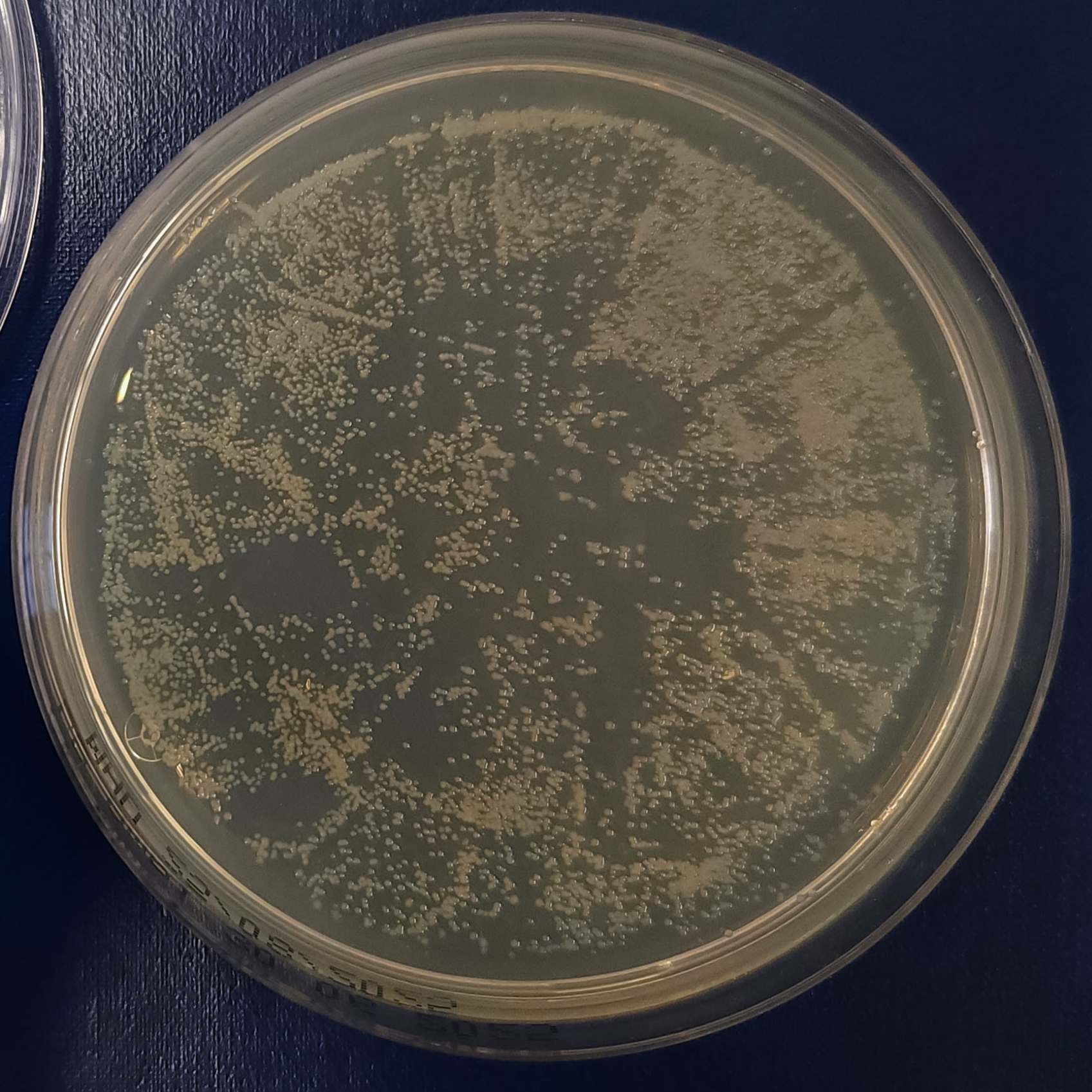
When successful transformed, you should have multiple colonies growing on the plate
1d
Picking transformed XL-1
Pick one bacterial colony from the plate using the tip of the pipette
Resuspend in 450 µL LBM
Note
To further increase validity of the results, you can also pick three more colonies. Resuspend the first again in 450 µL LMB to serve as control colony. The other two are resuspended in 950 µL LBM, for which one again is used as control colony.
Incubate in a shaker 200 rpm, 37°C, 00:10:00
Reconstitute lyophilized crRNA in buffer
Adjust crRNA concentration to 100 µL for RNP preparation
Dilute lyophylized crRNA in buffer depending on n(crRNA)
Note
Aliquots can be stored @-20 °C for 1 month or at -80 °C for longer periods
Note
Use the following formula to determine the required volume of buffer for 100 µL
Example: n(crRNA) = 2 µL
RNP complex generation
15m
Mix tracrRNA with crRNA in a ratio of 1.2:1.2
Safety information
- Work with extreme caution for the following section, since every μL can make a difference in the end result
- Make sure you're using separate tips for every step that follows to minimize the risk of unwanted dilution.
- Also ensure that you work according to lab specific genetic editing guidelines
Note
RNP complex consists of tracrRNA:crRNA:Cas9 in a ratio of 1.2:1.2:2.6
Note
tracrRNA & crRNA were reconstitued in 100 micromolar (µM) each while the Cas9 is available in 40 micromolar (µM)
Incubate at 96 °C for 00:05:00
5m
Cool down to Room temperature for around 00:10:00
Spin down at 13000 rpm, 37°C, 00:03:00
10m
In the meantime: bring Cas9 to Room temperature
Mix Cas9 to the sgRNA under continuous mixing
Incubate RNP complex at500 rpm, 37°C, 00:15:00 approx. 15 min
Note
Final RNP complex can be stored @ 4 °C for around 2 weeks and at -80 °C for longer periods
Electroporation with Bio-Rad
1d 2h
Mix
- 50 µL XL-1/pBSII+
- 2-3 µL Cas9 RNP
Transfer to 0.1 cm cuvette
Note
It is also possible to use a 0.2 cm cuvette, however 0.1 cm cuvettes are preferred
Electroporate at 1.8-2.5 kV
Recover in 950 µL SOC at 400 rpm, 37°C, 02:00:00
2h
Plate on selective LB-Amp plates
Note
It's recommended that you'll plate on a LB-agar plate as a control plate to validate your results.
Furthermore it'll be helpful if you plate more than one plate
Incubate upside down at 37 °C Overnight
Note
Don't incubate longer than 18-24 hours
Expected result
If everything has been successful you should see a reduction of the colonies growing on the LB-Agar plate compared to the control plate.
In the best case you shouldn't see any growing colonies on the LB-Amp plate
1d