Oct 28, 2025
Version 1
Isolating Symbionts from Vertically Transmitted Corals (Montipora capitata) V.1
- 1Hawai'i Institute of Marine Biology
- stuff



Protocol Citation: Tahirih Perez 2025. Isolating Symbionts from Vertically Transmitted Corals (Montipora capitata). protocols.io https://dx.doi.org/10.17504/protocols.io.j8nlkr7z6v5r/v1
License: This is an open access protocol distributed under the terms of the Creative Commons Attribution License, which permits unrestricted use, distribution, and reproduction in any medium, provided the original author and source are credited
Protocol status: In development
We are still developing and optimizing this protocol
Created: June 26, 2025
Last Modified: October 28, 2025
Protocol Integer ID: 221149
Keywords: culture, isolation, symbiodiniaceae, corals, coral, Montipora, Montipora capitata, symbiodiniaceae from montipora capitata egg, sustaining symbiodiniaceae culture, symbiodiniaceae culture, transmitted coral, transmitted symbiodiniaceae, montipora capitata egg, isolating symbiont, montipora capitata, spawning season, minimising contamination
Abstract
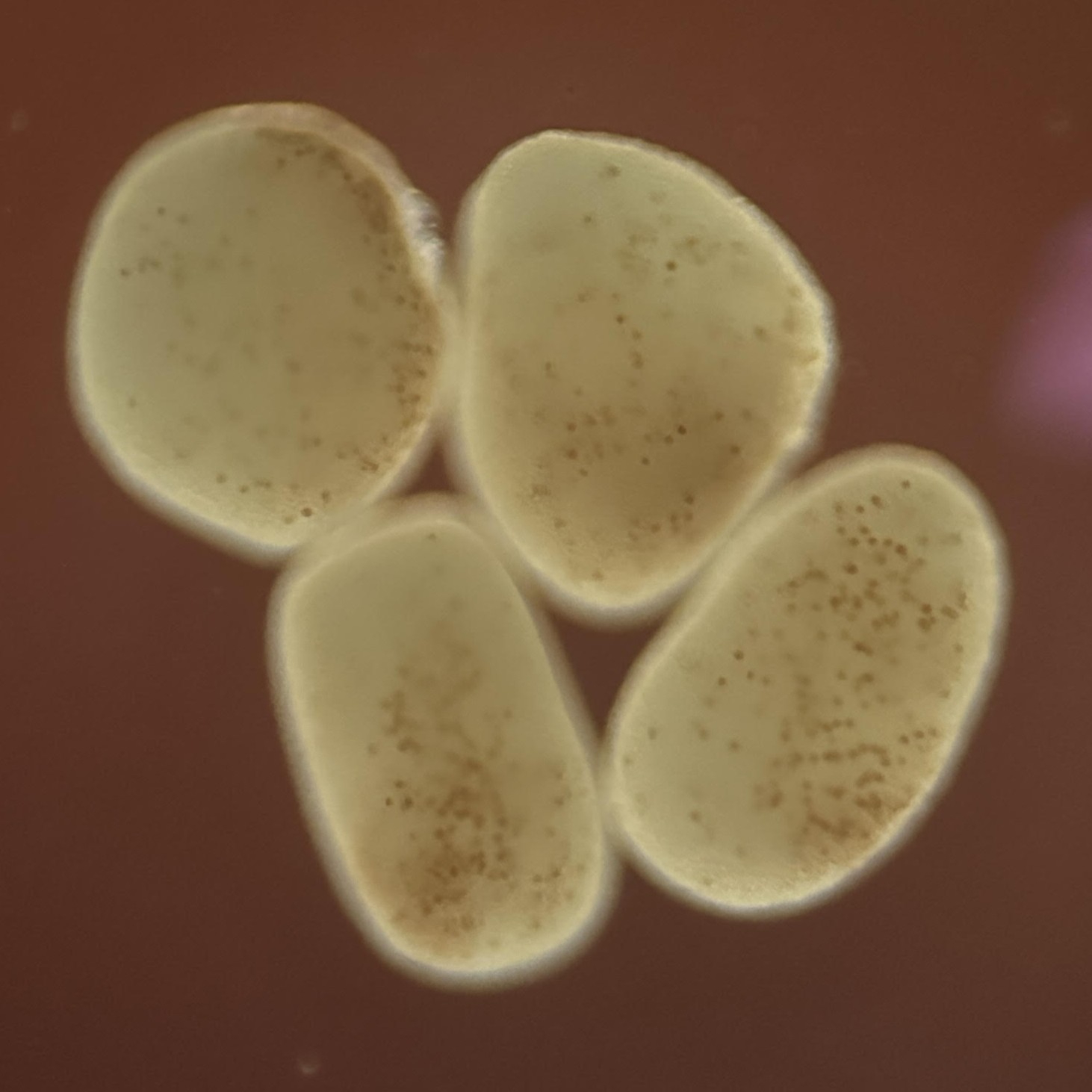
This protocol describes the isolation and culture of vertically transmitted Symbiodiniaceae from Montipora capitata eggs collected during the May 2025 spawning season in Hawai'i. It outlines methods for minimising contamination while maintaining cell viability, including antibiotic treatments, culture maintenance, and monitoring of growth and motility. This procedure could provide a reproducible framework for establishing and sustaining Symbiodiniaceae cultures; however, it is continuously being refined, and alternative media are being tested to optimise this approach.
Materials
- Montipora capitata eggs
- 0.2uM Filtered seawater (FSW)
- F/2 medium (50× stock)
- Antibiotics:
-Kanamycin
-Ampicillin
-Streptomycin
-Neomycin
-Germanium dioxide
-Amphotericin B
5. 24-well sterile culture plates
6.Sterile microcentrifuge tubes
7.Micropipettes and sterile tips
8.Sterile culture vessels for scale-up
Equipment:
-Incubator set to ~26–27 °C, 12:12 light:dark cycle (light intensity may vary)
-Laminar flow hood
-Inverted microscope
-Lab notebook for maintenance tracking
Obtain Material
Once corals spawn add eggs to a 50ml or 15ml falcon tube
Allocate material to 1.5 Eppendorf tube (1ml of material)
Clean
Centrifuge material at 1000rpm for 5 minutes x 7
After 7th spin remove all the liquid leaving behind the pellet
Add FSW (.2um) and resuspend the pellet carefully
Tube to Plate Transfer
Move all materials needed under the laminar flow hood
Remove top off 24 well plate with pre-prepped media (1ml of f/2 per well and/or antibiotics treatments)
Pipette material per well (this volume varies based on how many wells you have media in)
eg. If I have 1ml worth of resuspended material and 12 wells filled with 1ml of f/2 media. I would aliquot 83.333uL of material into each well
Place lid back on 24 well plate
Place well plate with material + treatments in incubator
Plate Refresh
After 24 hours add 1ml of fresh f/2 media to each well
On Day 4 of refreshing the well will be full.
Remove 1ml and add 1ml
Extra
Throughout the process I looked under the microscope every day to assess motility and behaviour of the cells.
If at any point in time you find a well contaminated pipette the entire volume out and evenly distribute across 1.5 Eppendorf tubes, and centrifuge till you see no 'gunk', and add the pellet or bottom portion of the media into a fresh well.
During refreshing when removing media, I always kept the pipette tip closest to the surface of the media and followed it downwards while removing media to ensure the least amount of disturbance to the cells.
After adding 1ml of F/2 I found it best practice to resuspend all material inside the well carefully
F/2 Media Prep
The F/2 media used was at 50x concentration when received
C1 = 50x (stock)
C2 = 1x (final)
V2 = total final volume
V1 = volume of stock to use
Eg. In a 1000ml Schott bottle I would add 980mL of sterile FSW and 20mL of F/2. This would be your working solution.
Antibiotics Prep
These values are for 1x concentrations in 500ml of FSW:
0.5mg/L of Streptomycin
0.5mg/L of Kanamycin
1mg/L of Neomycin
1mg/L of Ampicillin
1mg/L of Germanium Dioxide
2.5 mg/L of Amphotericin B
These values are extremely small therefore we did 6x each value to make a 6x stock antibiotic solution