May 06, 2026
iPSC-astrocyte differentiation protocol
- Charlie Arber1,
- Núria Setó-Salvia2,
- Rickie Patani3
- 1Department of Neurodegenerative Disease, Queen Square Institute of Neurology, UCL;
- 2Department of Clinical and Movement Neurosciences, Queen Square Institute of Neurology, UCL;
- 3Life Sciences Institute, National University of Singapore



Protocol Citation: Charlie Arber, Núria Setó-Salvia, Rickie Patani 2026. iPSC-astrocyte differentiation protocol. protocols.io https://dx.doi.org/10.17504/protocols.io.6qpvrb5xplmk/v1
Manuscript citation:
Ref: Hall et al 2017. PMID: 28564594
Ref: Ziff et al 2025. PMID: 40542358
License: This is an open access protocol distributed under the terms of the Creative Commons Attribution License, which permits unrestricted use, distribution, and reproduction in any medium, provided the original author and source are credited
Protocol status: Working
We use this protocol and it's working
Created: April 24, 2026
Last Modified: May 06, 2026
Protocol Integer ID: 315658
Keywords: iPSC, astrocyte , derived astrocyte, astrocyte, astrocyte differentiation protocol the generation, astrocyte differentiation protocol, expression of characteristic astrocyte marker, astrogliogenesi, neurogenesi, characteristic astrocyte marker, cortical ipsc, derived neuron, cortical identity, glutamate uptake, ipsc, resultant ipsc
Abstract
The generation of iPSC-derived astrocytes following developmental principles. Astrogliogenesis occurs after neurogenesis. For this reason, to generate astrocytes with more cortical identity, cortical iPSC-derived astrocytes are enriched from iPSC-derived neurons starting from DIV 60-80.
The resultant iPSC-astrocytes are maintained in serum-free conditions and show appropriate responses to inflammatory stimuli. Functionally, they demonstrate phagocytosis and glutamate uptake, as well as expression of characteristic astrocyte markers.
Image Attribution
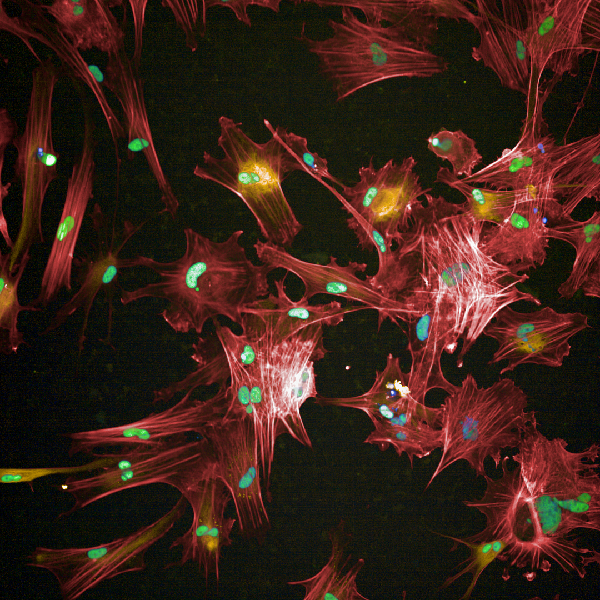
iPSC-derived astrocytes stained with SOX9 and GFAP and counterstained with DAPI and Phalloidin
Materials
Media
N2B27
N2B27 is a 50:50 mix of N2 and B27 media.
N2 Media
- DMEM/F12 Glutamax: 484ml
- N2 supplement: 5ml
- Non essential amino acid: 5ml
- B-mercaptoethanol: 1ml
- Pen strep: 5ml
- Insulin: 0.25ml
B27 media
- Neurobasal: 485ml
- B27: 10ml
- Lglut: 5ml
Glial progenitor media
N2B27 with FGF2 at 10 ng/ml (Peprotech 100-18B).
Maturation media
N2B27 with LIF at 10ng/ml (Sigma L5283) and BMP4 at 10ng/ml (Thermo PHC9534).
Generate iPSC-derived cortical neurons
- Follow established protocols to generate cortical neurons, such as Shi et al Nat Protocols (PMID 22976355) until DIV 60 - DIV 80
Prepare Geltrex coated plates/flasks
Coat plasticware with Geltrex (1:100 with DMEM-F12) for 1 hour at 37 degrees (e.g. 6 well plate or T25/T75 flask).
Enrich glial progenitor cells (GPCs)
Remove growth media from cells and wash once with PBS (without Mg and Ca).
Add EDTA (0.5mM in PBS) for 4-5 minutes at room temperature. Cells will become rounder as the EDTA loosens the cells.
Carefully aspirate EDTA and forcefully wash cells off with fresh glial progenitor media (N2B27 with 10ng/ml FGF2). Continue to pipette cells up and down around 5 times, jetting over the whole growth area.
Add glial progenitor cells to new flask/plate at a split ratio of 1:3 to 1:5 in glial progenitor media.
Passage glial progenitors before they reach 100% confluence.
At this stage (and from now on), GPCs can be cryopreserved and stored using standard procedures (i.e. 10% DMSO in N2B27 media).
Cells may be split once or twice a week.
After circa day 115, cells will progress from a neuronal morphology (small round cell body) to a glial morphology (larger and flatter and less defined cell body).
Glial progenitors can be maintained and passaged for over 1 year, but will often slow after DIV 200.
Once astrogenic switch has occurred, I have selected day 150 (and passage >15), astrocytes can be matured to astrocytes.
Glial precursor maturation to iPSC-astrocytes
Cells can be counted to around 25,000 per cm2
Change media to Astrocyte maturation media (BMP4+LIF) for at least 2 weeks of maturation. When BMP4+LIF is added, expect cell division reduction. BMP4+LIF for more than 4 weeks is not recommended.
Feed cells twice per week with maturation media.
Inflammatory stimuli
For astrocyte activation: 16 hour treatment with IL1α - 3ng/ml. TNFα – 30ng/ml. C1q – 400ng/ml.
Test astrocyte functional maturation
Take validation steps such as glutamate uptake, phagocytosis, response to inflammation (nuclear NFkB by ICC, C3 protein production, inflammatory cytokine production by qPCR or ELISA) can be tested to provide evidence of astrocytic identity. Calcium imaging can be used to measure astrocyte functional responses.
Protocol references
Ref: Hall et al 2017. PMID: 28564594
Ref: Ziff et al 2025. PMID: 40542358
Ref: Liddelow et al 2017. PMID 28099414
Ref: Seto-Salvia et al 2022. PMID 34951131