Jun 19, 2025
In-gel digestion protocol for protein identification
- 1MRC LMB



Protocol Citation: Catarina Franco 2025. In-gel digestion protocol for protein identification. protocols.io https://dx.doi.org/10.17504/protocols.io.j8nlk8165l5r/v1
License: This is an open access protocol distributed under the terms of the Creative Commons Attribution License, which permits unrestricted use, distribution, and reproduction in any medium, provided the original author and source are credited
Protocol status: In development
We are still developing and optimizing this protocol
Created: September 03, 2024
Last Modified: June 19, 2025
Protocol Integer ID: 106873
Keywords: gel band analysis, mass spectrometry, protein identification, gel digestion protocol for protein identification, gel digestion protocol, gel digest, gel protocol, protein identification, protein, avoiding keratin contamination, sample for mass spec analysis, digestion, keratin contamination, mass spec analysis
Abstract
This is the in-gel protocol we use in the facility and welcome you to use it to prepare your own in-gel digests. Once you complete the digestion you are ready to load Evotips with your sample for mass spec analysis. You can do this manually or with the help of a pipetting robot. Please see "Warning" section for tips on avoiding keratin contamination of your in-gel digests.
Protocol materials
Acetonitrile LC-MS grade B&J BrandVWR International (Avantor)Catalog #BJLC015-2.5
Ammonium bicarbonateMerck MilliporeSigma (Sigma-Aldrich)Catalog #A6141
Formic acid, LC-MS gradeThermo Fisher ScientificCatalog #28905
Promega trypsinPromegaCatalog #V5113
DTTMerck MilliporeSigma (Sigma-Aldrich)Catalog #D0632
IodoacetamideMerck MilliporeSigma (Sigma-Aldrich)Catalog #I1149-5G
Safety warnings
Dust will be your worse enemy when trying to identify a protein from a gel. Most dust components are proteinaceous in nature (e.g., skin cells, jumper fibers). If your gel sits on the bench uncovered for long or you use tools that have been left sitting on the bench with no cover, rest assured we will mostly see keratin instead of your critical proteins. To limit keratin/dust contamination use clean surfaces: e.g., cut the band with a new/clean scalpel and always use gloves.
Before start
Please make sure you have a clean surface and use clean tools to process your gels. This will avoid the dreaded keratin contamination.
Band excision from an SDS-PAGE gel
10m
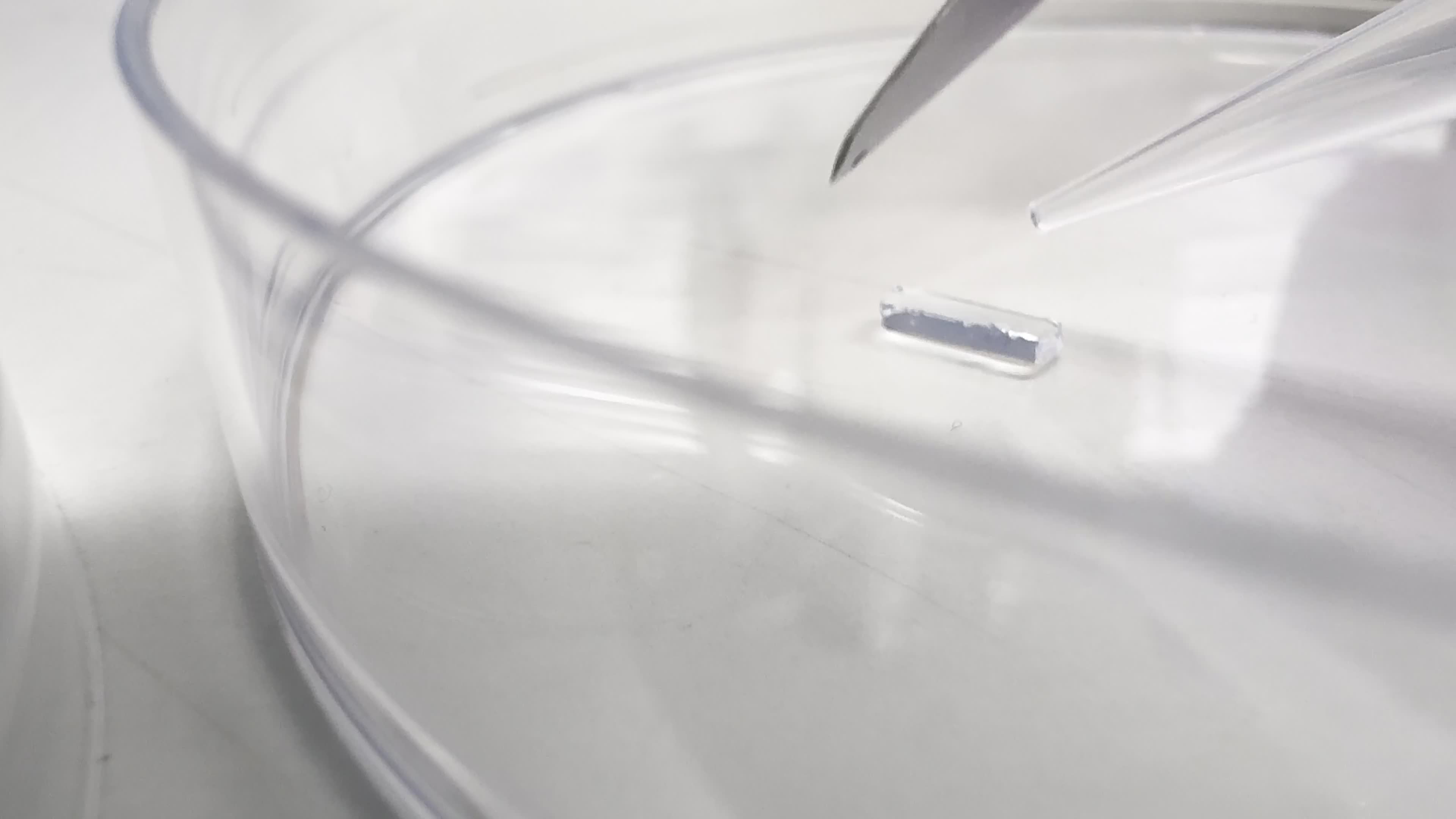
Cut either a small (1mm3) plug of a stained protein band or excise an entire band and slice this into smaller sections, place material into a 1.5ml tube containing approximately 200 µL 25mM AMBIC .
Note
10m
Gel band destaining
Prepare two wash solutions:
Solution A: 2 parts of 25mM ammonium bicarbonate (AMBIC) (made up in HPLC water) mixed with 1 part acetonitrile
Solution B: 25mM ammonium bicarbonate (AMBIC) (made up in HPLC water)
Ammonium bicarbonateMerck MilliporeSigma (Sigma-Aldrich)Catalog #A6141
Acetonitrile LC-MS grade B&J BrandVWR International (Avantor)Catalog #BJLC015-2.5
Wash the band with 500 µL of solution A. Incubate the gel plug for 15min at 37°C with gently agitation 800 rpm, 37°C, 00:15:00
Note
If the band is extremely stained you can increase the volume of Solution A/B to approximately 1000 µL .
Note
You can use an Eppendorf Thermomixer for the incubation steps at 37C or in alternative you can just shake at room temperature for 00:20:00
Equipment
Eppendorf Thermomixer C Model 5382
NAME
Thermomixer C
TYPE
Eppendorf
BRAND
5382000023
SKU
15m
Remove and discard solution A from the tube containing the gel band.
Wash the band with 500 µL of solution B: 25mM ammonium bicarbonate (AMBIC) (made up in HPLC water). Incubate the gel plug for 15min at 37°C.800 rpm, 37°C, 00:15:00
15m
Remove and discard solution B from the tube containing the gel band.
Repeat steps 2-7 until the gel band is fully destained.
Expected result
Destained gel band shown on the right.
It is really important that the gel bands are fully destained before progressing to the next step. This is usually attained by the end of two cycles of solution A/B washes. Once your gel is transparent it is ready for the next step - reduction and alkylation of cysteines.
Reduction and alkylation of cysteines
1h
Wash the gel piece with 500 µL acetonitrile 800 rpm, 22°C, 00:15:00 .
89Remove and discard the acetonitrile. Your gel band should have a whitish appearance when dry.
Expected result
Dehidrated gel band.
The gel should look white (dehydrated) as seen in the above picture. If the band is still transparent then repeat steps 8-9 until fully dehydrated.
Prepare a solution of 1.5mg/mL of DTT 10 millimolar (mM) and 10mg/mL of iodoacetamide 60 millimolar (mM) in 25mM AMBIC.
DTTMerck MilliporeSigma (Sigma-Aldrich)Catalog #D0632
IodoacetamideMerck MilliporeSigma (Sigma-Aldrich)Catalog #I1149-5G
Add enough volume of the DTT solution to fully cover the gel band.
Note
You usually need around 50uL of volume to fully cover the gel band.
Incubate for 60min at 60C 800 rpm, 60°C, 01:00:00
1h
Let the tube cool down and spin down to return liquid to bottom of tube.
Aspirate the liquid around the gel plug using a pipette and discard.
Add enough volume of the iodoacetamide solution to fully cover the gel band.
Note
You only need around 50uL of iodoacetamide per band.
Incubate at room temperature, IN THE DARK for 45min00:45:00 in the dark
45m
Wash the gel piece with 200 µL 25mM AMBIC 800 rpm, 22°C, 00:10:00
10m
Remove and discard the supernatant.
Wash the gel piece with 500 µL acetonitrile 800 rpm, 22°C, 00:15:00 .
15m
Remove and discard the acetonitrile. Your gel band should have a whitish appearance when dry.
Expected result
Dehidrated gel band.
The gel should look white (dehydrated) as seen in the above picture. If the band is still transparent then repeat steps 17-18 until fully dehydrated.
Overnight digestion with trypsin
16h
Prepare a trypsin solution of 6ng/uL using 25mM AMBIC and add enough to fully cover the dehydrated gel piece.
Promega trypsinPromegaCatalog #V5113
Add 25uL of the above trypsin solution and place the gel piece in the fridge for 10min so it fully rehydrates in the trypsin solution.
Incubate overnight at 37C800 rpm, 37°C, 16:00:00
16h
Extract tryptic peptides
30m
Quickly spin down the digest to bottom of tube. Add formic acid (FA, 10% v/v) to attain a final concentration of 1% (v/v). Aspirate and RETAIN solution, which will contain the peptides. To extract more peptides, soak the gel piece in 10uL of a solution containing water:Acetonitrile:formic acid (50:49:1) at 37°C for 00:30:00 . Pool the peptides.
Formic acid, LC-MS gradeThermo Fisher ScientificCatalog #28905
30m
Dry the extracted peptides to completion using a speedvac.