Aug 12, 2025
IDEXX as a Quantitative Detection Method for Antibiotic Resistant (ABR) E. coli
- 1North Carolina State University, Stanford University



Protocol Citation: Gracie Hornsby 2025. IDEXX as a Quantitative Detection Method for Antibiotic Resistant (ABR) E. coli. protocols.io https://dx.doi.org/10.17504/protocols.io.5qpvorkz9v4o/v1
License: This is an open access protocol distributed under the terms of the Creative Commons Attribution License, which permits unrestricted use, distribution, and reproduction in any medium, provided the original author and source are credited
Protocol status: Working
This protocol was validated in Hornsby et al., 2022
Created: December 06, 2022
Last Modified: August 12, 2025
Protocol Integer ID: 73640
Keywords: modification to the standard idexx, standard idexx, antibiotic resistant, idexx, substrate assay, quantitative detection method
Abstract
This SOP describes the validated modification to the standard IDEXX defined substrate assay for detecting both E. coli and Cefotaxime resistant E. coli in environmental matrices. This method was validated by Hornsby et al., 2022 and shown to be comparable to traditional methods for enumerating antibiotic resistant E. coli in environmental (water, soil, fecal) samples.
Materials
GROWING AND ESTIMATING E. COLI CONCENTRATIONS FROM A STANDARD STOCK
Materials
- LB Broth
- Plated standard strain
- 50 mL conical tube
- Disposable loops
- 10 mL Pipette
FILTER STERILIZATION OF AN ANTIBIOTIC
Materials
- 60mL or 20mL syringe (based on volume to filter)
- Sterilization filter
- 50mL or 10mL pipette
- Pipette bulb
- 2 50mL conical tubes
- Powdered antibiotic
- DI water
- Plastic or tin weigh boat
- Sterile scoop
ENUMERATING ABR E. COLIWITH IDEXX TRAYS
Materials
- IDEXX Quanti-Tray/2000 (1 tray per 100mL sample)
- ~10^8 standard stock in LB broth
- 120 mL vessels (with sodium thiosulfate)
- DI Water
- Colilert 18 medium (1 per tray)
- 50mL pipette and pipette bulb
- 100μL pipette and tips
- UV light chamber
- Microfuge tubes
Safety warnings
Cultivating antibiotic resistant organisms can pose a threat both to the researcher and the surrounding environment if not properly handled and disposed of. Wear appropriate PPE and follow all disposal instructions to prevent the unnecessary proliferation of antibiotic resistant organisms in the environment.
GROWING AND ESTIMATING E. COLI CONCENTRATIONS FROM A STANDARD STOCK
Follow standard protocol for starting and preparing the laminar flow hood (BSL-2)
Sterilize bench with 10% bleach solution then 70% ethanol solution
Pick one colony from the plated standard strain with a disposable loop
Spin the loop in a 50mL conical tube filled with 10mL of LB broth to wash the colony from the loop into the broth. Repeat with additional tubes if you wish to store additional standards. Dispose of loop in biohazard trash.
Store the tubes in a shaking incubator (vigorous; ~300rpm) at 37C overnight (12-16 hours)
After 12-16 hours, store at -80C in a labeled cryobox if you do not wish to use it immediately
All dilution containers and left-over solution should be placed in a biohazard waste bag then autoclaved on a kill-cycle (at least 121C and 15psi for at least 30 minutes) and disposed of.
FILTER STERILIZATION OF AN ANTIBIOTIC
Weigh 100mg (0.1 gram) of Cefotaxime powder into a metal weigh boat (or foil piece) using a sterile scoop
Add the 100mg of Cefotaxime powder to 20mL of DI water in a sterile 50mL conical tube.
Mix well (swirling or gentle vortexing) and continue agitating the container until the antibiotic in completely dissolved
This gives a stock concentration of 5mg/mL.
Draw up a small amount of air into the syringe, then draw up the entire volume of antibiotic solution
Attach the filter to the syringe and slowly extrude the solution through the filter into another sterile 50mL conical tube below. Also extrude all the air out of the syringe to clear the filter of all solution.
Cap the sterilized solution and dispose of the first container, syringe, and filter in a biohazard waste bag.
Label with date, antibiotic name, and initials then store the stock at 4C for up to one month.
ENUMERATING ABR E. COLI WITH IDEXX TRAYS
- CLEARLY mark 120mL vessels and IDEXX trays with organism type (if adding control strains), number if there are duplicates or triplicates (1, 2, 3), antibiotic addition name (CEF added, DI added, or no add), and estimated spiked concentration (10^3, 1-^2, 10^1). Sample label: ESBL EC, CEF added_1, 10^2, processor initials.
Follow the standard SOP for environmental samples using IDEXX to prepare samples in 120mL vessels.
If spiking some samples with control strain, follow steps 19-22. Otherwise, skip to step 23.
For samples receiving a control strain spike, 99mL of sample volume should be pipetted into a 120mL vessel rather than the standard 100mL volume.
When ready to use the standard to spike a sample, thaw at room temperature and perform a serial dilution so the spiked sample will be within the IDEXX detectable range (1-2,420 MPN).
Assuming the standard stocks rest at a concentration of 10^10 organisms after overnight incubation, dilute to obtain an adequate volume of 10^3 stock. Use 5 microfuge tubes filled with 900µL of DI water to create 10^9, 10^8, 10^7, 10^6, and 10^5 dilutions then use a 5mL screw top container to create an adequate volume of 10^4 dilution. Next, use a 50mL conical tube to create the final 10^3 dilution (for each organism) which will be used to spike the samples.
Pipette 1mL of 10^3 dilution into 99mL of sample volume to create the desired 10^1 spiked sample solution (total volume of 100mL). Change pipette tip between every sample.
Create lab blanks for each person processing samples by pipetting 100mL of DI water into a labeled 120mL vessel.
Pipette 80µL of Cefotaxime solution (from the 5mg/mL stock solution) into samples which are supposed to receive antibiotic treatment, and recap vessel. Invert a few times to promote mixing. Change pipette tip between each sample. If you wish to obtain the proportion of total E. coli which are antibiotic resistant, two aliquots should be processed from each sample. One aliquot receiving an antibiotic treatment and one aliquot receiving no addition at this step. Lab blanks receive no addition.
Add the Colilert 18 medium to every vessel regardless of treatment, including lab blanks. Continue to agitate intermittently until all medium is completely dissolved. Turn on IDEXX sealer now to ensure it is fully heated.
Pour contents of 120mL vessels into IDEXX trays with normal measures to decrease bubbles and prevent contamination. Tap tray on bench once the sample is poured in to send bubbles to the surface, do not pour sample directly on pull table to prevent cross-contamination.
Send each tray through the IDEXX sealer on the provided rubber trays with wells facing downward into the rubber tray (paper side facing up).
Stack the sealed trays with the wells facing down in an incubator for 18-22 hours at 35 degrees C (do not set incubator to shake). Mark date and time in and date and time out on the top tray.
COUNTING IDEXX TRAYS
Be careful to record the counts in the correct column and row on the data sheet, paying careful attention to whether the tray did or did not receive the antibiotic.
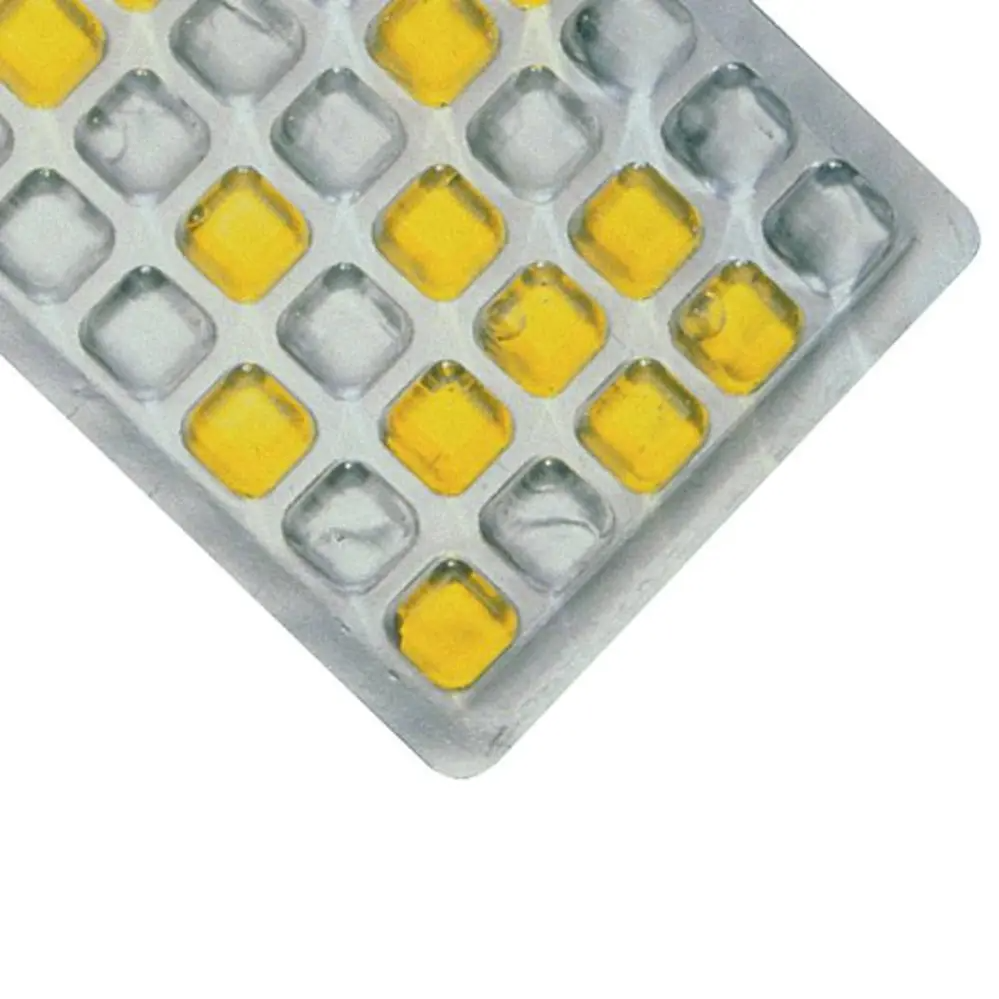
Count and record the number of large and small wells which appear yellow under normal laboratory light (does not require UV light chamber).
Place in the UV light chamber and count and record the number of large and small fluorescent wells. If some volume of sample overflowed into the large well at the top of the tray, include this in your count as a “large well.” This makes for 48 total small wells and 49 total large wells.
Trays with resistant bacteria cannot be disposed of in the normal trash, they must be put in the biohazard trash for autoclaving. Be sure to wipe down counters (bleach and ethanol), turn off the black light, and switch off the used incubator.
IDEXX trays should be disposed of by autoclaving on a liquid cycle (minimum of 121C and 15psi for 60 minutes; double-bag all trays and loosely tie both bags). Make sure bags are open enough for steam to penetrate but not so wide that edges could touch the walls of the autoclave.