Mar 20, 2023
HV-CTAB-PCI DNA Extraction Protocol
- Vicky Ooi1,
- Lee McMichael2,
- Margaret E. Hunter3,
- Aristide Takoukam Kamla4,5,
- Janet M. Lanyon1
- 1School of Biological Sciences, The University of Queensland, St Lucia, Queensland, Australia;
- 2School of Veterinary Science, The University of Queensland, Gatton, Queensland, Australia;
- 3U.S. Geological Survey, Wetland and Aquatic Research Center, Sirenia Project, Gainesville, Florida, USA;
- 4Aquatic Animal Health Program, College of Veterinary Medicine, University of Florida, Gainesville, Florida, USA;
- 5African Marine Mammal Conservation Organization, Dizangue, Littoral, Cameroon



External link: https://doi.org/10.1371/journal.pone.0278792
Protocol Citation: Vicky Ooi, Lee McMichael, Margaret E. Hunter, Aristide Takoukam Kamla, Janet M. Lanyon 2023. HV-CTAB-PCI DNA Extraction Protocol. protocols.io https://dx.doi.org/10.17504/protocols.io.n2bvj818ngk5/v1
Manuscript citation:
Ooi V, McMichael L, Hunter ME, Kamla AT, Lanyon JM (2023) A new DNA extraction method (HV-CTAB-PCI) for amplification of nuclear markers from open ocean-retrieved faeces of an herbivorous marine mammal, the dugong. PLoS ONE 18(6): e0278792. doi: 10.1371/journal.pone.0278792
License: This is an open access protocol distributed under the terms of the Creative Commons Attribution License, which permits unrestricted use, distribution, and reproduction in any medium, provided the original author and source are credited
Protocol status: Working
We use this protocol and it's working
Created: March 18, 2023
Last Modified: March 20, 2023
Protocol Integer ID: 79039
Keywords: HV-CTAB-PCI, High Volume, Faecal DNA, Faecal DNA Extraction, DNA Extraction, DNA Extraction Method, Dugongs, Herbivores, dna from dugong faece, several faecal dna extraction method, dna from dugong skin, dna extraction method, dna extraction, effective dna extraction method, genetic studies of dugong, novel dna extraction protocol, genetic studies of wildlife, faecal dna, collected faecal sample, dugong faece, first time from dugong faece, direct sampling of animal, mitochondrial dna, amplification success of mtdna, faecal sample, markers from faece, studies of other large herbivore, ndna, alternative source of dna, cryptic marine herbivores in remote location, mtdna, nuclear dna, cryptic marine herbivore, extraction, other large herbivore, dugong skin, dna, species, wild dugong, capture of sloughed intestinal cell, nuclear markers from large quantity, wildlife, dugong dugon
Funders Acknowledgements:
Sea World Research and Rescue Foundation Inc.
Grant ID: SWR/1/2015; SWR/6/2016
Disclaimer
Any use of trade, firm, or product names is for descriptive purposes only and does not imply endorsement by the U.S. Government.
Abstract
Non-invasively collected faecal samples are an alternative source of DNA to tissue samples, that may be used in genetic studies of wildlife when direct sampling of animals is difficult. Although several faecal DNA extraction methods exist, their efficacy varies between species. Previous attempts to amplify mitochondrial DNA (mtDNA) markers from faeces of wild dugongs (Dugong dugon) have met with limited success and nuclear markers (microsatellites) have been unsuccessful. This study aimed to establish a tool for sampling both mtDNA and nuclear DNA (nDNA) from dugong faeces by modifying approaches used in studies of other large herbivores. First, a streamlined, cost-effective DNA extraction method that enabled the amplification of both mitochondrial and nuclear markers from large quantities of dugong faeces was developed. Faecal DNA extracted using a new ‘High Volume- Cetyltrimethyl Ammonium Bromide- Phenol-Chloroform-Isoamyl Alcohol’ (HV-CTAB-PCI) method was found to achieve comparable amplification results to extraction of DNA from dugong skin. As most prevailing practices advocate sampling from the outer surface of a stool to maximise capture of sloughed intestinal cells, this study compared amplification success of mtDNA between the outer and inner layers of faeces, but no difference in amplification was found. Assessment of the impacts of faecal age or degradation on extraction, however, demonstrated that fresher faeces with shorter duration of environmental (seawater) exposure amplified both markers better than eroded scats. Using the HV-CTAB-PCI method, nuclear markers were successfully amplified for the first time from dugong faeces. The successful amplification of SNP markers represents a proof-of-concept showing that DNA from dugong faeces can potentially be utilised in population genetic studies. This novel DNA extraction protocol offers a new tool that will facilitate genetic studies of dugongs and other large and cryptic marine herbivores in remote locations.
Attachments

Guidelines
Clean the working bench before starting DNA extraction.
Make sure to leave a small amount of aqueous layer when transferring the aqueous phase to prevent carry-over of the organic layer.
Materials
TriGene Virucidal DisinfectantIn Vitro Technologies
Liquid nitrogen
CTAB (Hexadecyltrimethylammonium bromide)Merck MilliporeSigma (Sigma-Aldrich)Catalog #52365-50G
1M HClMerck MilliporeSigma (Sigma-Aldrich)Catalog #1090571000
TrisP212121
EDTA
Sodium chlorideP212121
ChloroformMerck MilliporeSigma (Sigma-Aldrich)Catalog #1024452500
Isoamyl AlcoholMerck MilliporeSigma (Sigma-Aldrich)Catalog #I9392-500ML
Liquified PhenolMerck MilliporeSigma (Sigma-Aldrich)Catalog #P9346-500ML
ProteaseMerck MilliporeSigma (Sigma-Aldrich)Catalog #P5147-100MG
IsopropanolMerck MilliporeSigma (Sigma-Aldrich)Catalog #I9516-500ML
70% EthanolThermo Fisher ScientificCatalog #AJA726-5PL
Safety warnings
Phenol and chloroform are hazardous chemicals. Please use appropriate personal protective equipment and lab safety protocol, e.g., always work in fume hoods when handling those chemicals.
Ethics statement
Dugong samples were obtained under The University of Queensland Animal Ethics Permit SBS/181/18, Scientific Purposes Permit WISP14654414, Moreton Bay Marine Parks Permit MPP18-001119, and Great Barrier Reef Marine Park Permit G14/36987.1.
Before start
Prepare the working reagents of Lysis Buffer 1, Lysis Buffer 2, Phenol-Chloroform-Isoamyl Alcohol (21:20:1), and TE Buffer. Autoclave the buffers.
Disinfection of working bench
Clean the working bench with TriGene disinfectant.
Faecal Sampling and Processing
Scrape 1 g of faecal material from the outer surface of a faeces and put it into a 15 mL centrifuge tube.
1 g of faeces
Transfer the faecal material into a mortar and grind the faeces into powder with liquid nitrogen.
Cell Lysis, Protein Digestion, and Purification
Add 1 mL of Lysis Buffer 1 (LB1: CTAB 2 %, Tris– HCL 100 mM, EDTA 20 mM, NaCl 1.4 M, pH 7.5) to the mortar containing the faecal material to further grind and mix in the buffer with the ground faeces. Transfer the liquid back into the 15 mL tube.
1 mL of Lysis Buffer 1 (LB1)
Add another 1 mL of LB1 to the mortar to mix in any leftover faecal material on the mortar and transfer the liquid back into the 15 mL tube. Repeat this step once more, and then add 2 mL of LB1 to the 15 mL tube containing the faecal homogenate. Thus, a total of 5 mL of LB1 would be added to the ground faeces.
1 mL of LB1 + 1 mL LB1 + 2 mL LB1
Vortex the faecal homogenate and incubate in a thermomixer for 3 h, with occasional mixing, at 60°C for cell lysis.
03:00:00 of incubation at 60 °C
3h
Centrifuge the sample at 3,150 g (4,000 rpm) for 12 min and pipette 4 mL of the supernatant into a new 15 mL tube.
00:12:00 of centrifugation
4 mL of supernatant
12m
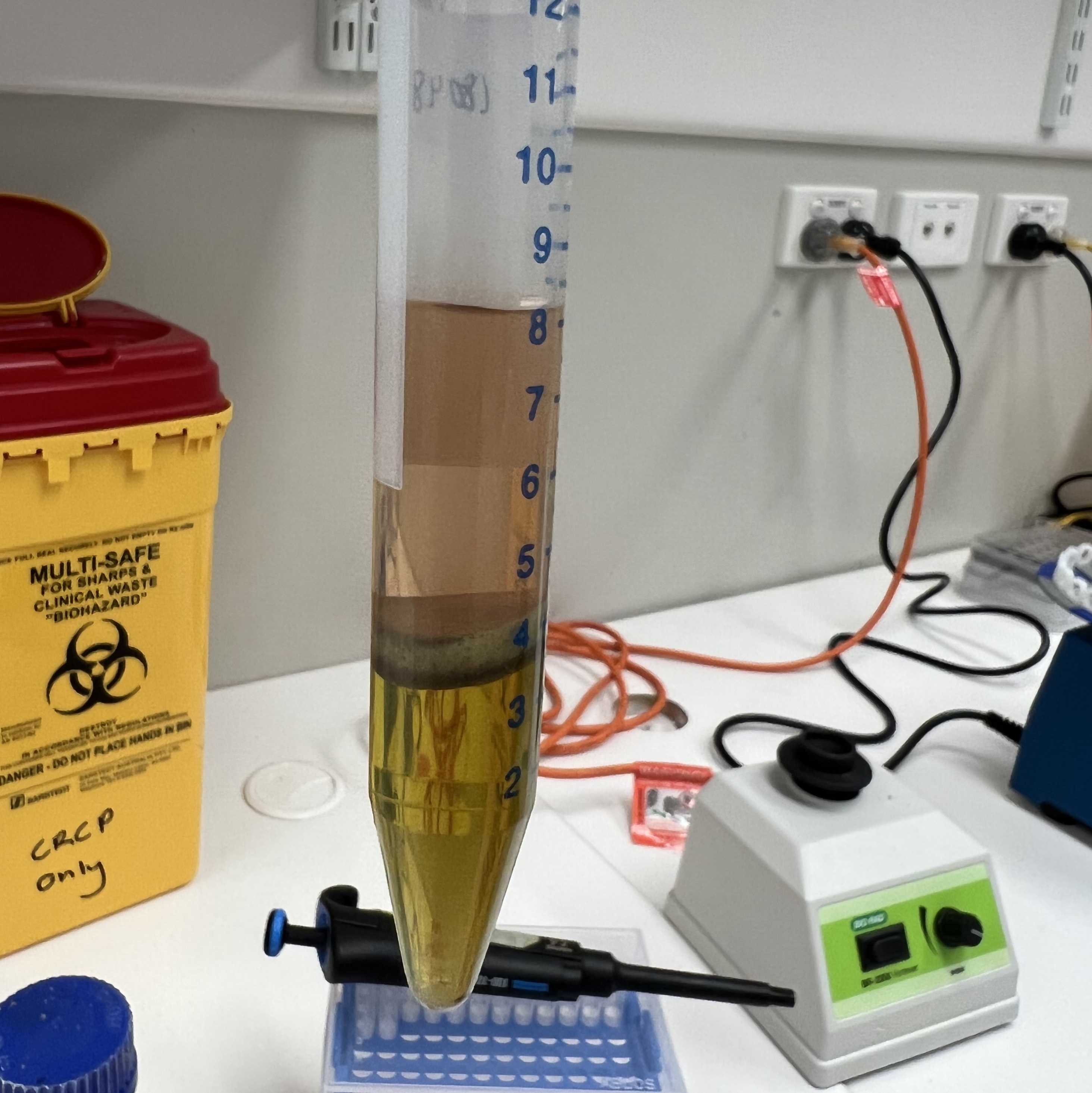
Add 4 mL of phenol: chloroform: isoamyl alcohol (21:20:1) to the supernatant, then gently mix the tube. Centrifuge the sample for 3 min at 3,150 g (4,000 rpm) and pipette 3 mL of the aqueous phase into a new 15 mL tube.
4 mL of phenol: chloroform: isoamyl alcohol
00:03:00 of centrifugation
3 mL of aqueous phase
3m
Add 330 µL of Lysis Buffer 2 (LB2: CTAB 10 %, NaCl 0.5 M, pH 5.5) to the aqueous phase, and leave it to lyse further at 60°C for 4 h.
330 µL of Lysis Buffer 2
04:00:00 of incubation at 60 °C
4h
Add 104 µL of protease to the sample and leave it to digest proteins at 60°C for another 1 h.
104 µL of protease
01:00:00 of incubation at 60 °C
1h
Add 3434 µL of phenol: chloroform: isoamyl alcohol (21:20:1) to the mixture, and then gently mix the tube well, and centrifuge the sample for 12 min at 3,150 g (4,000 rpm). Then, pipette 3 mL of the aqueous phase into a new 15 mL tube.
3434 µL of phenol: chloroform: isoamyl alcohol
00:12:00 of centrifugation
3 mL of aqueous phase
12m
DNA Precipitation and Purification
Add one volume of isopropanol (i.e., 3 mL) to precipitate the DNA overnight at -20°C.
3 mL of isopropanol
-20 °C Overnight
12m
Centrifuge the sample for 20 min at 8000 g (5,200 rpm), and then get rid of all the supernatant.
00:20:00 of centrifugation
20m
Add 400 µL of 70% ethanol to the pellet to wash it. Vortex and then centrifuge the sample at 3,150 g for 12 min and get rid of the supernatant.
400 µL of 70 % ethanol
00:12:00 of centrifugation
12m
Dry the pellet in a fume hood at room temperature for 15 min.
00:15:00 at Room temperature
15m
DNA Resuspension
Resuspend the pellet in 250 µL of TE buffer (10 mM Tris–HCl, 1 mM EDTA, pH 8).
250 µL of TE buffer
Storage of DNA Extracts
Store the DNA isolate at -20°C for use within a week or at -80°C for longer-time storage.
-20 °C
-80 °C
Protocol references
Vallet D, Petit EJ, Gatti S, Levréro F, Ménard N. A new 2CTAB/PCI method improves DNA amplification success from faeces of Mediterranean (Barbary macaques) and tropical (lowland gorillas) primates. Conserv Genet. 2008;9:677-80. doi: 10.1007/s10592-007-9361-8.