Feb 05, 2026
Human Experience in Regulated Offices (HERO) potocol
- Puneet Tomar1,
- Dianel Ago2,
- Ilaria Pigliautile1,
- Veronica Martins Gnecco1,3,
- Gloria Cosoli2,
- Sara Casaccia4,
- Gianluca Sartini4,
- Silvia Angela Mansi2,
- Anna Laura Pisello1,3,
- Marco Arnesano2
- 1EAPLAB at CIRIAF “Interuniversity research center on pollution and environment Mauro Felli”, University of Perugia, Italy;
- 2Department of Theoretical and Applied Sciences, Università degli Studi eCampus, Italy.;
- 3Department of Engineering, University of Perugia, Perugia (PG), Italy;
- 4Department of Industrial Engineering and Mathematical Sciences,, Marche Polytechnic University
- MuSIC



Protocol Citation: Puneet Tomar, Dianel Ago, Ilaria Pigliautile, Veronica Martins Gnecco, Gloria Cosoli, Sara Casaccia, Gianluca Sartini, Silvia Angela Mansi, Anna Laura Pisello, Marco Arnesano 2026. Human Experience in Regulated Offices (HERO) potocol. protocols.io https://dx.doi.org/10.17504/protocols.io.6qpvryx72gmk/v1
Manuscript citation:
P. Tomar, A.L. Pisello, Physiological-perceptual divergence (PPD) in human thermal adaptation: Multimodal evidence of decoupled body-mind responses during controlled indoor exposure, Building and Environment. (2026) 1–19, doi: https://doi.org/10.1016/j.buildenv.2026.114256
License: This is an open access protocol distributed under the terms of the Creative Commons Attribution License, which permits unrestricted use, distribution, and reproduction in any medium, provided the original author and source are credited
Protocol status: Working
We use this protocol and it's working
Created: December 18, 2025
Last Modified: February 05, 2026
Protocol Integer ID: 235334
Keywords: Physiological monitoring, Electroencephalography (EEG), Electrodermal activity (EDA), Skin temperature, Video-derived indicators, Indoor environmental quality (IEQ), Multi-domain comfort, Human–environment interaction (HEI), Office-activities protocol, wearable sensor devices while environmental condition, like indoor exposure experiment, human experience in regulated office, thermophysiological response, physiological signal, wrist skin temperature, dedicated lab monitoring station, wearable sensor device, exposure, human experience, electrodermal activity, office, relative humidity, environmental condition, subjective comfort, session, air temperature, potocol this protocol, social task, geiger csa climate classification, participant, regulated office
Funders Acknowledgements:
European Union’s Horizon Europe research and innovation programme under the Marie Skłodowska-Curie Doctoral Networks
Grant ID: 101073357
Italian Ministry of Research through the WEPOP ‘’WEarable Platform for OptImised Personal comfort’’ project, within the PRIN 2022 program.
Grant ID: Prot. 2022RKLB3J
Abstract
This protocol describes a controlled, office-like indoor exposure experiment designed to quantify multimodal human autonomic/thermophysiological responses and subjective comfort under two stable thermal conditions: a neutral reference condition (LT; ~22–24 °C) and a warm-load condition (HT; ~30 –32°C), conducted during the summer season in Köppen–Geiger Csa climate classification. Each participant completes two sessions (LT and HT) in counterbalanced order. During a 90-minute timeline, participants perform structured cognitive/social tasks (reading, writing, discussion, conference call) interleaved with standardized perception surveys. Physiological signals (electrodermal activity, EDA; wrist skin temperature, T_skin; and electroencephalography EEG) are recorded continuously using a wearable sensor devices while environmental conditions (air temperature, relative humidity, air velocity, globe temperature, and vertical temperature gradients) are monitored continuously via a dedicated lab monitoring station. Surveys are administered digitally at protocol-defined checkpoints to capture multi-domain indoor environmental quality (thermal, visual, acoustic, air-quality) and perceived productivity.
Guidelines
Eligibility (inclusion/exclusion)
- Age: 18–65 years
- Exclude individuals with medical conditions likely to influence physiological or perceptual responses.
Notes / reporting checklist (for reproducibility)
When publishing or sharing the dataset, report:
- LT and HT target set-points and achieved stability
- Counterbalancing method for session order
- Exact phase timeline (table above)
- Wearable placement (non-dominant wrist)
- Environmental sensor configuration (including vertical temperature heights)
- Survey instrument versions (SI, SBP, SRP, SWP, SDP, SCP)
- Stopping rules and adverse event logging
Materials
Digital materials (task stimuli)
- Reading text (Session A)
- Reading text (Session B; different content to reduce repetition bias)
- Writing prompt/instructions (summary task)
- Discussion prompt (theme-based)
- Conference-call script / scenario (All delivered digitally on participant laptops.)
Surveys (digital)
Administer via a digital survey platform (WEPOP) on a local server:
- Initial survey (SI): demographics + “topology traits” (environmental sensitivity + emotional state items)
- Baseline perception survey (SBP)
- Post-task perception surveys: after reading (SRP ), writing (SWP), discussion (SDP), call (SCP )
- Domains include thermal comfort, air-quality, acoustics, visual comfort, perceived productivity.
Equipment and Modalities
- Wearable physiological sensor (EmotiBit) worn on non-dominant wrist.
- EDA nominal sampling ~15 Hz (stock); reported resolution ±0.01 µS.
- Wrist skin temperature nominal sampling ~7.5 Hz; reported resolution ±0.1 °C.
- Headband four channel EEG sensor (Muse-2).
- EEG sampling ~256 Hz.
Environmental monitoring
- Lab monitoring station (NextRoom) with calibrated modules:
- Air temperature with vertical profiling (e.g., 4 heights: 10, 60, 110, 130 cm)
- Relative humidity probes
- Air velocity via hot-wire anemometers
- Globe temperature sensor
Computing
- Participant laptops for task delivery + surveys
- Local server or stable network access for the survey platform
- Time synchronization method (consistent Unix timestamps across systems is ideal)
Safety warnings
- HT exposure (30–32 °C) can elevate physiological strain. Monitor participants continuously.
- Stop immediately if participant reports dizziness, nausea, headache, overheating, panic, or requests termination.
- Ensure hydration access if permitted by your ethics protocol.
- Keep a trained supervisor present throughout.
(These warnings operationalize the paper’s statement that safety was ensured via screening, monitoring, and stopping rules.)
Troubleshooting
Problem
EDA flatlines or spikes unrealistically
Solution
Re-seat the wrist device on the non-dominant hand; ensure stable skin contact.
Confirm participant is seated and not performing excessive motion during baseline.
Problem
EEG noisy signals
Solution
Restart sensor bluetooth and reconnect.
Make sure to eeg channels is in contact with scalp.
Problem
Room fails to stabilize at LT/HT
Solution
Delay T0 until set-point stability is achieved; record actual environmental traces continuously.
Problem
Learning/repetition effects across LT/HT
Solution
Ensure different task contents across sessions while keeping task structure identical.
Before start
Pre-session restrictions (control measures):
Participants should follow the same pre-session instructions for all visits, including:
- Avoid caffeine
- Avoid vigorous physical activity
Record any deviations.
Procedure
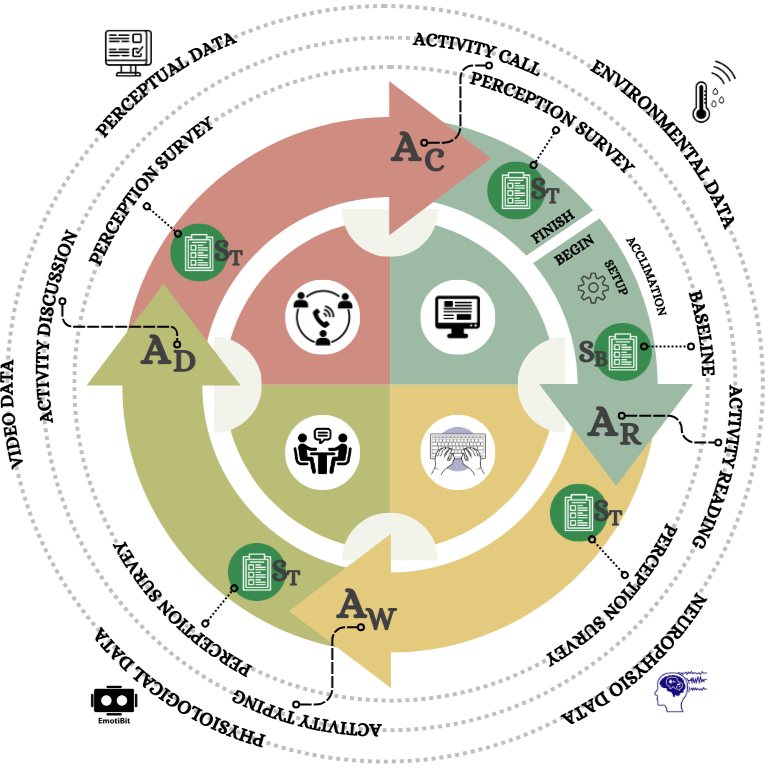
Overview timing (90 minutes total per session)
| Time (min) | Phase | Label | What happens | |
| 0–20 | Acclimation | START; S_I | Setup, instructions, seated rest, initial survey | |
| 20–25 | Baseline survey | S_BP | Baseline perception survey | |
| 25–30 | Baseline signals | B | Start/confirm data collection, stabilization | |
| 30–40 | Activity: Reading | A_R | Reading task | |
| 40–45 | Washout 1 + survey | S_RP | Post-reading perception survey | |
| 45–55 | Activity: Writing | A_W | Writing/typing summary task | |
| 55–60 | Washout 2 + survey | S_WP | Post-writing perception survey | |
| 60–70 | Activity: Discussion | A_D | Peer discussion task | |
| 70–75 | Washout 3 + survey | S_DP | Post-discussion perception survey | |
| 75–85 | Activity: Call | A_C | Simulated conference call | |
| 85–90 | Washout 4 + survey + end | S_CP; END | Post-call perception survey; stop recording |
Step-by-step
1h 55m
Session preparation (25-30 min before T0)
30m
Set thermal condition for the session (LT or HT) and stabilize the room at target set-point.
- LT target: ~22–24 °C; HT target: ~30–32 °C.
- Maintain humidity/air velocity stable (record continuously).
Prepare environmental logging
- Confirm sensors are recording: air temperature (including vertical gradient), RH, air velocity, globe temperature.
Prepare physiological logging
- Ensure wearable device is charged, time-synced if applicable, and ready to log.
Prepare survey platform
- Confirm the WEPOP survey flow: SI → SBP → SRP → SWP → SDP → SCP.
Prepare task materials
- Load reading/writing/discussion/call instructions on participant laptops. Use different content between LT and HT sessions to reduce learning effects.
T0–T20: Acclimation + Initial survey (SI)
20m
Participant arrival + checklist
- Confirm pre-session restrictions (caffeine/exercise) and record deviations.
- Confirm eligibility and that no new contraindications have emerged.
3m
Attach wrist-wearable sensor to non-dominant wrist.
Checkpoint: Verify stable EDA and skin-temperature readouts.
Attach headband-wearable sensor on forehead.
Checkpoint: Verify stable EEG readouts.
5m
Seated acclimation/rest until minute 15.
15m
At T15, administer Initial survey (SI).
- Includes environmental sensitivity and emotional state items.
5m
T20–T30: Baseline perception + start recording
10m
At T20, administer Baseline perception survey (SBP).
5m
At T25, begin baseline stabilization window and start data collection.
- Checkpoint: Confirm continuous logging for:
- physiological (EDA, T_skin)
- environmental channels
- timestamp continuity (no obvious gaps)
5m
T30–T40: Reading (AR) + post-reading survey (SRP)
10m
At T30, begin Reading task (AR).
10m
At T40, administer Post-reading perception survey (SRP).
5m
T45–T60: Writing (AW) + post-writing survey (SWP)
15m
At T45, begin Writing task (AW) (10 min): participant types a summary of the reading.
10m
At T55, administer Post-writing perception survey (SWP).
5m
T60–T75: Discussion (AD) + post-discussion survey (SDP)
15m
At T60, begin Discussion task (AD) (10 min): peer discussion of the theme, same room setup.
At T70, administer Post-discussion perception survey (S_DP).
5m
T75–T90: Conference call (AC) + post-call survey (SCP) + end
15m
At T75, begin Conference call task (AC) (10 min): simulated group call extending discussion.
At T85, administer Post-call perception survey (SCP).
5m
At T90, stop all recordings; debrief participant; remove sensors.
Protocol references
- Wen, X., Meng, Q., Yang, D., & Li, M. (2024). Effect of thermal-acoustic composite environments on comfort perceptions considering different office activities. Energy and Buildings, 305, 113887. https://doi.org/10.1016/j.enbuild.2024.113887
- Ko, W. H., Schiavon, S., Zhang, H., Graham, L. T., Mauss, I., Lin, Y.-W., … & Brager, G. (2020). The impact of a view from a window on thermal comfort, emotion, and cognitive performance. Building and Environment, 175, 106779. https://doi.org/10.1016/j.buildenv.2020.106779
- Konstantzos, I., Sadeghi, S. A., Kim, M., Xiong, J., & Tzempelikos, A. (2020). The effect of lighting environment on task performance in buildings – A review. Energy and Buildings, 226, 110394. https://doi.org/10.1016/j.enbuild.2020.110394
- F. Vittori, C. Chiatti, I. Pigliautile, A.L. Pisello, (2022) The next.room: design principles and systems trials of a novel test room aimed at deepening our knowledge on human comfort, Build. Environ. 211 (Mar 2022) 108744. ISSN 0360-1323, https://doi. org/10.1016/j.buildenv.2021.108744
Acknowledgements
The research experiment acknowledges support from EU Horizon Europe / MSCA Doctoral Networks and Italian Ministry of Research, and specific ethics approvals for experimentation. We thank all participants and the technical staff supporting climate chamber operation and instrumentation contributed to this research study.