Jun 19, 2026
HRM - High‑Resolution Melting analysis for SNP genotyping, indel detection and CRISPR screening
- 1CNRS
- Abdelmalek Alioua: AEG Genomics core facility manager



Protocol Citation: Abdelmalek Alioua 2026. HRM - High‑Resolution Melting analysis for SNP genotyping, indel detection and CRISPR screening. protocols.io https://dx.doi.org/10.17504/protocols.io.36wgq25mxgk5/v1
License: This is an open access protocol distributed under the terms of the Creative Commons Attribution License, which permits unrestricted use, distribution, and reproduction in any medium, provided the original author and source are credited
Protocol status: Working
We use this protocol and it's working
Created: June 18, 2026
Last Modified: June 19, 2026
Protocol Integer ID: 319390
Keywords: Genotyping , DNA , indel, CRISPR, HRM, SNP, screening of crispr, crispr, detecting dna sequence variation, dna methylation analysis, mutants detection of indel, analysis for snp, pathogen identification, dna sequence variation, snp
Abstract
High‑Resolution Melting (HRM) analysis is a rapid, cost‑effective, and high‑throughput method for detecting DNA sequence variations by examining precise post‑PCR melting curves. Using saturating dyes and highly controlled temperature ramps, HRM provides high sensitivity for distinguishing even subtle sequence differences without requiring sequencing.
Main applications:
- SNP genotyping (classes 1 to 4)
- Screening of CRISPR/Cas9‑edited mutants
- Detection of indel mutations
- DNA methylation analysis (methylation‑sensitive HRM)
- Pathogen identification and differentiation
Throughput:
Up to 192 samples can be screened in approximately 2 hours using 384‑well microplates.
Although this protocol is described for plant tissues, it can be universally applied by simply adapting the lysis buffer to the sample type.
Attachments

Guidelines
Edwards buffer (1×):
- 200 mM Tris‑HCl pH 8.0
- 25 mM EDTA
- 0.5 % (w/v) SDS
Materials
| Designation | Provider | reference | |
| Precision Melt supermix (2x) | Biorad | 1725112 | |
| Chloroform:Isoamyl alcohol 24:1 | Sigma Aldrich Chimie | C0549 | |
| Ethanol absolut anhydrous pure | Carlo Erba | 528131 | |
| Buffer EB pH 8,5 | Qiagen | 19086 | |
| Nuclease free water | Sigma Aldrich Chimie | 102755025 | |
| QUBIT dsdna hs assay kit | Life Technologies SAS | Q32854 | |
| Tube DNA LoBind 1,5 ml PCR clean | D.Dutscher | 033871 | |
| Tube DNA LoBind 2 ml PCR clean | D.Dutscher | 033872 | |
| Tungsten Carbide Beads, 3 mm | Qiagen | 69997 |
| A | |
| Heat incubator ThermoStat C (or equivalent) | |
| Nanodrop spectrophotometer (or equivalent) | |
| Qubit fluorometer (or equivalent) | |
| TissueLyser II (or equivalent) | |
| Tubes Rotary agitator (Hula mixer or equivalent) |
Safety warnings
This protocol requires the use of toxic products such as Chloroform and SDS.
Take precautions when handling these products or consider an alternative
Ethics statement
DNA collection for this protocol needs prior approval by the users' Institutional Animal Care and Use Committee (IACUC) or equivalent ethics committee.
Before start
What you need ?
- High Resolution Melt Instrument :
high-intensity + high sensitivity optics + high-speed data capture + very precise temperature control and resolution
- Appropriate software for analysis (ex: GeneScanning, Uanalyse....)
- HRM kit with Evagreen saturating dye
- Good gDNA quality & quantity
- The best primers as possible: TM: 60-64 °C
Amplicon size : 60 to 90 bp
Dimers prediction
- One wild type sample as a control
Sample collection , grinding and Lysis
2m
Collect 50 mg of fresh or snap-frozen plant tissue.
Add tissue to 2 mL Safe-Lock microtubes containing beads.
Add 500 µL Edwards buffer per sample.
Grind in a TissueLyser 2X 00:02:00 at 30 Hz
Check that tissue is fully homogenized; repeat 1–2 min if needed
2m
Clarification
10m
Centrifuge the 2 mL Safe-Lock microtubes containing the lysate 12000 x g, Room temperature , 00:05:00
Carefully transfer 300 µL of clear supernatant to a new 1.5 mL microtube, avoiding debris.
Add 1 V of Chloroform/isoamyl alcohol 24:1 - Room temperature
Mix by inverting on a hula mixer 20 rpm, Room temperature , 00:05:00
Centrifuge 10000 x g, Room temperature , 00:10:00
Take the upper aqueous phase and put it in a new 1,5 ml microtube.
10m
DNA precipitation
15m
Add 0.7 V of isopropanol
Mix gently by inversion 20X
Incubate 00:05:00 Room temperature
Pellet DNA by 12000 x g, Room temperature , 00:10:00
Discard the supernatant carefully without disturbing the pellet.
15m
Washing and drying
20m
Add 700 µL of cold 70 % (v/v) ethanol and invert gently 10X
12000 x g, Room temperature , 00:05:00 .
Remove ethanol completely and air‑dry the pellet 00:15:00 Room temperature
20m
Resuspension & Quality check
Resuspend the DNA pellet in 50 µL of EB or TE buffer.
Proceed to Nanodrop QC (1 µL), Qubit DNA dosage (1µl)
Note :
The expected results are : OD260/280 value is between 1,75 – 1,85 (ideally 1,8) and the OD260/230value is > 2.
The gDNA can be stored at 4 °C for several weeks
HRM reaction mix
Perform genotyping in technical duplicates for each sample to ensure reproducibility.
Prepare a master mix for each primer pair and for all samples (plus extra), distribute it into the microplate, and then add the DNA templates
For 10 µL final volume reaction, mix :
5 µL Precision Melt Supermix (2×)
1 µL Forward primer 2,5 micromolar (µM)
1 µL Reverse primer 2,5 micromolar (µM)
1 µL DNA template (10 ng )
1 µL Nuclease‑free water
Include a known genotype control (WT) & a No‑template control (NTC) for each primer pair.
Seal with optical sealing film & briefly centrifuge the microplate to eliminate air bubbles before starting the run.
PCR cycling conditions
4m 30s
Pre‑incubation: 95 °C 00:02:00
PCR 45 cycles:
95 °C 00:00:10
60 °C 00:00:30 with acquisition ON
HRM step :
95 °C 00:00:30
60 °C 00:01:00
Ramp:
65 °C 00:00:10 to 95 °C
Ramp rate: 0.02 °C/s & continuous acquisition 25 readings/°C)
4m 30s
Data analysis
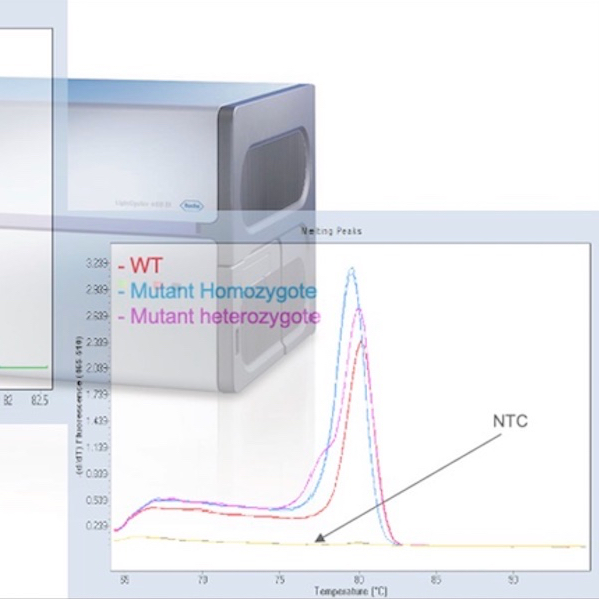
3 analysis options are available depending on the instrument and software used:
- HRM analysis with the LightCycler 480 Gene Scanning module
- or a combined interpretation using both tools for increased confidence.
- Tm calling for SNPs with clear melting domains. For indels or CRISPR edits, rely on curve shape rather than Tm.
Protocol references
Dwight ZL, Palais R, Wittwer CT. uAnalyze: web-based high-resolution DNA melting analysis with comparison to thermodynamic predictions. IEEE/ACM Trans Comput Biol Bioinform. 2012 Nov-Dec;9(6):1805-11. doi: 10.1109/TCBB.2012.112. PMID: 22889837.
Acknowledgements
I thank my colleagues Esther Lechner & Qianan Wang (UPR2357 - Strasbourg) who provided me with the samples for the development of this protocol.