Jan 09, 2025
High Molecular Weight (HMW) DNA extraction apple leaves for nanopore long-read sequencing
- Anthony Venon1,
- Ronan Dadole1,
- Amandine Cornille2
- 1GQE-Le Moulon, Université Paris-Saclay, INRAE, CNRS, AgroParisTech, Gif-sur-Yvette - France;
- 2Division of Science, New York University Abu Dhabi, Saadiyat Island, Abu Dhabi, United Arab Emirates
- Anthony Venon: [email protected];



Protocol Citation: Anthony Venon, Ronan Dadole, Amandine Cornille 2025. High Molecular Weight (HMW) DNA extraction apple leaves for nanopore long-read sequencing . protocols.io https://dx.doi.org/10.17504/protocols.io.kxygxwyzov8j/v1
License: This is an open access protocol distributed under the terms of the Creative Commons Attribution License, which permits unrestricted use, distribution, and reproduction in any medium, provided the original author and source are credited
Protocol status: Working
We use this protocol and it's working
Created: December 11, 2024
Last Modified: January 09, 2025
Protocol Integer ID: 114732
Keywords: High Molecular Weight, HMW, DNA extraction, ONT, plant, fruit trees, apple, gDNA, CTAB, Carlson Lysis buffer, long-read, genomic, dna extraction apple leaves for nanopore, dna extraction apple leaf, ont dna extraction protocol, hmw dna extraction, apple leaf sample, dna extraction, sequencers such as oxford nanopore technology, pure dna sample, absence of sheared dna, sheared dna, effective resuspension of dna pellet, apple leaf, dna pellet, oxford nanopore technology, nanopore, dna, sequencing application, unique biological characteristics of the sample type, extraction, high molecular weight
Abstract
High Molecular Weight (HMW) DNA is crucial for long-read sequencing applications using sequencers such as Oxford Nanopore Technologies' (ONT) MinION and PromethION. To ensure the collection of a pure DNA sample, it is critical to maintain a 260/280 absorbance ratio within the range of 1.8 to 2.0 and a 260/230 absorbance ratio between 2.0 and 2.2. Moreover, the sample must demonstrate high yield and integrity, indicating the absence of sheared DNA (1). These requirements highlight the need for a carefully optimized protocol that aligns with the unique biological characteristics of the sample type (2). In this study, we tested and modified the ONT DNA extraction protocol (3) specifically for apple leaf samples.
Following the standard protocol outlined on the ONT website, we faced significant challenges, particularly with certain genotypes collected in situ or under stress conditions. A primary issue was the effective resuspension of DNA pellets, which often resulted in considerable sample loss. This adapted protocol introduces few modifications to the ONT DNA extraction protocol that have been specifically designed for apple leaves, along with the outcomes of these methodological enhancements.
Image Attribution
Laurencia Fera, Amandine Cornille
Guidelines
All indicated procedures must be conducted under a certified chemical fume hood while wearing appropriate personal protective equipment (PPE).
Materials
Reagents:
RNAse AQiagenCatalog #19101
Tris-HCl, 9.5
CTAB (Hexadecyltrimethylammonium bromide)Merck MilliporeSigma (Sigma-Aldrich)Catalog #52365-50G
Sodium ChlorideFisher ScientificCatalog #S271
Poly(ethylene glycol) avg. mol. wt. 8000 (PEG 8000)
EDTA, disodium salt, dihydrateFisher ScientificCatalog #S312-500
2-MercaptoethanolMerck MilliporeSigma (Sigma-Aldrich)
ChloroformMerck MilliporeSigma (Sigma-Aldrich)Catalog #366919-1L
----
Blood and Cell Culture DNA Mini KitQiagenCatalog #13323
It contains :
Buffer G2QiagenCatalog #1014636
QIAGEN Protease and Proteinase KQiagenCatalog #19131
Buffer QBTQiagenCatalog #19054
Buffer QCQiagenCatalog #19055
Buffer QFQiagenCatalog #19056
Buffer C1Qiagen
----
-
Qubit dsDNA BR (Broad Range) assayThermo Fisher ScientificCatalog #Q32850
70% ethanol in nuclease-free water
2-Propanol or Isopropanol for molecular biologyMerck MilliporeSigma (Sigma-Aldrich)Catalog #I9516-500mL
TE Buffer (10 mM Tris-HCl, 1 mM EDTA, pH 8.0)
Equipment:
50 ml Falcon tubes
1.5 ml Eppendorf DNA LoBind tubes
Refrigerated centrifuge with capacity for 50 ml Falcon tubes
Vortex mixer
Refrigerated centrifuge and rotor for 15 ml tubes
Incubator or water bath with capacity for 37°C and 65°C
Magnetic stirrer and magnet
Ice bucket with ice
Sterile wipes
Equipment
QIAGEN Genomic-tip 100/G
NAME
gravity-flow, anion-exchange tips
TYPE
Qiagen
BRAND
10243
SKU
LINK
100/G - available in Blodd and Cell Culture DNA Mini Kit (Qiagen #13323)
SPECIFICATIONS
Troubleshooting
Safety warnings
The described protocol involves handling potentially hazardous chemicals and biological materials, including DNA extraction reagents, chloroform, and 2-mercaptoethanol. All procedures must be conducted under a certified chemical fume hood while wearing appropriate personal protective equipment (PPE). Follow institutional safety guidelines and consult material safety data sheets (MSDS) for all reagents before use. Dispose of chemical waste according to local regulations.
1. Liquid Nitrogen (N₂)
Main Hazards:
Severe cold burns (contact with skin or eyes).
Asphyxiation (in confined or poorly ventilated spaces).
Personal Protective Equipment (PPE):
Cryogenic gloves.
Safety goggles or face shield.
Long-sleeved lab coat and full-length pants.
Closed-toe shoes.
Waste Management:
Allow liquid nitrogen to evaporate in a well-ventilated area.
Do not seal containers to avoid pressure build-up.
2. Beta-Mercaptoethanol
Main Hazards:
Highly toxic if inhaled or ingested.
Causes skin and eye irritation; may cause severe respiratory irritation.
Strong unpleasant odor.
Personal Protective Equipment (PPE):
Nitrile or latex gloves.
Chemical splash goggles.
Lab coat.
Work under a fume hood.
Waste Management:
Collect waste in a dedicated chemical waste container labeled for beta-mercaptoethanol.
Dispose of according to institutional hazardous waste protocols.
3. Chloroform
Main Hazards:
Carcinogenic and toxic if inhaled, ingested, or absorbed through the skin.
Can cause dizziness and damage to the liver and kidneys.
Personal Protective Equipment (PPE):
Nitrile gloves (double-gloving recommended).
Safety goggles or face shield.
Lab coat.
Use only inside a fume hood.
Waste Management:
Collect chloroform waste in a clearly labeled, solvent-safe container.
Dispose of through your institution's hazardous waste disposal system.
4. Isopropanol
Main Hazards:
Highly flammable.
Causes irritation to the skin, eyes, and respiratory tract.
May cause dizziness if inhaled in large quantities.
Personal Protective Equipment (PPE):
Nitrile gloves.
Safety goggles.
Lab coat.
Work in a well-ventilated area or under a fume hood if necessary.
Waste Management:
Collect isopropanol waste in a labeled, solvent-safe container.
Dispose of through your institution's hazardous waste disposal program.
Ethics statement
This research does not involve any studies with human participants or vertebrate animals.
Sampling
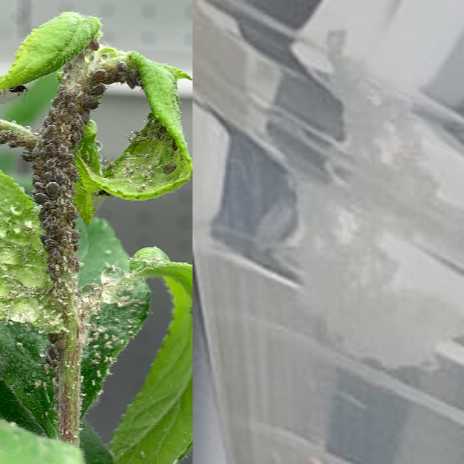
We collected four leaves from the same apple tree. If the tree was infected, we carefully removed all aphids present on the leaves. The samples were then flash-frozen and stored at -80°C for long-term conservation.
Carlson Lysis Buffer - Day 0
Prepare 50 mL Carlson Lysis buffer per sample:
100 millimolar (mM) Tris-HCl9.5 ,
2 %w/v CTAB,
1.4 Molarity (M) NaCl
1 %w/v PEG 8000,
20 millimolar (mM) EDTA.
Note
The buffer can be prepared in advance by batches of 1 or 2L.
Prepare the buffer at least one day in advance.
HMW DNA Extraction - Day 1
1h 45m
Tube preparation :
Transfer 20 mL of buffer to a 50mL Falcon Tube.
In a fume hood, add 100 µL β-mercaptoethanol to the Carlson buffer and mix by vortexing.
Pre-warm the solution to 65°C in a water bath or incubator for 30 minutes before starting the extraction.
30m
Add 3-4 frozen leaves to a mortar cooled with liquid nitrogen, crushing them into a fine homogenous powder.
Note
While crushing the leaves the mortar and leaf content need to be kept cool with liquid nitrogen. This can be achieved by adding liquid nitrogen to the mortar or by keeping the mortar in a container filled with liquid nitrogen.
Transfer the powder to 2 empty fresh 50ml Falcon tubes by splitting the powder in half.
Keep the Falcon tubes in liquid nitrogen.
In a fume hood, add 20 mL of the pre-warmed Carlson lysis buffer to each of the 50ml Falcon tubes containing the powdered leaf material.
Add 40 µL of RNase A to each of the tubes, and vortex 5s.
Transfer the tubes to a water bath or incubator at 65 °C and incubate for 1h30 . Every 30 minutes, gently invert the tubes 10 times.
Note
At the 1h mark start the centrifuge empty on a cycle at 4 °C and low RPM (e.g. 500rpm) to bring it down to 4 °C prior to step 11.
Allow the tube to cool down for a minimum of 5 minutes.
In a fume hood, add 20 mL of chloroform to each tube and vortex for two pulses of 5 seconds each.
Centrifuge the tubes at 3500 x g, 4°C for 15 minutes.
15m
In a fume hood, transfer the top layer of lysate from each tube to a new 50 ml Falcon tube, without disturbing the interphase layer.
Note: At this step, you can use a P5000 pipette with wide-bore tips.
Add 0.7 x volumes of isopropanol to the lysate and invert 10 times. Incubate at -80 °C for 15 minutes.
15m
Centrifuge the sample at 3500 x g, 4°C for 45 minutes.
45m
Discard the supernatant without disturbing the pellet. Use wipes to absorb the liquid on the tube walls, being careful not to disturb the pellet.
To each pellet, add 12 mL of G2 buffer, from the QIAGEN Blood and Cell Culture DNA Maxi Kit. Place it at 4 °C Overnight .
HMW DNA Extraction - Day 2
Pre-warm Buffer QF to 55 °C using an incubator or in a water bath.
Incubate at 50 °C for 15 minutes until the pellet is dissolved.
Note: If the pellets do not dissolved, feel free to remove the tubes from the water bath and gently swirl them in a circular motion by holding the tube by the cap to help dissolved the pellet
Do not try to pipette or vortex the pellet.
Equilibrate a QIAGEN Genomic-tip 100/G column with 4 mL of Buffer QBT.
Pour one tube with the fully dissolved DNA in G2 buffer through the equilibrated QIAGEN Genomic-tip 100/G column and allow it to go through with just gravity.
Once the tube of dissolved DNA has passed the column, repeat with the second tube of dissolved pellet with the same QIAGEN Genomic-tip 100/G column.
Once all the lysate has passed through the column, wash the QIAGEN Genomic-tip 100/G column with 8 mL of Buffer QC.
Wait until all the buffer flows through the column and repeat the wash with another of Buffer8 mL of Buffer QC.
Place the QIAGEN Genomic-tip 100/G over a clean 50ml Falcon tube, and elute the genomic DNA with 5 mL of Buffer QF, pre-warmed to 55 °C .
Allow the eluate to cool down to room temperature.
Add 3.5 mL of isopropanol to the eluted DNA and mix by inverting the tube 10 times.
Incubate the tube at -20 °C Overnight .
HMW DNA Extraction - Day 3
55m
Centrifuge the tube at 3500 x g, 4°C for 45 minutes.
45m
Discard the supernatant without disturbing the pellet.
Add 4 mL of ice-cold 70% ethanol to the pelleted DNA and slowly invert the tube 10 times.
Centrifuge at 3500 x g, 4°C for 10 minutes.
10m
Discard the supernatant without disturbing the pellet. Use wipes to dry the tube walls, being careful not to disturb the pellet.
Resuspend the DNA in 100 µL of TE buffer and incubate at Room temperature , typically Overnight .
Size selection - Day 4
Perform size selection protocole according to Nanopore.
Results on apple tree leaves
All the given results are obtained after size selection according Nanopore protocol.
| Sample | Condition | Concentration (nanodrop) | Unit | A260/280 | A260/230 | |
| Malus domestica | No infested by aphids | 1 880.30 | ng/ul | 1.81 | 1.84 | |
| Malus domestica | No infested by aphids | 736.00 | ng/ul | 1.85 | 2.35 | |
| Malus domestica | Infested by aphids | 1 031.60 | ng/ul | 1.86 | 2.26 | |
| Malus domestica | Infested by aphids | 576.90 | ng/ul | 1.81 | 2.11 | |
| Malus sylvestris | No infested by aphids | 1 557.40 | ng/ul | 1.86 | 2.11 | |
| Malus sylvestris | No infested by aphids | 1 009.10 | ng/ul | 1.88 | 2.22 | |
| Malus sylvestris | Infested by aphids | 3 513.10 | ng/ul | 1.87 | 2.24 | |
| Malus sylvestris | Infested by aphids | 1 768.70 | ng/ul | 1.85 | 2.15 |
Table 1: DNA quality and concentration of Malus domestica (domesticated apple) and Malus sylvestris (wild apple) leaf samples under different conditions. DNA was extracted from leaves either infested by aphids or not. Concentrations are expressed in ng/µl, and the purity of the samples is assessed using A260/280 and A260/230 ratios.
Figure 1: Results from genomic sequencing of apple tree samples extracted from this protocole using the SQK-LSK114 kit and following the manufacturer's protocol. The read length graph illustrates the total number of bases relative to the read length. The pink circle indicates the sequencing positive control.
Protocol references
[1] “Input DNA/RNA QC (IDI_S1006_v1_revC_25Nov2024),” Oxford Nanopore Technologies. Accessed: Dec. 11, 2024. [Online]. Available: https://nanoporetech.com/document/input-dna-rna-qc
[2] M. Kang, A. Chanderbali, S. Lee, D. E. Soltis, P. S. Soltis, and S. Kim, “High-molecular-weight DNA extraction for long-read sequencing of plant genomes: An optimization of standard methods,” Applications in Plant Sciences, vol. 11, no. 3, p. e11528, 2023, doi: 10.1002/aps3.11528.
[3] Oxford Nanopore Technologies, “Arabidopsis (Arabidopsis thaliana LEr) leaf DNA.” Aug. 06, 2021. Accessed: Dec. 11, 2024. [Online]. Available: https://nanoporetech.com/document/extraction-method/arabidopsis-leaf-dna
Acknowledgements
This protocol is entirely adapted from Oxford Nanopore Technologies leaf gDNA extraction protocol from Arabidopsis [3].
We would like to thank Natalia Conde e Silva, Laurencia Fera and Paul Barthélémy for testing and reviewing the protocol.