Sep 20, 2023
Handling and Sampling Medium-Large Mammals - ISL Peru
Forked from a private protocol
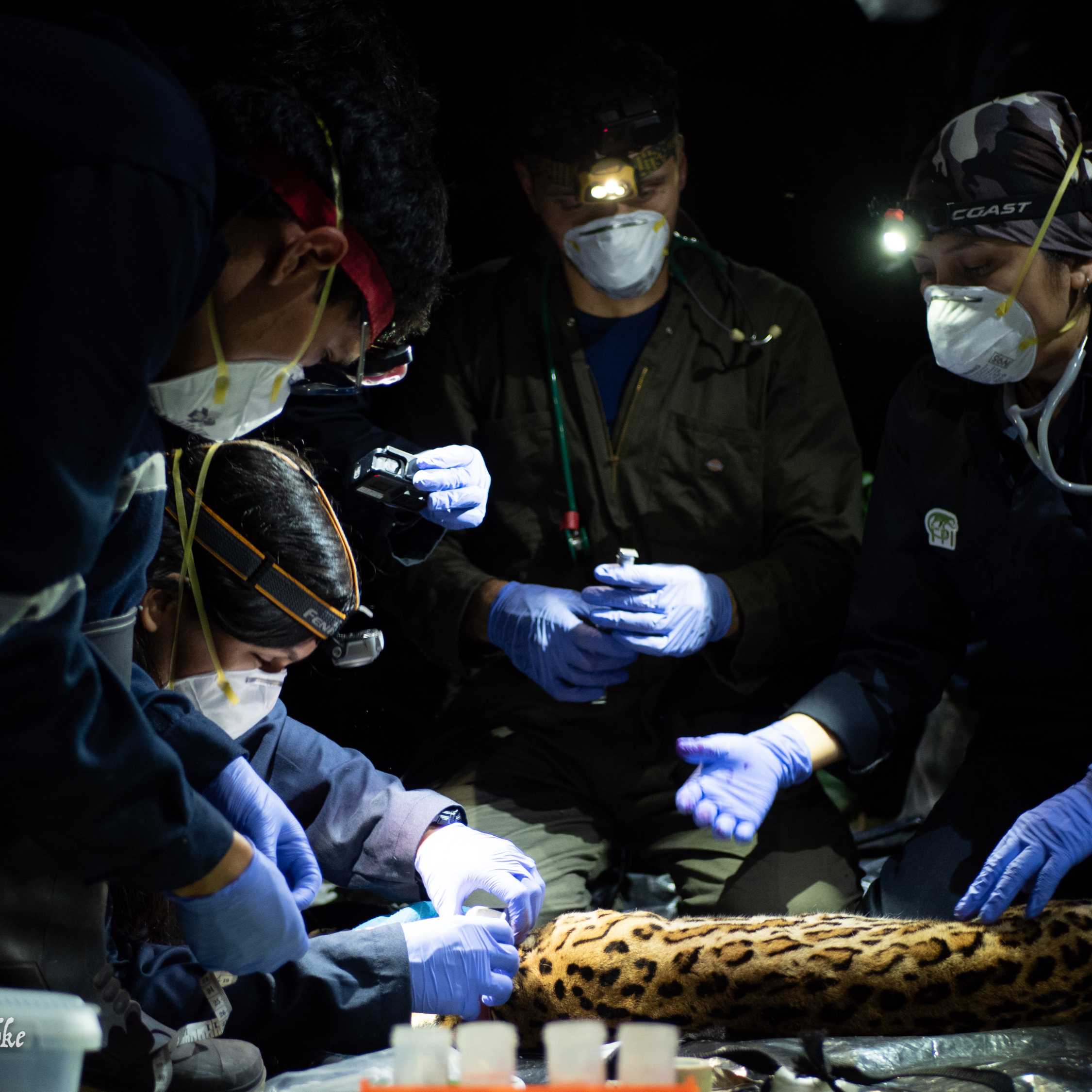
- Cristian Tirapelle1,
- Jorge Luis Mendoza-Silva1,
- Mrinalini Watsa2,1,
- Gideon Erkenswick1
- 1Field Projects International;
- 2San Dieego Zoo Wildlife Alliance
- In Situ LaboratoriesTech. support email: [email protected]



External link: https://doi.org/10.1038/s41597-025-05697-z
Protocol Citation: Cristian Tirapelle, Jorge Luis Mendoza-Silva, Mrinalini Watsa, Gideon Erkenswick 2023. Handling and Sampling Medium-Large Mammals - ISL Peru. protocols.io https://dx.doi.org/10.17504/protocols.io.81wgby8y1vpk/v1
Manuscript citation:
Sánchez-Vendizú P, Erkenswick G, Reyes J, Clinton SL, Espejo TS, Cáceres G, Libke Z, Arana A, Mendoza-Silva J, Tirapelle C, Williams S, Swamy V, Martínez-Altamirano J, Esteves J, Barnuevo-Bullón JP, Hernández-Mejía J, Caffo X, Malpica AM, Salazar-Aragón R, Gutiérrez-Jiménez L, Stabile J, Cuzmar N, Paine TD, Peralta-Aguilar P, Inga-Díaz G, Lescano J, Viñas-Martínez A, McElroy ME, Coayla D, R LL, Pilfold NW, Sacco AJ, Arakaki M, Mena JL, Tobler MW, Salinas L, Arana C, Pacheco V, Prost S, Watsa M (2025) Decoding the Peruvian Amazon with in situ DNA barcoding of vertebrate and plant taxa. Scientific Data 12(). doi: 10.1038/s41597-025-05697-z
License: This is an open access protocol distributed under the terms of the Creative Commons Attribution License, which permits unrestricted use, distribution, and reproduction in any medium, provided the original author and source are credited
Protocol status: Working
We use this protocol and it's working. This protocol is reviewed and updated annually.
Created: March 28, 2023
Last Modified: September 22, 2023
Protocol Integer ID: 79609
Keywords: mark recapture, wildlife, field anaesthesia, mammal handling, biological sampling, insitulabs, program overview tomahawk live trap, capture of the target animal, isl peru program timing trap placement, tomahawk trap, live trap, site of capture, use of forest habitat, trap for safe processing, animal processing, camera trap footage, rainforest dry season, forest habitat, encompassing major habitat type, trap, target animal, capture, large mammal, captures each season, isl peru program timing, rainforest, capture overview, major habitat type, capture attempt, size mammal, successional forest, primary forest, program overview tomahawk, sampling assistant, animal, species, sampling medium, anteater, sample collection
Funders Acknowledgements:
Gordon and Betty Moore Foundation
Grant ID: 9772
Gordon and Betty Moore Foundation
Grant ID: 9776
United States Forest Service
Grant ID: 21-DG-11132762-302
Disclaimer
This protocol is actively used by Field Projects International at the Estación Biológico Los Amigos, Madre de Dios, Peru. It is revised annually to reflect improved capture, handling, marking, and sampling methodology. It has been reviewed by the ethics committees of multiple institutions. No author nor affiliated institution takes responsibility or bears any liability for the use of this protocol by others. The protocol is listed as having sensitive content since it involves biosampling from wildlife. Note: these procedures should be carried out only by trained personnel, and are not recommended for use without first obtaining all required permissions.
Abstract
Program Timing
Trap placement and habituation occurs toward the end of the rainy season (March - May). Sample collection occurs annually during the rainforest dry season (June - August). Sample analyses is ongoing between September and April each year.
Team Composition
This protocol is intended to be carried out by a team of 4 individuals, including at least 2 trained personnel. Roles include: (1) designated handler; (2) chemical restraint operator; (3) sampling assistant; (4) data recorder.
Program Overview
Tomahawk live traps are set up at multiple locations encompassing major habitat types surrounding the field station (terra firme, flood plain, swamp, bamboo, successional forest, primary forest, edge forest, etc). Locations are selected based on prior knowledge from the area, camera trap footage, or following standard line transect methodology. Traps may be placed but not activated for a long period of time, until there is evidence that capture of the target animal is likely and predictable.We intend for 10-20 captures each season.
Capture Overview
When a tomahawk trap is baited and activated it is also fitted with a real-time, remote alert system -> medium- to large-size mammals will be chemically restrained with injectable anesthetic agents (10-15 min) -> upon induction, the animal is extracted from the trap for safe processing of morphometric measurements, photographs, nonlethal tissue collection (skin biopsy, fur/nail, blood, mucosal swabs), and placement of microchips or ID tags (20 min) -> an antagonist is administered and the animal is transferred into a covered holding cage, with 3-minute checks for breathing and movement until fully alert (on average ~ 10 - 15 minutes) -> once fully alert, animals are released at the site of capture.
Capture (Additional Details)
Animals are diverse in their behaviors, attraction to bait, and use of forest habitat. Occasionally, for species where capture with a Tomahawk Trap is not possible, such as sloths and anteaters, a capture attempt with the aid of restraining tools may be performed during a chance encounter. In this case, animal processing will be the same as described in this protocol.
Image Attribution
Zane Libke, Jorge Luis Mendoza-Silva
Guidelines
Whenever working in the presence of a rodent or marsupial, all personnel involved should wear:
(1) clean, long-sleeve coverall
(2) disposable gloves
(3) N95 face mask covering nose and mouth.
(4) when directly handling, a minimum of 2 layers of disposable gloves and protective glasses or a face-shield are recommended.
It is COMPULSORY to be vaccinated against rabies in order to handle small animals.
Materials
Mammal processing sheet
 MammalForm_hardcopy.pdf184KB
 ODK Form
All animal and sample information collected on the hardcropy datasheet is entered into an associated digital form made with Open Data Kit Software. ODK central will generate the form from this excel file: FPI-ODK_2023_mammal_handling.xlsx40KB
FPI-ODK_2023_mammal_handling.xlsx40KB Measuring material
- Ruler
- Calipers
- Measuring tape
Electronics
- Voice recorder (charge)
- Rectal thermometer
- Environmental thermometer
- 2 Stopwatches
- Electronic Scale
- Extra batteries
- Microchip reader
- Electric razor
- Ketomojo machine+ glucose and ketones stripes (10 each)
- Camera (charged)
Tool bag
- 2 anatomical forceps
- 2 Scissors(one straight, one curved)
- 2Hemostatic forceps
Marking materials
- Ear tags
- Ear tag pliers
- 2+ microchip syringes
Collar kit
- 2GPS collars
- collar belt
- hole maker
- locking system
- players and screw driver
Tail bleaching kit
- Bleaching powder
- Activator
- Plastic cup
- Brush
- Shampoo
- Tin foils
- Bucket of water
- 3 Towels for drying tail
Sampling Material
Serum
- 15 falcon tubes
- 2 tubes of micro haematocrit capillary tubes (at least 50)
- Clay
- cotton buds
- vaseline
Blood smears
- Full box (~20)
- Empty box for used smears
- Bag of Kim wipes (full)
Sample box (at least 5 of each):
- Longmire's blood tubes (LB)
- Ecto tubes (E)
- Biopsy tubes (BP)
- Buccal tubes (BUC), at least 60
- Vaginal tubes
- Rectal tubes
- Urine tubes
- Serum clot activator tubes
Biopsy bag
- 30+ small squares of cardboard
- 3 punch biopsy devices
Sample bags (5 of each)
- H-DNA bags
- Poop bags
- H-Merc bags
General
- 10% bleach spray bottle
- 70% Alcohol spray bottle
- Hydrogen peroxide
- Cotton
- 1, 3, 5mL syringes ( 5 of each)
- Antiseptic towelettes, 10+
- 25-gague needles, 10+
- Buccal swabs, 10+
- 23-gauge needles,10+
- Tube rack
Sterilization kit
- 10%Bleach falcon tube
- 2 distilled water falcon tubes
- 1 x 70% alcohol falcon tube
Cooler for samples
- Ice pack
- Ziplock bags
Miscellaneous
- Clipboard
- 30+ processing sheets
- pens, sharpies
- Sharps container
- Hot hands
- Hot water bottle
- Trash bag
- Gloves—size (S,M,L)
- Masks (N95) x6
- Thermos with hot water
- Processing table
- Masking tape
- Paper towels
- Handling gloves
- Towel
- trap divider
- injection poles
- ketch all pole
- throwing net
- 2 pairs of Leather handling gloves size L
- Recovery kennel
- Tarp
- Oxygen tank
- blow pipe
Darting kit:
- 3 x3ml darts
- Syringe connector
- 20ml syringe
- Bag of rubber pieces
- 3 stabilizers
- 5 medium mammal dart needles.
Anaesthetic and emergency box
- 1 bottle of ketamine
- 1 bottle of dexmedetomidine (at least half)
- 1 bottle of atipamezole (at least half)
- 1 vial of Midazolam
- 1bottle of Xylazine
- 1 bottle of Alfaxan
- 1bottle of Butorphnol
- 1 bottle of atropine
- 1 bottle of adrenaline
- 1 bottle of doxapram
- 1 bottle of yohimbine
- Antiseptic tincture
- Iodine disinfectant
- Cotton
- Vetrap
- tape
- tissue glue
- liquid bandage
- IV catheter (10yellow, 10blue, 10pink)
- 5x bung
- 4 Butterfly needle
- ET tubes (size 2 to 8)
- Drip lines
- Saline solution (500ml)
- Syringes( 5x 1ml, 4x 2ml, 2x10ml, 1x 2ml)
- Urinary catheter
- Scalpel blade
- Razor blade
- 2x 2/0 and 3/0 absorbable suture material
- Surgical kit
- Stethoscope
- Artificial tears
- Ambu bag
- Syringe pole
Safety warnings
In case of a bite from a small wild animal
Thoroughly rinse the site for 10 full minutes, disinfect the site, and notify the PI immediately.
Ethics statement
This protocol is modified annually as improvements are discovered, better technique is published, or new technologies are available. This protocol is based on prior versions that received approved by Institutional Animal Care and Use Committees (IACUC) of the University of Missouri - St. Louis, Washington University in St. Louis, and, most recently, by San Diego Zoo Wildlife Alliance.
Before start
All the material needed for processing the animal should be prepared in advance and the duty of carrying it to the trap site should be distributed among the capture team members.
ROLES
Team Composition
This protocol is intended to be carried out by a minimum of 4 individuals, including at least 2 trained personnel including: (1) veterinarian (in charge); (2) handler; (3) sampling assistant; (4) data recorder.
Veterinarian in charge (VET)
This is a trained and senior veterinarian that has experience with administering animal anesthesia. This person is responsible for overseeing the monitoring of animal vitals and determining when processing should conclude, even if full sampling has not been achieved. The VET decides whether or not additional doses of anesthesia or emergency drugs are needed, including the time for reversal agent injection.
Handler
This is a trained and senior researcher/veterinarian that is experienced with every step of the capture process. They are responsible for directing sample collection and directly handling the animal along with the VET.
Data Recorder
Will perform data recording on the animal processing sheet MammalForm_hardcopy.pdf184KB
MammalForm_hardcopy.pdf184KB - write down the weight of the animal and any other measurements, sample codes, and important time stamps.
- Recording notes from the HANDLER and VET.
- Notify the team when it is time to check vitals (every 3 minutes from the previous reading),
- make sure that all the vitals are taken at each check.
- Notify the team at 15 minutes from the beginning of the processing of a given animal.
| A | B | C | D | |
| Discovery (real time, 24hr): | Out of trap (SW): | Recovery (SW): | Release (SW): | |
Example from the PROCESSING FORM showing important time stamps
Sampling Assistant
Responsible for:
- taking pictures of the animal;
- assisting the HANDLER and VET by passing tools, designated tubes or bags to collect each sample;
- storing samples according to the protocol in use;
- help the DATA RECORDER to double-check that all samples have been recorded on the processing form, and that sample codes on tubes match the PROCESSING FORM.
If more personnel are available, other recommended roles include: (5) PHOTOGRAPHER; (6) COLLAR SPECIALIST; (7) 2ND SAMPLING ASSISTANT.
ACTIVE TRAP MONITORING
At all times, one team member monitors the trap sensor alert system (SAS), while all others remain ready to take action. Shifts should be organized to ensure continuous monitoring of SAS, even during the the night.
When SAS is triggered, the VET and HANDLER depart immediately for the trap-site. They carry with them all essential materials for safe physical and chemical restraint and communication, including (but not limited to):
- cage divider
- drug box
- tarp and handling gloves
- Walkie talkies - used to communicate with the team members that follow, carrying the majority of processing materials (refer to MATERIALS section).
Note
Bulky or heavy items may be left close to the trap-site and collected along the way. Be careful not to disturb the environment in any way that could impact capture success.
DISCOVERY
The VET and HANDLER approach the trap site first, inspecting the area for signs of any animals around the trap.
If no animals are present in the vicinity of the trap and it is deemed safe, proceed to inspecting the trap.
Note
When approaching the trap, a TARP can be held up as a screen to reduce stress to the captured animal.
Visually determine the species and approximate weight (using published reference literature is advised), then cover the entire trap with the tarp. This creates a dark environment that usually reduces stimuli that cause stress and panic.
The image shows a large tomahawk trap covered with a tarp to reduce light and reduce stress on the captured animal. Image courtesy of Jorge Luis Mendoza Silva.
Communicate discovery details to the rest of the team for processing set up for the particular species
Note
If the animal inside the trap belongs to a species already captured this season, look carefully for marking and processing signs (such as bleached fur, shaved patches on the fur, collars, etc..) to determine if it is a recapture. When possible, take pictures of any individual characters (scars, markings) or scan for a microchip, if safe to do so from a distance.
In the case of a recapture, the HANDLER, and ultimately the VET, will decide whether to release the animal right away and without administering any anesthetic agent.
Safety information
In the unlikely case that the animal is experiencing extreme stress and may sustain severe injuries to itself during the process of physical restraint or as a consequence of the chemical restraint, the VET may decide to release the animal without anesthetization.
The VOICE RECORDER and the STOPWATCH should be started, and say aloud:
- full date,
- time,
- trap site code/name
- team members participating
Note
From this moment onwards, the time on the STOPWATCH will be the one used when recording the time of any subsequent action on the PROCESSING SHEET.
PREPARATORY PHASE & CHEMICAL RESTRAINT
Safety information
Everyone should wear PPE according to the protocol in use, which includes:
- a N95 face mask covering nose and mouth,
- a clean coverall,
- a pair of disposable gloves.
- It is recommended to whoever is handling the animals and the samples to wear protective googles or a face-shield.
An estimated weight of the animal should be determined by taking into account guesses from two experienced team members -> prepares the anesthetic according to the pre-selected protocol for that taxa.
The image shows the lead veterinarian preparing the appropriate anesthetic for the captured animal. Image courtesy of Jorge Luis Mendoza Silva.
Meanwhile, everyone else prepares the PROCESSING TABLE about 30 meters away from the trap.
PROCESSING SET-UP:
- clean table surfaces by spraying (in order) with 10% diluted bleach -> water -> 70% ETOH;
- take out enough sampling supplies for the first animal and set on table or in secondary animal tray;
- take out measuring materials;
- ready the tool sterilization kit;
- ensure space for primary animal tray;
- check that camera is ready with lots of free space on card.
The table is prepared to receive the animal and perform all the sampling and measuring procedures. In the above picture it is possible to see sampling syringes, tubes, and bags prepared on a clean plastic tray. The material needed for placing an IV catheter and for monitoring the anesthesia is also being prepared on the table by one of the team members. Image courtesy of Thomas Parsons.
CHEMICAL IMMOBILIZATION
Using a trap divider and/or sticks, restrain the animal to one side of the trap while the VET injects the anaesthetic. The VET approaches the side of the trap where the animal’s musculature is closer to the mesh and injects the drug intramuscularly with a SYRINGE or, if neccesary, SYRINGE POLE. The use of a 23G-21G needle has proven to be effective for most medium size mammal species.
The restraint is usually carried out by inserting a METAL cage divider and/or sticks through the trap to confine the animal towards the side of the trap which is closer to the vet injecting the drug. Image courtesy of Thomas Parsons.
With the animal restrained at one side of the cage-trap, the VET can safely inject the anesthetic intramuscularly. Image courtesy of Thomas Parsons.
UPON INJECTION:
- DATA RECORDER records INJECTION TIME as well as the DOSE for each drug. Failed or partial injections should also be recorded
- start a dedicated STOPWATCH that the VET uses to monitor the duration of chemical immobilization
INDUCTION PERIOD
Cover the trap with a tarp and minimize noise to allow a smooth induction of the anaesthesia. Check on the animal every couple of minutes, or as soon as movement and sounds stop.
When the animal has lowered its head or it is no longer moving any extremities, check for response to external stimuli:
- gently touch a stick to the inner side of the ear pinna,
- check the jaw tone,
- check palpebral reflex.
The image shows two veterinarians checking the animal's vital signs after being anesthetized. Image courtesy of Jorge Luis Mendoza Silva.
If no response to stimuli --> open trap, test the reaction of the animal when pulling the paws and lifting the head.
If no response to stimuli --> remove animal and proceed to PROCESSING.
If signs of alertness or arousal to stimuli -> allow more time for the drug to take effect. If 15 - 20 minutes passes since the first dose and the animal is not completely sedated, an additional dose should be calculated and administered.
PROCESSING
WEIGHT
Place animal on the tarp to record WEIGHT. Any possible weight estimation error should be taken into account and the VET evaluates whether corrective measures are needed (e.g. additional dosages, reversal agents, etc..).
Weight measurement is performed as soon as the animal is removed from the trap. Image by Zane Libke.
Meanwhile, sampling assistant mixes activator and hair bleach powder.
Place animal on PROCESSING TABLE with a towel to cover the eyes (this reduces stimuli), and proceed to MEASUREMENTS & SAMPLING.
Safety information
At all times, the recovery cage should be kept close the front of the animal, with the door opened. In case of a sudden arousal, the animal can be quickly shifted inside it.
MEASURMENTS & SAMPLING
The VET and one assistant proceed as follow:
- auscultates the heart sounds and perform the first reading of VITALS.
- places the PUSLOXYMETER on the tongue or the paw pads of the animal
- places THERMOMETER probe intrarectally.
- shaves and prep a site for IV CATHETER (usually the cephalic vein).
Team fulfilling its functions in the processing of the animal, the veterinary assistant is observed monitoring vital signs and the main veterinarian finishing the catheter installation. Please note that the animal's eyes are covered with a towel. Image courtesy of Jorge Luis Mendoza Silva.
The image shows the installation of the pulse oximeter in the paw pads of a Tayra. Image courtesy of Jorge Luis Mendoza Silva.
Team preparing to insert IV catheter in a short-eared dog. Note the eyes of the animal are covered with a towel. Image courtesy of Thomas Parsons.
- Place IV CATHETER. The catheter should be left in place for the first 20 minutes of processing. In case of an emergency, the catheter can be used for quick drug delivery (additional anaesthetic drugs VS emergency drugs). If the anaesthesia is uneventful and the processing is about to be completed, the catheter should be removed before the animal will wake up (consider 20-30 minutes from the last effective dose of anaesthetics as a general rule) and the reversal agent is administered.
The image shows the use of IV catheter for the use of administering complementary anesthetics during the processing of the animal. Image courtesy of Jorge Luis Mendoza Silva.
MICROCHIP
- Scan for previous MICROCHIP, if no microchip found, insert one subcutaneously on the dorsal aspect of the neck (use the scanner to check that the chip stays in place after injection).
The image shows the insertion of a microchip into the back of the animal (in this case an ocelot). Image courtesy of Jorge Luis Mendoza Silva.
After inserting the microchip, it must be confirmed that it works correctly and the number must be verified again and then noted on the data sheet. Image courtesy of Jorge Luis Mendoza Silva.
BLOOD
Depending on the species, the blood might be drawn from the jugular, cephalic, femoral, saphenous or ventral coccygeal vein. If blood has not been previously drawn from the IV catether, then:
- shave the selected venipuncture site using a an electric hair clipper,
- disinfect skin with an antiseptic wipe,
- put pressure proximally to the venipuncture site to inflate the vein,
- draw blood using a 3-5 ml syringe with a 23G or 21G needle,
- A drop of blood will be used for blood glucose and ketone readings, and to create 2 blood smears. 0.3 mL aliquots of blood are placed in 1.7 mL tubes containing lysis buffer, 1 mL is placed in tubes containing clot activator factors and another 3 mL aliquote is placed inside an EDTA tube.
The image shows blood being drawn from the jugular vein of an ocelot. Image courtesy of Jorge Luis Mendoza Silva.
The image shows blood being drawn from the jugular vein of a Tayra. Image courtesy of Jorge Luis Mendoza Silva.
The image shows the extraction of blood from the cephalic vein of an Ocelot. Image courtesy of Jorge Luis Mendoza Silva.
Safety information
Total blood collected is < 1% of animal body weight, in accordance with the 2016 Guidelines of the American Society of Mammalogists for the use of wild animals in research and education.
USDA Pain/Distress Category: C
Risks
Loss of excessive blood: Venipuncture does not cause excessive blood loss, and left alone blood rapidly coagulates and stops bleeding. However, we hasten this process by applying light pressure to the puncture site once blood is collected.
Post procedure monitoring
None except confirming that the puncture site is not bleeding before animal is released.
Note
The vet team is also in charge of checking for and, whenever necessary, treating wounds or injuries caused by trapping.
All the injuries should be documented with pictures and annotated in the PROCESSING SHEET.
TRACKING DEVICE PACEMENT
Simultaneously to the above operations, team members fit and place a collar tag:
- measure the neck of the animal, marking spots on a string corresponding to where holes for a locking system will be made,
- mark or make corresponding holes in the collar,
- Before locking collar around neck of the animal, collar size should be independently assessed by 2 experienced team members.
Image showing the team member in charge of placing the collar while trying it on a tayra's neck. Image by Jorge Luis Mendoza Silva.
Safety information
As a general rule of thumb, collars should weigh < 5% of animal body weight. Tags are used on select taxa to study their use of heterogeneous habitats, to understand territorial behavior, migration or dispersal, to visualize overlap between species in space and time, to monitor animal survival and well-being, and to conduct follow-up research.
Tags are placed with the following guidelines in mind:
- In this program all animals are habituated to traps for annual health monitoring, and to replace/remove tracking devices. We rely on longitudinal data to demonstrate that the collars used do not effect the survival or reproduction of study subjects.
- If recapture is not anticipated, tags are damaged in a way that will cause it to fall off over time due to normal wear and tear
- If recapture is not anticipated and when weight is not a factor, pre-programmed drop-off mechanisms are considered. However, this feature is not a certainty, and thus the above considerations always apply.
RISKS
Poor sizing of animal tags on collars will result in collars falling off prematurely, or constraining an animals normal growth and causing excessive abrasion, injury, or worst case, death. Permanent, non-expanding collars are NEVER to be placed on juveniles or sub-adults with as yet unknown growth potential
MONITORING
According to the tag type, monitor the animal for normal movement in the days following capture, and then develop a schedule for checking on the animal regularly until the 1 year mark. After 1 year, attempt to recapture the animal to check health status, and sizing and integrity of the tracking device.
PICTURES
The person in charge of pictures will capture:
- PROCESSING SHEET before proceeding to photograph the animal,
- whole animal from one side,
- proceed from head to tail taking all the relevant pictures listed in the PROCESSING SHEET, communicating to DATA RECORDER.
- general pictures of sampling and processing of the animal.
MEASUREMENTS
Person in charge of MEASUREMENTS will:
proceed with BLEACHING the HAIR for marking porpoises following a protocol pre-established for the given species.
Tail hair bleaching of a short-eared dog's tail. Image courtesy of Thomas Parsons.
Different bleaching patterns used for the tail.
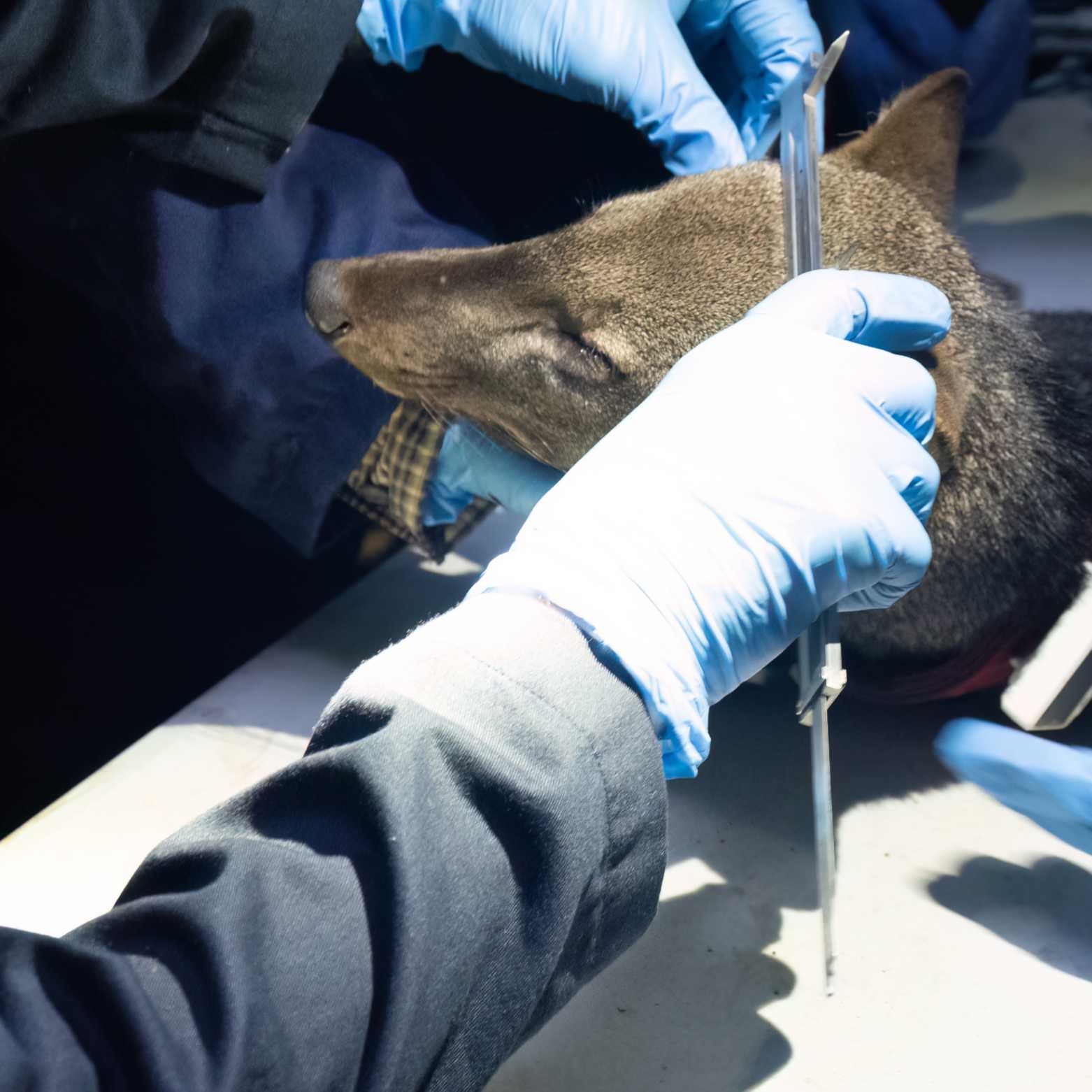
- MEASURE all body parts listed in the PROCESSING SHEET from head to tail, communicating each to the DATA RECORDER.
- Searching for scars, injuries (measuring when possible), and ectoparasites.
SAMPLING
Sample collection follows a caudal to cranial order. In an Ideal situation there are two team members working together to collect:
FECES
- Faecal samples are collected from a surface where they have been dropped, directly from the opening of the anus. Look for FECES in the trap, if no feces are found, take two RECTAL SWABS. Use designated, pre-labeled bags or tubes for feces.
Note
As a convention, only faeces collected directly from the anus (with clean tweezers) or the rectum (via rectal inspection or a swab), and transferred straight away into a dedicated bag/tube, can be considered "uncontaminated".
Conversely, faeces collected from a surface or the perineal region are to be considered contaminated, and this should be specified on the form.
VAGINAL SWAB (FEMALE ONLY) x2
- Make sure that the area around the opening of the vulva is clean from faeces,
- access the opening of the vulva without contaminating the swab by touching the fur or the skin in the area, and gently insert the swab directing it towards the birth canal. Be careful not to apply excessive pressure with the swab, and abort if the vaginal does not easily allow swab insertion. Gently rotate the swab back and forth for 5 seconds.
- Remove the swab from the orifice and place it inside the dedicated tube containing lysis buffer
- Hold the swab a few millimetres up from touching the bottom of the tube; this way when you break the tip of the swab inside the tube the piece of swab will be slightly shorter than the length of the tube, and it will fit inside it easily. If needed use a clean scissor to cut the stick.
- Close the tube and place it in the dedicated rake.
Safety information
Vaginal swab should not be attempted on immature females. Abort if the swab is NOT received easily.
USDA Pain/Distress Category: C
CUT/SHAVED HAIR
- Particularly when working with small animals be careful to avoid accidentally cutting skin.
- To collect hair for mercury studies, cut some hair from the flank or dorsum of the animal. You may also collect hair that is shaved for visualizing the venipuncture site.
- Whenever possible it is good norm to standardize the hair collection site for a species, and keep collecting from the same region in different individuals.
- The body location from which the hair sample is collected should be reported in the processing sheet.
The image shows how the animal's hair is cut for mercury bioaccumulation analysis samples. Image by Jorge Luis Mendoza Silva.
PLUCKED HAIR
- Be careful not to be overzealous and grab too much hair at one time, as (particularly in small mammals) this might injure the skin.
- To collect hair for DNA studies it is important to include the hair follicle in the sample. In order to achieve this, a small amount of hair is grabbed with a pair of tweezers and plucked from the animal's skin. Transfer the hair into a pre-labelled clean zip-lock bag marked as H-DNA followed by a serial number.
The image shows the hair sample being taken for DNA analysis. Image by Jorge Luis Mendoza Silva.
BIOPSY
- Select an area of the skin which is naturally bald, or shave a skin patch on the flank.
- Disinfect the selected skin area with the aid of an antiseptic wipe.
- Grip a small piece of skin (about 3mm) with the tip of a mosquito forceps.
- With a fine scissor cut around the tip of the forceps, this will allow collecting a 0.5cm diameter skin biopsy, to be placed in a dedicated 1.7 mL tube with lysis buffer.
- Place a drop of liquid bandage on the wound left by the biopsy, and let it dry.
The image shows the correct process for taking a tissue biopsy sample from the animal's skin. Image by Jorge Luis Mendoza Silva.
Safety information
Bleeding is very rarely observed, but if observed, it is cleaned with sterile gauze with oxygenated water and a small amount of antiseptic solution may be applied.
USDA Pain/Distress Category: C
Risks
Some minor bleeding from superficial capillary vessels may occur, and it can be stopped by applying pressure with the aid of a cotton ball wet with hydrogen peroxide.
Post procedure monitoring
None
BUCCAL SWAB x2
- Enter the buccal side of the mouth and rub the the swab against the mucous membrane on the internal aspect of the cheek and on the gums. Alternatively, position the swab between the tongue and the gums.
- Rotate the swab back and forth for 5 seconds
- Remove the swab from the orifice and place it inside the dedicated tube containing lysis buffer
- Hold the swab a few millimetres up from touching the bottom of the tube; this way when you break the tip of the swab inside the tube the piece of swab will be slightly shorter than the length of the tube, and it will fit inside it easily. If needed use a clean scissor to cut the stick.
- Close the tube and place it in the dedicated rack.
The image shows oral sampling of a Tayra. Image by Jorge Luis Mendoza Silva.
Safety information
USDA Pain/Distress Category: C
ECTOPARASITES
- The body of the animal, and in particular the interdigital are of the paws, the ventrum, the head and the neck should be inspected for ECTOPARASITES.
- Ectoparasites can be removed from the animal by using a pair of tweezers. In the case you are removing ticks, position the tweezer as close to the animal's skin as possible, aiming to grab the tick from its rostrum and being careful not to inadvertently squeeze the body of the arthropod.
- Once collected, ectoparasites can be stored in tubes containing >= 70% ETOH.
The image shows the presence of ectoparasites in the interdigital area of the tayra's paw, they should be carefully collected to avoid any damage to the animal. Image by Jorge Luis Mendoza Silva.
Note
OPPORTUNISTIC SAMPLES
- Body secretions such as feces, URINE or VOMIT may be collected opportunistically. Processing animals on top of a plastic surface can help retrieving urine. Urine can then be collected with a pasteur pipette or with a syringe. The urine can also be collected directly from the animal by placing an empty tube at the external opening of the urethra.
- CONJUNCTIVA AND EAR SWABS may be collected only at the end of the processing, after asking permission from the VET, as this may stimulate sudden arousal from the plane of the anaesthesia.
At the end of SAMPLING, the SAMPLING ASSISTANT and DATA RECORDER check that all samples taken have been recorded on the PROCESSING SHEET, and that they match the correct sample codes written on the tubes and bags used.
END PROCESSING & RELEASE
DATA RECORDER reviews PROCESSING SHEET as a checklist for missing data.
No info missing ->
- Remove IV catheter and apply PRESSURE to venipuncture site. VET will consider leaving a PRESSURE BANDAGE in place for 3 minutes to make sure there is no excessive bleeding.
- Removing monitoring equipment from the animal.
- Administer reversal agent intramuscularly (ideally, at least 45 minutes from the last ketamine/anesthetic injection). Record REVERSAL TIME.
- Place animal into the recovery cage, close door, and cover with tarp.
- Reduce noise to ensure smooth recovery.
Only one or two remain close to cage to inspect the animal regularly while it is awaking from the sedation. Presence of standing position, coordinated movements, interest in the bait* and managing to stimulate defensive behaviour when poking the animal, are all signs that can be used to evaluate the level of readiness for the release.
Meantime, the rest of the team may reorder samples and processing materials, generally preparing for departure to basecamp.
Note
*If approprriate, fruit may be offered to frugivores after they wake up from the anaesthesia, as this may help rehydrating the animal and gauging the readiness for the release.
Once animal recovers, record WAKE UP TIME, and a person may take position to safely capture pictures and videos of the release.
The door of recovery cage should face an open area, clear from people and away from water, cliffs or any other dangerous areas.
Open the door with protective gloves, or from a distance by pulling a rope attached to it.
Record RELEASE TIME on the STOPWATCH as well as any relevant comment on animal behaviour during and after release.
END SESSION
FIELD WRAP UP
After RELEASE:
- End the VOICE RECORDER after stating the following: full date, location, number of animals processed, names of each team member.
- Pack the used traps for cleaning and disinfection before they are returned to the transect (e.g., spraying with atoxic disinfectants).
- Clean and pack materials used for processing.
- Check, arrange and pack samples.
- VET must score the quality of the induction, maintenance, recovery, muscle relaxation achieved with the anaesthetic protocol, and give an overall assessment of chemical immobilization that is indicated on the PROCESSING SHEET.
- Clean out trap and return it to the same position as it was for baiting. Open, insert bait (if available, and ensure it is deactivated. Turn on any camera traps that record visits to the trap or surrounding area.
- Return to base camp.
FIX BLOOD SMEARS
- Arrange slides face-up on a clean surface and confirm that sample code is clearly visible, if not, trace over to make clear.
- Identify a coplin jar with methanol that has not expired.
- Open the jar and place smears inside (pairs can be placed back-to-back, MAKE SURE THAT SMEAR IS FACING OUTWARD). Quickly close jar again to prevent the methanol from oxidizing.
- Leave the smears in solution for 5 minutes.
- Wearing a pair of gloves, remove each slide and place in an open slide box to dry. Make sure to close the coplin jar as quickly as possible to preserve to the methanol.
SAMPLE SORTING
Organize all samples according to the sample storage protocol.
Unless otherwise indicated by the PI, all other samples should be stored in the freezer until sample intake procedure the next day. NOTE, serum samples must be spun and extracted to a serum storage tube the same night and stored frozen. EDTA tubes shall be moved to the -80 degree freezer soon after their intake.
Note
Immediate freezing will cause tissue to break and cells to lyse, and is important for nucleic acid based research. However, samples designated for morphological analysis will be ruined by freezing. Cell isolation by centrifugation will also be ruined if freezing occurs prematurely.
Shower and get changed.
Check missing information on the PROCESSING SHEET, and listen to the voice recording to fill in missing information with a differently colored ink pen (usually red).
Upload the information gathered on the PROCESSING FORMS to ODK.
First page of the ODK "MammalCapture" form as it appears on the tablet.
Write a detailed narrative report of the capture session.
Gather pictures and videos from and sort them into designated folders on the project hard drive.
Scan the processing sheets and convert them into PDF files, named by the serial mammal capture number.
Retrieve the recording from the voice recorder. Name the file using the following convention "YYYY-MM-DD_LMsession
Group all the files from point 21.6 to 21.9 into a unique folder named by the date and range of capture numbers used [yyyy-mm-dd_captures##-##].
Resupply and pack materials for the next capture session.