May 15, 2025
Guidelines for sampling mountain Galliformes feces for molecular analysis
- Emeline Charbonnel1,
- Gaël leix-Mata2,
- Pascal Lapébie3
- 1Independant researcher;
- 2Cos de Banders, Govern d’Andorra;
- 3Pôle Scientifique, Fédération Nationale des Chasseurs
- Emeline Charbonnel: Dr in Genetic and Genomic;



Protocol Citation: Emeline Charbonnel, Gaël leix-Mata, Pascal Lapébie 2025. Guidelines for sampling mountain Galliformes feces for molecular analysis. protocols.io https://dx.doi.org/10.17504/protocols.io.yxmvmyp9bv3p/v1
License: This is an open access protocol distributed under the terms of the Creative Commons Attribution License, which permits unrestricted use, distribution, and reproduction in any medium, provided the original author and source are credited
Protocol status: Working
We use this protocol and it's working.
Created: April 17, 2025
Last Modified: May 15, 2025
Protocol Integer ID: 130384
Keywords: Sampling protocol, Non-invasive samples, Genetic studies, Tetraoninae, sampling mountain galliformes fece, mountain galliformes feces for molecular analysis, collection of fecal sample, sampling fece, fecal sample, genomic studies on species, monitoring endangered species, black grouse, endangered species, microsatellites genotyping, mountain galliforme, genomic study, species, genetic study, genetic identification of individual, estimation of genetic diversity, hazel grouse, genetic identification, population, genetic diversity, structure of population, case fece, several studies on rock ptarmigan, habitat, type of sample
Funders Acknowledgements:
Fédération Nationale des Chasseurs
Grant ID: Pôle scientifique
Abstract
The use of non-invasive genetic sampling methods is particularly interesting for monitoring endangered species and/or species that are difficult to observe. These methods, based on sampling feces, feathers or hairs, avoid any manipulation of the animal and cause little disturbance to its environment. They allow individuals to be sampled even if they are not observed, whatever their sex or age. This type of sample offers the opportunity to carry out numerous genetic and even genomic studies on species: genetic identification of individuals, sexing, structure of populations, estimation of genetic diversity, abundance, inbreeding and so on.
The aim of this protocol is to provide a set of recommendations on how best to collect non-invasive samples, in this case feces, as part of a genetic study (e.g. microsatellites genotyping). This protocol applies more specifically to the collection of fecal samples from mountain Galliformes (Rock ptarmigan, Black grouse, Western capercaillie, Hazel grouse), species that are particularly difficult to observe due to their discretion and the stringency of their habitat.
Most of the recommendations proposed in this protocol have been successfully applied in several studies on Rock ptarmigan and Western capercaillie (Aleix-Mata et al. 2019, 2020, 2025). Furthermore, the advice and recommendations are supported by a number of bibliographical references, of which the main ones are presented in the ‘References’ section.
Image Attribution
We thank Gaël Aleix-Mata, Philippe Auliac and Estelle Lauer for the illustrations of this protocol.
Guidelines
All the elements presented in this protocol are tips or recommendations, which must be assessed in the light of the study's objectives, the species behavior, the available financial and human resources, the time limits and the skills of the laboratory carrying out the molecular analyses.
Materials
List of indispensable materials for collecting feces in the field:
- GPS tracker with phone or tablet, and map of collection site with transect lines.
- Flags to mark transect deviations in the field.
- Binoculars for visualizing feces or signs of presence.
- List of criteria that feces must meet to be collected. A single list for the entire study.
- Disposable sterile gloves.
- Sterile plastic tubes (50mL or more) containing ~15mL silica gel. The tube must be correctly identified (digital/paper label, marker, adhesive tape).
- Paper, precision wipes or absorbent cotton to avoid contact between feces and silica gel.
- Collection sheet in digital or paper format (pencil). One sheet per sample.
- Cooler or isothermal bag to freeze samples as quickly as possible.
Before start
We recommend that you read all these recommendations and define your protocol in its entirety before collecting samples.
Choice of collection period and sites
Collection period
If the purpose of the study does not preclude it, we recommend collecting fecal samples in early spring, generally from February to Mai, when the weather is cold and dry. The period can be adapted depending on the altitude and habitat of the target species, as well as the snowpack. It's even advisable to collect samples just after a snowfall. This period is advisable because:
- The cold, lack of humidity and presence of snow on the ground ensure optimum preservation of samples.
- The presence of snow facilitates the spotting of fecal samples.
- The age of a feces can be estimated in days after the last snowfall.
- Winter's higher-fiber diet favors the presence of epithelial cells, i.e. bird DNA.
In the case of rock ptarmigan and black grouse, the absence of plant cover means that feces are exposed to direct sunlight, so they dry out more quickly. This must be taken into account when collecting feces.
Later collections (spring, summer) are also possible. In this case, we recommend collecting the samples when there is no humidity, and so several days after a rain.
Depending on the season, males and females are more or less gregarious, which could result in sex-biased sampling. However, exhaustive sampling over the population's range as presented below should not be sex-biased.
Collection sites
Selection of the collection site(s) depends largely on the objectives of the study. It may target a particular site or locality, in which case the collection site is fixed. If the study has objectives on a wider spatial scale, it may be necessary to sub-sample the sites to be studied. The number of sites should increase in proportion to the scale of the study. In this case, depending on the objectives of the study too, it may be advisable to distribute the collection sites randomly over the study area, or to distribute the sites in areas of highest bird density.
Whatever the choice of site(s), the study must take place within the species' range. To define this range, we recommend considering the following factors:
- The results of previous studies describing the species' range and the results of models predicting the areas and habitats favorable to the species.
- The knowledge and expertise of the people studying or surveying the species, who can possibly validate its presence at the right time on the given site.
- The geographical and topographical characteristics of the habitats.
- The dispersal abilities of the species, which can vary according to season and sex.
These last two points are particularly important for assessing the degree of isolation of populations and, consequently, the minimum distance to be maintained between two sites. It is not recommended that exchanges of individuals occur between two sites over the period of the sampling. Should this be the case, it means that a site will not be representative of a population (in the sense of a genetic population) but of a locality.
In addition, it is imperative to prioritise the safety of observers during sample collection, ensuring the selection of areas devoid of cliffs and vigilant against the threat of avalanches.
Note
Whatever the protocol chosen, the results will be interpreted on the geographical and temporal scales of the sampling.
Prospecting method
Transect method
Note
To ensure repeatability within the study, it is important that the prospecting work is identical between collections, whether between different sites or between different collections on the same site. It is therefore essential to establish a protocol prior to the survey and to respect it.
To ensure exhaustive and uniform sample collection, we recommend walking parallel transects 25m apart. The second transect should be followed in the opposite direction to the first, and so on. These transects should be defined prior to the fieldwork, and can, for example, follow contour lines to facilitate prospecting.
Collection is visual, looking for feces or signs of presence (roosts, feathers, prints), with the naked eye or binoculars. The distance between transects can then be adjusted to observation abilities: 10m in the absence of visibility to a maximum of 50m with binoculars. Transects can also be closed if the site is only surveyed once, to ensure exhaustive sampling.
Whatever the distance between transects chosen, this distance must be respected on all sites and at each collection on each site.
We recommend using a GPS plotter to follow predefined transects as closely as possible on a phone or tablet. Marks (flags) can also be placed in the field if required. If for any reason they are deviated from (non-accessible or accident-prone area, topography too great, identification of a more favorable area nearby), this must be notified, marked on a map and/or in the field, and respected during future surveys.
Number of surveys
As a general rule, it is recommended to carry out 2 surveys per site within a maximum of 15 days, in order to obtain the most exhaustive sampling. The 2 surveys should be carried out using a strictly identical protocol over a limited period, to ensure that no individual has entered or left the population (targeting the same population).
Similarly, if more than 2 surveys are carried out, they should always be carried out using a strictly identical protocol, and the results should be interpreted on the correct time scale. For example, for a genetic mark-recapture study, we recommend 3 surveys within 15 days in order to consider that the populations are closed.
If the site is small and surveyed with close transects, a single survey may be sufficient.
A survey session should be scheduled over a half-day of about 3 hours (morning). If a site is too large to be surveyed in a single session, we recommend surveying it over two consecutive days, or increasing the number of collectors.
Collectors
To carry out these surveys, it is necessary to call on a limited number of trained collectors. To avoid observation bias and achieve maximum repeatability:
- There should be 2 or 3 collectors per site. This number can be increased very slightly if the site is very large.
- Sample collection is a lengthy process and requires motivation on the part of the collectors to maintain the same level of concentration from start to finish. We recommend a maximum sampling time of 3 hours, the number of collectors can be adapted not to exceed this time.
- It's also important to keep the same collectors to carry out the different collections on a given site. It is advisable to have trained all collectors in theory and practice to the same instructions, to ensure strict consensus between each collector and each site. Experienced collectors are more likely to recognize feces that meet the selected criteria (species, freshness).
- We recommend not informing collectors of the criteria used to select sampling sites, to avoid misleading them. Indeed, it is easy to imagine that a site known for its high bird density will be surveyed more thoroughly than a less favorable site. Each site must be surveyed with the same intensity.
- Each collector must be equipped with a GPS tracker to ensure that the transects are respected, that any deviations from the transects are reported, and that the exact GPS coordinates of each sample are recorded.
Sample selection and collection
Selection of fecal samples
Because it is very difficult to estimate the freshness of mountain galliform feces, we recommend systematic collection, i.e. sampling of all feces that meet the following minimum quality criteria:
- Whole, morphologically intact feces
- Solid, stool-shaped feces (non-liquid feces)
- Feces with visible uric acid (white coloration at the ends)
- Feces without signs of decomposition, rot or mold and undissolved.
Not applying further fecal selection criteria avoids observer bias and increases repeatability.
If the choice is to collect only fresh fecal samples, we recommend using the following criteria:
- (In winter) Feces on snow cover, close to fresh marks.
- Feces with a visibly moist surface, provided there has been no precipitation in the days preceding collection.
- Soft but not liquid feces.
- Feces of uniform color and not discolored, i.e. not gray, even on the lower surface.
Black grouse feces on the snow. Avoid collecting liquid feces, as on the right.
We remember that the ideal collection period is from February to May, and that the age of the feces can be estimated by referring to the last snowfall.
It's important that there is no snow stuck to the collected feces, and that no snow enters the tube when collecting, as this will bring in moisture.
Other selection criteria must also be applied:
- Only one feces must be collected per dropping (pile of feces), as they belong to a single individual. If several feces are collected from the same dropping, this must be mentioned.
- Each dropping wet be sampled, regardless of its proximity to other dropping (except within a one-meter radius). If several droppings are sampled in a small area (<30 m), it's worth mentioning this.
- Identifying the species from the morphology of feces requires a certain degree of expertise. It is therefore advisable to collect all feces. Specific identification can be achieved by simple genetic analysis.
Two droppings probably from the same Rock ptarmigan individual. Prefer collection of feces on snow (green circle) to feces on rock exposed to the sun (red circle).
Sample storage
Firstly, each container may hold only one feces. Then, good sample preservation is guaranteed by the absence of humidity and the absence of freeze/thaw cycles.
To avoid humidity, it is strongly recommended to collect samples in sterile plastic tubes of ~50 mL or more, containing ~15 mL silica gel. If possible, avoid direct contact with the silica gel using paper, precision wipes or absorbent cotton. Make sure the sample is not too wet, otherwise change the silica gel to avoid any risk of mould or contamination.
It is also possible to store samples in tubes containing pure ethanol. However, we prefer silica gel because, among other things, it's easier to transport in the field than ethanol (less heavy), can't spill in the backpack, and can't erase or peel off labels.
If the samples are sufficiently dry, they can be stored in an empty tube, but it will be necessary to monitor them regularly for moisture, decomposition and rot.
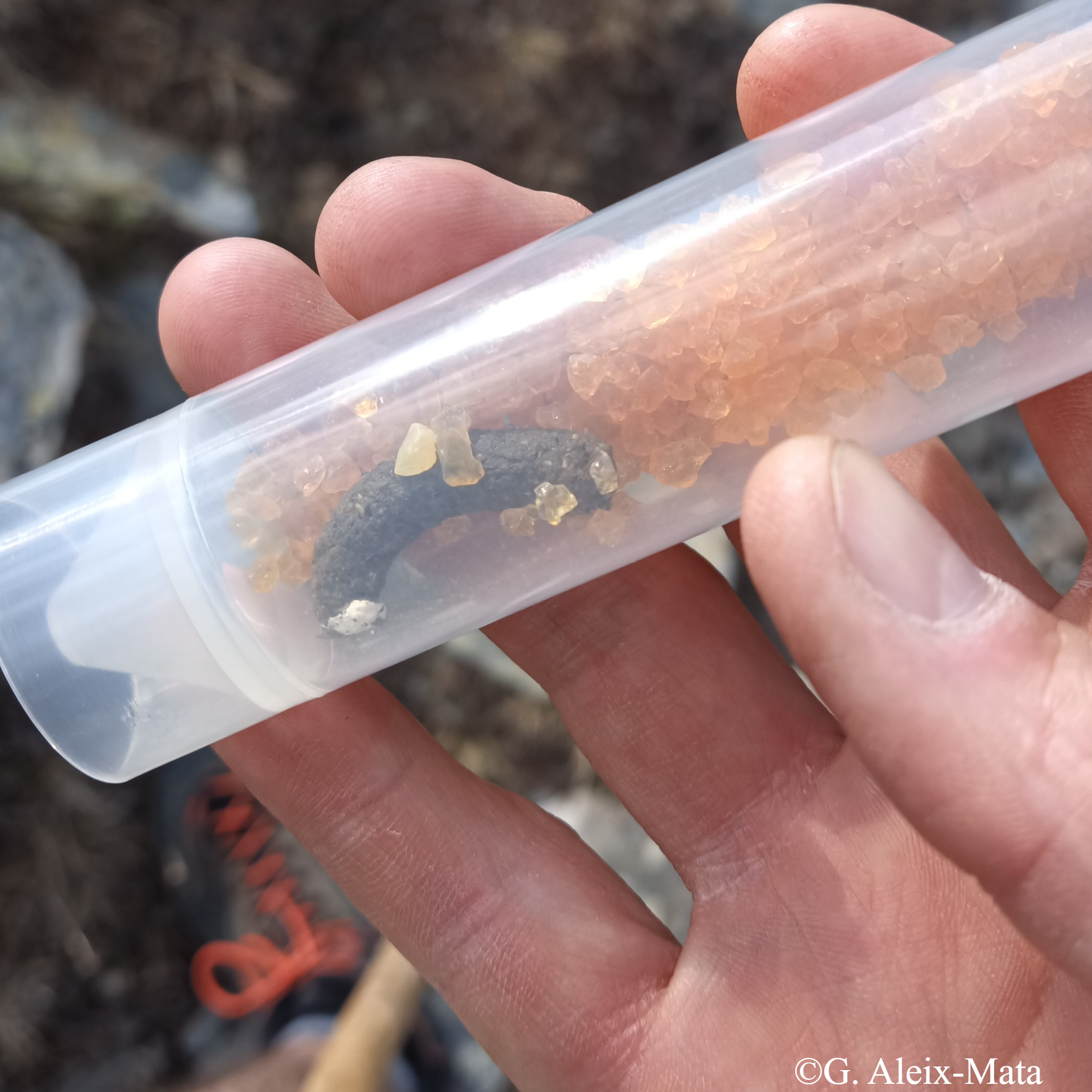
Rock ptarmigan feces directly stored in a tube with silica gel.
To avoid freeze/thaw cycles, it is strongly recommended that samples are placed in a cooler or isothermal bag as soon as they are collected, and stored at -20°C as soon as possible. If it is not possible to take a cooler into the field, samples should be stored at 4°C. Once the temperature of the sample has been lowered, it should not be raised any further.
Although it can be used for particularly wet samples, drying on absorbent paper (2-3 days after returning from collection) is not recommended. The use of paper envelopes to store samples is definitely not recommended. They need to be stored at room temperature, and great care must be taken to avoid the risk of rotting.
Note
Before deciding on the method of sample preservation to be used, it is imperative to check with the laboratory that will be carrying out the molecular analyses. The molecular analysis protocol depends directly on the sample storage method.
Collection protocol
Note
Only after defining the collection period and site(s), the prospection method, the selection criteria and the sample storage method, is it possible to collect the samples in the field.
Collection should be carried out when the weather has been cold and dry for several days. Collecting should be avoided in the days following precipitation (rain) or in wet weather.
Take care not to disturb the birds in their activities. It's important to opt for times when there are no birds in the collection site, or when any disturbance is not a problem. We recommend avoiding the afternoon before sunset.
In the field: (the equipment required for each step is specified in brackets)
1. Switch on GPS (GPS plotter, tablet, map)
2. Closely follow the transect (GPS, tablet, map), otherwise report any deviation from the transect (flags, GPS, tablet)
3. Locate feces that meet the selection criteria (with or without binoculars)
4. Put on gloves (disposable sterile gloves)
Gloves are used to avoid contamination with human DNA. However, they do not protect against contamination by the last elements handled. If gloves come into contact with feces, they absolutely must be changed.
5. Collect feces in a tube using a twig (sterile tube with silica gel)
A tube should contain only one feces and a small amount of silica gel (or pure ethanol).
A twig near the sample can be used to draw feces into the tube.
The lid of the tube can also be used, but care must be taken to avoid contamination.
6. Destroy the twig
The twig must be changed for each sample.
The use of materials other than twigs (e.g. clamps) is not recommended, as they require rigorous cleaning (bleach).
Example of twigs (circled in green) that can be used to insert feces into a collection tube.
7. Destroy uncollected feces, to avoid collecting the same sample several times.
8. Note the sample number on the tube (marker)
9. Complete the collection sheet (pencil + paper or digital collection sheet)
It is strongly recommended that steps 8 and 9 are completed before proceeding to the next step.
10. Store sample cold (backpack, cooler)
11. Move to next feces to be collected (GPS, map, tablet), and follow the protocol from the second step.
As soon as possible after field work, store samples in a cold, moisture-free laboratory.
Complete the metadata
Complete the metadata
Metadata recording is very important to ensure the repeatability of collections and the most accurate interpretation of results. It is therefore recommended that metadata be entered exhaustively as soon as a sample is collected. We recommend that all information and precisions be mandatory.
We also recommend setting up a nomenclature for each metadata element, and adhering to it so that each collector enters the same information.
The information to be entered is as follows:
- Sample number
- Collector's name
- Date and time of collection
- Name of collection site
- Locality: name of location and commune
- GPS coordinates of sample
- Nature of sample: feces / other (specify)
- Several samples taken from the same dropping: no / yes. If yes, specify sample number(s) from the same dropping.
- Proximity to one or more other samples (<30 m): no / yes. If yes, specify sample number(s) and distance between two samples.
- Substrate: snow / vegetation / rock / other (specify)
- Condition of sample:
Color: green / brown / gray / other (specify)
Presence of uric acid (white tip): yes / no
Dry / wet / other (specify)
- Transport condition (in the field):
Cooler / backpack (room temperature) / other (specify)
Tube with silica gel / empty tube / tube with ethanol (specify %) / envelope / other (specify)
- Storage condition (in laboratory):
Drying : no / yes (specify)
Tube with silica gel / empty tube / tube with ethanol (specify %) / envelope / other (specify)
Temperature: -20 °C / 4 °C / other (specify)
- Species: Rock Ptarmigan / Hazel Grouse / Black Grouse / Western Capercaillie / other (specify) / doubt (specify). Metadata to be entered only if the collector is trained and experienced.
GPS tracks acquired by collectors during surveys are also important metadata to record. In this way, collectors can specify the start and end times of surveys, the survey route, the distance covered, etc.
Molecular analysis
DNA extraction
Note
By consulting the molecular analysis laboratory, it will be possible to find the protocols best suited to the nature of the samples (feces) and the objectives of the study.
Note
It is obvious that all risks of contamination must be avoided at every stage of molecular analysis. Here is a non-exhaustive list of tips to avoid contamination: perform DNA extraction in a different room from the PCR room; use negative/positive controls; use pipettes with filters; change gloves regularly; label all tubes at each stage; open tubes without touching the lid or inner rim, otherwise change gloves (very important if the lid has been used to put feces into the tube during collection); do not pass pipettes over samples or tubes; clean bench and equipment before and after handling.
It is recommended to extract DNA from feces as soon as possible after collection. The shorter this time, the less stringent storage conditions will be.
It is also advisable to remove or avoid collecting any parts of the feces that are covered with uric acid (white coloration).
There is a consensus on using the QIAamp‱ DNA Stool Mini Kit from Qiagen. It is even recommended to use its newer version, the QIAamp‱ Fast DNA Stool Mini Kit (Qiagen). This kit is ideally suited for DNA extraction from fecal samples stored at -20°C or 4°C. This protocol has also proven very effective in removing PCR inhibitors thanks to its InhibitEX‱ Buffer, and is effectiveness (higher DNA concentrations).
Several recommendations from the supplier should be noted:
- “If the sample is frozen, use a scalpel or spatula to scrape bits of stool into a 2 ml microcentrifuge tube on ice.” To do this, make sure that the equipment used is sterile and/or cleaned between each use (bleach).
- “When using frozen stool samples, take care that the samples do not thaw until InhibitEX Buffer is added in step 2 to lyse the sample; otherwise the DNA in the sample may degrade.”
- “This protocol is optimized for use with 180–220 mg stool but can also be used with smaller amounts. There is no need to reduce the amounts of buffers when using smaller amounts of stool. For samples >220 mg, see “Protocol: Isolation of DNA from Larger Volumes of Stool”.”
We recommend using the protocol as proposed by the supplier. Any changes should be tested on a portion of the samples before being applied to the entire sample.
However, we have seen that it is possible to improve the protocol for samples stored in silica gel. These are very hard and dry samples that are difficult for the buffer to dilute.
Our recommendations are as follows:
- Place one half of a whole feces, depending its size, in a sterile test tube.
- Add 1,5 mL InhibitEX Buffer to each sample.
- Toss with a sterile wand to obtain a homogeneous viscous solution.
- Add a sterile bead of the same diameter as the tube. This pushes the solids to the bottom of the tube.
- Centrifuge until no particles remain in the supernatant.
- Follow the QIAamp‱ Fast DNA Stool Mini Kit protocol from step 3 (Centrifuge sample).
DNA extraction protocol modified from QIAamp Fast DNA Stool
Mini Handbook.
Molecular analysis
There are many possible molecular analyses based on fecal DNA (mitochondrial and nuclear sequencing, genotyping of microsatellite markers, high-throughput sequencing, etc.). We make some recommendations for studies that would involve genotyping of microsatellite markers, to date the most used method. Although high-throughput sequencing from feces is becoming more widely used, it still requires much development before we can make any general recommendations.
As a first step, we recommend assessing the quality of the DNA. To do this, it is possible to (1) measure the DNA concentrations and remove the lowest samples, (2) possibly attempt a second extraction, (3) and/or perform a test amplification on one marker and remove the samples without amplification.
Secondly, we recommend verifying the species identity of each sample using molecular barcoding. Indeed, amplification of mitochondrial genes, such as COI or the mtDNA control region, enables species identification.
Thirdly, we recommend amplifying all the markers only on usable samples. To do this:
- Use a multiplex approach.
- Use a multi-tube approach to genotype each locus and each sample three times. This allows for checking for genotyping errors. However, this approach is not necessary if the sample quality is very good (only fresh feces collected on snow, and the quality is assessed as very good). It is also possible to assess the quality of genotyping on a subset of samples.
- Choose markers whose amplification has already been validated for the target species. If possible, do not change the primers or original protocols. Any changes must be tested.
- Select short markers (<300 bp).
- Adapt the number of markers to the study scale. The more locally restricted the study, the greater the number of markers must be.
Protocol references
Aleix-Mata, G., Adrados, B., Boos, M., Marty, E., Mourieres, P., Tucat, G., Thion, N., Mossoll-Torres, M., Pérez, J. M., & Sánchez, A. (2019). Comparing methods for estimating the abundance of Western Capercaillie Tetrao urogallus males in Pyrenean leks: Singing counts versus genetic analysis of non-invasive samples. Bird Study, 66(4), 565–569. https://doi.org/10.1080/00063657.2020.1720594
Aleix‐Mata, G., López‐Montoya, A. J., Lapébie, P., Marty, E., Mourierres, P., Pérez, J. M., & Sánchez, A. (2025). Improving population size estimation at western capercaillie leks: Lek counts versus genetic methods. Journal of Avian Biology, 2025(2), e03176. https://doi.org/10.1111/jav.03176
Aleix-Mata, G., Pérez, J. M., Adrados, B., Boos, M., Marty, E., Mourieres, P., Lauer, E., Zimmermann, S., Mossoll-Torres, M., & Sánchez, A. (2020). Sex Ratio of Alpine and Pyrenean Rock Ptarmigans Lagopus muta Estimated by a Non-Invasive Method (Faecal DNA Analysis) and from Hunting Bag Data. Ardeola, 68(1), 193–204. https://doi.org/10.13157/arla.68.1.2021.sc1
Bergan, F., Sæbø, M., & Parker, H. (2016). Evaluation of in-field stability of mitochondrial and nuclear DNA in snow sampled fecal pellets from Rock ptarmigan (Lagopus muta). Oecologia Montana, 25(1), Article 1.
Costanzi, J.-M., Bergan, F., Sæbø, M., Jenkins, A., & Steifetten, Ø. (2018). Development and evaluation of 16 new microsatellite loci for the rock ptarmigan (Lagopus muta) and cross-species amplification for the willow grouse (L. lagopus). BMC Research Notes, 11(1), 147. https://doi.org/10.1186/s13104-018-3249-1
Costanzi, J.-M., & Steifetten, Ø. (2019). Island biogeography theory explains the genetic diversity of a fragmented rock ptarmigan (Lagopus muta) population. Ecology and Evolution, 9(7), 3837–3849. https://doi.org/10.1002/ece3.5007
Haider, M., Skubski, M., Lentner, R., Schlick-Steiner, B. C., & Steiner, F. M. (2025). Efficiency in conservation: Comparable genetic and population data from one and two non-invasive sampling rounds in Tetrao urogallus (Western Capercaillie). Ornithological Applications, duaf031. https://doi.org/10.1093/ornithapp/duaf031
Haider, M., Steixner, R., Zeni, T., Vallant, S., Lentner, R., Schlick-Steiner, B., & Steiner, F. (2023). The influence of sample size on two approaches to estimate Black Grouse (Lyrurus tetrix) population size using non‐invasive sampling methods. Ibis, 166. https://doi.org/10.1111/ibi.13229
Jacob, G., Debrunner, R., Gugerli, F., Schmid, B., & Bollmann, K. (2010). Field surveys of capercaillie (Tetrao urogallus) in the Swiss Alps underestimated local abundance of the species as revealed by genetic analyses of non-invasive samples. Conservation Genetics, 11(1), 33–44. https://doi.org/10.1007/s10592-008-9794-8
Lampa, S., Henle, K., Klenke, R., Hoehn, M., & Gruber, B. (2013). How to overcome genotyping errors in non-invasive genetic mark-recapture population size estimation—A review of available methods illustrated by a case study. The Journal of Wildlife Management, 77(8), 1490–1511. https://doi.org/10.1002/jwmg.604
Lundberg, R. H. (2014). Is non-invasive sampling of faecal pellets a reliable method to estimate rock ptarmigan (Lagopus muta) population density? [Master thesis, Høgskolen i Telemark]. https://openarchive.usn.no/usn-xmlui/handle/11250/2438931
Navidi, W., Arnheim, N., & Waterman, M. S. (1992). A multiple-tubes approach for accurate genotyping of very small DNA samples by using PCR: Statistical considerations. American Journal of Human Genetics, 50(2), 347–359.
Pérez, T., Vázquez, J. F., Quirós, F., & Domínguez, A. (2011). Improving non-invasive genotyping in capercaillie (Tetrao urogallus): Redesigning sexing and microsatellite primers to increase efficiency on faeces samples. Conservation Genetics Resources, 3(3), 483–487. https://doi.org/10.1007/s12686-011-9385-8
Regnaut, S., Lucas, F. S., & Fumagalli, L. (2006). DNA degradation in avian faecal samples and feasibility of non-invasive genetic studies of threatened capercaillie populations. Conservation Genetics, 7(3), 449–453. https://doi.org/10.1007/s10592-005-9023-7
Riauba, G., & Butkauskas, D. (2012). Investigation into genetic variability of Hazel Grouse Bonasa bonasia (=Tetrastes bonasia) population in Lithuania using non-invasive sampling. Zoology and Ecology, 22(3–4), 150–159. https://doi.org/10.1080/21658005.2012.744868
Rutkowski, R., Jagołkowska, P., Zawadzka, D., & Bogdanowicz, W. (2016). Impacts of forest fragmentation and post-glacial colonization on the distribution of genetic diversity in the Polish population of the hazel grouse Terastes bonasia. European Journal of Wildlife Research, 62(3), 293–306. https://doi.org/10.1007/s10344-016-1002-4
Rutkowski, R., Keller, M., & Jagołkowska, P. (2012). Population genetics of the hazel hen Bonasa bonasia in Poland assessed with non-invasive samples. Central European Journal of Biology, 7(4), 759–775. https://doi.org/10.2478/s11535-012-0051-2
Scridel, D., Tenan, S., Brambilla, M., Celva, R., Forti, A., Fracasso, I., Volcan, G., Dorigatti, E., Anderle, M., Marchesini, A., Crestanello, B., Vernesi, C., Pedrini, P., & Partel, P. (2022). Early-succession secondary forests following agropastoral abandonment are key winter habitats for the conservation of a priority bird in the European Alps. European Journal of Forest Research, 141(6), 1029–1043. https://doi.org/10.1007/s10342-022-01485-1
Segelbacher, G., & Steinbruck, G. (2001). Bird faeces for sex identification and microsatellite analysis. Vogelwarte, 41(2), 139–142.
Sittenthaler, M., Kunz, F., Szymusik, A., Grünschachner-Berger, V., Krumböck, S., Stauffer, C., & Nopp-Mayr, U. (2018). Fine-scale genetic structure in an eastern Alpine black grouse Tetrao tetrix metapopulation. Journal of Avian Biology, 49(5), jav-01681. https://doi.org/10.1111/jav.01681
Taberlet, P., Griffin, S., Goossens, B., Questiau, S., Manceau, V., Escaravage, N., Waits, L. P., & Bouvet, J. (1996). Reliable Genotyping of Samples with Very Low DNA Quantities Using PCR. Nucleic Acids Research, 24(16), 3189–3194. https://doi.org/10.1093/nar/24.16.3189
Taberlet, P., Waits, L. P., & Luikart, G. (1999). Noninvasive genetic sampling: Look before you leap. Trends in Ecology & Evolution, 14(8), 323–327. https://doi.org/10.1016/s0169-5347(99)01637-7
Vallant, S., Niederstätter, H., Berger, B., Lentner, R., & Parson, W. (2018). Increased DNA typing success for feces and feathers of capercaillie (Tetrao urogallus) and black grouse (Tetrao tetrix). Ecology and Evolution, 8(8), 3941–3951. https://doi.org/10.1002/ece3.3951
Acknowledgements
We thank the departmental hunting federations of Isère, Savoie and Haute Savoie, represented by Estelle Lauer, Sébastien Zimmerman, Philippe Auliac and Pascal Roche, and the regional hunting federation of Auvergne Rhône Alpes, represented by Marc Chautan, for their collaboration and expertise in monitoring mountain Galliformes.