May 06, 2026
Version 2
GIFT-seq: Gapfill and Library Preparation Protocol V.2
- Nabih Maslah1,2,
- Karolis Kumpaitis1,
- Catherine Snopkowski1,
- Sydney B. Blattman1,
- Austin A. Varela1,
- Ronan Chaligné1,
- Caleb Lareau1
- 1Computational and Systems Biology Program, Sloan Kettering Institute, Memorial Sloan Kettering Cancer Center, New York, NY;
- 2INSERM UMR 1342, Université Paris Cité, Assistance publique des Hôpitaux de Paris (APHP), Hôpital Saint-Louis, Paris, France



Protocol Citation: Nabih Maslah, Karolis Kumpaitis, Catherine Snopkowski, Sydney B. Blattman, Austin A. Varela, Ronan Chaligné, Caleb Lareau 2026. GIFT-seq: Gapfill and Library Preparation Protocol. protocols.io https://dx.doi.org/10.17504/protocols.io.4r3l2zm3jl1y/v2Version created by Karolis Kumpaitis
Manuscript citation:
Blattman, S. B. et al. Scalable genotyping in fixed transcriptomes resolves clonal heterogeneity via single-cell sequencing. bioRxiv (2026) doi: https://doi.org/10.64898/2026.04.11.717967
License: This is an open access protocol distributed under the terms of the Creative Commons Attribution License, which permits unrestricted use, distribution, and reproduction in any medium, provided the original author and source are credited
Protocol status: Working
We use this protocol and it's working
Created: May 02, 2026
Last Modified: May 06, 2026
Protocol Integer ID: 316165
Keywords: GIFT-seq, Nuclei, Cell, FFPE, Enrichment, Single-cell, Probe based assay, Gapfill, Genotyping, Flex assay, Probe hybridization, 10x Genomics, Flex, JAK2, Myeloproliferative neoplasm, 10x genomic, nuclei for gem, nuclei preparation, tissue derived nuclei, fixation of cell, seq, fixed cell, derived nuclei, gapfill, library preparation protocol this protocol, nuclei, library preparation protocol, sample preparation, ffpe sample, cell
Disclaimer
DISCLAIMER – FOR INFORMATIONAL PURPOSES ONLY; USE AT YOUR OWN RISK
The protocol content here is for informational purposes only and does not constitute legal, medical, clinical, or safety advice, or otherwise; content added to protocols.io is not peer reviewed and may not have undergone a formal approval of any kind. Information presented in this protocol should not substitute for independent professional judgment, advice, diagnosis, or treatment. Any action you take or refrain from taking using or relying upon the information presented here is strictly at your own risk. You agree that neither the Company nor any of the authors, contributors, administrators, or anyone else associated with protocols.io, can be held responsible for your use of the information contained in or linked to this protocol or any of our Sites/Apps and Services.
Abstract
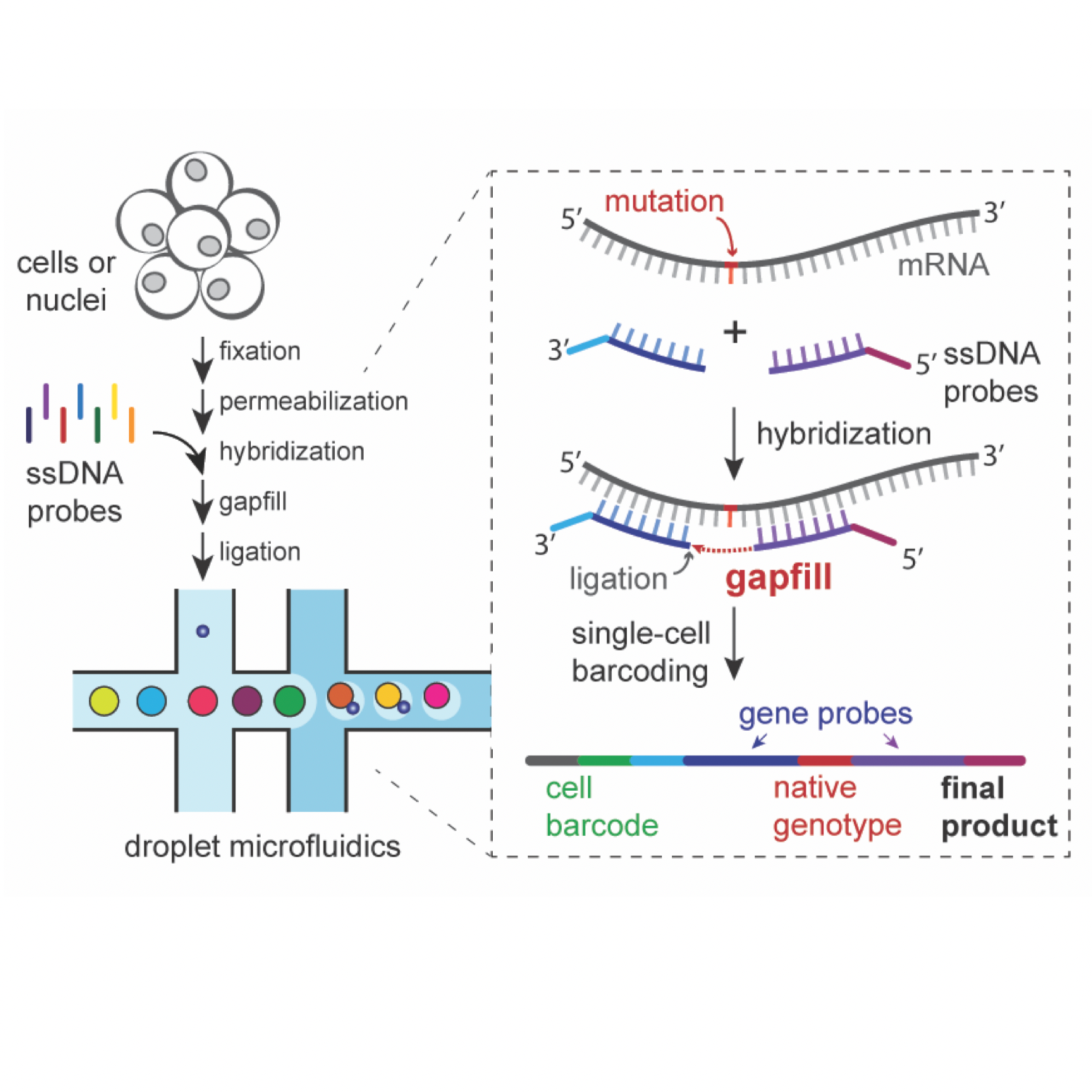
This protocol is intended for performing GIFT-seq on fixed cells and tissue-derived nuclei.
Sample preparation and fixation must be completed in advance according to the 10x Genomics "Fixation of Cells & Nuclei for GEM-X Flex Gene Expression" (CG000782 | Rev D) or other guidelines for the relevant sample type. For FFPE samples "GIFT-seq: Nuclei preparation" protocol can be followed.
Version 2 corrects minor typos.
Guidelines
- Maintain an RNAse free environment when preparing buffers and throughout the protocol by spraying bench with RNaseZap™ and using molecular grade reagents when possible.
- To increase cell recovery, opt for a swinging bucket rotor when pelleting and leave a 10-30 µL of liquid behind when aspirating buffers.
- When possible, use low-binding plasticware.
Materials
- Betaine solution (5M) (Sigma-Aldrich SKU# B0300-5VL)
- ThermoPol Reaction Buffer (10X) (New England Biolabs Cat# B9004S)
- Sulfolobus DNA Polymerase IV (2,000 units/mL) (New England Biolabs Cat# M0327S)
- Isothermal Amplification Buffer II Pack (10X) (New England Biolabs Cat# B0374S)
- T4 DNA Ligase Reaction Buffer (10X) (New England Biolabs Cat# B0202S)
- T4 DNA Ligase (2,000,000 units/mL) (New England Biolabs Cat# M0202M)
- Deoxynucleotide (dNTP) solution mix (10 mM) (New England Biolabs Cat# N0447S)
- SPRIselect DNA Size Selection Reagent (Beckman Coulter Cat# B23318)
Protocol materials
1 Liter IDTE pH 8.0 (1X TE Solution)Integrated DNA Technologies, Inc. (IDT)Catalog #11-05-01-09
Protector RNase InhibitorMerck MilliporeSigma (Sigma-Aldrich)Catalog #3335402001
Buffer EBQiagenCatalog #19086
Before start
Our research complies with all relevant ethical and regulatory guidance. Recruitment of patients was approved
under IDRCB 2023-A01414-41. Patient samples analyzed in this study were fully de-identified prior to transfer
and analysis. The use of these specimens for the present work was reviewed and determined to be exempt
from human subjects research by the Institutional Review Board of Memorial Sloan Kettering Cancer Center.
GIFT-seq probe design
See GitHub repository https://github.com/clareaulab/probeset_design_pipeline for probes design and guidelines.
Gapfill probe sequences
LHS Probe:
5'-GTGACTGGAGTTCAGACGTGTGCTCTTCCGATCT-25N-3'
- TruSeq Read 2 handle (For PCR enrichment and indexing)
- mRNA targeting sequence (25N)
RHS Probe:
/5Phos/-25N-ACGCGGTTAGCACGTA-NN-8N-CGGTCCTAGCAA-3'
- mRNA targeting sequence (25N)
- Constant Sequence
- Probe barcode 8 bases long
- Partial capture sequence 1
- Truncated version:
/5Phos/-25N-8N-CGGTCCTAGCAA-3'
Probe preparation for addition to probe hybridization.
If using individual oligos ordered in tubes:
- Resuspend all oligos to 100 µM in IDTE pH 8.1 Liter IDTE pH 8.0 (1X TE Solution)Integrated DNA Technologies, Inc. (IDT)Catalog #11-05-01-09
- Create an intermediate pool at 3200 nM per probe.
If using oPools:
- Resuspend each 50 pmol scale oPool in 31.25 µL for 1600 nanomolar (nM) per probe .
Primers required:
Forward primer - TruSeq Read 1: 5'-CTACACGACGCTCTTCCGATCT-3'
Reverse primer - TruSeq Read 2: 5'-GTGACTGGAGTTCAGACGTGTG-3'
- Standard desalting (HPLC purification isn't required)
- Should be supplied in IDTE (or low EDTA TE Buffer)
Introduction
The 10x Genomics GEM-X Flex Gene Expression Reagent Kits User Guide (CG000786, CG000787, CG000788, CG0007889) is performed according to the standard workflow and manufacturer’s instructions.
For GIFT-seq / Gapfill reaction, additional necessary steps are outlined below.
Probe Hybridization
30m
Thaw and keep spike-in / custom probes On ice .
Combine probe panels or individual probes to probe working concentration of 533.3 nanomolar (nM) per probe .
Important: Probe working solutions should be prepared fresh (Same day).
30m
During step 1 of"Probe Hybridization" (see one of 10x Genomics GEM-X Flex Gene Expression User Guides) add desired custom probes (at working concentration): 3 µL if doing GEM-X V1 for a final concentration of 32 nanomolar (nM) per probe .
Incubate for 16-24 hours at 42 °C in a thermal cycler or a thermometer with heated lid and no shaking (per protocol instructions).
Gapfill Reaction
1h
On day 2, Gapfill is performed after the post-hybridization (Post-Hyb) washes and before encapsulation.
Optional. For FFPE samples do one more Post-Hyb wash.
Prepare and keep Post-Hyb Resuspension Buffer B On ice , from 10x Genomics User Guide except supplemented by RNase Inhibitor.
Regardless of 10x Genomics Flex protocol, prepare as follows for:
- 1 sample: Water 475 µL + conc. Post-Hyb buffer B 25 µL + RNase Inhibitor 2.5 µL (Final conc. 0.2 U/µL)
- 2 samples: Water 950 µL + conc. Post-Hyb buffer B 50 µL + RNase Inhibitor 5 µL (Final conc. 0.2 U/µL)
- 4 samples: Water 1900 µL + conc. Post-Hyb buffer B 100 µL + RNase Inhibitor 10 µL (Final conc. 0.2 U/µL)
While performing washes, start preparing buffers for the Gapfill reaction:
Buffer should be prepared On ice .
All components should be completely thawed and no precipitates should be visible.
| A | B | C | D | E | F | |
| Reagent | Cat. No. | Final Conc. in Gapfill reaction | 1X + 10% | 2X + 10% | 4X + 10% | |
| Water, nuclease-free | -- | -- | 62.71 | 125.42 | 250.84 | |
| Betaine | B0300 | 1M | 22 | 44 | 88 | |
| 10X Thermopol Buffer | B9004S | 0.5X | 5.5 | 11 | 22 | |
| 10X Isothermal Amplification Buffer II | B0374S | 0.5X | 5.5 | 11 | 22 | |
| 10X T4 DNA Ligase Buffer | B0202S | 0.05X | 0.55 | 1.1 | 2.2 | |
| Deoxynucleotide (dNTP) Solution Mix | N0447S/N0447L | 50 µM | 0.55 | 1.1 | 2.2 | |
| Total, µL: | 96.81 | 193.6 | 387.2 | |||
Gapfill Buffer Mix
10m
Gapfill Reaction Mix should be prepare On ice .
| A | B | C | D | E | F | |
| Reagent | Cat. No. | Final Conc. | 1X + 10% | 2X + 10% | 4X + 10% | |
| Gapfill Buffer (from step 9) | -- | -- | 96.8 | 193.6 | 387.2 | |
| Sulfolobus DNA Polymerase IV | M0327S | 0.07 units/µL | 3.85 | 7.7 | 15.4 | |
| T4 DNA Ligase | M0202T/M0202M | 150 units/µL | 8.25 | 16.5 | 33 | |
| RNase Inhibitor | 3335402001 | 0.4 U/µL | 1.1 | 2.2 | 4.4 | |
| Total, µL: | 110 | 220 | 440 | |||
Gapfill Reaction Mix
Protector RNase InhibitorMerck MilliporeSigma (Sigma-Aldrich)Catalog #3335402001
10m
When washes are completed, each sample should be resuspended in 250 µL of Post-Hyb Resuspension Buffer B (Step 8.1, similar to 10x Genomics protocol but with RNase Inhibitor).
Filter sample with 30 µm filter to new 1.5 mL Protein LoBind tube.
Equipment
Pre-Separation Filters (30 µm)
NAME
Sample Filter
TYPE
Miltenyi Biotec
BRAND
130-041-407
SKU
Determine cell concentration using available cell counter.
Aliquot between 100,000 - 120,000 cells into 0.5 or 1.5 mL Protein LoBind tube.
Note
Plates can be used instead if centrifuge with swinging bucket plate adaptor is available.
Do not exceed 120,000 cells per gap fill reaction. Otherwise perform multiple reactions.
Centrifuge 850 x g, 4°C, 00:05:00 .
5m
Remove the supernatant carefully without disturbing the pellet.
Resuspend pellet in 100 µL of Gapfill Reaction Mix (Step 10).
Transfer to PCR tubes or P96 plate if necessary.
Gapfill reaction is performed in a thermocycler with lid set at 37 °C:
- 25 °C 00:10:00 .
- 37 °C 00:20:00 .
- 4 °C Hold.
30m
When thermocycler reaction is finished, add 150 µL of Post-Hyb Resuspension Buffer B in each well.
Pipette mix 5x. Then transfer to 0.5 or 1.5 mL Protein LoBind tubes if necessary for subsequent steps.
Centrifuge 850 x g, 4°C, 00:05:00 .
5m
Remove 235 µL of the supernatant carefully without disturbing the pellet.
Resuspend pellet in 36.7 µL of Post-Hyb Resuspension Buffer B.
Cells / nuclei could be filtered again after Gapfill to avoid clumping and eventual clogging (Resuspend in 150 µL and filter through 30 µm filter).
Estimate cell / nuclei concentration with a cell counter and pool samples if necessary according to 10x Genomics recommendations.
Then proceed immediately to 10x Genomics Flex GEM encapsulation.
Pre-Amplification PCR
20m
Supplement Pre-Amp Mix with 50 µM TruSeq Read 2 Reverse primer 2.0 µL for 1X rxn or 8.8 µL for 4X + 10% for final conc. of 1 µM in Pre-Amp Mix + sample from step 4.1 of"Post-GEM Incubation - Recovery" (see one of 10x Genomics GEM-X Flex Gene Expression User Manuals).
Add 2 additional cycles to Pre-Amp reaction.
Note. Decrease cycle number for indexing PCR of WTA Library by 1-2 cycles to avoid overamplification.
20m
Continue with cleanup outlined in step 4.3 "DNA Cleanup - SPRIselect" (see one of 10x Genomics GEM-X Flex Gene Expression User Manuals).
Stopping point.
Store at 4 °C for =<72 h or -20 °C for =< 4 weeks .
Gapfill Feature PCR
40m
Prepare Gapfill PCR master mix On ice .
| A | B | C | D | E | F | G | |
| Reagent | Cat. No. | Final Conc. | 1X | 1X + 10% | 2X + 10% | 4X + 10% | |
| Amp Mix or Amp Mix C | 2000047 or 2001311 | -- | 50 | 55 | 110 | 220 | |
| Fwd primer: TruSeq Read 1 (100 µM stock) | -- | 1 µM | 1.0 | 1.1 | 2.2 | 4.4 | |
| Rev primer: TruSeq Read 2 (100 µM stock) | -- | 1 µM | 1.0 | 1.1 | 2.2 | 4.4 | |
| Water, nuclease-free | -- | -- | 28 | 30.8 | 61.6 | 123.2 | |
| Total, µL: | 80 | 88 | 176 | 352 | |||
Gapfill Feature PCR master mix
10m
Take 20 µL of clean pre-Amp product (Step 20) and mix it with 80 µL Gapfill Feature PCR master mix. Thoroughly pipette mix and briefly centrifuge.
Incubate in a thermal cycler with the following protocol.
| A | B | C | |
| Lid Temperature | Volume | Run Time | |
| 105 °C | 50 µL | ~30 min | |
| Step | Temperature | Time (mm:ss) | |
| 1 | 98 °C | 00:45 | |
| 2 | 98 °C | 00:20 | |
| 3 | 63 °C | 00:30 | |
| 4 | 72 °C | 01:00 | |
| 5 | Go to step 2, 9x (Total 10x) | ||
| 6 | 72 °C | 01:00 | |
| 7 | 4 °C | Hold | |
Gapfill Feature PCR thermal cycler protocol
30m
Continue to Gapfill Feature PCR cleanup.
Stopping point.
Store at 4 °C for =<72 h or -20 °C up to 1 week .
Post Gapfill Feature PCR Cleanup - SPRIselect
12m
Vortex to resuspend the SPRIselect reagent. Add 180 µL SPRIselect Reagent (1.8X) to each sample. Pipette mix 15x (Pipette set to 180 µL).
Incubate 00:05:00 Room temperature .
5m
Place on the magnet High until the solution clears.
Higher bead quantity takes longer to settle.
2m
Remove the supernatant. DO NOT discard any beads.
With the tube still in the magnet, add 300 µL 80% ethanol to the pellet.
Wait 30 sec. Remove the ethanol.
1m
With the tube still in the magnet, add 200 µL 80% ethanol to the pellet.
Wait 30 sec. Remove the ethanol.
1m
Centrifuge briefly and place on the magnet Low.
Remove any remaining ethanol. DO NOT let the sample dry to ensure maximum elution efficiency.
Remove from the magnet. Add 31 µL Buffer EB. Pipette mix 15x.
Buffer EBQiagenCatalog #19086
Incubate 00:02:00 Room temperature .
2m
Place on the magnet Low until the solution clears.
1m
Transfer 30.6 µL to a new tube strip.
Continue to Sample Index PCR - Gapfill library.
Stopping point.
Store at 4 °C for =< 72 h or -20 °C for =< 4 weeks .
Sample Index PCR - Gapfill Library
40m
Add 50 µL of Amp Mix (PN-2000047) or Amp Mix C (PN-2001311) to each clean Gapfill Library (Step 37). Use the whole volume of Gapfill Library.
Optional. After optimization less amount of Gapfill Feature PCR product can be used and leftovers may be stored at -20 °C for up to 4 weeks. In reaction add water to a total volume of 80 µL.
Add 20 µL of an individual Dual Index TT Set A (PN-300431) to each sample. Pipette mix 5x (pipette set to 90 µL). Centrifuge briefly.
Incubate in a thermal cycler with the same protocol as used for indexing the Flex Gene Expression library. Determine cycle number based on 10x Genomics User Guide.
| A | B | C | |
| Lid Temperature | Volume | Run Time | |
| 105 °C | 100 µL | ~25-40 min | |
| Step | Temperature | Time (mm:ss) | |
| 1 | 98 °C | 00:45 | |
| 2 | 98 °C | 00:20 | |
| 3 | 54 °C | 00:30 | |
| 4 | 72 °C | 00:20 | |
| 5 | Go to step 2, determine cycle number. | ||
| 6 | 72 °C | 01:00 | |
| 7 | 4 °C | Hold | |
Note. For whole transcriptome library reduce 1-2 cycles as pre-amp cycle number was increased.
40m
Continue to Post Sample Index PCR Cleanup.
Stopping point.
Store at 4 °C for =<72 h or -20 °C for =< 4 weeks .
Post Sample Index PCR Cleanup - SPRIselect
17m
Vortex to resuspend the SPRIselect reagent. Add 80 µL SPRI select Reagent (0.8X) to each sample. Pipette mix 15x (Pipette set to 180 µL).
Incubate 00:05:00 Room temperature .
5m
Place on the magnet High until the solution clears.
2m
Remove the supernatant. DO NOT discard any beads.
With the tube still in the magnet, add 200 µL 80% ethanol to the pellet.
Wait 30 sec. Remove the ethanol.
2m
Repeat step 46 for a total of 2 washes.
Centrifuge briefly and place on the magnet Low.
Remove any remaining ethanol. DO NOT let the sample dry to ensure maximum elution efficiency.
Remove from the magnet. Add 41 µL Buffer EB. Pipette mix 15x.
Buffer EBQiagenCatalog #19086
Incubate 00:02:00 Room temperature .
2m
Place on the magnet Low until the solution clears.
1m
Transfer 40.6 µL to a new tube strip.
Stopping point.
Store at 4 °C for =<72 h or -20 °C for =< 4 weeks for long-term storage.
Post Library Construction quality control. Run 1 µL sample at 1:20 dilution on an Agilent TapeStation High Sensitivity D1000 tape. Expected peak size 250-260.
5m
Sequencing
Sequencing can be done together with Flex WTA libraries.
Sequencing read lengths options:
- Read 1: 48, i7 index: 10, i5 index:10, Read 2: 50.
- Read 1: 28, i7 index: 10, i5 index:10, Read 2: 90.
Based on gap length used, Read 2 should be increased if full probe should be captured in first case or to capture probe barcode in second case.
Number of reads for Gapfill library can be estimated based on formula:
100 * num of probes * num of cells = required num of reads
PhiX used 9% but can be variable based on other libraries in the same pool.
Protocol references
1. Fixation of Cells & Nuclei for GEM-X Flex Gene Expression, 10x Genomics
2. GEM-X Flex Gene Expression Reagent Kits for Multiplexed Samples, 10x Genomics
3. GIFT-seq: Nuclei preparation