Oct 22, 2025
Fuzzy Cognitive Mapping as Tool to Understand Socio-Ecological Systems
- Dr. Elliot Convery-Fisher1,2,
- Dr. Adam Devenish2,3,
- Louisa Leach3
- 1School of GeoSciences, University of Edinburgh, UK;
- 2Tropical Diversity, Royal Botanic Garden Edinburgh, UK;
- 3Royal Botanic Gardens Kew, UK
- Fuzzy Cognitive Mapping Protocol



Protocol Citation: Dr. Elliot Convery-Fisher, Dr. Adam Devenish, Louisa Leach 2025. Fuzzy Cognitive Mapping as Tool to Understand Socio-Ecological Systems. protocols.io https://dx.doi.org/10.17504/protocols.io.q26g7n67qlwz/v1
Manuscript citation:
License: This is an open access protocol distributed under the terms of the Creative Commons Attribution License, which permits unrestricted use, distribution, and reproduction in any medium, provided the original author and source are credited
Protocol status: Working
We use this protocol and it's working
Created: October 13, 2025
Last Modified: October 22, 2025
Protocol Integer ID: 229679
Keywords: Fuzzy cognitive mapping, mental models, socio-ecological, fire, social science, informed strategies for sustainable fire management, ecological challenges of fire management planning, sustainable fire management, fire management, fire management planning, fuzzy cognitive mapping as tool, applying fuzzy cognitive mapping, complex dynamics of fire management, fuzzy cognitive mapping, drivers of wildfire, fcm to wildfire, issue of wildfire, wildfire, collective intelligence of stakeholder, stakeholder, different stakeholder, experiences of different stakeholder, cognitive map, participatory nature, responsibility among stakeholder, measuring stakeholder, occurrence of wildfire, participatory approach, ecological systems welcome to this guide, ecological systems welcome, participatory method, ecological system, ecological challenge, addressing complex socio, qualitative insight, collective knowledge of local, valuable tool in understanding, beauty of participatory method, collaborative approach, areas in madagasc
Funders Acknowledgements:
NERC E4 Doctoral Training Programme PhD studentship
Grant ID: NE/S007407/1
Albert Reckitt Award, Royal Geographical Society (with IBG)
UK International Development to RBG Kew as lead delivery partner through the Biodiverse Landscapes Fund project 'Achieving Sustainable Forest Management through Community Protected Areas in Madagascar'
Grant ID: ecm 62237
Disclaimer
DISCLAIMER – FOR INFORMATIONAL PURPOSES ONLY; USE AT YOUR OWN RISK
The protocol content here is for informational purposes only and does not constitute legal, medical, clinical, or safety advice, or otherwise; content added to protocols.io is not peer reviewed and may not have undergone a formal approval of any kind. Information presented in this protocol should not substitute for independent professional judgment, advice, diagnosis, or treatment. Any action you take or refrain from taking using or relying upon the information presented here is strictly at your own risk. You agree that neither the Company nor any of the authors, contributors, administrators, or anyone else associated with protocols.io, can be held responsible for your use of the information contained in or linked to this protocol or any of our Sites/Apps and Services.
Abstract
Welcome to this guide on applying fuzzy cognitive mapping (FCM), a valuable tool in understanding and addressing complex socio-ecological challenges. Here we focus on particularly the drivers of wildfires around protected areas in Madagascar as an example.
Why Fuzzy Cognitive Mapping?
Fuzzy Cognitive Mapping (FCM), our chosen method, is a participatory approach to
integrating the perspectives, knowledge, and experiences of different stakeholders into a visual framework, making the complex dynamics of fire management tangible and comprehensible. The beauty of participatory methods like FCM lies in their ability to foster a sense of ownership and shared responsibility among stakeholders. When people who live and work in the affected areas are involved, they become contributors and co-creators of solutions.
This collaborative approach is instrumental in addressing the socio-ecological challenges of fire management planning, ensuring that strategies are not only practical but also sustainable and sensitive to the unique context and needs of the region. The insights derived from these methods can shape comprehensive and context-specific solutions. In the following sections, we will delve deeper into how FCM's participatory nature can harness the collective intelligence of stakeholders, leading to innovative and informed strategies for sustainable fire management in Madagascar's protected areas.
The Power of FCM
FCM is a unique method because it allows us to integrate qualitative insights and quantitative data. This integration is vital when dealing with complex socio-ecological challenges. It's the bridge between what we know qualitatively, through discussions and local knowledge, and what we can measure quantitatively by measuring stakeholders' perceptions of the drivers of wildfire. It allows us to create models rooted in the wisdom of people closest to the problem while also being mathematically analysable. This versatility and adaptability are especially valuable when dealing with complex socio-ecological systems and can help us to compare our results across the different partners in the FMH project.
Applying FCM to Wildfires in Madagascar
In the context of Madagascar's protected areas and the pressing issue of wildfires, FCM is a natural fit. It empowers us to draw on the collective knowledge of locals, experts, and researchers to construct cognitive maps that display how various factors, like human behaviours, vegetation patterns and climate
conditions, contribute to the occurrence of wildfires. We chose FCM for its ability to provide a visual representation of these complex relationships.
Image Attribution
Author's own
Materials
Staff:
- One person to lead the focus group who is trained in qualitative social science methods and has some knowledge/experience of fire
- One person to support the lead trained in the method (by setting up focus groups). Preferably with previous experience in qualitative social science methods
- One community liaison who has been shown how the method works before starting the fieldwork
Time:
Each focus group takes 1-2 hours to complete (+ 30 minutes – 1 hour to set up)
For reference, in the Ambatofinandrahana district, the author’s team (once trained) were able to perform three focus groups daily.
Equipment:
- Prepare the following materials for each focus group. Have them organised and ready to transport before each session:
- At least 20-30 Post-it notes, or small slips of blank paper cut to a uniform size (e.g. 4x6 inches).
- two large sheets of paper (flipchart paper approximately 30x40 inches works well).
- Thick black markers (4-6) for primary mapping.
- Coloured markers (4-6) to denote relationships.
- Masking tape to affix paper sheets to walls/boards.
- 3-4 ballpoint pens for participants.
- Storage tube for transporting paper.
- Digital audio recorder with extra batteries (optional but recommended).
- Notebook for facilitator's detailed notes.
- Small context-appropriate gifts (e.g., food items, seeds, household goods, phone credits).
- Chairs and a table (optional).
Before start
A Note Before We Start
This guide is not a rigid set of rules but rather a flexible compass. Real-world challenges often require adaptation to local realities. So, consider this a guide as you navigate the complex landscape of understanding and addressing the drivers of wildfires in Madagascar.
Fuzzy Cognitive Mapping
This section guides (1) recruiting appropriate participants; (2) preparing necessary materials; and (3) the step-by-step procedure for conducting FCM-based focus groups to elucidate drivers of problematic wildfires.
Set-Up
Recruiting participants
Recruiting Principles
In this research, we wish to be careful about whom we talk to because we want to learn from people who understand this topic. During previous field trips, we’ve already identified some key stakeholders. These include:
- National & Regional Government Officials – for example, staff at MEDD, DREDD, Chef de Cantonmont des Eaux et Forest.
- Conservation Practitioners – for example, staff at KMCC, MBG, Durrell
- Community Leaders – Mayor, Deputy Mayor, President Fokontany, President VOI, VOI committee members, SHEVEK leaders
- Community farmers - non-VOI committee-associated herders[1]
- Community herders – non-VOI committee-associated herders
We will pick people from these groups who have the most knowledge and experience about the topic we are studying. This is a purposeful sampling method where participants are chosen because they possess specific knowledge, direct experience, insights and expertise relevant to the research context.
In reality, it is not always possible to talk to all the chosen participants due to time constraints. Selecting participants will be a balance between those whom we aim to speak to and those who are available at the time. This approach will allow for the rapid engagement of participants from each stakeholder group.
This combined approach helps to ensure that participants can contribute valuable insights into the Fuzzy
Cognitive Mapping (FCM) process, aligning to gain in-depth and meaningful perspectives while acknowledging the real-world constraints.
Recruitment in Practice
Plan to have at least four focus groups per sector, up to a maximum of 6. Each focus group should be between 4-6 to allow all participants to engage well in the discussion. Community liaisons should communicate the voluntary, confidential nature of discussions during recruitment. If appropriate, share study information sheets during recruitment so potential participants understand the purpose and nature of the research. For example, you may have:
- One or two focus groups with farmers not affiliated with village committees.
- One or two focus groups with herders not involved in the committees
- One or two focus groups with VOI members/leaders per sector.
In addition:
- One or two focus groups with commune leaders per commune or sector (chef fokontany, mayor, deputy mayor, committee presidents)
- One focus group with chef cantonnement officials per district.
- One focus group with DREDD officials per district.
These should be held as separate focus groups with different key stakeholder groups.
[1] Dividing community members into farmers and herders was suitable in Itremo because they had distinct views on fire. However, it may not apply to your context.
Before the Focus Group
Before the Discussion
- Engage with 1-2 well-networked community liaisons. These individuals help with community engagement, identifying/recruiting potential participants and help to build trust.
- When deciding on the logistics of the focus group, ensure it aligns with the participants' preferences, which may enhance their comfort and participation. Tip: it often works well indoors, early in the morning or late in the afternoon.
- Let people join or leave the discussion as they wish
Getting Started
- Set up the room with chairs and a table (if using), tape up large sheets of paper and test the audio recorder.
Introductions
- Introduce yourself, explain the research’s purpose and thank them for hospitality.
- Ask everyone to say their name, age, gender, and connection to the issue, understory and job.
- Note the location, date, time and duration, and the participants’ names, gender, age, and occupation.
Getting Permissions
- Use a consent form to share details about the study, its goals, its benefits and how you will use their information.
- Stress the importance of participant privacy and the confidentiality of their responses to create a safe space for open discussion.
- Request written or oral consent. Letting them know there's no money involved is not about reporting them.
Set the Ground Rules
- Encourage everyone to share; their views are vital. Remind them it's a safe space, and their details won't be shared.
- Answer any questions they have.
- Lighten things up with a fun activity if it fits.
- Start the audio recorder if they agree.
FCM process
Step-by-step
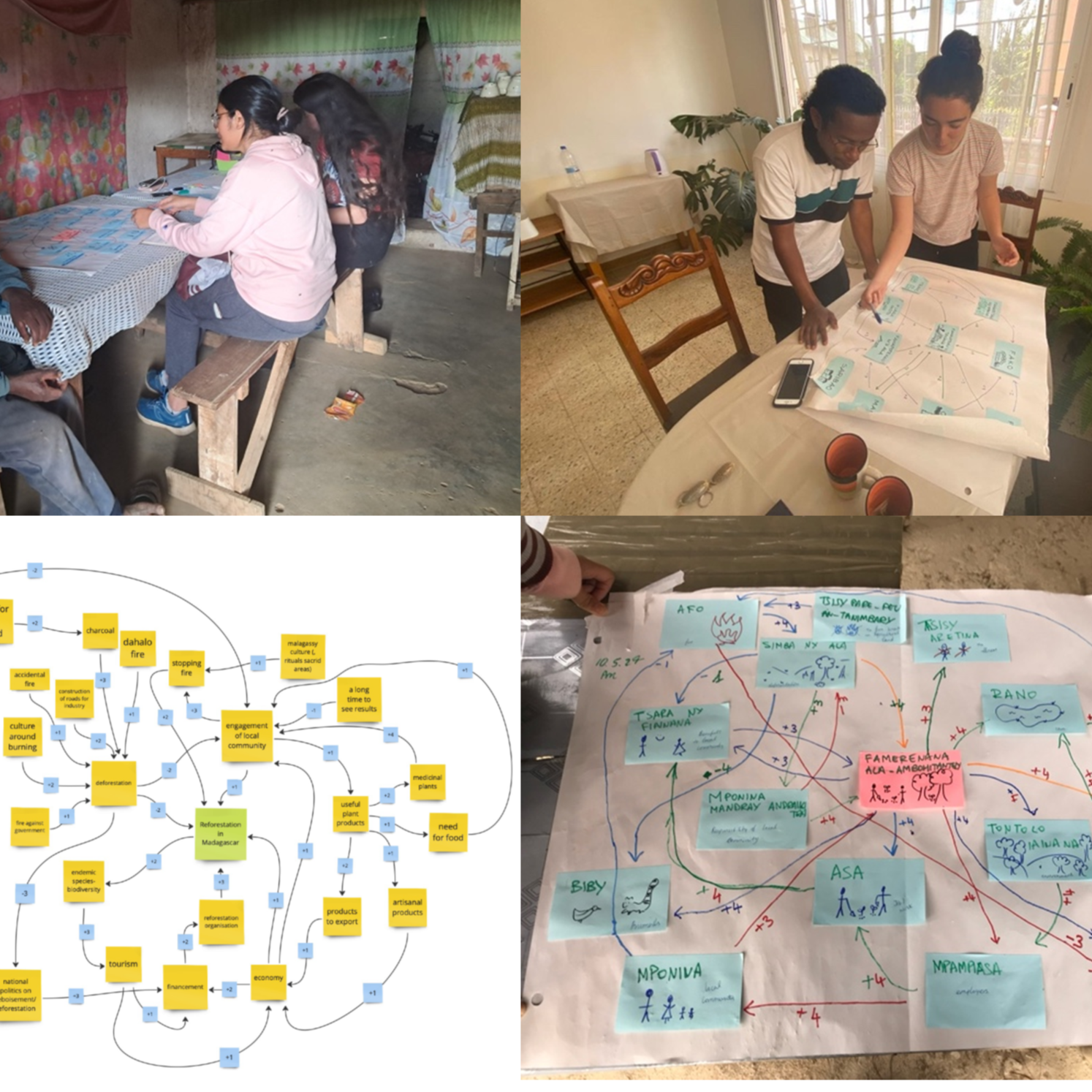
Explain the FCM process by showing the participants a hypothetical unrelated map (see
below). We asked participants if they wished or wanted us to write for
them.
Once they’ve understood the process, prompt participants with a topic to discuss, like "dorotanety" (landscape fires) and its causes.
Tip: I asked, “If I say dorotanety and its causes, what are the factors, things and variables that come to your mind?”
Note: "dorotanety" works for grasslands; choose terms that fit your context.
Write each idea on individual slips of paper.
List the factors on the left side of the paper. If it is unclear what a variable means, ask clarifying questions, but do not direct the participant to an answer.
Ask them to describe how the ideas are connected.
Draw the variables in the centre of the paper and draw lines between the variables to represent their relationships.
Label all lines with arrows to indicate their directions, with positive or negative signs
Use different coloured pens for these different stages
Use questions to dive deeper but do not prompt for specific answers.
- Why do you think X explains Y?
For example, if the participants think rainfall links to wildfire, ask them to explain that connection
- How does X explain Y?
For example, if the participants think elections connect to wildlife amount of fire, ask them to explain that connection.
- Why does X/Y happen?
For example, if a participant links grazing fires to wildfires, ask them why grazing fires happen.
- Are there any social reasons for X?
- Are there any economic reasons for X?
- Are there any environmental reasons for X?
- Are there any political reasons for X?
Rank the strength of each connection on a scale from 1 (weak) to 4 (very strong).
For example, if the participant thought that fire breaks decreased the amount of ‘problem’ fires substantially, they would draw a line with the arrow pointing from fire breaks to ‘problem’ fires and give the connection a value of -4.
Continue until the participants felt that their maps were complete and they had nothing more to add (see below), and the facilitators had no further questions
Giving Thanks
- Provide small context-specific gifts to thank participants for their time. This can include credit for phones or seeds.
- We provided two packets of seeds to each participant in the Ambatofinandrahana district.
- Be clear that gifts are only for workshop attendees.
- It might be appropriate to ask someone in your sector (and pay them) to cook your lunch, which you should bring. If suitable, you can also provide lunch for all workshop attendees.
Protocol references
Axelrod, R. (1976). Structure of Decision: The Cognitive Maps of Political Elites. Princeton University Press.
https://www.jstor.org/stable/j.ctt13x0vw3
Gray, S. A., Gray, S., Cox, L. J., & Henly-Shepard, S. (2013). Mental Modeler: A Fuzzy-Logic Cognitive Mapping
Modeling Tool for Adaptive Environmental Management. 2013 46th Hawaii International Conference on System Sciences, 965–973. https://doi.org/10.1109/HICSS.2013.399
Gray, S. A., Gray, S., De Kok, J. L., Helfgott, A. E. R., O’Dwyer, B., Jordan, R., & Nyaki, A. (2015). Using fuzzy cognitive
mapping as a participatory approach to analyze change, preferred states, and perceived resilience of social-ecological systems. Ecology and Society, 20(2), art11. https://doi.org/10.5751/ES-07396-200211
Hage, P., & Harary, F. (1984). Structural Models in Anthropology. Cambridge University Press. https://doi.org/10.1017/CBO9780511659843
Harary, F. (1965). Structural models: An introduction to the theory of directed graphs [by] Frank Harary, Robert Z.
Norman [and] Dorwin Cartwright. Wiley.
Kosko, B. (1986). Fuzzy cognitive maps. International Journal of Man-Machine Studies, 24(1), 65–75. https://doi.org/10.1016/S0020-7373(86)80040-2
Mourhir, A. (2021). Scoping review of the potentials of fuzzy cognitive maps as a modeling approach for integrated environmental assessment and management. Environmental Modelling & Software, 135, 104891. https://doi.org/10.1016/j.envsoft.2020.104891
Özesmi, U., & Özesmi, S. (2003). A Participatory Approach to Ecosystem Conservation: Fuzzy Cognitive Maps and Stakeholder Group Analysis in Uluabat Lake, Turkey. Environmental Management, 31(4), 518–531. https://doi.org/10.1007/s00267-002-2841-1
Özesmi, U., & Özesmi, S. L. (2004). Ecological models based on people’s knowledge: A multi-step fuzzy cognitive mapping approach. Ecological Modelling, 176(1–2), 43–64. https://doi.org/10.1016/j.ecolmodel.2003.10.027
Papageorgiou, E. I., & Salmeron, J. L. (2013). A Review of Fuzzy Cognitive Maps Research During the Last Decade. IEEE Transactions on Fuzzy Systems, 21(1), 66–79. https://doi.org/10.1109/TFUZZ.2012.2201727
Tebbutt, C. A., Devisscher, T., Obando‐Cabrera, L., Gutiérrez García, G. A., Meza Elizalde, M. C., Armenteras, D., & Oliveras Menor, I. (2021). Participatory mapping reveals socioeconomic drivers of forest fires in protected areas of the post‐conflict Colombian Amazon. People and Nature, 3(4), 811–826. https://doi.org/10.1002/pan3.10222