Dec 11, 2025
Fly Sampling Protocol
- Jan Gogarten1,
- Lorenzo Lagostina1,
- Cato Vangenechten2,
- Vincent Sluydts2,
- Lucinda Kirkpatrick3
- 1Helmholtz Institute for One Health Helmholtz-Centre for Infection Research (HZI);
- 2Universiteit Antwerpen;
- 3Bangor University



Protocol Citation: Jan Gogarten, Lorenzo Lagostina, Cato Vangenechten, Vincent Sluydts, Lucinda Kirkpatrick 2025. Fly Sampling Protocol. protocols.io https://dx.doi.org/10.17504/protocols.io.bp2l6dm6rvqe/v1
Manuscript citation:
License: This is an open access protocol distributed under the terms of the Creative Commons Attribution License, which permits unrestricted use, distribution, and reproduction in any medium, provided the original author and source are credited
Protocol status: Working
We use this protocol and it's working
Created: January 16, 2025
Last Modified: December 11, 2025
Protocol Integer ID: 118548
Keywords: eDNA, Biodiversity monitoring, Invertebrates, Vertebrate diversity, local vertebrate diversity through environmental dna, promising addition to the biodiversity assessment toolbox, vertebrate dna traces for downstream molecular analysis, impact monitoring of vertebrate community, vertebrate dna trace, biodiversity assessment toolbox, feeding fly, local vertebrate diversity, environmental dna, vertebrate community, fly, bait selection, use of fly, invertebrate, challenging ecosystem, rare species, downstream molecular analysis, guidelines for trap placement, vertebrate tissue
Funders Acknowledgements:
RESTOREID
Grant ID: 101134969
Abstract
In recent years, invertebrate-derived DNA (iDNA) has emerged as a powerful tool for non-invasive biodiversity monitoring. This protocol outlines a standardized method for the collection of flies to assess local vertebrate diversity through environmental DNA (eDNA) analysis. By exploiting the natural behavior of carrion- and dung-feeding flies, which interact closely with vertebrate tissues and excreta, we obtain vertebrate DNA traces for downstream molecular analysis. The protocol includes guidelines for trap placement, bait selection, fly handling, and preservation methods. This approach enables efficient, scalable, and low-impact monitoring of vertebrate communities, with particular relevance for remote or logistically challenging ecosystems. The use of fly-derived eDNA represents a promising addition to the biodiversity assessment toolbox, complementing traditional survey methods and enhancing the detection of elusive or rare species.
Guidelines
- Ensure that all equipment (e.g., traps, storage tubes, preservatives) is clean, labeled, and ready before entering the field.
- Sampling should be conducted during suitable weather conditions to avoid trap disruption or fly mortality due to extreme heat or rain.
- Use sterile tools and gloves when handling flies to avoid contamination, especially if used for eDNA or pathogen screening.
- Document metadata for each deployment, including date, time, GPS coordinates, habitat type, and weather conditions.
Materials
Required materials:
- Nets (e.g. mosquito netting or similar) to make pyramid traps. Make sure that the nets are not treated with insect repellents if using mosquito netting.
- Bait (e.g. prepared synthetic attractant, chicken or fish meat). If possible, try to avoid using synthetic bait and/or bait that could contain the DNA of species that naturally occur in the environment.
- Plastic container for holding the bait. Secure a piece of mesh over the container using a rubber band to prevent flies from entering.
- Ether, isoflurane, or 90% alcohol to euthanize the flies.
- Cotton
- Silica bags
- A 50mL Falcon tube to collect and euthanize the flies.
- 15mL or 50mL Falcon tubes to store the flies
- Bleach for sterilizing the pyramid traps, containers, and mesh covering.
- Gloves
- Tweezers
Safety warnings
- Wear appropriate field gear such as sturdy boots, gloves, and long-sleeved clothing to protect against rough terrain, sharp vegetation, and insect bites.
- Be cautious when setting traps in remote or wildlife-rich environments — avoid contact with wild animals and be aware of local hazards (e.g., snakes, ticks).
Ethics statement
- All fly sampling must comply with local and national regulations on invertebrate collection and biodiversity research.
- The method is non-invasive to vertebrates and aims to minimize environmental disturbance.
- If working in protected areas or on community lands, obtain and document prior informed consent from relevant stakeholders or landowners.
Before start
- Confirm local sampling permits and approvals are in place before fieldwork begins.
- Verify GPS coordinates and site access permissions for all sampling locations.
- Prepare all sample labels and metadata sheets in advance (include date, time, site ID, trap ID, etc.).
Making the fly trap
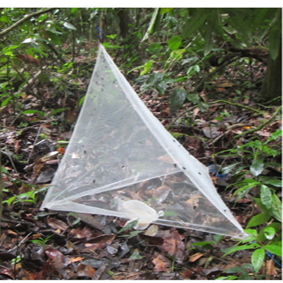
Cut three triangular pieces of netting with sides measuring approximately 50cm for tropical sites or 1m for temperate sites.
Sew the edges of the triangles together to form a pyramid structure, leaving the bottom open.
Option: Attach a small loop of sturdy fabric to each corner to allow for staking the trap to the ground or hanging it from a tree.
Label each trap with a unique ID.
Bait preparation:
Synthetic bait: Dissolve one bag of bait powder in 1L of water. If possible: leaving the mixture in direct sunlight for a few days (up to a week) increases the bait's attractiveness. The resulting strong odour will attract flies.
Real meat bait: Purchase the meat bait two or three days before fly trapping begins. Allow the meat to rot in a sealed container - this can be accelerated by exposing the container to sunlight, but the process will depend on local temperature conditions and the meat. Prepare one bait container for each trap. Do not use a species as bait meat that you might detect in that ecosystem.
Trapping procedure
30m
Trap placement:
Secure the top of the net to a branch of a small tree or bush.
Attach the loops at the corners of the net to sticks anchored in the ground, leaving approximately 5cm of space between the bottom of the net and the ground to allow flies to enter.
Position the bait container beneath the net. Cover the container with a small piece of mesh secured with a rubber band to prevent flies from accessing the bait directly.
You can deploy traps sequentially or in parallel - particularly if the goal is to maximize the number of flies collected.
Allow the trap to remain in place until at least 20 flies entered or 30 minutes have passed.
30m
Prepare a 50mL Falcon tube for euthanizing the flies:
Insert a piece of cotton into the tube.
Add a small amount fo ether, isoflurane, or 90% alcohol to the cotton.
While wearing gloves, guide the flies to the top of the net.
Use the open 50mL Falcon tube to collect flies by moving it beneath the net. The vapor from the ether, isoflurane, or 90% alcohol will render the flies unconscious or dead, causing them to fall into the tube.
Using sterile tweezers, transfer the collected flies into a 15mL or 50mL Falcon tube prefilled with silica gel and cotton for preservation.
Label the tube accordingly.
Post-trapping sterilization
12h
At the end of each trapping session, soak the trapping nets overnight in a bleach and water solution to sterilize them.
12h