Nov 26, 2025
Fluorescein Serial Dilution (1:2)荧光素梯度稀释

- Gao Yuan1
- 1University of Chinese Academy of Sciences
- Gao Yuan: SIAT student
- LabscriptAITech. support email: [email protected]



External link: https://github.com/KRATSZ/LabScript-AI
Protocol Citation: Gao Yuan 2025. Fluorescein Serial Dilution (1:2)荧光素梯度稀释. protocols.io https://dx.doi.org/10.17504/protocols.io.261gekzwwg47/v1
Manuscript citation:
Gao, Y., Luo, Y., Lan, Y., Jiang, H., Fu, L., & Si, T. (2025). Autonomous liquid-handling robotics scripting through large language models enables accessible and safe protein engineering workflows. bioRxiv, 2025-09.
License: This is an open access protocol distributed under the terms of the Creative Commons Attribution License, which permits unrestricted use, distribution, and reproduction in any medium, provided the original author and source are credited
Protocol status: Working
We use this protocol and it's working
Created: November 25, 2025
Last Modified: November 26, 2025
Protocol Integer ID: 233530
Keywords: Opentrons, Serial Dilution, Fluorescence, Calibration, Python Protocol, Laboratory Automation, 96-well plate, PBS, Fluorescein, Liquid Handling, fluorescein serial dilution, serial dilution of fluorescein, calibrating plate reader fluorescence, plate reader fluorescence, serial dilution, fluorescein, dilution series, smart pipetting, opentrons flex robot
Disclaimer
This protocol is for research use only and is not intended for diagnostic procedures. The author assumes no responsibility for any damage to equipment or loss of samples resulting from the use of this code. Users should verify the robot calibration and labware definitions before running the protocol with valuable reagents.
Abstract
This protocol performs an automated 1:2 serial dilution of fluorescein across columns 1–11 of a 96-well plate using the Opentrons Flex robot. It is designed for calibrating plate reader fluorescence.
- Flexibility: Supports 1–8 parallel replicates.
- Smart Pipetting: Automatically selects between 1-channel (for <8 samples) and 8-channel pipettes (for 8 samples).
- Outcome: Columns 1–11 contain the dilution series; Column 12 serves as a PBS blank.

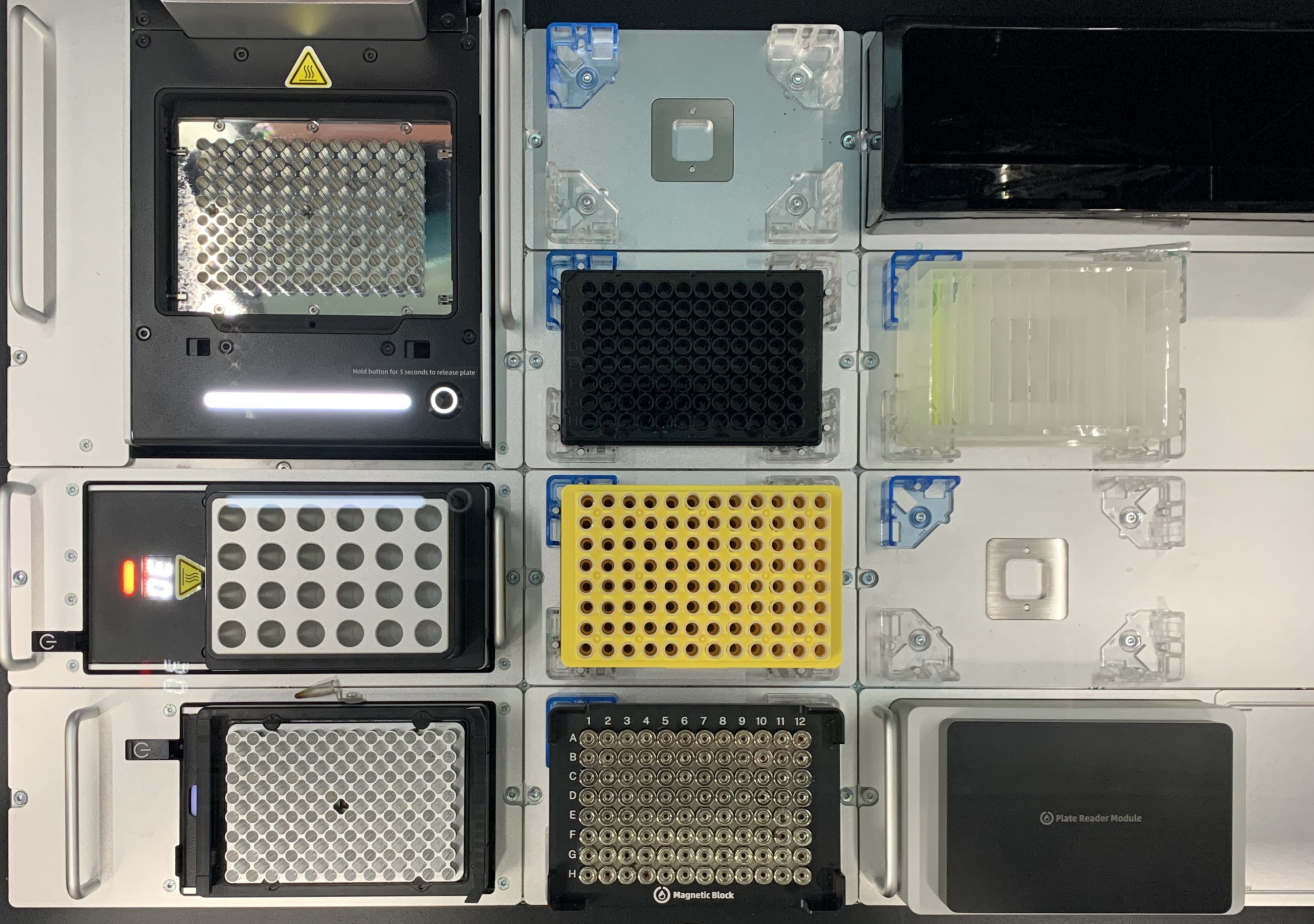

Image Attribution
All images and diagrams were created by the author.
Guidelines
- Labware Definitions: Ensure the labware placed on the deck exactly matches the definitions in the Python protocol (96_wellplate_360ul_flat and nest_12_reservoir_15ml). Using different labware dimensions may result in crashes or inaccurate pipetting.
- Pipette Calibration: Verify that the pipettes (Flex 1-channel and 8-channel) are calibrated and the deck calibration is up to date.
- Dead Volume: Always add slightly more reagent than calculated to account for the reservoir dead volume (recommend adding +500 µL extra).
- Tip Usage: The protocol assumes a full tip rack at the start. If using a partially used rack, ensure columns 1, 2, and the necessary columns for dilution are present.
Materials
Robot: Flex
- Pipettes: Left `flex1channel1000` (8 replicates), Right `flex8channel1000` (=8 replicates)
#### Deck Layout
| Position | Item | Role |
| --- | --- | --- |
| B2 | 96-well plate (Dilution Plate) | Serial dilution |
| B3 | 12-well reagent reservoir | Reagents (stock, diluent) |
| C2 | 200 µL tiprack | Tips |
| A3 | Trash bin | Liquid waste |
#### Reagents (Reservoir)
| Well | Reagent | Details |
| --- | --- | --- |
| A1 | Fluorescein 1X stock | Source for dilution series |
| A2 | PBS 1X | Diluent |
Safety warnings
- Light Sensitivity: Fluorescein is light-sensitive. Prolonged exposure to bright light can affect fluorescence readings. Analyze the plate immediately after the protocol finishes.
- Collision Risk: Do not place any tall labware in unused slots (A1, B1, D1, D2) that might interfere with the gantry movement.
- Liquid Waste: The protocol discards liquid into the trash bin. Ensure the bin liner is not leaking.
Ethics statement
This protocol involves standard chemical reagents and does not involve human subjects or animal experimentation. No ethical approval is required.
Before start
- Power On: Switch on the Opentrons Flex and connect via the Opentrons App.
- Trash Check: Ensure the Trash Bin in Slot A3 is empty and properly installed.
- Tip Loading: Place a full 200 µL tip rack in Slot C2.
- Plate Loading: Place a clean, empty Corning 96-well flat-bottom plate in Slot B2.
- Reagent Loading: Fill the NEST 12-well reservoir in Slot B3:
- Well A1: Add at least 2.5 mL of Fluorescein (1X Stock).
- Well A2: Add at least 12 mL of PBS (Diluent).
Lighting: If possible, dim the room lights or cover the reservoir to prevent photobleaching of the fluorescein before the run starts.
Abstract
This protocol performs an automated 1:2 serial dilution of fluorescein across columns 1–11 of a 96-well plate using the Opentrons Flex robot. It is designed for calibrating plate reader fluorescence.
- Flexibility: Supports 1–8 parallel replicates.
- Smart Pipetting: Automatically selects between 1-channel (for <8 samples) and 8-channel pipettes (for 8 samples).
- Outcome: Columns 1–11 contain the dilution series; Column 12 serves as a PBS blank.
Materials & Equipment
Reagents:
- Fluorescein (1X Stock Solution)
- PBS (Phosphate Buffered Saline, 1X)
Labware (Opentrons Definitions):
- Corning 96 Well Plate 360 µL Flat (corning_96_wellplate_360ul_flat)
- NEST 12 Well Reservoir 15 mL (nest_12_reservoir_15ml)
- Opentrons Flex 96 Tip Rack 200 µL (opentrons_flex_96_tiprack_200ul)
Equipment:
- Opentrons Flex Robot
- Flex 1-Channel Pipette 1000 µL (Mount: Left)
- Flex 8-Channel Pipette 1000 µL (Mount: Right)
Procedure
Section 1: Deck & Reagent Setup
Step 1: Deck Layout
Place the labware on the Opentrons Flex deck as defined below:
| Position | Item | Role | |
| B2 | 96-well Plate | Dilution Target | |
| B3 | 12-well Reservoir | Reagent Source | |
| C2 | 200 µL Tip Rack | Tips | |
| A3 | Trash Bin | Waste |
equipment
layout
Step 2: Reagent Preparation (Reservoir B3)
Fill the NEST 12-well reservoir (Slot B3) as follows:
- Well A1: Fluorescein 1X Stock (Min. 2 mL)
- Well A2: PBS 1X (Diluent) (Min. 10 mL)
Step 3: Protocol Parameters
Load the Python protocol. Set the parallel_samples parameter (Runtime Parameter):
- 1–7 samples: Robot uses Left Mount (1-channel pipette).
- 8 samples: Robot uses Right Mount (8-channel pipette).
Step 4: Phase 1 – Plate Preparation (Automated)
The robot will perform the following actions automatically:
Add Diluent: Dispense 100 µL PBS into Columns 2–12.
- Note: Uses new tips per column.
Add Sample: Dispense 200 µL Fluorescein Stock into Column 1.
Step 5: Phase 2 – Serial Dilution (Automated)
The robot performs the 1:2 dilution series:
- Transfer: Aspirate 100 µL from Col 1 → Dispense to Col 2.
- Mix & Propagate
- Mix 3 times (150 µL volume).
- Transfer 100 µL to the next column.
- Repeat until Column 11.
Final Step: After mixing Column 11, aspirate 100 µL and discard into Trash (A3).
- Result: Column 12 remains pure PBS (Blank).
Result
Warnings / Notes (注意事项)
- Tip Usage: Ensure the tip rack at C2 is full before starting. The protocol consumes 1 column of tips for PBS, 1 column for Fluorescein, and 1 column (or single tips) for the dilution series.
- Liquid Waste: Ensure the Trash Bin is installed at A3.
- Calibration: Ensure the robot deck calibration is up to date, especially for the 96-well plate, to avoid tip collision during mixing.