Oct 01, 2025
Fine Root Identification in a Northern Hardwood Forest
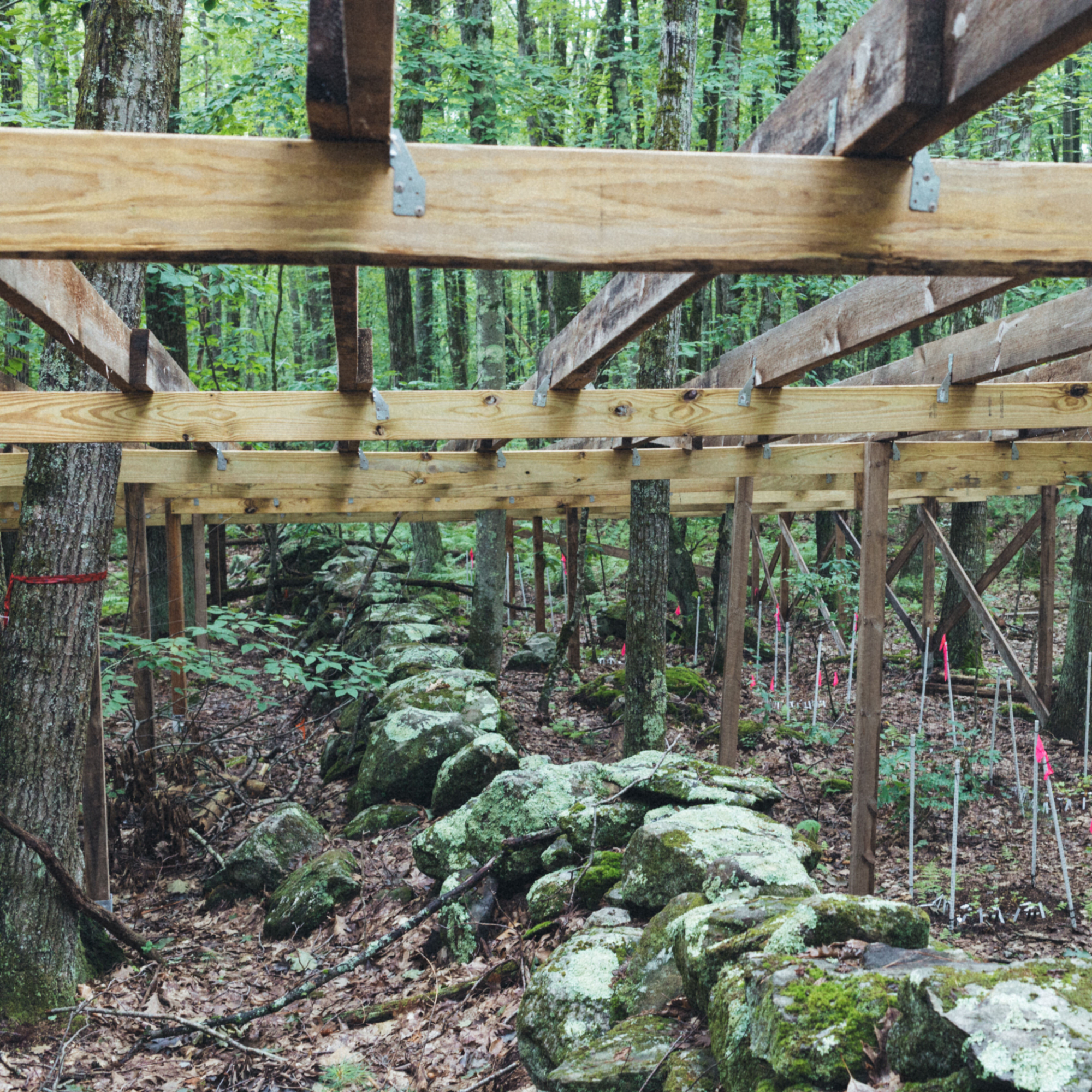
- Grady Welsh1,
- Lara Roelofs1,
- Shersingh Joseph Tumber-Dávila1
- 1Dartmouth College
- Tumber-Dávila LabTech. support email: [email protected]



Protocol Citation: Grady Welsh, Lara Roelofs, Shersingh Joseph Tumber-Dávila 2025. Fine Root Identification in a Northern Hardwood Forest. protocols.io https://dx.doi.org/10.17504/protocols.io.dm6gpo195vzp/v1
License: This is an open access protocol distributed under the terms of the Creative Commons Attribution License, which permits unrestricted use, distribution, and reproduction in any medium, provided the original author and source are credited
Protocol status: Working
We use this protocol and it's working
Created: April 25, 2025
Last Modified: October 01, 2025
Protocol Integer ID: 162061
Keywords: root morphology, root identification, root ecology, belowground biomass, fine root identification, northern hardwood forest, root trait analysis, root scanning, quercus rubra, fragmented root, cliff site at harvard forest, harvard forest, red oak, sieved soil core, white pine, black birch, herbaceous species, including red oak, shrub species, red maple, soil core, soil, pinus strobus
Abstract
This protocol was developed to identify fragmented roots from sieved soil cores taken from the CLIFF site at Harvard Forest in Petersham, MA. The protocol provides images, description, and resources to identify common species found at the site, including red oak (Quercus rubra), red maple (Acer rubrum), black birch (Betula lenta), white pine (Pinus strobus), shrub species, and herbaceous species. Refer to Tumber-Dávila Lab Workspace for related protocols on Coring, Core Processing, Root Scanning, and Root Trait Analysis.
Image Attribution
S. Grady Welsh, Tumber-Dávila Lab
Guidelines
Root identification is challenging. However, with practice, it is possible identify roots accurately and rapidly with only a digital microscope. The subsequent methods have been verified by digging up whole (albeit small ~1 m tall) trees and in some cases through DNA barcoding.
Intraspecific fine root morphology may vary depending on environmental conditions, age, and other factors. However, root mophology tends to vary into similar morphotypes that become clearer with practice. It is important to have an understanding of the various morphotypes that each species can produce.
To practice fine root identification, check out the Rhidentify: Root Identification Practice on Google Slides.
We have also created the Rhizarium: A virtual herbarium of roots and rhizospheres to allow further identification practice and image analysis.
Materials
Digital microscope (i.e. Andonstar AD210)
10 Weigh boats
Tweezers
Lab squeeze bottle with deionized water
Waste container and sieve
Before start
Reference Tumber-Dávila Lab Protocols:
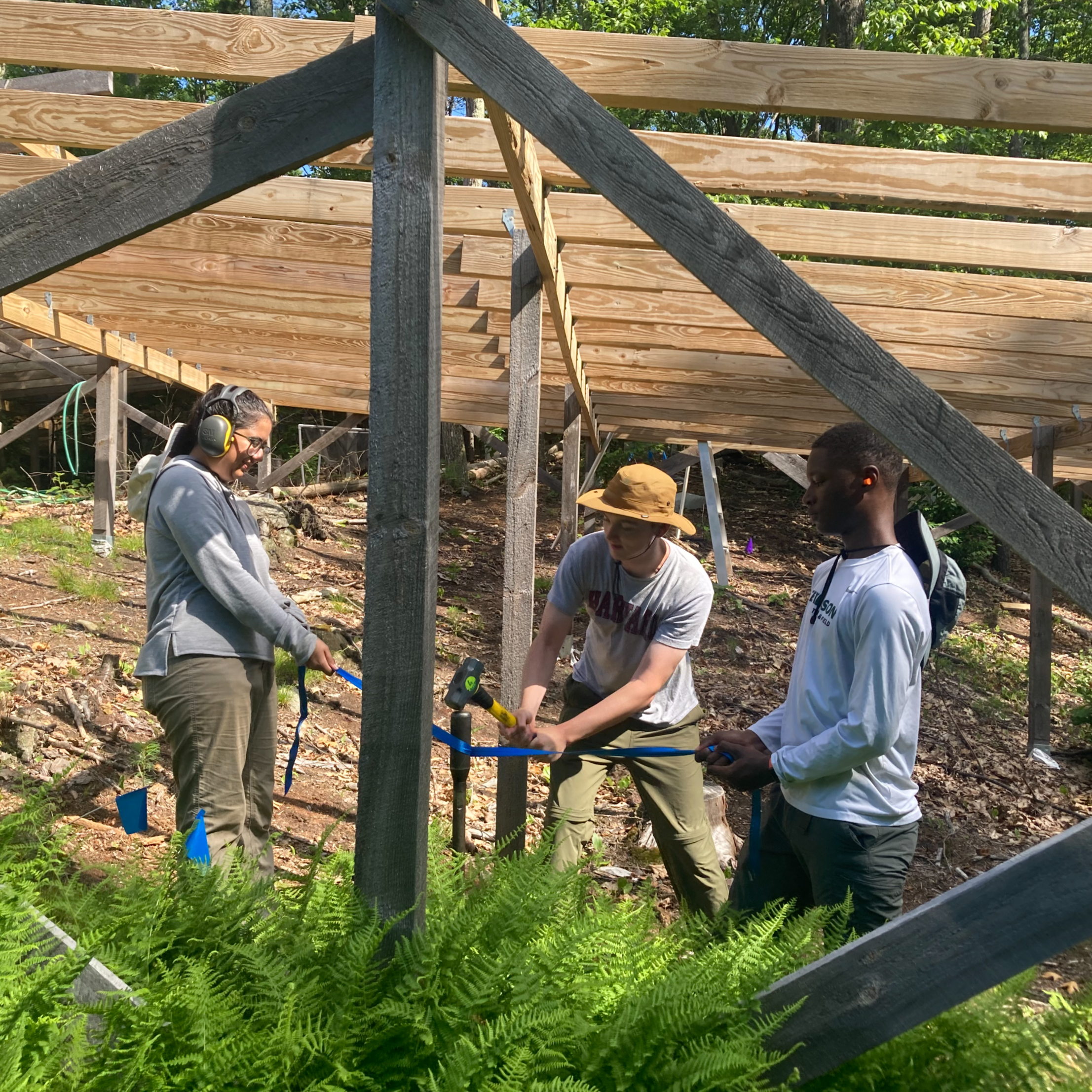
1. Soil Coring Protocol provides an explanation of field methods.
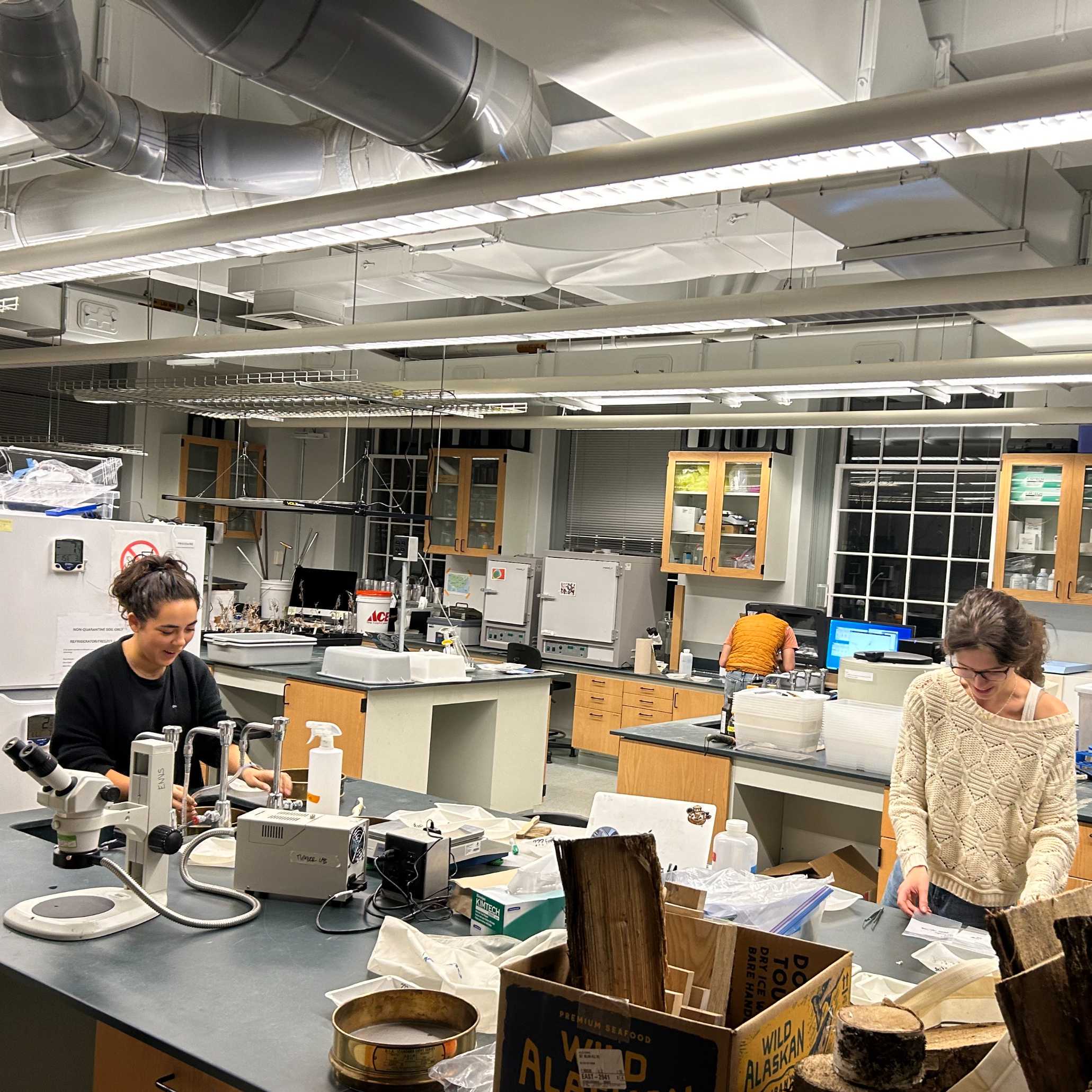
2. Core Processing and Root Washing Protocol provides information on washing and cleaning roots in preparation for identification and sorting.
Ensure roots are washed, clean, and thawed. Thaw frozen roots until no longer frozen/brittle (5-10 minutes at room temperature). Refrigerated roots can be sorted immediately but should not be stored for more than 5 days in the refrigerator to minimize decomposition.
Set Up
Reference Field Data from "Soil Coring for Rocky New England Soils". Note the debris cleared and the surrounding plants.
Note
Tree roots stretch far beyond their canopies, so there will likely be species that were not noted in the surrounding plants. Shrubs, sub-shrubs, saplings, and herbaceous roots have more contained root systems, and would likely only extend into the core if in closer proximity.
Place ten clean weigh boats near the electronic microscope as sorting bins. The boats should be labelled Oak, Maple, Pine, Herbaceous, Shrub, Necromass, Unidentified Fine, Unidentified Coarse. This set up could be modified for other ecosystems with different plants.
Place root sample in an empty weigh boat for Untangling and Cleaning and place an empty weigh boat for Viewing and Sorting beneath the microscope.
Note
Many digital soldering microscopes are available online for under $200. These microscopes have sufficient quality for the task and will cause less eye strain than a traditional optical microscope.
We use an Andonstar (AD210) digital scope which works well, but any dissecting microscope with a magnification of 5-10x will be sufficient.
Annotated root sorting set up.
Fill a lab squeeze bottle with deionized water. Add a layer of water to the Untangling and Viewing weigh boats, enough to submerge fine roots. A splash of water in each sorted root boat will make it easier to drop roots off tweezers.
Note
Root sorting tends to be a messy process, and changing out the water in the sorting and viewing boats can make sorting easier. It may be helpful to have a waste container and sieve nearby to dump excess water, sediment and fungi while catching any remaining roots.
Identification Advice and Resources
The goal of this protocol is to be accurate but complete the 3 inch diameter core section within a reasonable amount of time. Some 0-5 cm depth sections contain dense quantities of roots and will take around 8 hours to sort. Other samples deeper than 50 cm contain only a few root fragments and will take less than 10 minutes to sort.
To practice fine root identification, check out the Rhidentify: Root Identification Practice on Google Slides.
We have also created the Rhizarium: A virtual herbarium of roots and rhizospheres to allow further identification practice and image analysis.
The following protocol guide provides images, descriptions, and tips for identifying fine roots in an oak-maple dominated forest rapidly, accurately, and easily.
Identification Guide
Dead Roots (Necromass):
Definitions for dead root identification vary widely in the literature (See Ohashi et al. 2025).
Drawing from Persson & Stadenberg (2009), Freschet et al. (2021), and Chari et al. (2024), dead roots are defined as roots that:
1. Do not contain intact root tips and have lateral branches frequently broken off.
AND
2. Check at least one of the following:
A. Darkened color, rigid, more brittle than living roots,
B. Softer than living roots, stele and cortex disconnected or loosely connected (roots compress or break apart when pressure applied),
C. Clearly deteriorating.
Note
Living roots vary in squishiness by species and size, so dead root identification will require some practice. For example, oak roots tend to be much more rigid than pine roots, so a soft oak root might be dead while a similarly soft pine root might be alive. The best way to differentiate dead roots from alive roots is to spend time looking at living roots of the model species either by digging up roots connected to live trees or referencing the provided resources within the Guidelines Section.
Oak Roots:
Oak roots are narrow (root tips ~200 µm in diameter, colonized tips ~250 µm), often reddish-brown or orange-brown, and highly branched. They often have short stubby branches (8.1) that are highly colonized (8.2) and densely packed tips (8.3). They frequently present with a zigzag along fine roots between alternating branching tips (8.1). Even small fine oak roots are woody and dense, though new growth can on occasion be less woody and more elongate (8.4).
8.1 Quercus rubra fine root with light colonization and zigzag pattern visible on lightly colored root.
8.2 Quercus rubra fine root with heavy colonization.
8.3 Quercus rubra fine root with densely packed tips.
8.4 Quercus rubra fine root with elongate tips. New growth on left side is clearly less woody.
Birch Roots:
Birch roots are the narrowest tree roots in this guide (root tips <200 µm in diameter, colonized tips <250 µm), often white-yellow to orange-brown, and highly branched. They resemble oak roots in that they are fine, woody, and often colonized (9.1–9.3), but they do not share the same highly-branched tip groupings (See 8.3). Uncolonized tips resemble elongated maple tips in their light-yellow colors (9.4). Black birch (Betula lenta) roots smell like wintergreen when scratched.
Note
We included birch roots with oak roots during root sorting, but they are morphologically distinct, so they are separated out here.
9.1 Betula lenta fine roots.
9.2 Betula lenta with uncolonized sections.
9.3 Betula lenta with colonization.
9.4 Betula lenta with bright yellow hyphae and reddish transport roots.
Maple Roots:
Maple roots are moderately thick (root tips ~350 µm in diameter), often yellow, white, or orange-brown. As an arbuscular mycorrhizal associating species, maple roots do not have ectomycorrhizal fungal sheaths on the exterior of root tips as arbuscular fungi occupy the intracellular space. Branching frequency varies from highly branched (10.1, 10.2) to intermediately branched (10.3, 10.4) with tips ranging from stubby (10.1) to moderately elongate (10.4). Tips look swollen from the inside like ballon-animals, pinching narrower as they meet with a larger root (10.1). Often maple roots have a darkly-colored root cap at the apical meristem which should not be confused with colonization (10.2).
10.1 Acer rubrum with densely packed tips.
10.2 Acer rubrum. Note darkly-colored round tip of root tip (this is not ectomycorrhizal colonization).
10.3 Acer rubrum with lighter colored tips.
10.4 Acer rubrum with more elongate tips (still somewhat cinched near base of tip).
Pine Roots:
Pine root tips are thick (root tips ~400 µm in diameter), brown to yellow-brown with tree-like tip clusters spreading sporadically (sometimes frequently) from a central transport root (11.1). Smaller transport roots are covered with root hairs (11.2) while larger transport roots develop light brown bark that is prone to peeling off (11.1). Tips have a light-colored root cap at the apical meristem (11.3). Tip clusters can host ectomycorrhizal fungi, but are often uncolonized. Tip clusters appear fairly infrequently, though they can become densely packed (11.5).
11.1 Pinus strobus with root tip clusters around transport root (light colored from stripped off bark).
11.2 Pinus strobus with fine root hairs but no tip clusters.
11.3 Pinus strobus tip clusters with lightly colored root cap visible.
11.4 Pinus strobus with ectomycorrhizal colonization on central root cluster.
11.5 Pinus strobus with lighter colored tip clusters but root caps still prominent.
Shrub Roots:
Shrub roots are woody and elongate with tips narrowing, rather than bulging. Initial observations suggest that shrub root tips resemble their parent roots morphologically, differing mainly in size, while tree root tips are morphologically distinct from their parent roots. Morphology remains fairly consistent within family taxa.
Ericaceous Shrubs
Ericaceous shrubs (e.g., Vaccinium spp., Gaultheria procumbens) do not have visible mycorrhizal colonization. Tips tend to grow in parallel to the transport root (Y-shaped) while tree roots tend to grow more perpendicularly (T-shaped). Root tips narrow from gradually from ~200 µm to <100 µm in diameter.
12.1 Vaccinium angustifolium (Lowbush Blueberrry) with thin elongate tips. Branches often grow in parallel to the transport root rather than spreading perpendicularly.
12.2 Vaccinium angustifolium with red-tinted transport roots. Similar to oak transport roots but differentiated by elongate absorptive roots and lack of colonization.
Rhamnaceae (Buckthorn Family)
Distinctive bi-colored fine roots change notably with age and senescence. Young (yellow) roots shrink from ~300 µm in diameter to <250 µm as they fade from bright yellow to dark brown.
12.3 Frangula alnus (Glossy buckthorn) with bi-colored fine roots.
12.4 Frangula alnus with red transport root.
Note
An introduced species that has not been observed at the CLIFF site yet, buckthorn is included because it is a common shrub plants of edge habitats, disturbed areas, and abandoned farmland.
Fern Roots:
Brown to yellow-brown absorptive roots (~200 µm in diameter) extend from a larger brown central rhizome (>2 mm) (13.1). Both the absorptive roots and central rhizome become lighter toward recent growth, culminating in a light colored "glowing" apical meristem (Fig 13.2). Absorptive roots are less woody than tree roots, softer and more flexible (13.3). Fine hairs may coat the fine roots and rhizome, though not always (13.4).
13.1 Dennstaedtia punctilobula (hayscented fern) with y-branched rhizome.
13.2 Dennstaedtia punctilobula with yellow "glowing" rhizome and fine root tips.
13.3 Dennstaedtia punctilobula fine roots clearly more flexible than woody plants.
13.4 Dennstaedtia punctilobula with root hairs visble on fine roots and rhizomes.
Other Herbaceous Roots:
Herbaceous plants are a taxonomically diverse group characterized by a lack of woody tissue (both above and below ground). Fine roots are typically yellow, cream, and white colored (14.1–14.2), though some such as the aptly named goldenthread (Coptis trifolia) are more distinct. Thin and stringy herbaceous roots, often with little to no branching, extend from a central rhizome (14.3–14.4). Herbaceous plants often resprout annually from the central rhizome. Our work has found herbaceous roots almost exclusively in top 20 cm of soil, though this may not be the case in all ecosystems.
14.1 Eurybia divaricata (White wood aster) with no fine root branching.
14.2 Maianthemum canadense (Canada mayflower) with elongate fine roots.
14.3 Medeola virginiana (Cucumber root) with prominent storage organ.
14.4 Viola canadensis (Canada violet) with resprouting rhizome.
Unidentified Roots:
Some roots are too fragmented, too small, or too coarse to accurately identify. These can be classified as unidentified.
Coarse vs. Fine Roots
Fine roots are ≤2 mm in diameter. Roots >2 mm should be considered coarse. This is not a functional designation (more so a functional approximation) and fine roots will contain both absorptive and transport roots.
Root Sorting
Using the set up outlined in Steps 1–3, the tips outlined in Steps 4–6, and the guide outlined in Steps 7–16, begin sorting the roots.
Note
Before placing roots, remove any large clumps of soil aggregates or non-colonizing fungi. These should be fairly easy to remove gently with tweezers. Do not remove the ECM fungi from colonized root tips as this could damage fine roots.
Eventually, only very small fragments (<1 cm in length) will remain at the end of a section of core. If a meaningful quantity can be easily gathered, place them in the unidentified fine roots. The remainder can be disposed of with any other detritus left behind.
Separate coarse and fine roots, using scissors if necessary.
Fine Roots may be scanned in an archival scanner for further root trait analysis.
Clean Up and Storage
Rinse labeled weigh boats for reuse and set out to dry.
Immediately prepare roots to be dried at 60°C for 48 hours or store them briefly in the fridge until they can be dried.
Store dried roots in coin envelopes labeled with Core, Depth, and Group (i.e. C45-C1, 0-5 cm, Oak Fine).
Protocol references
Chari, N. R., Tumber-Dávila, S. J., Phillips, R. P., Bauerle, T. L., Brunn, M., Hafner, B. D., Klein, T., Obersteiner, S., Reay, M. K., Ullah, S., & Taylor, B. N. (2024). Estimating the global root exudate carbon flux. Biogeochemistry, 167(7), 895–908. https://doi.org/10.1007/s10533-024-01161-z
Freschet, G. T., Pagès, L., Iversen, C. M., Comas, L. H., Rewald, B., Roumet, C., Klimešová, J., Zadworny, M., Poorter, H., Postma, J. A., Adams, T. S., Bagniewska-Zadworna, A., Bengough, A. G., Blancaflor, E. B., Brunner, I., Cornelissen, J. H. C., Garnier, E., Gessler, A., Hobbie, S. E., … McCormack, M. L. (2021). A starting guide to root ecology: Strengthening ecological concepts and standardising root classification, sampling, processing and trait measurements. New Phytologist, 232(3), 973–1122. https://doi.org/10.1111/nph.17572
Ohashi, M., Makita ,Naoki, Dannoura ,Masako, Fukuzawa ,Karibu, & and Hirano, Y. (2025). Mission impossible? Criteria for judging dead fine roots in forest field studies. Journal of Forest Research, 0(0), 1–9. https://doi.org/10.1080/13416979.2025.2465818
Persson, H. Å., & Stadenberg, I. (2010). Fine root dynamics in a Norway spruce forest (Picea abies (L.) Karst) in eastern Sweden. Plant and Soil, 330(1), 329–344. https://doi.org/10.1007/s11104-009-0206-8