Collection Citation: Francesca Cohn, Erika Johnston, Scott Burgess, Jordan Sims, Krithika Layagala, Pierrick Harnay, Hollie Putnam, Adrienne Correa 2026. Field-tested workflow for molecular identification of cryptic Pocillopora spp. in French Polynesia. protocols.io https://dx.doi.org/10.17504/protocols.io.bp2l6j57rvqe/v1
Manuscript citation:
Cohn, F.M., E. Johnston, S. Burgess, J.A. Sims, K. Layagala, P. Harnay, H.M. Putnam, A.M.S. Correa. (In prep). A genetic method for distinguishing cryptic Pocillopora species in French Polynesia without sequencing. Molecular Ecology Resources.
License: This is an open access collection distributed under the terms of the Creative Commons Attribution License, which permits unrestricted use, distribution, and reproduction in any medium, provided the original author and source are credited
Protocol status: Working
We use this collection and it's working
Created: April 28, 2026
Last Modified: May 12, 2026
Collection Integer ID: 315900
Keywords: RFLP, Pocillopora, Coral reefs, Cryptic species, cryptic coral species, cryptic coral species in reef region, accurate identification approaches for pocillopora species, cryptic pocillopora spp, foundational reef science, pocillopora species, coral genus, species of pocillopora, building coral genus in the indo, pocillopora individuals to the species level, workflow for molecular identification, level markers for pocillopora, reef region, pocillopora individual, standard molecular laboratory facility, pocillopora, dominant reef, molecular identification, field laboratory, sequencing facility, lab work, completion of lab work, french polynesia this protocol, french polynesia, species, example workflow for the rflp, used species, species level
Abstract
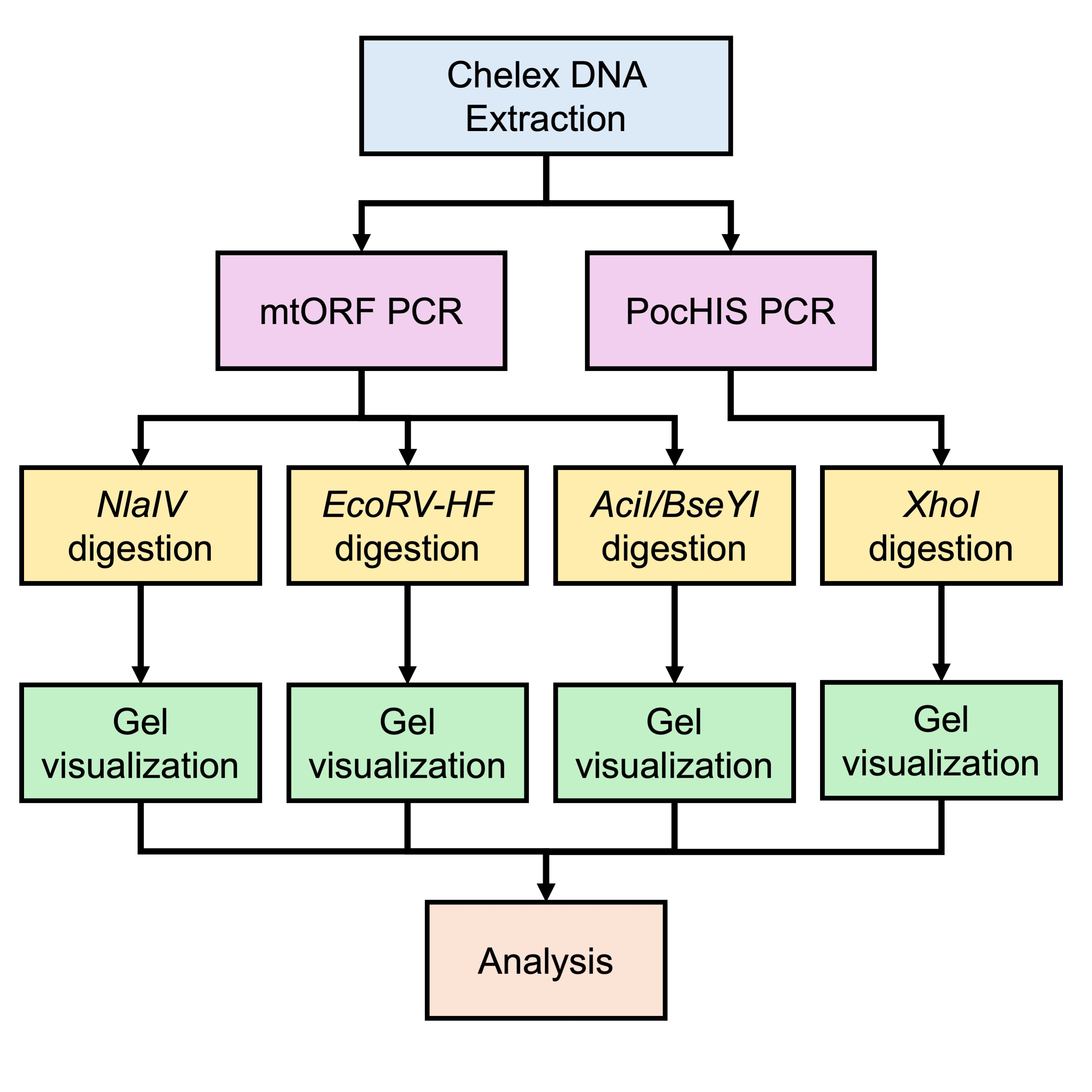
This protocol presents a field-tested example workflow for the RFLP assay described in Cohn et al. (2026), used for quickly and cost-effectively identifying morphologically cryptic Pocillopora spp. in French Polynesia. The method is highly modular, and therefore flexible, to suit a variety of needs regarding project design, timelines, and equipment availability. See image above (and attached below) for a visual representation of the workflow. This protocol was designed for use in a field laboratory with limited access to full-size equipment (e.g., PCR thermalcyclers) but would require only minimal modifications for use in a standard molecular laboratory facility. Note that analysis can be performed after the completion of lab work or in parallel with lab work, depending on logistical needs. Analysis performed in parallel with lab work increases processing time but can greatly reduce cost and use of reagents, depending on the species present, because redundant steps can be omitted.
Cohn et al. (2026) Abstract:
Pocillopora is a widespread, dominant reef-building coral genus in the Indo-Pacific that exhibits high morphological similarity and plasticity. Given this, genetic tools are needed to robustly identify Pocillopora individuals to the species level. Quick and accurate identification approaches for Pocillopora species are critical to estimating biodiversity patterns under current and future environmental challenges. In recent years, the mitochondrial open reading frame (mtORF) and a histone region (PocHistone) have been validated using genome-wide data to become the most widely used species-level markers for Pocillopora. However, Sanger sequencing of a large number of samples can be prohibitively expensive and sequencing facilities are not always readily available. Therefore, we present restriction fragment length polymorphism (RFLP) digests here that identify the six species of Pocillopora (P. acuta, P. cf. effusa, P. grandis, P. meandrina, P. tuahiniensis, and P. verrucosa) found in French Polynesia, without sequencing. In uninformed validation tests (in silico and in vitro), our protocol identified each Pocillopora species with 100% accuracy. Given their cost-effective, rapid nature, the tailoring of additional RFLP digest protocols to identify cryptic coral species in reef regions around the world will support foundational reef science, conservation and restoration initiatives.