Jun 04, 2025
Female transcriptome from the Pacific blue swimming crab Callinectes arcuatus and vitellogenin expression at different gonadal maturity stages
- Jimenez-Gutierrez L. R.1,2,
- Montes-Dominguez A.L.1,2,
- Avena-Soto A.J.1,2
- 1Universidad Autonoma de Sinaloa;
- 2Secretaria de Ciencia Humanidades Tecnologia e Innovacion



Protocol Citation: Jimenez-Gutierrez L. R., Montes-Dominguez A.L., Avena-Soto A.J. 2025. Female transcriptome from the Pacific blue swimming crab Callinectes arcuatus and vitellogenin expression at different gonadal maturity stages. protocols.io https://dx.doi.org/10.17504/protocols.io.5qpvowmr7l4o/v1
License: This is an open access protocol distributed under the terms of the Creative Commons Attribution License, which permits unrestricted use, distribution, and reproduction in any medium, provided the original author and source are credited
Protocol status: Working
We use this protocol and it's working
Created: June 04, 2025
Last Modified: June 04, 2025
Protocol Integer ID: 219588
Keywords: blue swimming crab callinectes arcuatus, pacific crabs of the genus callinecte, pacific crab, swimming crab, vitellogenin expression at different gonadal maturity stage, female transcriptome from the pacific, reproductive evaluation in the mexican pacific, female transcriptome, particular the vitellogenin, different gonadal, vitellogenin expression, different gonadal maturity stage, transcriptome, vitellogenin, reproduction, gonad, reproductive evaluation, genus callinecte, species like the atlantic
Abstract
The swimming crab is a commercially
and nutritionally important resource. In Mexico, the East Pacific has the highest
catch volumes. From the Pacific crabs of the genus Callinectes, the blue
crab C. arcuatus has the widest distribution and can be found
year-round. Its close resemblance to well-studied species like the Atlantic
blue swimming crab C. sapidus makes it an excellent model for molecular
reproductive evaluation in the Mexican Pacific. Through new generation
sequencing, this study aims to characterize the transcriptome from female
gonads and in particular the vitellogenin (Vtg) and its expression in
the ovaries and hepatopancreas from C. arcuatus, at different gonadal
maturity stages. Reproduction-related genes from C. arcuatus
transcriptome correspond to 1.81%. Almost 200 proteins are reported for this
species, 33 of them never reported before, including the complete Vtg. The
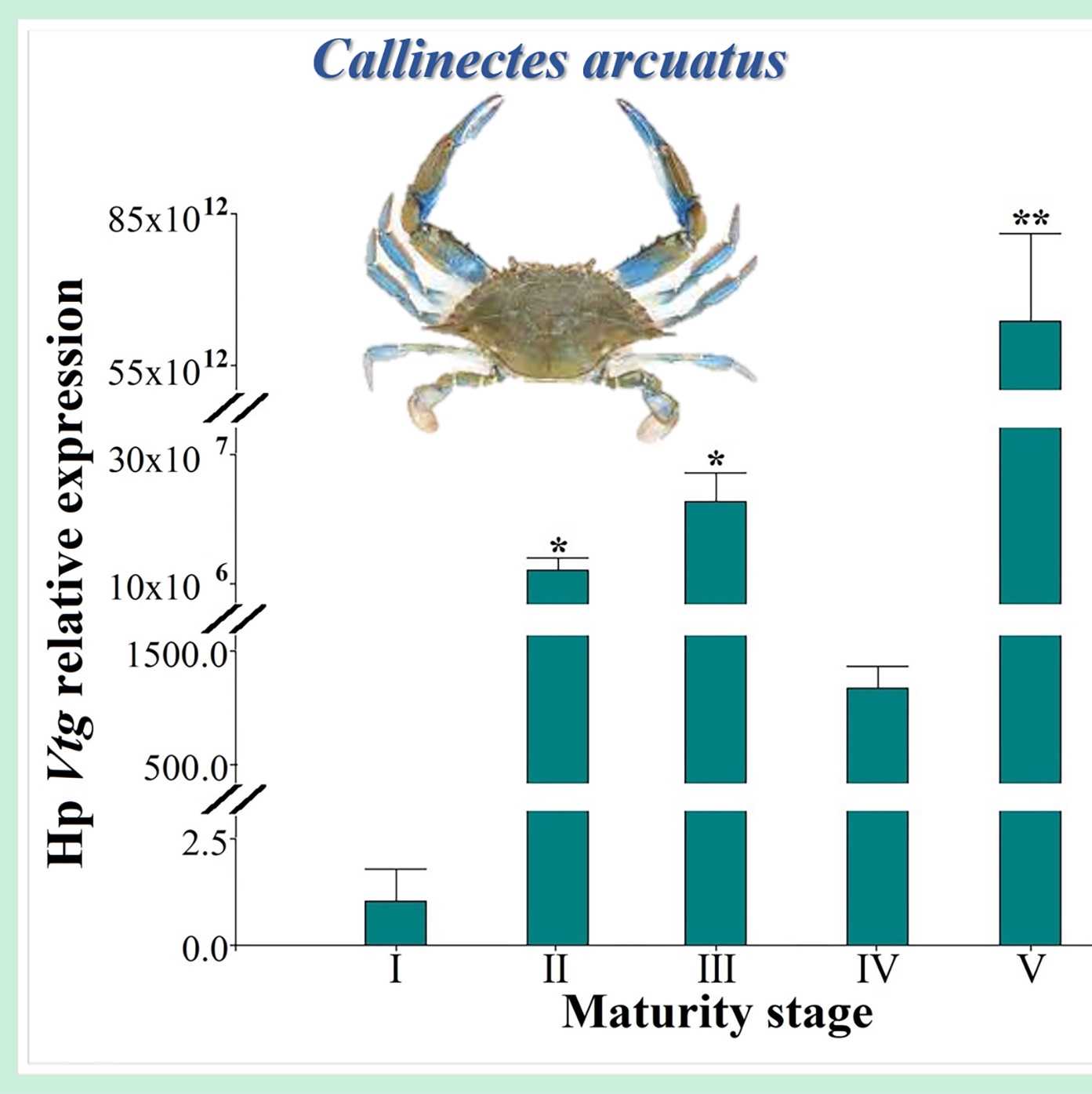
expression of Vtg is tissue-specific, with levels in the hepatopancreas
being 13 orders of magnitude higher than in the ovary. In the hepatopancreas, Vtg
expression shows an exponential increase from stage I to stage V of gonadal
maturity, while the pattern is the opposite in the ovaries. The hepatopancreas,
with its abundant nutrient reserves, serves as an ideal site for Vtg
expression and synthesis.
Sample colection
Samples were obtained with the help of local
fishermen, each one with personal collection permit given by CONAPESCA (by its initials
in Spanish: Comision nacional de pesca y acuicultura). To obtain mRNA
transcription profiles throughout an entire year, five live females of C.
arcuatus were collected monthly from Mazatlán, Sinaloa, from 2018 to 2019. All
animals were handled according to ARRIVE (Animal Research: Reporting of In Vivo
Experiments) guidelines. The organisms were sacrificed by freezing and
subsequently dissected to obtain hepatopancreas and ovaries tissues. Gonadal
development was identified using morpho-colorimetric methods (Castañeda-Fernández
et al. 2015). The tissues were preserved at -20 °C
until further use.
RNA isolation, Illumina sequencing and bioinformatic analyses
In order to found a wide range of reproductive transcripts, total RNA
from each organisms and each tissue (ovaries and hepatopancreas) was obtained
to make a sample pool for next-generation sequencing (NGS). Total RNA was extracted from 100 mg of each
tissue using the PureLink RNA Mini Kit following the manufacturer's
instructions (Thermo Fisher Scientific). The integrity of the ribosomal RNAs
was verified under native conditions in 1.5% agarose gels in 1X TAE buffer with
0.1% SYBR Safe (Invitrogen, USA), and electrophoresis was conducted using a
Mini-Sub Cell GT Systems chamber (Bio-Rad, USA). Degraded samples were
discarded, and only intact RNA was used for further analysis. Total RNA was
treated with DNase I (Roche, USA; 1U/µg RNA) to remove genomic DNA, following
the manufacturer's instructions.
The sample pool was submitted to Genoma Mayor, Universidad Mayor in
Chile (Santiago de Chile). The library was constructed with the protocol TruSeq
Stranded mRNA (Illumina, San Diego, CA) and sequenced in an Illumina MiSeq
equipment following the manufacturer's instructions. First De novo assembly and
ontological identification were conducted as previously described
(Jimenez-Gutierrez et al. 2019).
A second De novo assembly and ontological identification was performed
to confirm each sequence: the adapter sequences from each read and low-quality reads
were first eliminated with the software Trimmomatic 0.39. The normalization was
done with Trinity version 2.15.1 with the function: <insilico_read_normalization.pl>.
The de novo assembled was carried out with the software Trinityrnaseq. TransDecoder
version 5.5.0 was used for ORF identification and Coding Sequence Prediction. Finally,
to establish the correlation between the sequences assembled and their
function, a BLAST (Basic Local Alignment Search Tool) alignment
was done with software Diamond version 2.1.7 versus the “Nucleotide collection”
database. The sequences of interest were individually verified for a third time
through BLAST alignment in NCBI. Subsequently,
the sequences of interest with a possible reproduction role were individually
verified for a third time using the BLAST algorithm at NCBI.
mRNA expression of C. arcuatus VtgUntitled section
Specific primers were designed for β-actina as a housekeeping gene, and the double-verified C. arcuatus Vtg
sequence using the FastPCR program (Supplementary material 1). For gene
expression tests, at least four females were sampled for each stage of
maturity. Total RNA was extracted individually as described above.
Complementary DNA (cDNA) synthesis was performed on intact and treated RNA
using the FirstStrand commercial system (Invitrogen, USA) following the
manufacturer's instructions. PCR amplification of each gene was conducted using
the TopTaq PCR Master Mix kit (QiagenTM, USA) with the following components:
12.5 μL of TopTaq mix, 2.5 μL of Coral dye, 1 μL of each 20 μM primer, cDNA
template from each tissue, and milliQ water to reach a final volume of 25 µL.
PCR products were analyzed on 1.5% agarose gels and digitized using a Gel DocTM
EZ photodocumenter (Bio-Rad, USA).
First, Vtg amplification was performed, along with the constitutive
β-actin gene of hepatopancreas and ovarian tissues. These samples were purified
using Nucleospin columns (Macherey-Nagel, New Zealand) following the
manufacturer's instructions. The concentration of the purified products was
quantified using nanodrop. For absolute expression quantification, two samples
with two replicates were amplified for each stage, resulting in four
subreplicates.
Along with the Vtg from each maturity stage, purified products
were amplified. The absolute expression was quantified based on the optical
density using the previously purified product of known concentration as a
control, with the assistance of ImageTM Lab 2.0 software (Bio-Rad, USA).
Subsequently, relative expression was calculated using the 2 –ΔΔCT
method with modifications according to Montes-Dominguez et al. (2021), with β-actin
gene as the first control and stage I as the reference point (time zero) for
the second control.
Statistical analysis
Data normality and homoscedasticity from Vtg expression values
were checked, and a one-way analysis of variance (ANOVA) was conducted for the
independent variable: stage of gonadal development. Subsequently, a post hoc
comparison of means was performed using the Tukey-Kramer test (P < 0.05). All
statistical analyses were carried out using STATISTICA software (StatSoft, EU),
version 5.5, in the GLM (General Linear Model) section.