Dec 26, 2023
Extraction of Food Items and Analysis with Thin Layer Chromatography (Outreach Activity)
- Anna I. Elizondo1,
- Tu M. Ho1,
- Jose G. Urbiola1,
- Kaitlyn Varela1,
- Francis Yoshimoto1
- 1The University of Texas at San Antonio, Department of Chemistry
- Metabolomics Protocols & WorkflowsTech. support email: [email protected]



Protocol Citation: Anna I. Elizondo, Tu M. Ho, Jose G. Urbiola, Kaitlyn Varela, Francis Yoshimoto 2023. Extraction of Food Items and Analysis with Thin Layer Chromatography (Outreach Activity). protocols.io https://dx.doi.org/10.17504/protocols.io.14egn3rdml5d/v1
License: This is an open access protocol distributed under the terms of the Creative Commons Attribution License, which permits unrestricted use, distribution, and reproduction in any medium, provided the original author and source are credited
Protocol status: Working
We use this protocol and it's working
Created: December 22, 2023
Last Modified: December 26, 2023
Protocol Integer ID: 92675
Keywords: Extraction, Thin Layer Chromatography (TLC), Spinach, Coffee, Red Cabbage, Tea, Spirulina Flakes (Fish Food), Tomato, Carrots, Outreach Activity, extraction of food item, analysis with thin layer chromatography, thin layer chromatography, extraction, resulting extract, food item, compounds from natural source, chemistry technique, fish food, tlc analysis, spinach, tomato, ethanol, carrot, consumer item, food, tlc, compound, experiment
Abstract
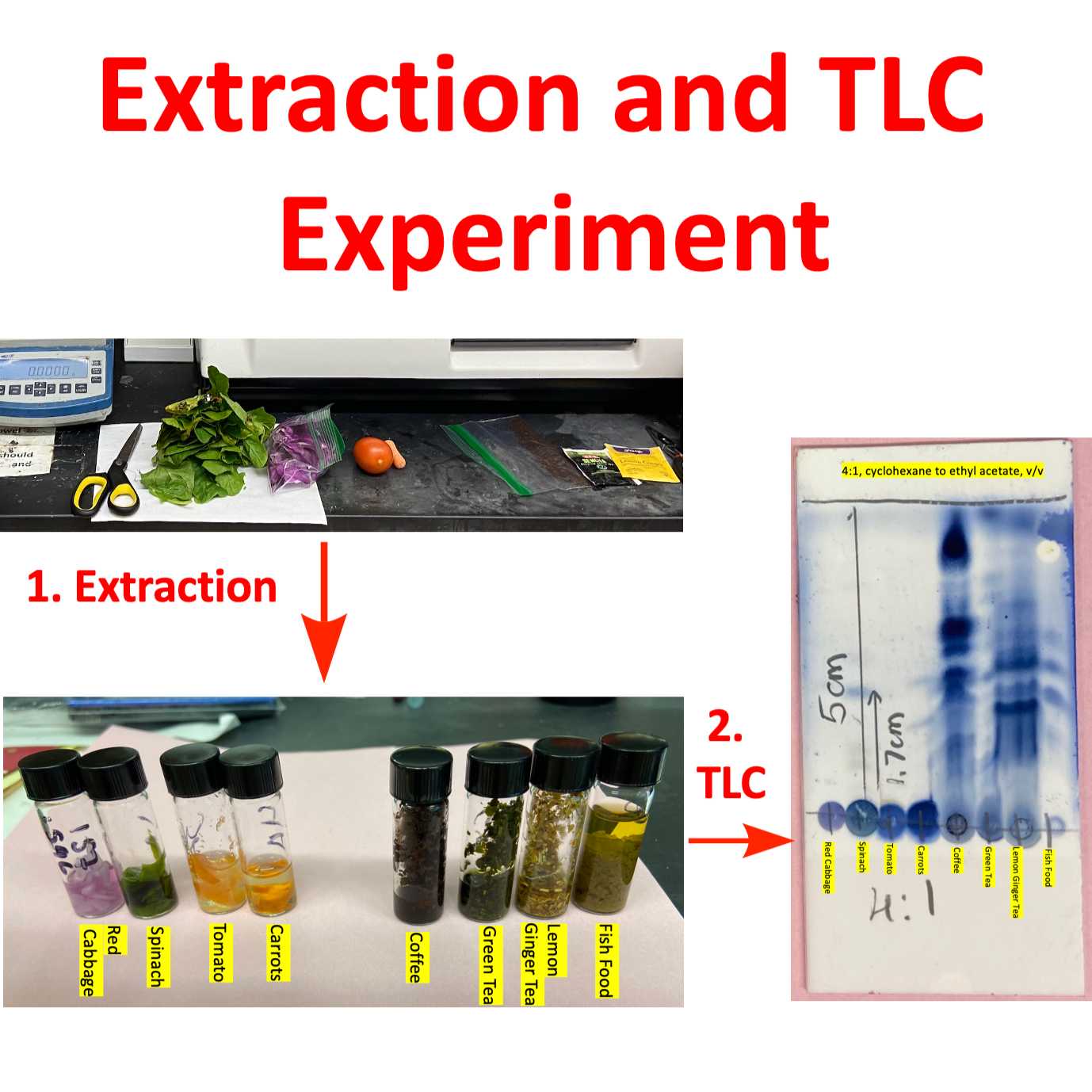
An experiment was performed where grocery store bought consumer items (i.e. spinach, red cabbage, carrots, tomatoes, tea leaves, coffee, and fish food) were extracted with ethanol and the resulting extracts were analyzed by thin layer chromatography (TLC). This protocol will be deployed for outreach activity purposes to show STEM participants how chemistry techniques (extraction and TLC analysis) can be used to analyze compounds from natural sources.
Safety warnings
Proper personal protective equipment (gloves, safety glasses, and lab coats) were worn at all times.
Table of Contents: Extraction of Food Items and Analysis with Thin Layer Chromatography
Table of Contents for Extraction of Food Items and Analysis with Thin Layer Chromatography
A. Weigh out items in vials
B. Dissolve the solid in each vial and prepare TLC chambers
C. Spot the solutions on each plate and develop the plates in the TLC chambers
D. Take out the TLC plates and visualize the spots
Step A (Weigh out items in vials)
Step A: Weigh out 500 mg of each material in respective vials (Label each vial 1-8)
- Spinach
- Red cabbage
- Roma Tomato
- Carrots
- Coffee
- Tea bag 1 from the grocery store (green tea)
- Tea bag 2 from the grocery store (lemon tea)
- Spirulina flakes (fish food)
Step B (Dissolve solid in each vial in 1 mL of ethanol and prepare TLC chambers)
Step B: Dissolve solids and prepare TLC chambers
Step B.1. Dissolve solid
- Add 1 mL of ethanol to each vial with a pipettor fitted with a pipet tip.
- After around 2 minutes, the vial with the fish flakes will soak up the solvent, add 2 mL more of ethanol.
- Shake the mixture in each vial with the vortex.
- Let the solvent sit in the vial for 30 minutes.
Step B.2. Prepare TLC chambers
- Using a graduated cylinder, make the TLC chamber 1 and TLC chamber 2 by preparing a solvent systems: (50 mL of ethyl acetate and 50 mL of cyclohexane) for TLC chamber 1, and (25 mL of ethyl acetate and 75 mL of cyclohexane) for TLC chamber 2.
- add the 100 mL organic solvent mixture (1:1 ethyl acetate to cyclohexane, v/v) to beaker 1.
- add the 100 mL organic solvent mixture (1:4 ethyl acetate to cyclohexane, v/v) to beaker 2.
Step C (Spot the solutions on each plate and then develop the plates)
Step C. Spot the TLC plates and develop them in the TLC chambers
- Label one TLC plate with a base line using the pencil – mark 8 different lanes labeled 1-8). The baseline should be higher than the solvent level in the TLC chamber that will be described in the next section.
- Label the second TLC plate the same as above (point 1).
- spot each liquid from the vial in the corresponding lane on the TLC plate. In between each spot, clean the spotting pipet by dipping into the vial containing ethanol and drying it on a paper towel.***
- Let each spot dry.
- Place the TLC plate 1 to the chamber 1 and make sure that the baseline is above the solvent level in the TLC chamber.
- Place the aluminum foil on the top of the beaker and develop the solvent in the beaker.
- Place the TLC plate 2 to the chamber 2 and make sure that the baseline is above the solvent level in the TLC chamber.
- Place the aluminum foil on the top of the beaker and develop the solvent in the beaker.
Step D (Take out the plates and visualize the spots)
Step D. Take out the TLC plates and visualize the spots
- Once the solvent level reaches near the top of the TLC plate (but don’t let the solvent travel higher than the length of the plate) remove the TLC plate (note time – it takes around 5-10 minutes to develop the TLC plate depending on the height of the solvent level in the chamber and also the length of the TLC plate that was cut).
- Mark the solvent level on the TLC plate (this mark is the solvent front).
- Visually look at the TLC plate.
- Take a photo of the plate.
- Stain the TLC plate with the CAM stain.
- Calculate Rf (retention factor) values by measuring the distance from the baseline to the middle of each spot (“X”) and also measuring the distance between the baseline and the solvent front (“Y”).
- The Rf values are calculated by dividing X from Y described above.
Notes - TLC (Outreach Activity)
**In preliminary trials, ethyl acetate and water were used to attempt to extract the compounds, however, the liquids were not as colored suggesting that the solvent was not optimal for extracting the compounds. Therefore, ethanol was used to dissolve the solid in the vials and within 2 minutes the liquid showed a color change.
**Also, in preliminary studies, 100 mg of each solid was used to dissolve the vegetables (i.e. spinach, Red cabbage (but its color is purple), tomatoes, and carrots) in 1 mL of ethanol. However, the spots on the TLC plates after CAM stain did not appear very clearly (they were too faint). Therefore, 500 mg of solid was weighed out and the spots appeared on the TLC plate.
**Solvent system for the TLC chamber was used as 1:4, ethyl acetate to cyclohexane, v/v, since in the preliminary trial, when 1:1, ethyl acetate to cyclohexane, v/v, was used as the solvent system, there were dark spots at the solvent front. The spots at the solvent front in 1:1 EA/cyclohexane suggested that the solvent system was too polar. Therefore, the solvent system of 1:4 EA/cyclohexane was used in addition to the 1:1 EA/cyclohexane solvent system.
**When 1 mL of ethanol was added to 500 mg of fish flakes, the liquid was all soaked up by the solid. Therefore, a total of 3 mL of ethanol was added to the vial containing the fish flakes.
***In the video, the red cabbage was spotted first then spinach. The order of the rest of the spots followed how the items were weighed in Step A.
Materials
Materials:
Personal Protective Equipment (PPE):
-Gloves
-Safety glasses
-Lab coat
Items to be extracted:
1. Spinach
2. Purple cabbage
3. Tomatoes
4. Carrots
5. Coffee
6. Tea bag 1 from the grocery store (green tea)
7. Tea bag 2 from the grocery store (lemon tea)
8. Spirulina flakes (fish food)
Organic solvents:
-ethanol
-ethyl acetate
-cyclohexane
Supplies:
-glass cutter
-2 TLC plates (thin layer chromatography)
-Stain (CAM):
- dissolve 0.5 g ceric ammonium sulfate and 12 g of ammonium molybdate in 235 ml deionized water, then add 15 ml of concentrated sulfuric acid. Store the stain in a jar.
-500 mL glass beaker
-aluminum foil
-Graduated cylinder (100 ml size)
-Heat gun
-glass vials (8x 1-dram vials) with screw caps
-vial box holder
-pencil
-ruler
-Sharpee
-clear tape
-lab notebook
-ball point pen
-balance
-spatula
-weighing paper
-Scissors
-vortex
-camera
-calculator
-rubbing alcohol
-kimwipes
-paper towels
-Pasteur pipets
-rubber bulb for Pasteur pipets
-micropipetter (1 ml volume)
-micropipette tips (1 ml volume)
-optional: tweezers