Apr 23, 2026
Establishing Drosophila melanogaster Crosses through the Sexing and Sorting of Pupae
- Allison Harris1,
- Wolfgang Stein2
- 1Department of Physics, Illinois State University, Normal, IL 61790;
- 2School of Biological Sciences, Illinois State University, Normal, IL 61790



Protocol Citation: Allison Harris, Wolfgang Stein 2026. Establishing Drosophila melanogaster Crosses through the Sexing and Sorting of Pupae. protocols.io https://dx.doi.org/10.17504/protocols.io.x54v9qn44l3e/v1
License: This is an open access protocol distributed under the terms of the Creative Commons Attribution License, which permits unrestricted use, distribution, and reproduction in any medium, provided the original author and source are credited
Protocol status: Working
We use this protocol in our lab and it works beautifully.
Created: April 22, 2026
Last Modified: April 23, 2026
Protocol Integer ID: 315522
Keywords: fruit fly, pupae, pupal sexing, crossing, genetic cross, Drosophila melanogaster, pre-eclosion sorting, drosophila melanogaster crosses through the sexing, establishing drosophila melanogaster cross, genetic crosses in drosophila, sorting drosophila, identifiable morphological markers of pupal sex, drosophila at the pupal stage, drosophila, controlled mating, throughput of genetic cross, sorting of pupae, genetic cross, collection of virgin female, pupal sex, defined genotype, virgin male, sexing, female, identifiable morphological marker, virgin female, pupal stage
Abstract
Genetic crosses in Drosophila are fundamental to many experimental workflows but typically require the labor-intensive and precisely-timed collection of virgin females, involving the monitoring of eclosing adults and the use of anesthesia to identify sex. These steps can limit scalability, increase handling time, and require training. This protocol describes a simple and reliable method for sexing and sorting Drosophila at the pupal stage to identify virgin males and females prior to eclosion. By isolating individuals before emergence, the method eliminates the need for adult anesthesia and reduces the frequency of collection, while ensuring controlled mating between defined genotypes. The procedure uses readily identifiable morphological markers of pupal sex and can be implemented with minimal equipment. This approach improves efficiency, reproducibility, and throughput of genetic crosses and is suitable for a wide range of researchers, from high school students to senior researchers.
Materials
- Artistic paint brush, size 2 to 4
- Small container with 5 mL of de-ionized or distilled water
- Lint-free wipe (e.g. Kim Wipe)
- Micro Spatula with rounded ends (e.g. Fisher Scientific # 14-100-176)
- Petri dish with silicone elastomer dish (20 to 100 mm diameter)
- 2 fly vials/bottles with food and closures (‘flugs’)
- Lab tape
- Permanent marker
Safety warnings
Genetically modified Drosophila melanogaster require Biosafety Level 1 facilities. Follow all appropriate guidelines and regulations for their use and handling.
Before start
The goal of this protocol is to provide a simple and reliable procedure to cross two fly strains (called strain A and strain B). These F0 flies can be raised in vials or bottles, or in any container where pupae are accessible. The F0 flies of the desired strains must be available with late-stage pupae present in the vials/bottles.
Overview
The overall workflow for this protocol is shown in the figure below.
Isolating the Pupae
Prepare the working space around the stereomicroscope with a small container of de-ionized water (5 mL for wetting the paintbrush), small paintbrush, lint-free wipe (e.g., Kim Wipes), micro spatula, and silicone elastomer dish. If no silicone elastomer dish is available, a small piece of damp Ethylene-Vinyl Acetate (EVA) foam can be used.
Prepare two new vials or bottles with standard fly food for housing the sorted pupae. Label one vial/bottle as “Strain A Females + Strain B Males” and the other as “Strain A Males + Strain B Females” and set them aside.
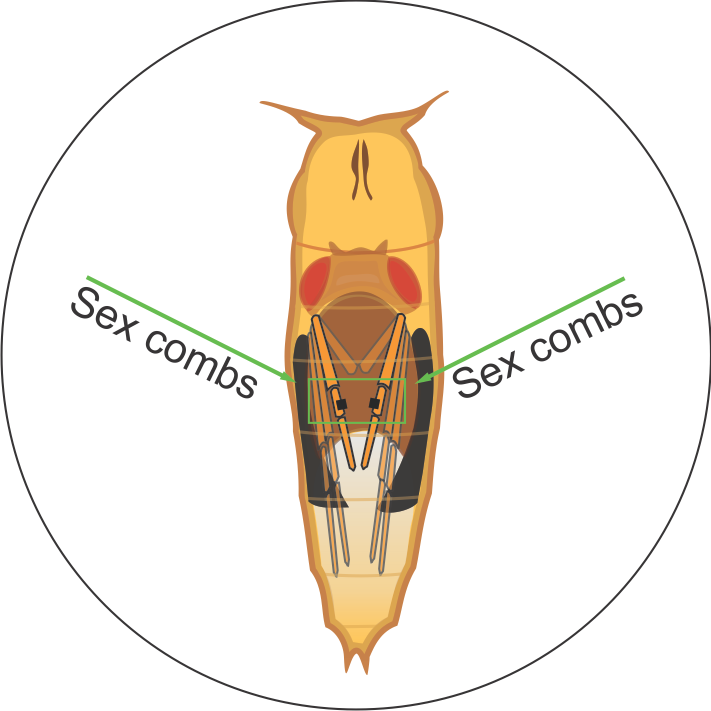
Select a vial or bottle of strain A F0 flies that has pupae attached to the side. Pupae used for sexing and crossing in this protocol need to be at the brown pupal stage (P12) or later. At this age, pupae will appear darker than earlier stage pupae (see arrows in figure below), with wings and legs clearly visible. This allows for observation of the sex combs on the front legs and thus the separation of pupae by sex.
Remove all adults from the strain A vial/bottle.
Gently remove a brown pupa from the strain A vial/bottle by following these steps:
Place the tip of the spatula next to the lateral side of a pupa (see (A) in figure below).
Gently slide the spatula tip between the pupa and the wall of the vial/bottle to release the pupa. Once loose, the pupa will stick to the spatula (see (B) in figure below). Do not attempt to remove the pupa from the anterior side near the head as this would likely injure the pupa.
Gently place the pupa onto the silicone elastomer dish.
Repeat steps 6 and 7 for as many strain A brown pupae as desired. It is recommended to place at least 5 pupae of each sex in a given vial/bottle to generate a sufficient number of offspring.
Sexing the Pupae
Place the silicone elastomer dish under the stereomicroscope and center one of the pupae in view. A 10 – 20 times magnification is sufficient.
Moisten the paintbrush by dipping it into the water. Remove excess water on the lint-free wipe.
Using the paintbrush tip, orient the pupa ventral side up so that the legs are visible.
Determine whether sex combs are present on the first tarsal segment of the front legs (prothoracic legs). The presence of sex combs indicates a male pupa (see arrows in figure below), and the absence of them indicates a female. If in doubt, discard the pupa.
Scoop up the pupa onto the paintbrush and deposit it on the side of the appropriate new vial/bottle from step 3. The small amount of water from the damp paintbrush used to transfer the pupa will help it stick to the side of the vial/bottle. If the pupa is female, place it in the “Strain A Females + Strain B Males” vial/bottle. If the pupa is male, place it instead in the “Strain A Males + Strain B Females” vial/bottle. It is recommended to place all pupae of strain A in close proximity to each other in their new vial/bottle and mark this section using tape or writing to denote strain A. This will allow for the experimenter to determine later how many pupae of each strain have eclosed and whether additional pupae need to be added later.
Repeat steps 10-13 for all brown pupae on the silicone elastomer dish.
Creating the Cross
Repeat steps 4 -14 for strain B, placing males of strain B into the “Strain A Females + Strain B Males” vial/bottle and females of strain B into the “Strain A Males + Strain B Females” vial/bottle. This way, each of the two new vials/bottles will have virgin females of one strain and virgin males of the other, and no further sorting is required.
Typical survival and eclosion rates for this procedure are between 75 - 100%. It is recommended to place at least 5 pupae of each sex in a given vial/bottle to generate a sufficient number of offspring.
In 24-48 hours, most F0 pupae will have eclosed and will be mating and lay eggs to generate the desired F1 generation. In the event that an insufficient number of pupae of either strain eclose, this process can be repeated, adding pupae to the appropriate vial/bottle. Additional pupae can be added even with adults in the vial/bottle by tapping the flies down, quickly removing the flug, adding the new pupa, and replacing the flug.
To prevent cross-breeding between F0 and F1 generations, the adult F0 flies must be removed before the F1 generation ecloses. The latest time to remove the F0 flies is when the first F1 pupae appear (approximately 1 week at 25°C).
To continue propagation of the desired F1 crosses, the adult F0 flies can be transferred into a new vial/bottle. Steps 18 and 19 can be repeated as long as the adult F0 flies live.
Protocol references
1. Sylgard-Coated Glass Petri Dishes. Cold Spring Harbor Protocols 2024, pdb.rec108372 (2024).
2. Bainbridge, S. P. 6 Bownes, M. Staging the metamorphosis of Drosophila melanogaster. Development 66, 57–80 (1981).