Mar 18, 2026
Version 1
Environmental sample collection protocol for the surveillance of Foot and Mouth Disease Virus (FMDV) and Lumpy Skin Disease Virus (LSDV) V.1
- Amrutlal Patel1,
- Ramesh Pandit1,
- Bhumika Prajapati1,
- Tejas Shah1,
- Kalpesh Katudia1,
- Abhinandan Patnaik1,
- Shewane Bishnoi1,
- Roselin Neihsial1,
- Jinal Thakor1,
- Jill Gada1,
- Rajvi Der1,
- Parth Pandit1,
- Kunjan Panchal1,
- Bhagirath Dave1,
- Harshal Purohit1,
- Snehal Bagatharia1,
- Amit Kanani2,
- Dhwani Pandya1,
- Madhvi Joshi1,
- Chaitanya Joshi1
- 1Gujarat Biotechnology Research Centre, Dept. of Science and Technology, GoG, Gandhinagar, Gujarat, India;
- 2Directorate of Animal Husbandry, GoG, Gandhinagar, Gujarat , India



Protocol Citation: Amrutlal Patel, Ramesh Pandit, Bhumika Prajapati, Tejas Shah, Kalpesh Katudia, Abhinandan Patnaik, Shewane Bishnoi, Roselin Neihsial, Jinal Thakor, Jill Gada, Rajvi Der, Parth Pandit, Kunjan Panchal, Bhagirath Dave, Harshal Purohit, Snehal Bagatharia, Amit Kanani, Dhwani Pandya, Madhvi Joshi, Chaitanya Joshi 2026. Environmental sample collection protocol for the surveillance of Foot and Mouth Disease Virus (FMDV) and Lumpy Skin Disease Virus (LSDV). protocols.io https://dx.doi.org/10.17504/protocols.io.4r3l2zqq3l1y/v1
License: This is an open access protocol distributed under the terms of the Creative Commons Attribution License, which permits unrestricted use, distribution, and reproduction in any medium, provided the original author and source are credited
Protocol status: Working
We use this protocol and it's working
Created: January 23, 2026
Last Modified: March 18, 2026
Protocol Integer ID: 239219
Keywords: Environmental surveillance , LSDV, FMDV, early warning, Environmental sample collection, Gates Foundation, fmdv on dairy farm, environmental sample collection protocol for the surveillance, environmental surveillance programmes for the detection, protocols for the environmental surveillance, environmental surveillance programme, environmental surveillance, animal markets in the indian state, drinking water from animal farm, viral pathogens such as lsdv, environmental sample collection protocol, herd health without the need, mouth disease virus, animal farm, animal market, herd health, collection of environmental sample, dairy farm, viral pathogen, environmental sample, such as dung, lumpy skin disease virus, surveillance, dung, manger swab, lsdv
Funders Acknowledgements:
Gates Foundation, USA
Grant ID: INV-064425
Abstract
Environmental surveillance offers a simple, affordable method that can be easily integrated into environmental surveillance programmes for the detection of viral pathogens such as LSDV and FMDV on dairy farms. It provides a practical way to routinely monitor both herd health without the need to test each animal individually, offering an efficient and cost-effective solution. This protocol describes the collection of environmental samples such as dung, milk, slurry, leftover feed, manger swab and drinking water from animal farms and animal markets in the Indian state of Gujarat. This is part of a set of protocols for the environmental surveillance of FMDV and LSDV.
Image Attribution
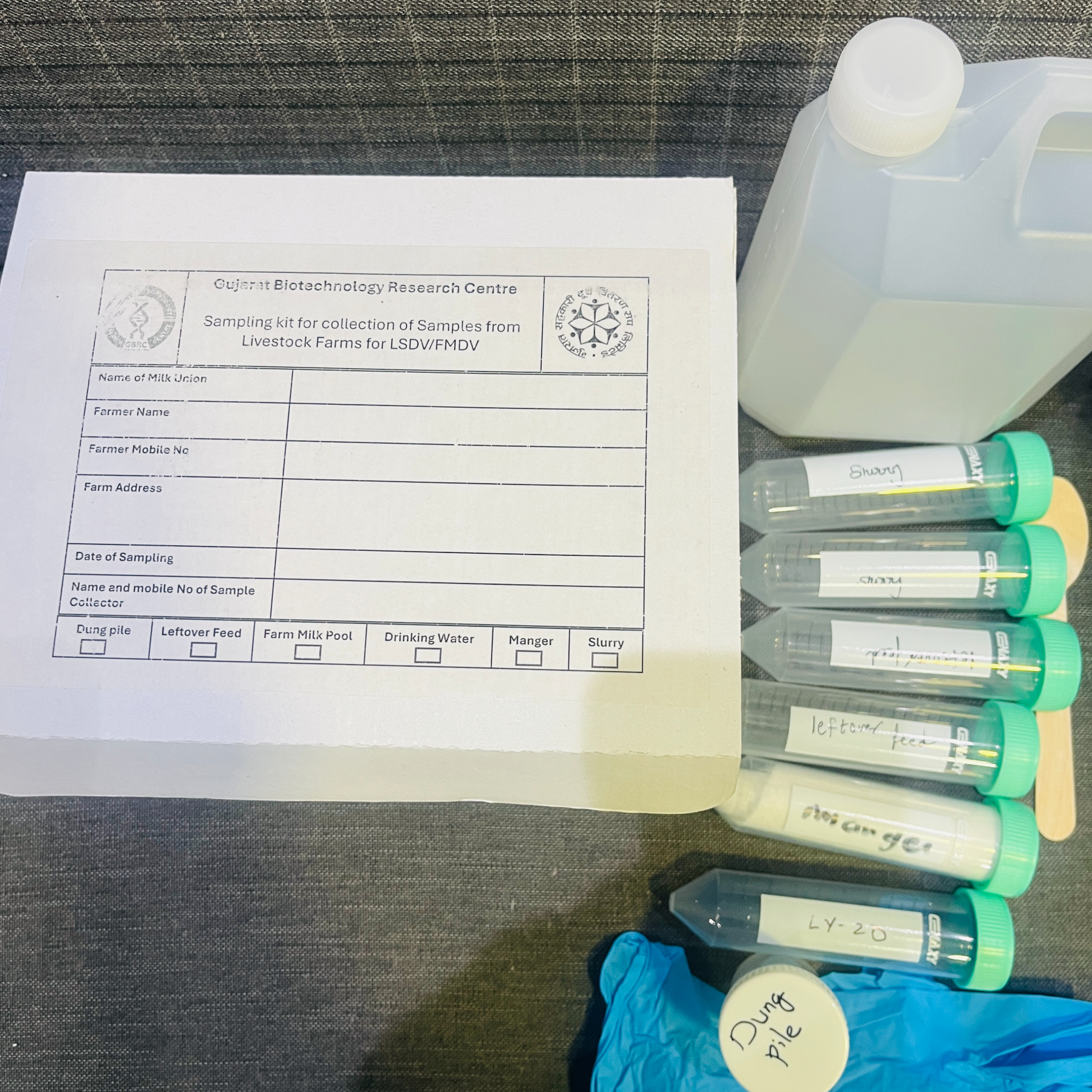
The image describes a sampling kit with details on the top . The kit contains the following items
1 falcon for slurry
2 two falcons for left over feed
3 falcon for manger swab
4 dung container
5 water container
6 spoon
7 nitrile gloves
8 falcon with LY -20 for milk
Guidelines
Environmental sampling in the study is designed as a risk-based, longitudnal, non-invasive surveillance approach, involving collection of water, slurry, left over feed, manger swab,milk, drinking water and dung at defined frequencies, followed by standardized molecular testing for early detection and monitoring of pathogens.
Materials
Materials required:
1. 50 mL sterile centrifuge tubes
2. Plastic containers (Capacity 50 gm)
3. Mobile phone with Epicollect application for filling metadata
4. Appropriate PPEs (Lab coat, nitrile hand gloves, safety glasses, shoe covers, etc.)
5. Appropriately barcoded stickers/labels for each sample type
6. Waterproof markers
7. LY-20 preservative for milk
8. PBS 1X solution (pH 7.5)
9. Wooden spoon/spatula for dung collection
10. Teflon tape
11. Electrostatic dust cloth (Reusable bamboo kitchen towel from Beco brand)
12. Ice packs or mini cooler for sample transportation
13 PPE kit
LY 20
Composition -1000 ml
50g Boric acid
0.75 g Potassium sorbate
10g Glycerin
0.5 ml 1% Methylene blue
Fill up with water
Concentration : 1.18 ml LY-20 per 10ml milk
Safety warnings
Precautions
- Use protective clothing and work aseptically avoiding cross-contamination between samples
- Change gloves after each sample collection
- Nasal swabs must be collected using sterile swabs and placed into sterile tubes containing 1X PBS for transportation
Before start
Before starting
- Personal Protective Equipment (PPE): Gather lab coats, gloves, masks, and eye protection for all personnel handling samples to ensure biosafety and prevent contamination.
Sample Collection Materials: Prepare 50mL collection tubes containing 50mL of 1X PBS. Label tubes using cryo-resistant permanent markers or cryo-compatible barcoded stickers. Arrange cooler boxes with ice packs for transporting samples at 4°C.
ABSTRACT
Abstract
Environmental surveillance offers a simple, affordable method that can be easily integrated
into environmental surveillance programmes for the detection of viral pathogens such as LSDV
and FMDV on dairy farms. It provides a practical way to routinely monitor both herd health
without the need to test each animal individually, offering an efficient and cost-effective
solution. This protocol describes the collection of environmental samples such as dung, milk,
slurry, leftover feed, manger swab and drinking water from animal farms and animal markets in
the Indian state of Gujarat. This is part of a set of protocols for the environmental surveillance
of FMDV and LSDV.
Before starting
Materials required:
1. 50 mL sterile centrifuge tubes
2. Plastic containers (Capacity 50 gm)
3. Mobile phone with Epicollect application for filling metadata
4. Appropriate PPEs (Lab coat, nitrile hand gloves, safety glasses, shoe covers, etc.)
5. Appropriately barcoded stickers/labels for each sample type
6. Waterproof markers
7. LY-20 preservative for milk
8. PBS 1X solution (pH 7.5)
9. Wooden spoon/spatula for dung collection
10. Teflon tape
11. Electrostatic dust cloth (Reusable bamboo kitchen towel from Beco brand)
12. Ice packs or minicooler for sample transportation
13 Personal Protective Equipment (PPE): Gather lab coats, gloves, masks, and eye
protection for all personnel handling samples to ensure biosafety and prevent
contamination.
14 Our laboratory provided SAMPLING KITS for sample collection, consisting of falcons for slurry, leftover feed, manger swab LY-20, a container for dungpile, a spoon for collecting dung, nitrile gloves, and a water container
Sample collection (field team)
A. Wear appropriate personal protective equipment (PPE), including a laboratory coat,
nitrile gloves, safety goggles, and shoe covers.
B. Accurately enter all required sample and metadata information in the Epicollect
application.
C. Prior to sample collection, ensure that all plastic containers/centrifuge tubes are
properly labelled with the appropriate barcoded stickers, and collect samples in the
corresponding pre-labelled containers.
Collection of dung:
Approximately 50 g of dung should be collected from multiple directions and different regions
of the dung pile using a sterile spatula or wooden spoon to ensure representative sampling. The
collected material should be thoroughly mixed, transferred into a sterile plastic container, and securely sealed with the lid. If required, seal the container using Teflon tape. Place the container
in the designated sample collection box.
Collection of slurry:
Collect 50 mL of slurry in the provided sterile centrifuge (Falcon) tube from multiple points of
the drainage outlet originating from the animal shed to ensure representative sampling. As the
sample is liquid, seal the tube using Teflon tape to prevent leakage. Place the sealed tube in the
sample collection box.
Collection of drinking water:
Collect 1 L of drinking water from the animal trough, individual feeding stall, or water trough
into a sterile plastic container. Since the sample is liquid, secure the container lid using Teflon
tape before final sealing.
Collection of manger swab:
Animal saliva is a critical matrix for the detection of LSDV and FMDV; therefore, manger
swabs are essential for environmental surveillance. To collect the swab, use a sterile 10 × 10
cm autoclaved electrostatic dust cloth. While wearing gloves, thoroughly swab the manger
surface, focusing on areas likely to be contaminated with animal saliva, including corners and
edges. After swabbing, place the cloth into a 50 mL centrifuge tube containing 50 mL of 1×
PBS buffer
Collection of farm milk:
Collect pooled farm milk in a 50 mL Falcon tube pre-filled with 4.72 mL of preservative
(LY20). Add milk up to a final volume of 40 mL, maintaining a ratio of 1.18 mL preservative
per 10 mL of milk.
Collection of leftover feed:
Collect approximately 5–10 g of leftover feed, representing all mangers within the farm, into a
sterile Falcon tube. Ensure the container is properly sealed.
Transportation and storage
The samples must be transported to the laboratory in cooler boxes maintaining 4 °C using ice packs.
Protocol references
Environmental sampling for the detection of foot-and-mouth disease virus and peste des petits ruminants virus in a live goat market, Nepal. Transboundary and Emerging Diseases, 69, 3041–3046.
Environmental and air sampling are efficient methods for detection and quantification of foot- and- mouth
disease virus Brown et. al, Journal of Virological Methods, January 2021, Vol. 287, 113988
Review of epidemiology and economic importance of lumpy skin disease. Abera, et. al. 2015. Int. J. Basic.
Appl. Virol. 4(2015) pp: 8-21
Acknowledgements
We acknowledge the support of the Gates Foundation (USA), NCBS Bengaluru (India), and the Department of Animal Husbandry, Government of Gujarat. We are also grateful to the veterinary technicians associated with GCMMF and to the livestock traders who kindly permitted sampling activities in the animal markets.