Apr 07, 2026
Elevated Zero Maze for Animal Behavior Testing
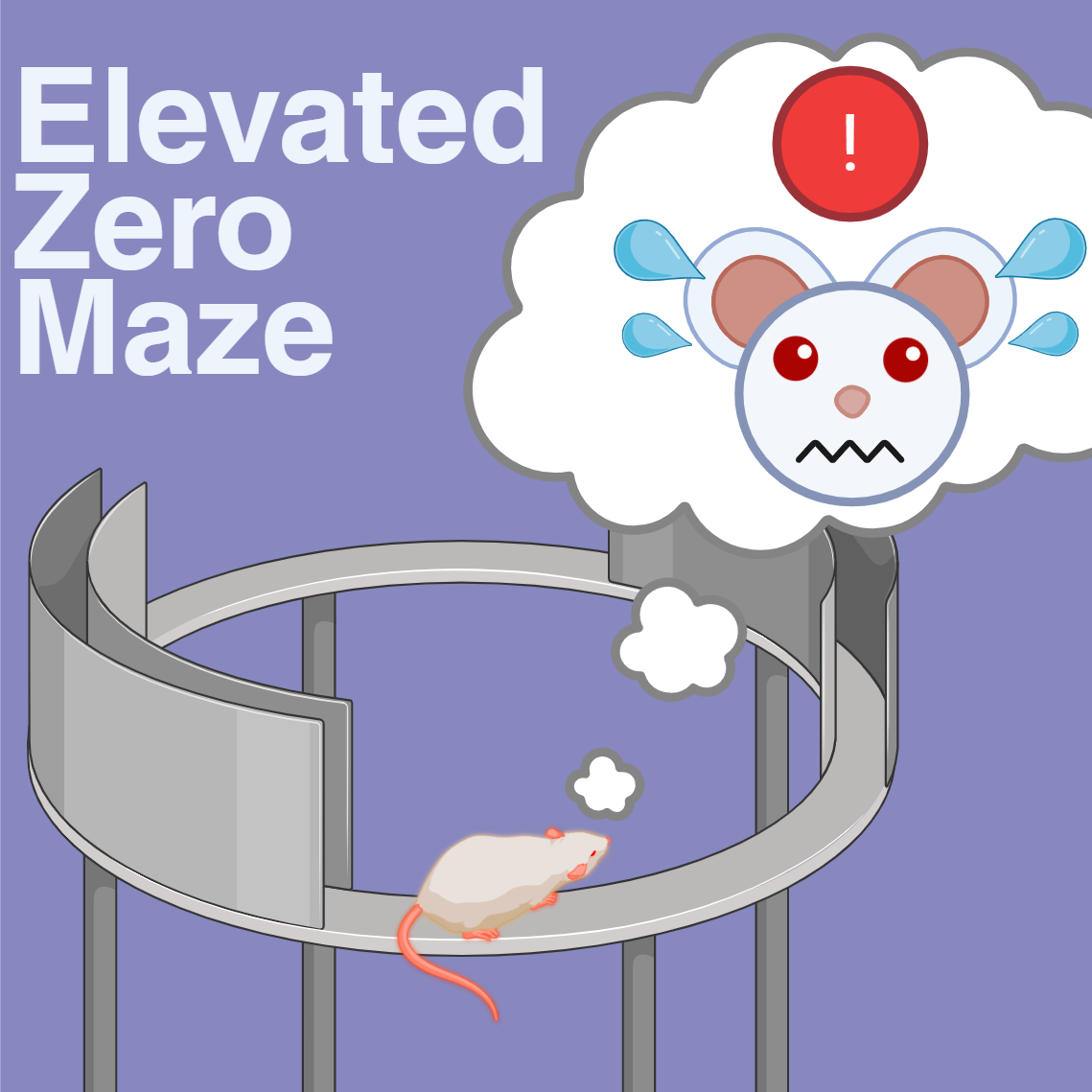
- Taryn E McFadden1,
- Ann Sipe1,
- Jennifer E Nyland1
- 1Penn State College of Medicine, Hershey, Pennsylvania
- Nyland Lab



Protocol Citation: Taryn E McFadden, Ann Sipe, Jennifer E Nyland 2026. Elevated Zero Maze for Animal Behavior Testing. protocols.io https://dx.doi.org/10.17504/protocols.io.q26g7o7o1vwz/v1
License: This is an open access protocol distributed under the terms of the Creative Commons Attribution License, which permits unrestricted use, distribution, and reproduction in any medium, provided the original author and source are credited
Protocol status: Working
We use this protocol and it's working
Created: April 03, 2026
Last Modified: April 07, 2026
Protocol Integer ID: 314455
Keywords: Behavior, Anxiety, rodent, rat, elevated-zero-maze, elevated zero maze for animal behavior, elevated zero maze, rodent study, like behavior in rodent, behavioral assay, anxiety, rodent studies at penn state college, animal behavior, continuous elevated circular track, measuring exploration, testing
Funders Acknowledgements:
National Institutes of Health - NIGMS
Grant ID: GM146774
Abstract
The Elevated Zero Maze is a behavioral assay to assess anxiety-like behavior in rodents by measuring exploration of open versus enclosed arms on a continuous elevated circular track. Expected outcomes include standardized quantification of time spent in open versus enclosed areas as an index of anxiety-like behavior for use in rodent studies at Penn State College of Medicine and translatable to any other research group.
Image Attribution
Created in BioRender. McFadden,T.; Remite, G. (2026)
Guidelines
The Elevated Zero Maze is used to assess anxiety-like behavior, emotionality, and reactivity in rodents. It is a modification of the Elevated Plus Maze that eliminates the ambiguous central platform by forming a continuous circular track. The maze consists of two open (anxiogenic) and two enclosed (protective) elevated arms of equal area where animal behavior is recorded by overhead camera. The goal of the assay is to balance the rodent’s conflicting innate tendencies to either explore a novel environment or avoid open, elevated spaces associated with predator risk. Behavioral outcomes are measured as the time spent in open versus closed arms, providing an index of anxiety. This SOP describes procedures for assessing rodents with the Zero Maze at Penn State College of Medicine in the CMF Module. It is intended for all researchers conducting behavioral testing using the Elevated Zero Maze in rodents. Procedures are based on senior researcher experience, commercial manuals and Noldus eBook “Basic behavioral neuroscience in rodents”.
Materials
- Elevated Zero Maze Apparatus [Maze Engineers]
- Logitech Brio Camera, mounted above maze [Camera stand, retort stand, affixed to the ceiling etc.]
- Camera cable connection to the computer
- EthoVision XT Software [Noldus Information Technology]
- Computer (System requirements: Windows XP Professional or higher, 2.60GHz)
- Cleaning supplies: water spray bottle, 70% ethanol spray bottle, paper towels
Safety warnings
Safety: Monitor animals continuously during testing to prevent falls and ensure immediate intervention if needed.
The elevated platform requires safety oversight to protect animal welfare during behavioral assessment.
Cleaning CAUTION: Do not use other disinfectants as they may damage the stage.
Ethics statement
All experimental procedures were approved by the Penn State College of Medicine Institutional Animal Care and Use Committee (PROTO202202209) and were conducted in accordance with the National Institutes of Health (NIH) Guide for the Care and Use of Laboratory Animals.
Before start
- If animals are not normally housed adjacent to testing room, (i.e. brought in from a different lab/facility) acclimate animals in home cages within the testing room for 30–60 minutes before testing.
- Minimize noise and disturbance during acclimation and testing!
Animal Preparation
- If animals are not normally housed adjacent to testing room, acclimate animals in home cages within the testing room for 30–60 minutes before testing.
- Minimize noise and disturbance during acclimation and testing.
- Noldus recommends “Preferably leave the testing room to allow free and uninterrupted movement of the subject animal.”
- In practice: minimize distractions (i.e., no talking, no other concurrent activity), ensure wall shields are positioned to obscure the subject field of view, place “Do Not Disturb/Enter” sign on the outermost door to the testing room.
Cleaning Procedures
- Between subjects: wipe the walkway with a wet paper towel and then dry.
- After testing: clean with 70% ethanol.
CAUTION: Do not use other disinfectants as they may damage the stage.
Configuring the Zero Maze and Camera
- Place the “Testing in Progress – Do Not Enter” sign on the door.
- Ensure maze is aligned with floor markings and enclosure is in place to reduce external distractions.
- Plug in and turn on the Logitech camera.
- Power on and log in to the computer using PSH credentials.
- Launch Logitech recording software.
- Confirm or adjust settings (see posted print-out):
- Auto-flicker: 50 Hz
- Field of view: 78°
- NOTE: Maze will appear inverted in recordings, new updates may allow for image flipping.
7. Initiate recording before placing the animal into the maze.
8. While already holding the animal, press “Start Record” → Camera initiates countdown → place animal into the Zero Maze.
Testing Procedure
- Remove a single animal from its home cage using your preferred handling technique.
- Place the animal into the maze. Animals typically move into an enclosed arm immediately.
- Decide animal placement in experimental design, which can be standardized or randomized.
- Record behavior for a minimum of 10 minutes.
- If an animal jumps or falls, note the incident in records → jumping is rare, but occasionally animals lose their footing. NOTE: Remain silent throughout testing.
6. After recording, video files will be saved to the local C: Drive. Transfer files to the network drive for processing.
7. Recommended to: rename the files as appropriate with animal ID, date, timepoint, etc.
8. Use a data sheet to record the start time for each rat to avoid opportunities for recording errors.
Video Analysis (EthoVision XT)
Fig 1: Elevated Zero Maze (EZM) image from Noldus Information Technology. (2022). Basic behavioral neuroscience in rodents: A practical guide.
Fig 2 a, b: Adapted from Gómez-Gonzalo, 2025.
a) EZM to assess anxiety levels in rodents: Open/unprotected Anxiogenic areas shown in red vs. Closed/shielded Safer areas in green
b) Quadrants for Ethovision gating → Used to trace travel between open vs. closed arms
Yellow boxes around red areas = Open Quadrants (OQ)
Blue boxes around green areas = Closed Quadrants (CQ)
Complete video analysis in Ethovision to quantify the duration of time spent in different maze areas.
Basic procedure for Ethovision processing:
- Define four zones: Open Quadrant 1, Open Quadrant 2, Closed Quadrant 1, Closed Quadrant 2.
- Group zones into ‘Open’ and ‘Closed’ categories for automated extraction of total time in open versus closed quadrants.
- Be aware EthoVision may misclassify transitions between open and closed areas; manual verification required.
- Additional behaviors (e.g., rearing, freezing) can be automatically detected and scored for expanded analysis.
Notes on Manual Verification: Ethovision is highly sensitive/vulnerable to misclassification. Some examples are:
- Animal enters a “hidden zone” (i.e. within the enclosed arm), thus behaviors in closed areas cannot be analyzed (e.g., freezing, rearing etc.)
- Delays entering and exiting different quadrants: classification struggles when animals are equally in two different quadrants
Future troubleshooting may include: utilizing two camera angles to visualize both the open and closed arms and/or obtaining an increased camera angle to capture the entire maze.
Protocol references
Noldus Information Technology. (2022). Basic behavioral neuroscience in rodents: A practical guide.
Gómez-Gonzalo, M. (2025). Astrocytes in rodent Anxiety-Related behavior: role of calcium and beyond. International Journal of Molecular Sciences, 26(6), 2774.