Jan 26, 2018
Version 2
Electrophoretic Mobility Shift Assay (EMSA) Using IRDye® Oligonucleotides V.2
- LI-COR Biosciences1,
- Margaret Dentlinger
- 1LI-COR
- LICORbio



External link: https://www.licor.com/documents/1mqrtw8bbwd31jgcpk5r
Protocol Citation: LI-COR Biosciences, Margaret Dentlinger 2018. Electrophoretic Mobility Shift Assay (EMSA) Using IRDye® Oligonucleotides. protocols.io https://dx.doi.org/10.17504/protocols.io.k3ccyiw
License: This is an open access protocol distributed under the terms of the Creative Commons Attribution License, which permits unrestricted use, distribution, and reproduction in any medium, provided the original author and source are credited
Protocol status: Working
We use this protocol and it's working
Created: November 29, 2017
Last Modified: March 28, 2018
Protocol Integer ID: 9028
Keywords: emsa, gel shift assay, ir fluorescent emsa, emsa using near-infrared fluorescence, odyssey emsa, mobility shift assay, licor, electrophoretic mobility shift assay, odyssey imager model, specific emsa oligo pack insert for more information, dna interaction, nfκb protein, sample mobility shift protocol, emsa reaction, specific emsa, irdye
Abstract
This is a sample Mobility Shift Protocol (NFκB). Each oligo labeled with IRDye 700 provided by LI-COR® Biosciences for EMSA reactions will have an optimized protocol to measure the protein-DNA interaction. See the specific EMSA oligo pack insert for more information. As an example, the NFκB protein-DNA interaction will be described in this protocol.
Please refer to your manual to confirm that this protocol is appropriate for the applications compatible with your Odyssey Imager model.
Guidelines
I. Introduction
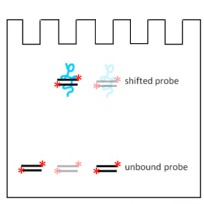
Gel shift assays or electrophoretic mobility shift assays (EMSA) provide a simple method to study DNA-protein interactions.This assay is based on the principle that a DNA-protein complex will have different mobility during electrophoresis than non-bound DNA.These shifts can be visualized on a native acrylamide gel using labeled DNA to form the DNA-protein binding complex. To date, protocols require labeling DNA by (1) radioisotope, (2) digoxygenin, or (3) biotin.The Odyssey® Family of Imagers (LI-COR® Biosciences) offers a quick and easily-adapted alternative method to radioisotopic and chemiluminescent detection methods for EMSA analysis and visualization.
A DNA oligonucleotide end-labeled with LI-COR IRDye is a good substrate for protein binding. LI-COR offers pre-annealed oligonucleotides specific to eight unique binding proteins. DNA detection using IRDye reagents is linear within a 50-fold dilution range, from 9.1 fmol to 0.18 fmol. Additional benefits include no hazardous radioisotope, no gel transfer to membrane or gel drying, no chemiluminescent substrate reagents, and no film exposure. Following electrophoresis, the gel can be imaged while remain- ing in the glass plates. If necessary, the gel can be placed back in the electrophoresis unit and run longer.
Existing mobility shift assay protocols can be easily transformed into infrared assays by replacing the existing DNA oligonucleotides with oligonucleotides end-labeled with IRDye reagents.The binding conditions and electrophoresis conditions will remain the same as with any other EMSA detection method.
II. General Methodology
EMSA Oligonucleotides Labeled with IRDye 700
| Part Number | ||
| IRDye 700 p53 Consensus Oligonucleotide | 829-07921 | |
| IRDye 700 STAT3 Consensus Oligonucleotide | 829-07922 | |
| IRDye 700 CREB Consensus Oligonucleotide | 829-07923 | |
| IRDye 700 NFκB Consensus Oligonucleotide | 829-07924 | |
| IRDye 700 AP-1 Consensus Oligonucleotide | 829-07925 | |
| IRDye 700 Sp-1 Consensus Oligonucleotide | 829-07926 | |
| IRDye 700 HIF-1 Consensus Oligonucleotide | 829-07929 | |
| EMSA Buffer Kit for the Odyssey | 829-07910 |
Labeling DNA Fragments with IRDye Infrared Dyes
To obtain DNA fragments end-labeled with IRDye infrared dyes, oligos labeled with IRDye infrared dyes are used. It is critical that the DNA fragment is end-labeled rather than having dye incorporated into the DNA, which interferes with the formation of the DNA-protein complex.
Oligonucleotides are manufactured in single strand form; therefore, both forward and reverse DNA oligo-nucleotides must be purchased. Once oligonucleotides are obtained, they need to be annealed to form a double-stranded DNA fragment.
Oligonucleotides are annealed by placing the oligonucleotide set in a 100°C heat block for 5 minutes and then leaving the oligonucleotides in the heat block and turning it off to slowly cool to room temperature.
Important: Both oligonucleotide sequences should be end-labeled with the same IRDye infrared dye.There is a significant decline (~70%) in signal intensity when using only one end-labeled oligonucleotide.
III. Mobility Shift Sample Protocol (NFκB)
Each oligo labeled with IRDye 700 provided by LI-COR® Biosciences for EMSA reactions will have an optimized protocol to measure the protein-DNA interaction. See the specific EMSA oligo pack insert for more information. As an example, the NFκB protein-DNA interaction will be described in this protocol.
See 'STEPS' for protocol.
One of the benefits of using the Odyssey® Infrared Imaging System for EMSA analysis is that it provides an easy method for quantification. However, there are issues to consider when using the Odyssey Imager to quantify EMSA results.The primary issue is that the free DNA fragment has much less signal than the DNA fragment when bound to a protein, making quantification of the unbound DNA inaccurate.The addition of DTT/Tween® 20 to the binding reaction stabilizes the dye and reduces this phenomenon. In addition, it is unrealistic to perform quantification analyses under the assumption that the free DNA band in the control, containing DNA only (no extract), should equal the sum of the signals of the free and bound DNA in the samples where the protein-DNA binding reaction occurs. Using end-labeled oligonucleotide duplexes as the DNA source and nuclear extract as a protein source renders this assumption impractical, due to the non-specific binding that occurs from using a nuclear extract. Oligonucleotides can also complicate quantification because the free oligonucleotides form a smear rather than a tight band.This makes it more difficult to assign an intensity value to bands.
Optimization
Binding Reaction
A universal binding condition that applies to every protein-DNA interaction cannot be recommended, since binding conditions are specific for each protein-DNA interaction.Thus, the user should establish binding reaction conditions for each protein-DNA pair. Binding buffer should be the same for this method as with any other mobility shift detection method used.
After the addition of DNA to the protein-buffer mix, reactions are incubated to allow protein to bind to DNA. Time required for binding is the same as when radioactively-labeled DNA fragments are used; a typical incu- bation condition is 20-30 minutes at room temperature. Since IRDye reagents are sensitive to light, it is best to keep binding reactions in darkness during incubation periods (e.g., put tubes into a drawer or simply cover the tube rack with aluminum foil). After the incubation period, native loading dye is added to the binding reaction.
NOTE: In some cases, it was observed that DNA control reactions (no protein) have lower signal than reactions containing protein.This may be due to lower stability of the dye in certain buffer conditions.The addition of 5 mM DTT and 0.5%Tween 20 to all reactions reduces this phenomenon.
IMPORTANT: It is critical not to use any blue loading dye (e.g., bromophenol blue), as this will be visible on the Odyssey® image. Use 10X Orange loading dye instead (LI-COR®, P/N 927-10100).
Competition using mutant DNA duplexes is another common method to determine binding specificity. A mutant DNA sequence is used to compete with the wild-type binding sequence. Specific binding is observed when mutant DNA (unlabeled) does not reduce the binding of labeled wild-type DNA.Two-color analysis of mutant vs. wild-type binding is done using the Odyssey Infrared Imaging System.The wild-type oligos are labeled with IRDye 700 phosphoramidite and mutant oligos with IRDye 800 phosphoramidite. In the figure above, the mutant non-specific binding is very intense (800 nm image); however, there is no decrease in wild-type binding (700 nm image).
| Lane 1 | Free IRDye 700 AP-1 consensus oligonucleotide and IRDye 800 AP-1 mutant oligonucleotide with no nuclear extract; | |
| Lane 2 | Nuclear extract with 0:1 ratio of IRDye 700 AP-1 consensus oligonucleotide to IRDye 800 AP-1 mutant oligonucleotide; | |
| Lane 3 | Nuclear extract with 1:0 ratio of IRDye 700 AP-1 consensus oligonucleotide to IRDye 800 AP-1 mutant oligonucleotide; | |
| Lane 4 | Nuclear extract with 1:1 ratio of IRDye 700 AP-1 consensus oligonucleotide to IRDye 800 AP-1 mutant oligonucleotide; | |
| Lane 5 | Nuclear extract with 1:2 ratio of IRDye 700 AP-1 consensus oligonucleotide to IRDye 800 AP-1 mutant oligonucleotide; | |
| Lane 6 | Nuclear extract with 1:3 ratio of IRDye 700 AP-1 consensus oligonucleotide to IRDye 800 AP-1 mutant oligonucleotide; | |
| Lane 7 | Nuclear extract with 1:4 ratio of IRDye 700 AP-1 consensus oligonucleotide to IRDye 800 AP-1 mutant oligonucleotide; | |
| Lane 8 | Nuclear extract with 1:5 ratio of IRDye 700 AP-1 consensus oligonucleotide to IRDye 800 AP-1 mutant oligonucleotide; |
References
1. Wolf, S.S., Hopley, J.G., and Schweizer, M. (1994) The Application of 33P-Labeling in the Electrophoretic Mobility Shift Assay. Biotechniques 16, 590-592.
2. Suske, G., Gross, B., and Beato, M. (1989) Non-radioactive method to visualize specific DNA-protein interactions in the band shift assay. Nucleic Acids Research, 17, 4405.
3. Ludwig, L.B., Hughes, B.J., and Schwartz, S.A. (1995) Biotinylated probes in the electrophoretic mobility shift assay to examine specific dsDNA, ssDNA or RNA-protein interactions. Nucleic Acids Research, 23, 3792-3793.
Materials
MATERIALS
IRDye Consensus OligonucleotideLI-CORCatalog #See guidelines
Odyssey EMSA Buffer KitLI-CORCatalog #829-07910
10X Orange Loading DyeLI-CORCatalog #927-10100
Gel Preparation
Native pre-cast polyacrylamide gels such as 5%TBE (BioRad) or 4-12%TBE (Invitrogen) are recommended. Alternatively, the recipe below can be used to prepare a 4% native gel.
Note
NOTE: The protein shift detected on each gel type (i.e., 5% vs 4-12%) will be unique.
Prepare 4% native polyacrylamide gel containing 50 mMTris, pH 7.5; 0.38 M glycine; and 2 mM EDTA:
For 40 ml mix:
5 mL 40% polyacrylamide stock (Polyacrylamide-BIS ratio = 29:1)
2 mL 1 MTris, pH 7.5
7.6 mL 1 M Glycine
160 μL 0.5 M EDTA
26 mL H2O
200 μL 10% APS
30 μL TEMED
Pour the gel between glass plates and wait about 1-2 hours to polymerize.
02:00:00
Oligo Preparation
Dilute oligos in 1XTE for final concentration of 20 pmol/μL.
Note
EMSA oligonucleotides from LI-COR Biosciences are pre-annealed.
Place 5 μL of forward IRDye 700 oligo into a new tube and add 5 μL of reverse IRDye 700 oligo.
Anneal oligos by placing the oligo set in a 100° C heat block for 3 minutes. Leave the oligos in the heat block and turn it off to slowly cool to room temperature.
00:03:00
Dilute annealed oligos 1 μL in 199 μL water. This is your working DNA stock. Oligos can be stored at -20° C for up to a year if protected from light.
Binding Reaction
For NFκB IRDye 700 oligonucleotide, the following binding reaction is a good starting point.
| Reaction | μL | |
| 10X Binding Buffer (100 mM Tris, 500 mM KCl, 10 mM DTT; pH 7.5) | 2 | |
| Poly(dI•dC) 1 μg/μL in 10 mM Tris, 1 mM EDTA; pH 7.5 | 1 | |
| 25 mM DTT/2.5%Tween®-20 | 2 | |
| Water | 13 | |
| IRDye 700 NFκB | 1 | |
| Raji nuclear extract (Positive control) (5 μg/μL) | 1 | |
| TOTAL | 20 |
After the addition of the DNA to the protein-buffer mix, reactions are incubated to allow protein binding to DNA. A typical incubation condition is 20-30 minutes at room temperature.
00:30:00
Note
Since IRDye 700 infrared dye is sensitive to light, it is best to keep binding reactions in the dark during incubation periods (e.g., put tubes into a drawer or cover the tube rack with aluminum foil).
Electrophoresis
Add 1 μL of 10X Orange loading dye (LI-COR®, P/N 927-10100), mix, and load on a gel.
Run the gel at 10 V/cm for about 30 minutes in non-denaturing buffer (i.e., 1X TGE or TBE buffer).
00:30:00
Note
NOTE: For best results, electrophoresis should be performed in the dark (simply put a cardboard box over the electrophoresis apparatus).
Imaging
Gels can be imaged either inside the glass plates or removed from the glass plate. When removing gel from the glass plates, take care not to deform or tear the gel. Scan the gel. Please refer to your manual for specific information on your model of imager.