Dec 18, 2025
Efficient extraction of high molecular weight dsDNA from bacterial cell cultures (QIAGEN silica membrane method)
Forked from a deleted protocol
- Mitchell G Hedges1
- 1The Kids Research Institute Australia


Protocol Citation: Mitchell G Hedges 2025. Efficient extraction of high molecular weight dsDNA from bacterial cell cultures (QIAGEN silica membrane method). protocols.io https://dx.doi.org/10.17504/protocols.io.e6nvwnpo7vmk/v1
License: This is an open access protocol distributed under the terms of the Creative Commons Attribution License, which permits unrestricted use, distribution, and reproduction in any medium, provided the original author and source are credited
Protocol status: Working
We use this protocol and it's working
Created: December 18, 2025
Last Modified: December 18, 2025
Protocol Integer ID: 235314
Keywords: dsDNA, DNA, DNEasy, Blood & Tissue, QIAGEN, silica-based membrane, silica, column, high, molecular, weight, extraction, DNA extraction, PhageWA, Oxford Nanopore, Nanopore, sequencing, whole genome sequencing, WGS, ONT, genome, fast, 2 hours, efficient extraction of high molecular w..., high molecular weight dsdna, high molecular weight dna, read whole genome sequencing, oxford nanopore technology, such as oxford nanopore technology, qiagen dneasy blood, bacteria, bacterial, Gram-positive, Gram-negative, G+ve, G-ve, Gram, negative, positive, metapolyzyme, DNA concentration, DNA yield, efficient, hard to lyse, lysis, efficient extraction of high molecular weight dsdna, high molecular weight dsdna, high molecular weight dna, appropriate for agarose gel electrophoresi, dna concentration, resulting dna concentration, including clinical isolate, clinical isolate, agarose gel electrophoresi, positive bacterial culture, qiagen silica membrane method, bacterial cell culture, it 1x dsdna broad range kit, such as the qiagen dneasy blood, qiagen dneasy blood, p
Funders Acknowledgements:
Medical Research Future Fund
Grant ID: 2023559
Disclaimer
We have tested this protocol using many Pseudomonas aeruginosa, Burkholderia cc and Staphylococcus aureus clinical isolates which passed our internal QA/QC criteria for DNA extraction and downstream sequencing requirements.
Users may wish to extend the enzymatic treatment with Metapolyzyme for Gram-positive lysis to 4 hours which will increase the yield and concentration of DNA. Our data showed that a two hour incubation would strike a balance between laboratory time-efficiency and DNA yield when considering the end use of long read sequencing. Users could extend this incubation to 24 hours as described in the manufacturer's literature.
Note: our group has detected nucleic acids within commercially available propagation broths ranging between ~2 - 10 ng/uL of DNA and ~25 - 100 ng/uL of RNA with fragment sizes from ~50 bp to 200 bp. We note this to alert users that sources of nucleic acid within your sample may be from the broth used to grow bacteria. Despite this, we attain very high quality long read sequencing results using this protocol and genomic assemblies have not been impeded by this observation. We recommend the testing of all reagents for endogenous nucleic acids prior to use in DNA extractions. Users may consider the use of a SPRI bead clean up on extracted DNA to remove such low molecular weight DNA or RNA, if this is of concern.
Abstract
High molecular weight DNA can be efficiently extracted from both Gram-negative and Gram-positive bacterial cultures using a silica membrane method, such as the QIAGEN DNeasy Blood & Tissue Kit. This protocol uses the multi-enzyme lytic cocktail Metapolyzyme to ensure that difficult to lyse Gram-positive bacteria, including clinical isolates, are able to be extracted consistently.
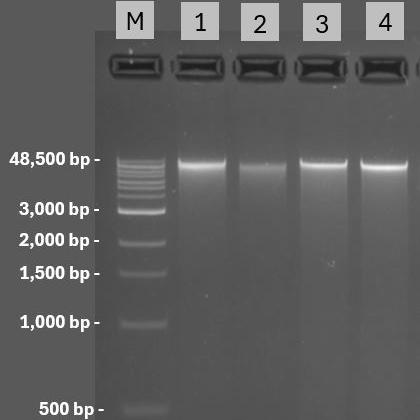
The resulting DNA concentration and yield using this protocol is appropriate for agarose gel electrophoresis, PCR, long read whole genome sequencing, such as Oxford Nanopore Technology, as well as short read sequencing. Users can expect DNA concentrations of greater than 15 ng/uL as measured by QuBit Fluorometry analysis (Quant-iT 1x dsDNA Broad Range Kit or equivalent).
Image Attribution
Mitchell G Hedges 2025 (20250312_EXPMH138)
Guidelines
- Expected input: Mid-log phase bacterial broth cultures of between >1 x 10⁶ to 2 x 10⁹ cells, however lower counts may be extracted successfully.
- Expected output: Users can expect DNA concentrations in the range of 15 to 100 ng/uL with sufficient volume for quantification, agarose gel electrophoresis and long read sequencing, assuming 100 ng, 50 ng and 400 ng requirements respectively.
- Intended End Use: Bacterial DNA extracted using this protocol is appropriate for whole genome sequencing such as Oxford Nanopore Technology long read sequencing, or PCR based applications.
Materials
- DNeasy Blood & Tissue Kit (QIAGEN #69504 or 69506)
- 100% Ethyl alcohol Molecular Biology Grade (Sigma Merck #E7023-1L)
- RNase A, DNase & Protease-Free (Thermo Fisher #EN0531)
- UltraPure molecular grade water (Thermo Fisher #10977023)
- UltraPure 0.5M EDTA, pH 8.0 (Thermo Fisher #15575020)
- MetaPolyzyme DNA free (Sigma #MAC4LDF-5X1VL)
- Phosphate Buffered Saline Microbial DNA free (Sigma #MBD0058-1ML)
- PBS - Phosphate-Buffered Saline (10X) pH 7.4, RNase-free (Thermo Fisher #AM9624)
- 1.5 mL Eppendorf DNA LoBind tubes (Thermo Fisher #30108.051)
- Thermoshaker heating block (Thermo Fisher #0006286)
- Microcentrifuge (Thermo Fisher #43231565)
Troubleshooting
Problem
Gram-positive sample did not yield sufficient DNA.
Solution
Extend the metapolyzyme incubation duration up to 24 hours.
Problem
Sample DNA concentration is low.
Solution
Increase input of cells.
or
Perform a SPRI bead clean up using a 1.8X or conservative bead ratio and elute in 30 uL.
Before start
- Preheat the thermomixer to 37°C.
- All centrifugation steps are carried out at room temperature (15–25°C) in a microcentrifuge.
- Vortexing should be performed by pulse-vortexing for 5–10 s.
- If using frozen cells, equilibrate the sample to room temperature (15–25°C) prior to commencing the protocol.
Preparation of reagents
15m
EDTA (50 mM) Working Solution
- For each sample, combine 198 µL of molecular grade water with 22 µL of 0.5 Mass Percent EDTA for a final concentration of 50 millimolar (mM) .
2m
DNEasy Blood & Tissue Kit Buffer Preparation
- Prepare kit buffers Buffer AW1 and Buffer AW2 with 100% molecular grade ethanol as per the manufacturer's manual.
3m
Metapolyzyme Resuspension
- Determine the bacterial enzymatic activity (U) per vial using the lot specific Certificate of Analysis as provided by the manufacturer.
- Reconstitute the vial of lyophilised metapolyzyme to ensure that within a 10 µL volume, at least 5000 µL of enzyme is applied. For most batches, reconstituting with approximately 50 µL of 1X PBS (microbial DNA free, Sigma #MBD0058-1ML) ensures a 10 µL dose will contain at least 5000 µL of enzyme. Users may wish to optimise the volumes used during reconstitution to ensure a sufficient dose within 10 µL whilst maximising the number of doses from a vial.
- Place on ice just before use. Store unused aliquots at -20 °C for long term storage as per manufacturers instructions.
10m
Dilution of the 10X PBS Stock Solution
- Dilute the 10X PBS stock to a 1X PBS final concentration using molecular grade water. For each Gram-positive sample, add 33 µL of 10X PBS to 297 µL of molecular grade water in a clean, labelled tube.
Gram-negative Bacterial DNA extraction
1h 5m
Harvest bacterial cells in a microcentrifuge tube by centrifuging at 13000 x g for 00:01:00 and then discard the supernatant.
Use a minimum 1 x 10⁶ cells to a maximum of 2 x 10⁹ cells. If the cell concentration is unknown, use 1 mL of an overnight bacterial cell suspension.
2m
Perform a cell wash by gently resuspending the cell pellet with200 µL of the 50 millimolar (mM) EDTA wash and incubating at room temperature for 00:02:00 .
3m
Centrifuge for 00:01:00 at 13000 x g , then discard supernatant.
2m
Resuspend the cell pellet in 180 µL Buffer ATL and add 20 µL proteinase K, then vortex thoroughly for 10 seconds.
1m
Add 5 µL of RNAse A and vortex for 00:00:05 , incubate for 00:15:00 at 37 °C at 500 rpm in the thermomixer.
16m
Incubate at 56 °C for 00:15:00 at 500 rpm in the thermomixer. Spin down tubes after incubation to remove any accumulated moisture from the tube lids.
16m
To each tube containing the lysis mixture, add 200 µL of Buffer AL and mix thoroughly by vortexing.
1m
Promptly add 200 µL of ethanol (96 – 100%) and mix again thoroughly by vortexing.
It is essential that the sample, Buffer AL, and ethanol are mixed immediately and thoroughly by vortexing or pipetting to yield a homogeneous solution.
1m
Incubate at 56 °C for 00:05:00 .
If a gelatinous mass is present, vigorously vortex or pipette mix with a P200 tip every 2 minutes to homogenise the mass.
6m
Pipette the mixture into a labelled silica-membrane spin column. Centrifuge the spin column at 6000 x g for 00:01:00 , discarding the throughflow into a waste container. The throughflow is not compatible with bleach. Discard the tube to avoid liquid cross contamination.
During the centrifugation, aliquot 110 µL of Buffer AE into a clean, labelled microcentrifuge tube and incubate at 56 °C .
2m
Place the silica-membrane spin column in a new collection tube, discard any used collection tubes and any throughflow.
1m
Add 500 µL of ethanol Wash Buffer 1 (AW1) onto the spin column and centrifuge the spin column in the collection tube at 6000 x g for 00:01:00 . Discard the throughflow and do not combine with bleach. Discard the used collection tube. Place the spin column in a new and clean collection tube.
2m
Add 500 µL of Wash Buffer 2 (AW2) into the spin column, centrifuge the spin column in the collection tube at maximum speed 16000 x g to 20000 x g for 00:01:00 .
2m
Discard the throughflow (this is compatible with bleach if required by laboratory processes) and replace the column back into the collection tube and spin at maximum speed 16000 x g to 20000 x g for 00:03:00 to dry the column.
4m
Place the spin column in a labelled, clean 1.5 mL LoBind tube (which will become the final sample tube for storage) and pipette 100 µL of warmed (56 °C ) Buffer AE directly onto the membrane. Incubate at 56 °C for 00:01:00 and then centrifuge for 00:01:00 at ≥ 6000 x g to elute.
3m
Re-elute the sample by pipetting the eluate back onto the silica membrane and incubate at 56 °C for 00:01:00 then centrifuge for 00:01:00 at ≥ 6000 x g to re-elute.
2m
Store the eluate containing the DNA at 2 - 8 ℃ in a labelled tube and take forward to DNA QA/QC processes, whole genome sequencing or PCR.
1m
Optional (recommended): Quantify the extracted DNA using a 1x dsDNA Broad Range Kit and a sample volume of 5 µL . Following favourable quantification, load 50 ng of DNA with a loading dye onto a 1% TAE agarose gel prepared with 1X SYBR Safe Stain and run at 100V for 01:00:00 to assess DNA quality. Ensure a ladder such as 1kb Extend DNA Ladder (NEB) is used and loaded at the same mass as the DNA samples for visualisation on a trans-UV system such as ChemiDoc.
Gram-positive Bacterial DNA extraction
3h 36m
Harvest bacterial cells in a microcentrifuge tube by centrifuging at 13000 x g for 00:01:00 and then discard the supernatant.
Use a minimum 1 x 10⁶ cells to a maximum of 2 x 10⁹ cells. If the cell concentration is unknown, use 1 mL of an overnight bacterial cell suspension.
2m
Perform a cell wash by gently resuspending the cell pellet with200 µL of the 50 millimolar (mM) EDTA wash and incubating at room temperature for 00:02:00 .
3m
Centrifuge for 00:01:00 at 13000 x g , discard supernatant.
2m
Resuspend and wash cells with 200 µL of 1X PBS by pipetting ten times, then pellet the cells at 13000 x g for 00:01:00 , discard supernatant.
2m
Resuspend the cell pellet in 90 µL of 1X PBS.
1m
Add >5000 µL of metapolyzyme (this should be approximately 10 µL ) and mix by pipetting, then incubate for 02:00:00 at 37 °C at 500 rpm in thermomixer.
Users may wish to extend the enzymatic treatment with Metapolyzyme for Gram-positive lysis to 4 hours which will increase the yield and concentration of DNA. Our data showed that a two hour incubation would strike a balance between laboratory time-efficiency and DNA yield, for the purpose of long read sequencing. Users may extend this incubation to 24 hours as per the manufacturer's literature.
2h
Add 20 µL of proteinase K, mix by pipetting.
1m
Add 5 µL of RNAse A (0.2 mg/mL final concentration) and pipette mix until homogenous.
1m
Incubate for 00:15:00 at 37 °C at 500 rpm in the thermomixer.
16m
Incubate at 56 °C for 00:15:00 at 500 rpm in the thermomixer. Spin down tubes after incubation to remove any accumulated moisture from the tube lids.
16m
Add 75 µL of molecular grade water.
1m
Add 200 µL Buffer AL to tube and mix via pipetting.
1m
Incubate at 56 °C for 00:30:00 .
30m
Add 200 µL of ethanol (96 – 100%) and mix thoroughly by vortexing to yield a homogeneous solution.
1m
Incubate at 56 °C for 00:02:00 . If gelatinous debris is present, vortex or pipette mix with a P200 tip every 00:02:00 to assist lysis.
3m
Pipette the mixture into a labelled silica-membrane spin column. Centrifuge the spin column at 6000 x g for 00:01:00 , discarding the throughflow into a waste container. The throughflow is not compatible with bleach. Discard the tube to avoid liquid cross contamination.
During the centrifugation, aliquot 60 µL of Buffer AE into a clean, labelled microcentrifuge tube and incubate at 56 °C .
2m
Place the silica-membrane spin column in a new collection tube, discard any used collection tubes and any throughflow.
1m
Add 500 µL of ethanol Wash Buffer 1 (AW1) onto the spin column and centrifuge the spin column in the collection tube at 6000 x g for 00:01:00 . Discard the throughflow and do not combine with bleach. Discard the used collection tube. Place the spin column in a new and clean collection tube.
1m
Add 500 µL of Wash Buffer 2 (AW2) into the spin column, centrifuge the spin column in the collection tube at maximum speed 16000 x g to 20000 x g for 00:01:00 .
2m
Discard the throughflow (this is compatible with bleach if required by laboratory processes) and replace the column back into the collection tube and spin at maximum speed 16000 x g to 20000 x g for 00:03:00 to dry the column.
4m
Place the spin column in a labelled, clean 1.5 mL LoBind tube (which will become the final sample tube for storage) and pipette 50 µL of warmed (56 °C ) Buffer AE directly onto the membrane. Incubate at 56 °C for 00:01:00 and then centrifuge for 00:01:00 at ≥ 6000 x g to elute.
3m
Re-elute the sample by pipetting the eluate back onto the silica membrane and incubate at 56 °C for 00:01:00 then centrifuge for 00:01:00 at ≥ 6000 x g to re-elute.
3m
Store the eluate containing the DNA at 2 - 8 ℃ in a labelled tube and take forward to DNA QA/QC processes, whole genome sequencing or PCR.
Optional (recommended): Quantify the extracted DNA using a 1x dsDNA Broad Range Kit and a sample volume of 5 µL . Following favourable quantification, load 50 ng of DNA with a loading dye onto a 1% TAE agarose gel prepared with 1X SYBR Safe Stain and run at 100V for 01:00:00 to assess DNA quality. Ensure a ladder such as 1kb Extend DNA Ladder (NEB) is used and loaded at the same mass as the DNA samples for visualisation on a trans-UV system such as ChemiDoc.
Protocol references
QIAGEN DNeasy Blood & Tissue Handbook (June 2023)
MetaPolyzyme, DNA free, Product Information, Rev 06/25