Aug 18, 2025
Effect of Exercises on Pain and Discomfort During Periods in adult female students
- Ms. Jarin Tasnim1,
- Sharmila Jahan1
- 1Jashore University of Science and Technology



Protocol Citation: Ms. Jarin Tasnim, Sharmila Jahan 2025. Effect of Exercises on Pain and Discomfort During Periods in adult female students. protocols.io https://dx.doi.org/10.17504/protocols.io.kxygx43ykl8j/v1
License: This is an open access protocol distributed under the terms of the Creative Commons Attribution License, which permits unrestricted use, distribution, and reproduction in any medium, provided the original author and source are credited
Protocol status: Working
We use this protocol and it's working
Created: August 16, 2025
Last Modified: August 18, 2025
Protocol Integer ID: 224808
Keywords: managing primary dysmenorrhea, menstrual distress in the intervention group, menstrual distress among female university student, exercise intervention group, effect of exercise, menstrual distress, primary dysmenorrhea, discomfort during period, breathing exercise, adult female students this protocol, physiotherapy, reducing pain, significant reduction in pain intensity, exercise, period, based intervention, female student, pain intensity, female university student, discomfort, effectiveness of core stabilization, intervention group
Disclaimer
This protocol is provided for research and educational purposes only. The authors and affiliated institutions are not responsible for any adverse outcomes resulting from the use or misapplication of this protocol. Users must ensure all procedures comply with local regulations, institutional approvals, and ethical guidelines before implementation.
Abstract
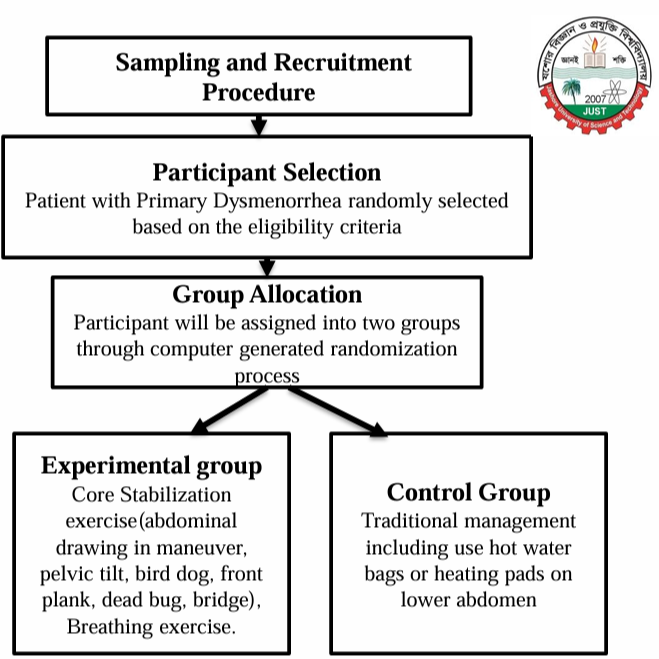
This protocol describes a randomized controlled trial to evaluate the effectiveness of core stabilization and breathing exercises in reducing pain and menstrual distress among female university students with primary dysmenorrhea. 50 participants aged 18–25 years will be randomly assigned to either an exercise intervention group or a control group receiving traditional management over a 4-week period.
The expected results are a significant reduction in pain intensity and menstrual distress in the intervention group, along with improvements in quality of life and sleep quality compared to controls. These findings aim to support physiotherapy-based interventions as safe and effective strategies for managing primary dysmenorrhea.

Guidelines
- Orientation and one familiarization session will be provided before intervention to ensure correct technique.
- Participants should wear comfortable clothing, avoid heavy meals 1 hr prior, and maintain a menstrual diary.
- Written informed consent is mandatory before enrollment.
- Initial sessions supervised by a physiotherapist; participants must stop immediately if severe pain, dizziness, heavy bleeding, or abnormal discomfort occurs.
- First aid and emergency support will be available on-site.
- Adherence will be monitored weekly with exercise logs; any adverse events will be documented and reported to the IRB.
- Study approved by IRB, Jashore University of Science and Technology (PTR-JUST/IRB/2025/04/015), following the Declaration of Helsinki.
- Participation is voluntary; withdrawal is allowed anytime without penalty.
- Confidentiality of participant data ensured; no financial burden on participants.
Materials
- Yoga/exercise mat
- Timer or stopwatch
- Comfortable exercise clothing for participants
- Pillows or cushions (for exercise support)
- Hot water bag (for home use during menstruation)
- Visual Analogue Scale (VAS)
- Menstrual Distress Questionnaire (MEDI-Q)
- Pittsburgh Sleep Quality Index (PSQI)
- Exercise log sheets for adherence tracking
- Menstrual diary for participants
- Consent forms and participant information sheets
- First aid kit for emergencies
- Sanitizers or wipes for hygiene
- Pen/pencil and notepads for session notes
Safety warnings
- Participants must immediately stop the intervention if they experience severe abdominal pain, dizziness, shortness of breath, heavy menstrual bleeding, or unusual discomfort.
- Only perform exercises under the initial supervision of a qualified physiotherapist to prevent incorrect technique or injury.
- Do not continue intervention if any adverse events occur until cleared by the study supervisor/medical team.
- Participants should avoid taking pain-relieving medications during the study unless absolutely necessary and must report any use to the research team.
- High-risk individuals (secondary dysmenorrhea, pelvic surgery, hormonal therapy, high physical activity) are excluded to reduce potential harm.
Ethics statement
This study does not involve animals. It involves only human participants with primary dysmenorrhea.
As per standard protocols, experiments involving animals must be conducted according to internationally accepted standards and must always have prior approval from an Institutional Animal Care and Use Committee (IACUC) or equivalent ethics committee(s). Prior approval must be obtained before performing such experiments, and relevant permit numbers should be reported.
For this protocol, animal ethics approval is not applicable. The study has obtained human ethics approval from the Institutional Review Board (IRB), Jashore University of Science and Technology (Approval No: PTR-JUST/IRB/2025/04/015).
Protocol references
- Azagew, A. W. (2020). Prevalence of primary dysmenorrhea, its intensity, impact and associated factors among female students’ at Gondar town preparatory school, Northwest Ethiopia. BMC Women's Health, 20(1), 5. https://doi.org/10.1186/s12905-019-0873-4
- Burnett, M. &. (2017). No. 345-primary dysmenorrhea consensus guideline. Journal of Obstetrics and Gynaecology Canada, 39(7), 585–595. https://doi.org/10.1016/j.jogc.2016.12.023
- Daley, A. (2009). The role of exercise in the treatment of menstrual disorders: the evidence. The British Journal of General Practice, 59(561), 241. https://doi.org/10.3399/bjgp09X420301
- Golomb, L. M. (1998). Primary dysmenorrhea and physical activity. Medicine and Science in Sports and Exercise, 30(6), 906–909. https://doi.org/10.1097/00005768-199806000-00020
- Kaur, S. K. (2014). To compare the effect of stretching and core strengthening exercises on Primary Dysmenohrrea in Young females. IOSR Journal of Dental and Medical Sciences, 1(13), 22–32. https://doi.org/10.9790/0853-13652232
- KHAN, N. N. (2021). Effects of Aerobics Versus Core Stability Exercises for the Management of Primary Dysmenorrhea. Pakistan Journal of Medical & Health Sciences, 25(2.64), 21–38. https://doi.org/10.53350/pjmhs211582442
- Kirmizigil, B. &. (2020). Effectiveness of functional exercises on pain and sleep quality in patients with primary dysmenorrhea: a randomized clinical trial. Archives of Gynecology and Obstetrics, 302(1), 153–163. https://doi.org/10.1007/s00404-020-05579-2
- Saleh, H. S. (2016). Stretching or Core Strengthening Exercises for Managing Primary Dysmenorrhea. Journal of Women’s Health Care, 5(295), 2167–0420. https://doi.org/10.4172/2167-0420.1000295
- Unsal, A. A. (2010). Prevalence of dysmenorrhea and its effect on quality of life among a group of female university students. Upsala Journal of Medical Sciences, 115(2), 138–145. https://doi.org/10.3109/03009730903457218
- Wahyuni, W. &. (2022). The effect of deep breathing exercise in minimizing pain level of primary dysmenorrhea: Study at physiotherapy students of Universitas Muhammadiyah Surakarta. International Journal of Health Sciences, 6(S3), 11745–11753. https://doi.org/10.53730/ijhs.v6nS3.8828
Acknowledgements
We sincerely acknowledge the support and guidance of Dr. Sharmila Jahan, PT, our supervisor. The study was partially funded by the department of Physiotherapy and Rehabilitation and was approved by the Institutional Review Board (IRB), department of Physiotherapy and Rehabilitation, Jashore University of Science and Technology, Jashore-7408, Bangladesh. We also thank all participants who voluntarily took part in this research. Their cooperation ensures the integrity, credibility, and transparency of this work.