Dec 11, 2023
EdU Staining Protocol in juvenile F. hepatica
- Paul McCusker1,
- Duncan Wells1,
- Rebecca Armstrong1,
- Emily Robb1,
- Paul McVeigh1,
- Nathan Clarke1,
- Erica Gardiner1,
- Erin McCammick1,
- Aaron Maule1
- 1Queen's University Belfast



Protocol Citation: Paul McCusker, Duncan Wells, Rebecca Armstrong, Emily Robb, Paul McVeigh, Nathan Clarke, Erica Gardiner, Erin McCammick, Aaron Maule 2023. EdU Staining Protocol in juvenile F. hepatica. protocols.io https://dx.doi.org/10.17504/protocols.io.eq2lyjnrrlx9/v1
License: This is an open access protocol distributed under the terms of the Creative Commons Attribution License, which permits unrestricted use, distribution, and reproduction in any medium, provided the original author and source are credited
Protocol status: Working
We use this protocol and it's working
Created: July 31, 2023
Last Modified: December 11, 2023
Protocol Integer ID: 85723
Keywords: Fasciola, EdU, Proliferative cells, juvenile fasciola hepatica with the thymidine analogue, juvenile fasciola hepatica, staining proliferative cell, staining protocol, schistosoma mansoni, thymidine analogue, proliferative cell
Funders Acknowledgements:
LIVER FLUKE MOTOR FUNCTION AND PARASITE CONTROL: EXPLOITING A 'TARGET VALIDATION TOOLBOX' AS A DRUG SCREEN-INTERFACE FOR FLUKICIDE DISCOVERY
Grant ID: BB/K009583/1
Probing in vivo parasite biology in vitro
Grant ID: NC/N001486/1
Exploiting stem cell biology for liver fluke control
Grant ID: BB/T002727/1
Abstract
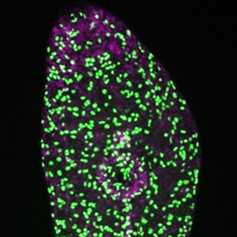
This protocol describes the process of labelling and whole mount staining proliferative cells in in vitro juvenile Fasciola hepatica with the thymidine analogue 5-ethynyl-2′-deoxyuridine (EdU). The protocol is based on the Schistosoma mansoni EdU staining protocol developed by the Collins and Newmark groups. A full copy of that protocol is available here - http://collinslab.org/PDF/Whole_mount_EdU_Smansoni.pdf.
Guidelines
Fixation
While flat fixing is necessary for worms grown for more than three weeks in vitro younger worms may be suitable for free fixing in 4%FA.
Materials
CS50 - 50% Chicken Serum, New Zealand OriginThermo FisherCatalog #16110082 and 50% RPMI 1640 Medium, no phenol redThermo FisherCatalog #11835105 with x1 Antibiotic Antimycotic Solution (100×), StabilizedMerck MilliporeSigma (Sigma-Aldrich)Catalog #A5955
PBSTx - 1X PBS + 0.3% Triton X-100Merck MilliporeSigma (Sigma-Aldrich)Catalog #T8787-50ML
4%FA - 500 µL Formaldehyde solutionMerck MilliporeSigma (Sigma-Aldrich)Catalog #F8775-25ML with 4 mL PBSTx
4%PFA - Add 8 g Paraformaldehyde to 100 mL millipore water, stir/heat in a flow hood for 1 h between 55 °C and 60 °C on hotplate (NB. must NOT go above 60oC; if it does, start again). Following 1 h heating turn off heat and add NaOH dropwise until solution goes clear before adding 100 mL 2X PBS. and mix. Store at 4 °C for 2 weeks or-20 °C in aliquots for 6 months.
EdU Detection Solution
| A | B | C | D | E | |
| Reagent | 200 (µl) | 1 ml (µl) | 5ml (ml) | 10ml (ml) | |
| PBS | 158 | 789 | 3.945 | 7.89 | |
| 100mM Copper Protectant in Water (Store 4oC) | 2 | 10 | 0.05 | 0.1 | |
| 10mM AlexaFluor (488 or 545)/6-FAM azide | 0.2 | 1 | 0.005 | 0.01 | |
| 500mM Ascorbic Acid (Make fresh – 88 mg in 1 ml PBS) | 40 | 200 | 1 | 2 |
Copper protectant - Copper(II) sulfateMerck MilliporeSigma (Sigma-Aldrich)Catalog #451657
Alexafluor 488 - Azide-fluor 488Merck MilliporeSigma (Sigma-Aldrich)Catalog #760765
6-FAM azide - 6-Fam AzideMetabion
DAPI solution - 1:1000 of 1 mg/mL stock in PBSTx
Protocol materials
Triton X-100Merck MilliporeSigma (Sigma-Aldrich)Catalog #T8787-50ML
RPMI 1640 Medium, no phenol redThermo FisherCatalog #11835105
Azide-fluor 488Merck MilliporeSigma (Sigma-Aldrich)Catalog #760765
Copper(II) sulfateMerck MilliporeSigma (Sigma-Aldrich)Catalog #451657
Chicken Serum, New Zealand OriginThermo FisherCatalog #16110082
6-Fam AzideMetabion
Antibiotic Antimycotic Solution (100×), StabilizedMerck MilliporeSigma (Sigma-Aldrich)Catalog #A5955
Formaldehyde solutionMerck MilliporeSigma (Sigma-Aldrich)Catalog #F8775-25ML
VECTASHIELD Mounting MediumVector LaboratoriesCatalog #H-1000
Safety warnings
EdU Mutagen
As a thymidine analogue EdU is known for germ cell mutagenicity and reproductive toxicity. Particular care should be taken when disposing of the chemical and around pregnant mothers.
In vitro addition of EdU to juvenile F. hepatica
1d
Juvenile liver fluke are cultured in 50% Chicken serum (CS50) as described in McCusker et al. (2016).
10 µL of 10 millimolar (mM) 5-Ethynyl-2'-deoxyuridine (EdU) is mixed with 190 µL pre-warmed CS50 and added to worms for between 6 and 24 h.
Stain immediately following EdU incubation15 steps
Fixation
Add 20 µL 4% FA/4% PFA to a petri dish.
Pipette worms in into 4% FA/4% PFA and immediately flatten with coverslip and weight (e.g. half full 15 mL falcon tube) for 10 min.
Add 4% FA/4% PFA to float coverslip. Lift coverslip and move worms into 1.5 mL eppendorf with 1 mL 4% FA/4% PFA. Place tube on a rotator for further 10 min (4%FA)/2 h (4%PFA) at Room temperature OR O/N at4 °C .
OPTIONAL Storage Step
Wash in 1 mL PBSTx for 10 min.
Wash in 1 mL 1:1 PBSTx:Methanol for 10 min.
Store in 1 mL methanol at -20 °C until required.
Rehydrate in 1 mL 50:50 PBSTx:Methanol for 10 min.
Staining
x2 washes in 1 mL PBSTx for 10 min each.
Incubate in 1 mL fresh Proteinase K Solution for 15 min at Room temperature .
Postfix in 1 mL 4%FA for 10 min.
Wash in 1 mL PBSTx for 10 min.
Incubate in EdU Detection Solution for 30 min at Room temperature . NB: cover with tinfoil from this point on.
x2 washes in 1 mL PBSTx for 5 min each
Incubate in 1 mL DAPI Solution for 20 min at Room temperature or O/N at 4 °C .
Rinse in PBSTx and mount in VECTASHIELD Mounting MediumVector LaboratoriesCatalog #H-1000 .
Protocol references
McCusker, P., McVeigh, P., Rathinasamy, V., Toet, H., McCammick, E., O'Connor, A., Marks, N. J., Mousley, A., Brennan, G. P., Halton, D. W., Spithill, T. W., & Maule, A. G. (2016). Stimulating Neoblast-Like Cell Proliferation in Juvenile Fasciola hepatica Supports Growth and Progression towards the Adult Phenotype In Vitro. PLoS Neglected Tropical Diseases, 10(9), [e0004994]. https://doi.org/10.1371/journal.pntd.0004994