Jan 18, 2024
DNA isolation from cattle semen for long read sequencing
Peer-reviewed method
- Erwan Denis1,
- Cecile CG Grohs2,
- Carole Iampietro1
- 1INRAE, US 1426, GeT-PlaGe, Genotoul, France Genomique, Université Fédérale de Toulouse, Castanet-Tolosan, France;
- 2Université Paris-Saclay, INRAE, AgroParisTech, GABI, 78350, Jouy-en-Josas, France
- PLOS ONE Lab ProtocolsTech. support email: [email protected]



External link: https://doi.org/10.1371/journal.pone.0308011
Protocol Citation: Erwan Denis, Cecile CG Grohs, Carole Iampietro 2024. DNA isolation from cattle semen for long read sequencing. protocols.io https://dx.doi.org/10.17504/protocols.io.j8nlkw1qwl5r/v1
Manuscript citation:
Denis E, Grohs C, Donnadieu C, Iampietro C (2024) Validated DNA isolation method ensuring successful long-read sequencing of cattle semen genome. PLOS ONE 19(8). doi: 10.1371/journal.pone.0308011
License: This is an open access protocol distributed under the terms of the Creative Commons Attribution License, which permits unrestricted use, distribution, and reproduction in any medium, provided the original author and source are credited
Protocol status: Working
We use this protocol and it's working
Created: March 24, 2023
Last Modified: January 18, 2024
Protocol Integer ID: 79397
Keywords: extraction, high molecular weight, sperm, DNA, Long read sequencing, bovine, DNA isolation, PacBio, dna isolation from cattle semen, dna from sixty semen straw, cattle semen, available frozen bull semen straw, dna isolation, washing of semen, sixty semen straw, semen, precipitation of genomic dna, sequencing mode, genomic dna, removal of protein, dna, high molecular weight dna
Funders Acknowledgements:
European Union and Occitanie region
Grant ID: Operational Program FEDER-FSE MIDI-PYRENEES ET GARONNE 2014-2020
Abstract
Here we describe a method for isolate high molecular weight DNA from commercially available frozen bull semen straws.
This protocol is based on a salting-out method and uses several commercially available solutions. It consists of several steps: washing of semen, lysis, removal of proteins and precipitation of genomic DNA.
This protocol was used to isolate DNA from sixty semen straws, all of which were successfully sequenced using the CLR sequencing mode on the PacBio SequelII platform.
Guidelines
Salting out is a good method to obtain high molecular weight (HMW) DNA, as it avoids damaging steps such as the use of purification columns or heavy mixing with phenol/chloroform.
Note that all mixing steps should be gentle to obtain HMW DNA fragments (from lysis steps to DNA precipitation). We also recommend to use DNA low bind tubes.
Protocol materials
Tris(2-carboxyethyl)phosphine hydrochloride solutionMerck MilliporeSigma (Sigma-Aldrich)Catalog #646547-10X1ML
Buffer RLTQiagenCatalog #79216
Phosphate-buffered saline, pH 7.4
DNA LoBind Tubes 2.0 mLEppendorfCatalog #30108078
EB bufferQiagenCatalog #19086
Isopropanol
Puregene Tissue Kit QiagenCatalog #158063
Proteinase KQiagenCatalog #19133
Safety warnings
See Safety Data Sheets for warnings and safety hazards.
Before start
As we use commercial sperm straws to perform our extractions, we do not always know the composition of these straws, the quantity of material contained, the nature of the diluents and preservatives used. This is why it is sometimes necessary to use several straws to obtain enough material for sequencing. It is also sometimes wise to perform several washes (see step 3) to eliminate contaminants from diluents and preservatives.
Preparation of reagents
Immidiately before use, prepare a mix containing RLT buffer (Qiagen) and TCEP [Tris(2-carboxyethyl)phosphine hydrochloride] to a final volume of 500µL per sample as follow:
-450 µL RTL
-50 µL TCEP
Buffer RLTQiagenCatalog #79216
Tris(2-carboxyethyl)phosphine hydrochloride solutionMerck MilliporeSigma (Sigma-Aldrich)Catalog #646547-10X1ML
Note
This mixture of a guanidine-based reagent (RLT) and a thiol-free reducing agent facilitate dissociation of disulfide bonds (Wu et al, 2018).
TCEP is odorless, and more stable than DTT (Han & Han, 1994).
Citation
LINK
Citation
LINK
Preparation of sample
Recovery of spermatozoa from the straw:
- Empty the 200 µL Sample in a 2 mL tube by cutting the two ends of the straw
DNA LoBind Tubes 2.0 mLEppendorfCatalog #30108078
- Rince the straw it with 200 µL 1X PBS Room temperature
Phosphate-buffered saline, pH 7.4
Wash:
- Add 800 µL more PBS (up to 1 mL 1X PBS )
- Pellet 1000 x g, Room temperature, 00:05:00
- Discard the supernatant
Second wash is optional (no significant impact observed)
-Re-suspend in 1 mL 1X PBS
-Pellet 1000 x g, Room temperature, 00:05:00
-Discard the supernatant
Note
Centrifuge gently so that the pellet does not stick. It should be easy to resuspend for efficient lysis.
10m
Lysis
Step one:
Add 500 µL of RLT-TCEP to the pellet
- Vortex 00:00:10 by pulsing at max speed
- If necessary, use a wide opening tip to resuspend the pellet
- Incubate On ice 00:10:00
10m 10s
Step two: continue with Qiagen Puregene Tissue kit adapted as follow
- Add 500 µL of Cell Lysis Solution
- Add 60 µL of 20 mg/mL proteinase K (20 mg/ml)
- Mix by inversion ( about 25 inversions)
- Incubate 55 °C 01:30:00
Puregene Tissue Kit QiagenCatalog #158063
Proteinase KQiagenCatalog #19133
1h 30m
Remove RNA:
- 3 µL RNAse from Qiagen Puregene Tissue Kit
- Incubate 37 °C 00:15:00
- Incubate On ice 00:01:00
16m
Protein precipitation
1m 15s
- Add 200 µL of Protein precipitation buffer (from Qiagen Puregene Tissue Kit)
- Mix by hand or gently vortexing 00:00:15
- Incubate On ice 00:05:00
- Centrifuge 16000 x g, Room temperature, 00:01:00
6m 15s
DNA precipitation
6m
- Transfert the supernatant to a new tube containing 600 µL of Isopropanol
- Carrefully invert the tube 25-50X times to form the pellet
- Incubate 00:05:00 Room temperature
- Centrifuge 16000 x g, 00:01:00
- Discard supernatant
Isopropanol
6m
- Add 600 µL of 70% ethanol to the pellet
- Centrifuge 5000 x g, 00:02:00
- Discard supernatant
- Almost dry the pellet Room temperature 00:05:00
- Add 50 µL to 100 µL of EB (Qiagen) or TE buffer to eluate DNA
- Store DNA at 4°C
EB bufferQiagenCatalog #19086
Note
DNA in EB buffer can be heated to 60°C for 1 hour to dissolve it. Do not vortex or pipet DNA.
It is recommended not to freeze the DNA to preserve long fragments.
Expected result
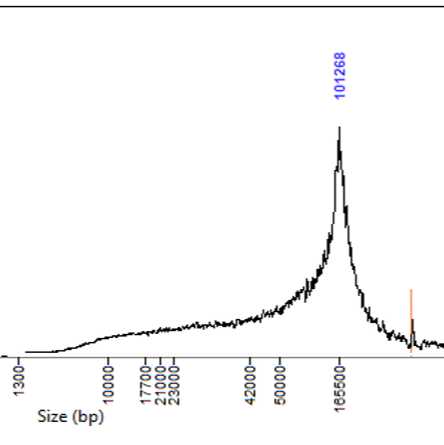
Of the 60 extractions carried out using this protocol, the average size of the fragments generated is around 53 kb, ranging from 25 to 120 kb on average. We expect 30 ug of DNA from a commercial semen straw, but this figure can vary considerably from sample to sample. We obtained absorbance ratios of 260/280 for DNA of around 1.8 nm, and 260/230 ratios averaging 0.5 nm. Low ratios have already been observed using RLT buffer (Wu et al, 2018), but these did not affect PacBio sequencing significantly.
Some of these DNA have been sequenced and published in Jourdain et al. 2023.
Citation
LINK
Citations
Step 1
Han JC & Han GY. A Procedure for Quantitative Determination of Tris(2-Carboxyethyl)phosphine, an Odorless Reducing Agent More Stable and Effective Than Dithiothreitol
https://doi.org/10.1006/abio.1994.1290Step 1
Wu H, de Gannes MK, Luchetti G, Pilsner JR. Rapid method for the isolation of mammalian sperm DNA.
https://doi.org/10.2144/000114280Step 9
Jourdain J, Barasc H, Faraut T, Calgaro A, Bonnet N, Marcuzzo C, Suin A, Barbat A, Hozé C, Besnard F, Taussat S, Grohs C, Kuchly C, Iampietro C, Donnadieu C, Pinton A, Boichard D, Capitan A. Large-scale detection and characterization of interchromosomal rearrangements in normozoospermic bulls using massive genotype and phenotype data sets.
https://doi.org/10.1101/gr.277787.123