Aug 15, 2022
DNA Extraction from Yeast
This protocol is a draft, published without a DOI.
- 1University of Wisconsin - Stout
- Yeast ORFans CURE



Protocol Citation: Brian Teague 2022. DNA Extraction from Yeast. protocols.io https://dx.doi.org/
License: This is an open access protocol distributed under the terms of the Creative Commons Attribution License, which permits unrestricted use, distribution, and reproduction in any medium, provided the original author and source are credited
Protocol status: Working
We use this protocol and it's working
Created: August 15, 2022
Last Modified: August 15, 2022
Protocol Integer ID: 68648
Keywords: dna, extraction, saccharomyces, pcr, lioac, sds, dna extraction from yeast, genomic dna out of yeast cell, dna extraction, pcr template, genomic dna, yeast cell, yeast
Abstract
This is a "quick and dirty" way to get some genomic DNA out of yeast cells. Not pure enough for many things, but should be fine for a PCR template.
This protocol is adapted from
Citation
LINK
who in turn adapted it from
Citation
LINK
Image Attribution
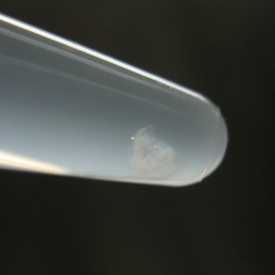
By gskx via Flickr. https://www.flickr.com/photos/gskx/89462961
Guidelines
The centrifugation steps all specify 21000 x g . If your microcentrifuge doesn't go this high, spin at the fastest speed available.
Materials
Equipment
- Dry bath at 72°C
- Dry bath at 42°C (optional)
Materials
- Sterile water
- Lithium Acetate DihydrateMerck MilliporeSigma (Sigma-Aldrich)Catalog #L4158 solution, 1 Mass Percent
- Sodium dodecyl sulfateMerck MilliporeSigma (Sigma-Aldrich)Catalog #436143-25G solution, 10 Mass / % volume
- Ethanol (100%, Molecular Biology Grade)Fisher ScientificCatalog #BP2818500
- Ethanol (100%, Molecular Biology Grade)Fisher ScientificCatalog #BP2818500 solution, 70 % (v/v)
- TE Buffer
Protocol materials
Ethanol (100%, Molecular Biology Grade)Fisher ScientificCatalog #BP2818500
TE Buffer
Lithium Acetate DihydrateMerck MilliporeSigma (Sigma-Aldrich)Catalog #L4158
Sodium dodecyl sulfateMerck MilliporeSigma (Sigma-Aldrich)Catalog #436143-25G
Safety warnings
Both lithium acetate and SDS are irritants, particularly in the eyes. Wear appropriate PPE, including safety glasses, lab coats and gloves.
SDS is particularly gnarly if it's inhaled. If you're making a solution from powdered SDS, use a dust mask and/or weigh it out in a hood.
Make 100 µL of yeast lysis solution by mixing the following in a 1.7 ml microcentrifuge tube:
- 70 µL H2O
- 20 µL Lithium Acetate DihydrateMerck MilliporeSigma (Sigma-Aldrich)Catalog #L4158 solution, 1 Mass Percent
- 10 µL Sodium dodecyl sulfateMerck MilliporeSigma (Sigma-Aldrich)Catalog #436143-25G solution, 10 Mass / % volume
Choose a yeast colony to analyze and circle it on the bottom of the petri dish. A large one is best.
Using a micropipette tip, scrape some of the colony off and resuspend it in the lysis solution. Vortex vigorously until the colony is mixed completely into the lysis solution.
Note
THIS IS NOT A CASE WHERE MORE IS BETTER. Your solution should be slightly cloudy. If it is quite "thick", then try again.
Incubate at 70 °C for 00:05:00
5m
Add 300 µL of Ethanol (100%, Molecular Biology Grade)Fisher ScientificCatalog #BP2818500 and vortex briefly. Centrifuge 21000 x g, 00:03:00 .
Note
Make sure the centrifuge is balanced!
3m
Using a P-1000 micropipettor, carefully aspirate the supernatant and discard as biological waste. Do not disturb the pellet.
Add500 µL of 70 % (v/v) Ethanol (100%, Molecular Biology Grade)Fisher ScientificCatalog #BP2818500 to the microcentrifuge tube. Centrifuge 21000 x g, 00:03:00 .
Note
Make sure the centrifuge is balanced!
3m
Using a P-1000 micropipettor, carefully aspirate the supernatant and discard as biological waste. Do not disturb the pellet. Try to get as much of the ethanol off as you can.
Let the pellet dry by leaving it in a 42 °C dry bath for 00:15:00 . Leave the cap open.
Note
If you don't have a dry bath, just leave the tube (cap open) at room temperature. Extend the time to 00:30:00
15m
Add 100 µL of TE Buffer and vortex to resuspend the pellet.
Centrifuge 21000 x g, 00:00:30 to collect the cellular debris at the bottom. The DNA remains suspended in the supernatant.
30s
Label the tube and store at -20 °C , or proceed directly to PCR.
If you need to use this sample again:
- Thaw the sample completely.
- Vortex briefly to resuspend everything.
- Centrifuge 21000 x g, 00:00:30 to (re)collect the cellular debris at the bottom of the tube.
30s
Citations
Blount BA, Driessen MR, Ellis T. GC Preps: Fast and Easy Extraction of Stable Yeast Genomic DNA.
https://doi.org/10.1038/srep26863Lõoke M, Kristjuhan K, Kristjuhan A. Extraction of genomic DNA from yeasts for PCR-based applications.
https://doi.org/10.2144/000113672