May 27, 2025
DNA extraction for unsorted bulk river samples
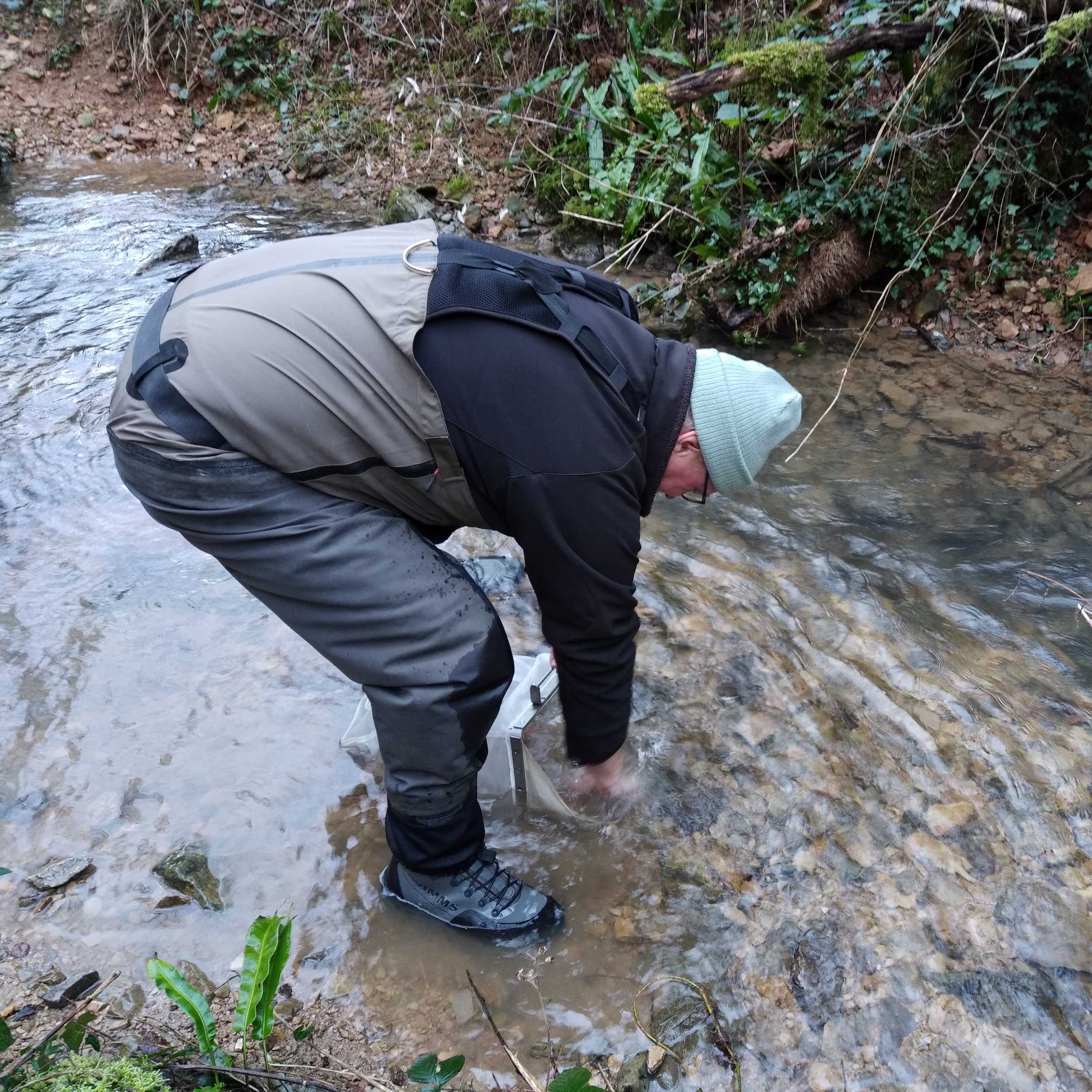
- Maïlys Gauthier1,
- Maxence Forcellini2,
- Bertrand Launay2,
- Guillaume LeGoff2,
- Thibault Datry2,
- Tristan Lefébure3
- 1Université Claude Bernard Lyon 1, LEHNA UMR 5023, CNRS, ENTPE, F-69622, Villeurbanne, France;
- 2INRAE, UR-Riverly, Centre de Lyon-Villeurbanne, Villeurbanne Cedex, France;
- 3UCBL



Protocol Citation: Maïlys Gauthier, Maxence Forcellini, Bertrand Launay, Guillaume LeGoff, Thibault Datry, Tristan Lefébure 2025. DNA extraction for unsorted bulk river samples. protocols.io https://dx.doi.org/10.17504/protocols.io.5jyl8dy27g2w/v1
License: This is an open access protocol distributed under the terms of the Creative Commons Attribution License, which permits unrestricted use, distribution, and reproduction in any medium, provided the original author and source are credited
Protocol status: Working
We use this protocol and it's working
Created: February 20, 2025
Last Modified: May 27, 2025
Protocol Integer ID: 122876
Keywords: kick-net sample, macroinvertebrate, bulk DNA, biodiversity, dna extraction for unsorted bulk river sample, unsorted bulk dna extraction methods for sample, community dna extraction, unsorted bulk dna extraction method, dna extraction, dna extraction with the qiagen powersoil pro kit, unsorted bulk river sample, extraction, bulk dna, dna, aquatic environment, algae, aquatic environment such as kick, net sample, macrozobenthos organism
Funders Acknowledgements:
ZABR - Agence de l'eau RMC
Grant ID: MISTRAL
PEPR OneWater, France 2030
Grant ID: ANR-22-PEXO-0011
Abstract
The objective of this protocol is to propose an unsorted bulk DNA extraction methods for samples collected in aquatic environment such as kick-net samples. These community DNA extractions can then be used to describe various aspect of these communities using for example metabarcoding approaches.
The protocol starts with a sample preserved in ethanol. The different steps of the protocol are:
- replacing the ethanol by a TNES Buffer,
- grinding the sample,
- DNA extraction with the Qiagen PowerSoil Pro kit.
This protocol has been optimized and tested on mock samples composed of macrozobenthos organisms, algae, bryophytes, leaf litter, sand, gravels, and ethanol.
Image Attribution
Maïlys Gauthier
Guidelines
The main steps of the protocol are :
Day 1 :
- Leaving the samples in TNES overnight
Day 2 :
- Grinding the samples
- Extraction using Qiagen PowerSoil Pro kit
Materials
- Materials
- Biosafety cabinet
- Cole-Parmer‱ SamplePrep HG-600 Geno/Grinder‱ 2010 Tissue Homogenizer and Cell Lyser
- 600µm nylon mesh : 2 per sample
- Elastic bands : 2 per sample
- Beaker for ethanol waste
- Beaker for TNES waste
- 10 mm stainless steel beads : 1 per sample
- 5 mm stainless steel beads : 100g per sample
- Tweezers
- Scale
- Clean spatula
- 1000µL pipette
- 100µL pipette
- Centrifuge
- Vortex
- Consumables
- Bench protection papers
- Qiagen Power Soil Pro kit
- 1000µL tips with filter
- 100µL tips with filter
- Reagents
- TNES buffer :
- Tris-HCl
- EDTA
- NaCl
- Samples to be extracted
- Samples in bulk sample containers prefilled with ethanol
Note: The bulk sample containers need to be autoclavable and watertight even in the genogrinder.
We used Bulk Wide-mouth Containers from CAPLUGS EVERGREEN, ref: 240-9750-W3L with the matching lids.
Before start
Before starting :
- Prepare TNES buffer : 100 mM Tris-HCl, 100 mM EDTA, 1,5 M NaCl
- Place all the equipment under UV light for 15min
Every 2 extractions
- Refill 9L of TNES
- Wash the meshes of the 2 extractions: spray with decontaminant (5% bleach, 0.5% NaOH, 0.5% detergent) and leave for 10 minutes, then rinse with demineralized water.
Between each extraction
Autoclave:
- Elastics
- Beads
- Tweezers if required
- Mesh (every 2 extractions)
- TNES (every 2 extractions)
PRE-EXTRACTION TREATMENT: Grinding with buffer
1d 1h 40m
These steps are done under a biosafety cabinet
DAY 1
Place all the equipment under UV light for 15min before starting (beaker, elastics, Day 1 mesh, bench protection paper, TNES)
- Empty the ethanol from the bulk sample container into a beaker using 600 µm nylon mesh.
Note: when pouring ethanol or TNES, make sure the mesh is taut and pulled tight at the elastic band to avoid leaks.
Note: Check that no material (especially organisms) remains on the mesh. If any remain, return them to the bottle (e.g. by flicking the top of the mesh).
- Add TNES buffer (100 millimolar (mM) Tris-HCL , 100 millimolar (mM) EDTA , 1.5 Molarity (M) NaCl ) to get a 2:1 ratio (TNES:sample) and homogenize (12 pipettings).
Note: Don't forget the treatment blank: 100 mL in an empty flask.
- Leave the samples in TNES Overnight at 4 °C
1d
At the end of Day 1 :
- Empty the ethanol beaker in a liquid container and set aside
- Put dirty elastics and mesh aside
10m
DAY 2
Place all the equipment under UV light for 15min before starting (beaker, elastics, mesh, tongs, Day 2 spatulas, beads, 2 bench protective papers)
- Recover Day 1 vials and keep on ice.
- Empty the TNES into a beaker using 600 µm nylon mesh.
Note: when pouring TNES, make sure the mesh is taut and pulled tight at the elastic band to avoid leaks.
Note: Check that no material (especially organisms) remains on the mesh. If any remain, return them to the bottle (e.g. by flicking the top of the mesh).
Removing TNES before grinding
- Add 1 x 10 mm stainless steel beads and 100g of 5 mm stainless steel beads to the flask.
- Clean the bench and replace the protective paper with a new one.
- Grind with Geno/Grinder:
- 3 cycles of : 5 * (2 min + 30 sec pause), 1500 rpm
- 10 min pause between each cycle.
Note: Run a cycle and check the sample's condition before starting a new one, stopping when the sample is fully ground up.
Inside a kick-net sample before (A) and after (B) grinding with steel beads in the Geno/Grinder
- Back under the biosafety cabinet, proceed directly to weighing for extraction (see the first step of Extraction section).
Note: At this stage, you can recover the beads (with tweezers if necessary) from the samples and return them to their boxes in the biosafety cabinet. This step can be carried out while the extraction tubes are being filled, or afterwards.
- Proceed to extraction or store at 4 °C or -20 °C until extraction.
1h 30m
EXTRACTION USING QIAGEN POWERSOIL PRO KIT (modified from Qiagen protocol)
1h 15m
DAY 2
- Spin the PowerBead Pro Tube briefly to ensure that the beads have settled at the bottom.
- Add up to 250 mg of matrice in the Power Bead Pro Tube with a clean spatula.
(250 µL of TNES buffer for treatment blank).
- Add 800 µL of solution CD1 .
- Homogenize samples thoroughly using the Geno/Grinder: 15000 rpm, 00:10:00
- Centrifuge the PowerBead Pro Tube at 15.000 x g, 00:01:00 .
- Transfer the supernatant to a clean 2 ml Microcentrifuge Tube (provided).
- Add 200 µL of Solution CD2 and vortex for 5 s.
- Centrifuge at 15.000 x g, 00:01:00 . Avoiding the pellet, transfer up to 700 µL of supernatant to a clean 2 ml Microcentrifuge Tube (provided).
- Add 600 µL of Solution CD3 and vortex for 5 s.
- Load 650 µL of lysate onto an MB Spin Column and centrifuge at 15.000 x g, 00:01:00 .
- Discard the flow-through and repeat the previous step to ensure that all of the lysate has passed through the MB Spin Column.
- Discard the flow-through and place the MB Spin Column into a clean 2ml Collection Tube (provided). Avoid splashing any flow-through onto the MB Spin Column.
- Add 500 µL of Solution EA to the MB Spin Column. Centrifuge at 15.000 x g, 00:01:00 .
- Discard the flow-through and place the MB Spin Column back into the same 2 ml Collection Tube.
- Add 500 µL of Solution C5 to the MB Spin Column. Centrifuge at 15.000 x g, 00:01:00 .
- Discard the flow-through.
- Centrifuge at 16.000 x g, 00:02:00 . Carefully place the MB Spin Column into a new 1.5 ml Elution Tube (provided).
- Add 70 µL of Solution C6 to the center of the white filter membrane.
- Centrifuge at 15.000 x g, 00:01:00 . Discard the MB Spin Column. The DNA is now ready for downstream applications.
Note: We recommend storing the DNA frozen (–30 to –15°C or –90 to –65°C) as Solution C6 does not contain EDTA.
1h
At the end of Day 2 :
- Empty buffer beaker
- Put dirty elastics and mesh aside
- Wash the elastics in demineralized water
- Decontaminate equipment (beaker + beads + tweezers + spatulas): spray with decontaminant (5% bleach, 0.5% NaOH, 0.5% detergent) and leave for 10 minutes, then rinse with demineralized water.
15m
Protocol references
Qiagen PowerSoil Pro manual : https://www.qiagen.com/us/resources/download.aspx?id=9bb59b74-e493-4aeb-b6c1-f660852e8d97&lang=en
Acknowledgements
Sophie Darinot for publising the protocol on protocols.io