Apr 18, 2025
DNA extraction and Nanopore library prep for ultralong-reads
- James Hemker1,
- Hannah Gellert1,
- Bernard Y Kim2
- 1Stanford University;
- 2Princeton University



Protocol Citation: James Hemker, Hannah Gellert, Bernard Y Kim 2025. DNA extraction and Nanopore library prep for ultralong-reads. protocols.io https://dx.doi.org/10.17504/protocols.io.14egn98wql5d/v1
Manuscript citation:
License: This is an open access protocol distributed under the terms of the Creative Commons Attribution License, which permits unrestricted use, distribution, and reproduction in any medium, provided the original author and source are credited
Protocol status: Working
We use this protocol and it's working
Created: November 12, 2024
Last Modified: April 18, 2025
Protocol Integer ID: 112003
Keywords: Drosophila, nanopore, ligation, bead-free, HMW, ultra-long, typical drosophila nanopore, nanopore library prep for ultralong, genome assembly of drosophila species, drosophila species, nanopore library prep, drosophila, dna extraction, genome assembly, genome, dna, using ont promethion sequencer, ont promethion sequencer, read n50, reads this protocol, sequencing
Funders Acknowledgements:
Bernard Y Kim
Grant ID: NIGMS F32GM135998
Dmitri A Petrov
Grant ID: NIGMS R35GM118165
Abstract
This protocol is optimized for rapid and cost-effective (about $150) genome assembly of Drosophila species from laboratory lines using ONT PromethION sequencers. Following this protocol, a typical Drosophila Nanopore sequencing run should have read N50 of 20-40kbp. Sequencing is halted at about 40-60X depth of coverage (10-14 Gbp on MinKNOW for most species, assuming ~20% of data is removed by a quality filter). Adapted from Kim et al. 2021
Guidelines
This protocol is used to prepare ~1-2 ug of Nanopore library from a single reaction. The amount loaded onto the flow cell depends on the quality of the library. Larger amounts of longer libraries should be loaded to keep the molar concentration of adapted ends consistent. However, longer libraries tend to clog the flow cell more quickly, necessitating frequent DNase flushing and reloading and reducing throughput. Two libraries with the same N50 but where one has a larger number of >100kb fragments will sequence differently.
Ballpark estimates of R10.4.1 library loads maintaining good pore occupancy are:
Read N50 1kb: 10-15 ng library
Read N50 5kb: 25 ng library
Read N50 10kb: 50 ng library
Read N50 20kb: 100 ng library
Read N50 30kb: 200 ng library
Read N50 40kb+: 300 ng library
To maximize read lengths, one should not wait until all active pores have been depleted to flush and reload. A DNase flush should take place as soon as sequencing throughput starts to decrease, or about every 8 hours. A flow cell with loaded library can be stored at 4C overnight with no ill effects.
Materials
MATERIALS
10% SDS solution
NEBNext Companion Module forOxford Nanopore Technologies Ligation Sequencing – 24 rxnsNew England BiolabsCatalog #E7180S
Ligation sequencing kit 1DOxford Nanopore TechnologiesCatalog #SQK-LSK109
ChloroformMerck MilliporeSigma (Sigma-Aldrich)Catalog #CX1055-6
Phenol Chloroform Isoamyl Alcohol (25:24:1) Tris-saturated (pH 8.0)Fisher ScientificCatalog #BP1752I-400
3M sodium acetate
Proteinase K Solution (20 mg/mL) RNA gradeThermo Fisher ScientificCatalog #25530049
RNase A solutionMerck MilliporeSigma (Sigma-Aldrich)Catalog #R6148
Tris-EDTA (TE) buffer pH 8.0 1X
Homogenization Buffer (HB) [0.1M NaCl 30mM Tris-HCl pH 8.0 10 mM EDTA 0.5% Triton X-100]
Lysis Buffer (LB) [0.1M Tris-HCl pH 8.0; 0.1M NaCl; 20mM EDTA]
Hydration Buffer (STE) [400mM NaCl 20mM Tris-HCl pH 8.0 30mM EDTA]
DNAse wash buffer (DWB) [300mM KCl 2mM CaCl2 10mM MgCl2 15 mM HEPES pH 8.0]
Elution Buffer (EB) [10 mM Tris-HCl pH 8.0]
Short Read Eliminator (SRE)CirculomicsCatalog #SS-100-101-01
DNA extractions are performed in Phase lock gel tubes to minimize handling and to maximize yield. A cheaper alternative to the official phase lock gel tubes is to put ~200uL of Dow Corning High Vacuum Grease into a 2.0 mL LoBind tube with a small syringe. Care should be take with homebrew phase lock gel tubes as using too little grease will result in the phase lock layer collapsing during the chloroform extraction step.
Although less effective, a solution of [0.8M NaCl, 9% w/v PEG8000, 10mM Tris-Cl pH 8.0] can be substituted for the Short Read Eliminator. See John Tyson's "Rocky Mountain" protocol for more details (https://www.protocols.io/view/rocky-mountain-adventures-in-genomic-dna-sample-pr-7euhjew). The SRE XS or XL versions can be used if DNA is short or sufficiently long. This may require a bit of trial and error to figure out.
Equipment
DNA LoBind tubes, 1.5 mL
NAME
Tubes
TYPE
Eppendorf
BRAND
022431021
SKU
LINK
1.5 mL
SPECIFICATIONS
Equipment
DNA LoBind tubes, 1.5 mL
NAME
Tubes
TYPE
Eppendorf
BRAND
022431048
SKU
LINK
1.5 mL
SPECIFICATIONS
Equipment
Large-orifice pipet tips, 200uL
NAME
Pipette tips
TYPE
Fisher
BRAND
02-707-134
SKU
LINK
200 uL
SPECIFICATIONS
Equipment
Dounce Homogenizer, 2mL
NAME
Tissue Grinder
TYPE
Kimble
BRAND
885300-0002
SKU
LINK
2 mL with Pestles A and B
SPECIFICATIONS
Equipment
5PRIME Phase Lock Gel tube, light, 2mL
NAME
Quantabio
BRAND
2302820
SKU
LINK
Light
SPECIFICATIONS
Protocol materials
NEBNext Companion Module forOxford Nanopore Technologies Ligation Sequencing – 24 rxnsNew England BiolabsCatalog #E7180S
PCR Tubes, 0.2mL, flat cap, natural, PCR Tube; 0.2mL; Natural; w/flat cap; 1000/Pk.Thermo FisherCatalog #3412
Nuclease-free water or water filtered using a Milli-Q filtering systemAmbionCatalog #AM9932
Oxford Nanopore Ligation Sequencing KitOxford Nanopore TechnologiesCatalog #SQK-LSK110
Ligation Sequencing Kit V14Oxford Nanopore TechnologiesCatalog #SQK-LSK114
Large-Orifice Pipet Tips 200μLFisher ScientificCatalog #02-707-134
Elution Buffer (EB) [10 mM Tris-HCl pH 8.0]
Short Read Eliminator (SRE)CirculomicsCatalog #SS-100-101-01
Agencourt AmPure XP beadsCatalog #A63880
DNA LoBind Tubes, 1.5 mLEppendorfCatalog #0030108051
DNA Precipitation Buffer (PB) [0.8 M NaCl 9% w/v PEG 8000 10mM Tris-HCl pH 8.0]
ONT Flow Cell Wash KitOxford Nanopore TechnologiesCatalog #EXP-WSH004
SDS, 10% SolutionLife TechnologiesCatalog #AM9822
1M Tris-HCI, pH 8.0Thermo Fisher ScientificCatalog #15568025
Sodium ChlorideFisher ScientificCatalog #S271
Proteinase KThermo Fisher ScientificCatalog #100005393
RNAse ANew England BiolabsCatalog #T30318-2
10% Triton X-100Merck MilliporeSigma (Sigma-Aldrich)Catalog #648463
0.5M EDTA, pH 7.5bioworldCatalog #40120779
Nuclease-Free WaterThermo Fisher ScientificCatalog #AM9932
Phenol Chloroform Isoamyl Alcohol (25:24:1) Tris-saturated (pH 8.0)Fisher ScientificCatalog #BP1752I-400
ChloroformMerck MilliporeSigma (Sigma-Aldrich)Catalog #CX1055-6
Sodium acetateP212121
10 mM Tris-HCL pH 8.0
Troubleshooting
Before start
This protocol is for DNA extraction from whole Drosophila. Before starting the protocol, up to ~400 whole female flies should be starved for 1 day. Fresh flies work best for generating ultra-long reads. The nuclear extraction steps require siginificant input material, hence the extremely high number of flies. Testing can be done for specific flies to determine the best number for your situation.
Fly collection
1d
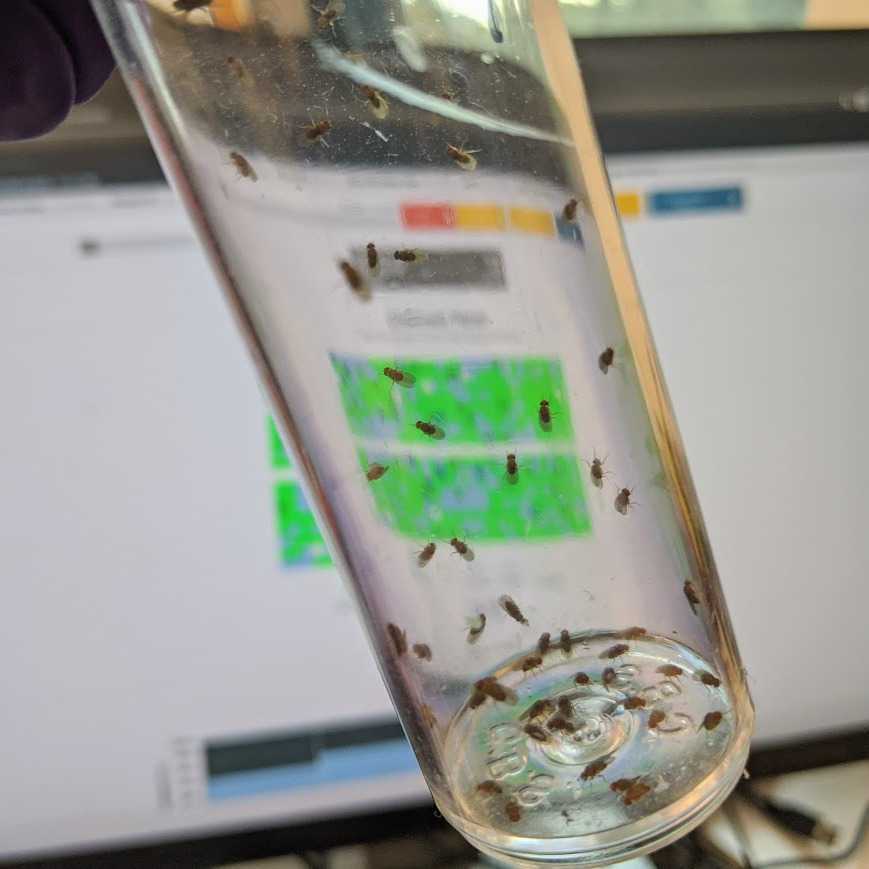
The day before DNA extraction, sex and sort ~200 female flies and transfer to empty fly vials with no media for starvation. Cotton plug should be soaked with water to prevent dehydration.
Tissue homogenization
15m
Prepare Homogenization Buffer (HB), Lysis Buffer (LB), and Lysis Master Mix (LMM).
Molar recipe Homogenization Buffer:
- 0.1 Molarity (M) NaCl
- 30 millimolar (mM) Tris-Hcl ph 8.0
- 10 millimolar (mM) EDTA
- 0.5 % (v/v) Triton X-100
Recipe for 50 mL Homogenization Buffer :
- 45 mL Nuclease-Free WaterThermo Fisher ScientificCatalog #AM9932
- 2.5 mL 10% Triton X-100Merck MilliporeSigma (Sigma-Aldrich)Catalog #648463
- 1.5 mL 1M Tris-HCI, pH 8.0Thermo Fisher ScientificCatalog #15568025
- 1 mL 0.5M EDTA, pH 7.5bioworldCatalog #40120779
- 0.292 g Sodium ChlorideFisher ScientificCatalog #S271
Molar recipe for Lysis Buffer:
- 0.1 Molarity (M) Tris-Hcl pH 8.0
- 0.1 Molarity (M) NaCl
- 20 millimolar (mM) EDTA
Recipe for 50 mL Lysis Buffer :
- 43 mL Nuclease-Free WaterThermo Fisher ScientificCatalog #AM9932
- 5 mL 1M Tris-HCI, pH 8.0Thermo Fisher ScientificCatalog #15568025
- 2 mL 0.5M EDTA, pH 7.5bioworldCatalog #40120779
- 0.292 g Sodium ChlorideFisher ScientificCatalog #S271
Recipe for Lysis Master Mix per sample (not 50-fly batches) (multiply by n+1 for n samples)
- 500 µL Lysis Buffer
- 15 µL SDS, 10% SolutionLife TechnologiesCatalog #AM9822
- 15 µL Proteinase KThermo Fisher ScientificCatalog #100005393
- 5 µL RNAse ANew England BiolabsCatalog #T30318-2
Hold the LMM on a heat block at 50 °C while doing the extractions.
Before beginning DNA extraction, separate the flies into groups of 50 or less, as it will make grinding them in the Dounce homogenizer much easier. If too many flies are homogenized at the same time, it will be difficult to move the tighter pestle properly. Excessive force may result in spillage of homogenate or glass breakage. Split the flies into batches to avoid this issue.
Equipment
Dounce Tissue Grinder
NAME
Tissue Grinder
TYPE
Kimble Kontes
BRAND
885300-0002
SKU
LINK
Note: Perform extractions On ice to try and limit activity of endogenous DNAses that will chew up DNA. You want to get the extracted material into LMM as soon as possible.
Add 50 flies to Dounce pestle along with 500 µL HB .
Dounce 8-10X with the loose pestle (A), and then follow with 8-10 strokes of the tighter pestle (B). Make sure that the fly bodies are crushed, however overgrinding will lead to shorter reads.
Use a wide-bore tip to move the homogenate into a new 1.5 mL LoBind tube.
Equipment
DNA LoBind tubes, 1.5 mL
NAME
Tubes
TYPE
Eppendorf
BRAND
022431021
SKU
LINK
1.5 mL
SPECIFICATIONS
Repeat steps 5-6 for all 50-fly batches, each going into a new LoBind tube.
Clean or switch to new Dounce pestles between samples.
Pellet debris via centrifugation for 1 minute at 500 x g
Pipette the supernatent containing the nuclei into new LoBind tubes with a wide-bore tip. Make sure to get as much of the yellow-white layer on top of the dark debris as possible.
Pellet nuclei via centrifugation for 5 minutes at 2000 x g, 4°C . If 4C centrifuge is unavailable, room temperature is OK.
Decant off the supernatant, and wipe off the white lipid smear on the side of the tube. Can use a kimwipe wrapped around tweezers.
For each sample, resuspend the first batch tube with 100 µL LMM by pipetting vigorously using a P1000. Transfer the resuspended nuclei to the next batch tube and repeat, until all nuclei for one sample are gathered in a single tube.
Add another 400 µL LMM to the final tube, bringing the total to 500 µL LMM per sample.
Lysis
4h
Incubate lysis tube at 50 °C for ~ 04:00:00 . Every 45 minutes, invert the tubes to make sure that the LMM has a chance to contact all pieces of material.
Note
Sometimes a bit of vigorous shaking is needed, especially if there is a lot of material. This is OK - the end product needs to be sheared for library prep anyway. Qualitative observations suggest that thorough mixing improves DNA yield and purity substantially.
4h
Phenol chloroform extraction
1h
Spin down 1 phase lock gel tube per sample at 15000 x g for 00:00:30 .
Note
Although not essental, phase lock gel tubes help minimize shearing and loss of yield caused by repeated pipetting. Dow Corning High Vacuum Grease is compositionally identical to the light phase lock gel material. You can buy the 5.3oz tube from Amazon and squeeze some into a 10mL BD syringe for dispensing. This size of tube/syringe fits well for minimial mess and hassle. Avoid overfilling and air bubbles. Autoclave but be warned this may cause a mess, so wrap the syringe in foil beforehand.
About 250 µL of grease is placed into a 2mL LoBind tube to make the homebrew phase lock gel tube.
IMPORTANT: If an insufficient amount of grease is applied, the phase lock layer will collapse during the chloroform extraction.
Safety information
WARNING: If you are using normal tubes in lieu of LoBinds, do not use polystyrene tubes for the phenol-chloroform extraction. They will melt and burst in the centrifuge. Polypropylene tubes do not melt.
Equipment
5PRIME Phase Lock Gel tube, light, 2mL
NAME
Quantabio
BRAND
2302820
SKU
LINK
Light
SPECIFICATIONS
Transfer all of the lysate solution from the heat block to the phase lock gel tube by pipetting with a wide-bore tip.
Add an equal volume (~400 µL ) of Phenol Chloroform Isoamyl Alcohol (25:24:1) Tris-saturated (pH 8.0)Fisher ScientificCatalog #BP1752I-400 to the phase lock tube.
Safety information
This should be performed inside the fume hood.
Note
We recommend shaking the bottle of phenol first to remix, and then letting it sit for ~5 minutes. It will then separate into the phenol on the bottom and the tris buffer on top. Make sure to pipette from the phenol layer.
Mix by placing tubes on a rocker at medium speed for 00:08:00 .
Note
We use a rocking platform, so the tubes are placed on their sides horizontally to maximize the surface area. When solution is well mixed, aqueous (top) layer will be a cloudy milky color.
8m
Centrifuge the phase lock tube at 10000 x g for 00:08:00 . Phase lock layer should now separate aqueous and organic layers.
8m
Add an equal volume (400 µL ) of ChloroformMerck MilliporeSigma (Sigma-Aldrich)Catalog #CX1055-6 to the tube.
Safety information
This step should be performed inside the fume hood.
Mix by placing tubes on a rocker at medium speed for 00:08:00 .
8m
Centrifuge the phase lock tube at 15000 x g for 00:08:00 . Phase lock layer should now separate aqueous and organic layers.
8m
Quickly decant the aqueous (top) layer into a fresh 2.0 mL LoBind tube.
Note
Try to perform the decanting step in a few seconds, and don't tap/shake the phase lock tube to get the last drops out. Care must be taken as the chloform significantly weakens the phase lock gel layer. If the phase lock tube is inverted for too long during decanting, the layer will collapse and everything will pour out. It's best to leave a couple of drops behind but avoid the hassle of cleaning this up.
IMPORTANT: It is highly recommended to use LoBind tubes in this and subsequent steps. The coating will prevent DNA sticking to the tube. This is helpful for maximizing yield and minimizing shearing.
Safety information
This step should be performed inside the fume hood.
Equipment
DNA LoBind Tube
NAME
2 mL
TYPE
Eppendorf
BRAND
022431048
SKU
LINK
DNA precipitation, wash, and resuspension
1h 30m
Chill 100% ethanol on ice and additionally make fresh 1 mL 70% ethanol using nuclease-free water, per sample.
Add 10% volume (~50 µL ) of 3 Molarity (M) Sodium acetateP212121 to each sample.
Add 2-2.5x volumes (typically 1000 µL ) of cold 100% ethanol to the tube, and mix with careful swirling and gentle rocking.
Expected result
DNA should slowly precipitate into a single white stringy clump, and un-precipitated DNA should be visible as shimmering strands at the bottom of the tube that are attached to the white clump.
Note
If the extraction tube turns cloudy, it is likely salt precipitation because the solution is too nonpolar and not DNA. Add water dropwise with thorough mixing and the solution should clear up.
Using a P200 pipette and a wide-bore tip, transfer the stringy clump to a fresh 1.5 mL LoBind tube.
Note
This step can be somewhat tricky. The DNA clump can get stuck to your pipette tip and be very difficult to get off. Making sure that the DNA is fully precipitated (no un-precipitated strands present) and quick pipetting helps prevent this. Position the pipette tip right above the clump and aspirate quickly to bring the clump into the tip. Using a similar quick motion, dispense the DNA clump and liquid into the fresh 1.5 mL tube.
Add 150 µL (or enough to cover the DNA) of 70% ethanol.
Remove and discard the ethanol. Be careful not to discard any DNA.
Add 150 µL 70% ethanol to wash the DNA. Gently swirl to mix.
Centrifuge the tube at 2000 x g for 00:05:00 .
5m
While being careful not to disturb the pellet, pipette off the ethanol.
Add 175 µL 70% ethanol
Spin at 10000 rcf for 00:01:00 .
1m
Being careful not to disturb the DNA pellet, remove the ethanol.
Add 200 µL 70% ethanol
Spin at 10000 rcf for 00:01:00 .
1m
Remove the ethanol.
Spin at 10000 rcf for 00:01:00 .
Using a 10uL pipette, remove any excess ethanol.
Allow the DNA to air dry right until the moment it becomes translucent (~00:05:00 ). Do not over-dry the pellet.
Note
Oftentimes the whole DNA pellet will not become translucent but the edges of the pellet will.
Resuspend in 60 µL 10 mM Tris-HCL pH 8.0 and incubate at 50 °C for at least 01:00:00 .
Note
Usually resuspend in 60 µL , but can range from 31 µL -90 µL depending on the amount of material
1h
Briefly spin down tube to gather any condensation and store at 4 °C .
DNA resuspension
1w
Keep the DNA at 4C for at least a few days to obtain proper resuspension. If the DNA blob is not resuspending (which will be likely with very long reads), mix the DNA twice, very slowly, with a P1000 pipette tip. This will encourage DNA to resuspend and make sure it is adequately sheared for library prep.
Note
While it is possible to over-shear the DNA, under-shearing makes for much worse Nanopore runs because it makes the sample too viscous. More shearing may be needed depending on how much the sample was mixed during incubation, or how fresh the flies were.
If there is a lot of DNA that doesn't seem to be resuspending, shearing with a blunt-end needle may be necessary. When using a blunt-end needle, be sure to 'unstick' the plunger before using it on DNA. Aspirate DNA into the needle (not the plunger) 3x times maximum.
Check sample concentration and quality of 1 µL aliquots using Qubit and Nanodrop.
Note
Ideally, this should Qubit at >75 ng/uL and have Nanodrop ratios of 260/280 >1.8 and 260/230 >2.0. If sample is above 150 ng/uL, dilute with more 10mM tris to 150ng/ul before SRE.
Short Read Elimination 1
Using a cut-off P200 tip (a wide bore will be too small to fit in the PCR tube), gently transfer 30 µL of sample to a 1.5 mL DNA LoBind tube. Add 30 µL SRE XL buffer. Using a wide-bore P200 tip, quickly but gently mix the tube. The precipitation buffer described here can be used in place of the SRE buffer but is not as effective at removing small DNA fragments as SRE.
Note
Dilute sample down to 150 ng/uL as possible before mixing with buffer
Short Read Eliminator (SRE)CirculomicsCatalog #SS-100-101-01
DNA LoBind Tubes, 1.5 mLEppendorfCatalog #0030108051
DNA Precipitation Buffer (PB) [0.8 M NaCl 9% w/v PEG 8000 10mM Tris-HCl pH 8.0]
Large-Orifice Pipet Tips 200μLFisher ScientificCatalog #02-707-134
Centrifuge the sample at 10000 x g for 00:30:00 or until DNA has pelleted and solution is no longer viscous. Meanwhile, prepare 500 µL fresh 70% ethanol with nuclease-free water.
Pipette off the supernatant, taking care not to disturb the DNA pellet.
Note
We have increased our yield by leaving 10-15 uL of supernatant in the bottom of the tube going into the first wash. This is particularly important if the pellet is invisible.
Add 150 µL of 70% ethanol. Pipette slowly, with the tip touching the front wall of the tube, so that the pellet is not disturbed.
Centrifuge at 10000 x g for 00:02:00 .
Pipette off the supernatant, taking care not to disturb the DNA pellet. Make sure all the supernatant is removed and only the pellet remains.
Repeat wash:
Note
The second centrifuge (step 43) can be shorter, ~1 minute.
Briefly spin sample and use a P10 to remove any remaining ethanol.
Resuspend pellet in 48.5 µL EB.
Elution Buffer (EB) [10 mM Tris-HCl pH 8.0]
Incubate the tube on the heat block at 50 °C for at least 01:00:00 . Briefly spin down the tube to collect condensation. Incubate at least 48:00:00 and preferably for twice that time at 4 °C .
Note
Before proceeding to the next stage, we recommend 1 µL Qubit to ensure there is still DNA.
DNA repair and end-prep
Thaw NEBNext repair and DNA-tailing mixes and buffers from the Nanopore Companion Module. Vortex buffers and flick mixes after thawing. Spin down tubes and keep chilled on ice.
NEBNext Companion Module forOxford Nanopore Technologies Ligation Sequencing – 24 rxnsNew England BiolabsCatalog #E7180S
Add 3.5 µL of FFPE DNA Repair Buffer, 3.5 µL of End-Prep Reaction Buffer, 2 µL of FFPE DNA Repair Mix, and 3 µL of End-Prep Reaction Mix to a PCR tube. Add remaining 47.5 µL of DNA sample to the PCR tube using a cut-off P200 tip. Mix tube with gentle flicking (or very gentle pipetting with the cut-off P200 tip), and then briefly spin down.
Note
To increase efficiency and decrease amount of pipette tips needed, prep PCR tubes with buffers and mixes and add the HMW DNA sample last.
Note
We have found that half-reaction volumes for this step do not decrease yield. To follow half-reaction volumes, see the Single Fly Forked Protocol for more information.
PCR Tubes, 0.2mL, flat cap, natural, PCR Tube; 0.2mL; Natural; w/flat cap; 1000/Pk.Thermo FisherCatalog #3412
Nuclease-free water or water filtered using a Milli-Q filtering systemAmbionCatalog #AM9932
In a thermal cycler, incubate at 20 °C for 01:00:00 then 65 °C for 00:30:00 . After this, sample can be held at 4 °C temporarily until ready to proceed.
1h 30m
Bead Clean Up
Prepare 500 µL of 70% ethanol per sample.
Transfer sample from PCR tube to a LoBind tube using a cut-off P200 tip.
Add equal volume of AmPure XP beads (normally 59.5 µL ) to the sample. Immediately use a P200 wide bore tip to mix 5x.
Note
This step must be performed quickly; otherwise, DNA will precipitate onto pipette tip and will result in sample loss.
Note
If needed, briefly spin down to ensure there are no bubbles or any sample on the wall of the LoBind tube.
Agencourt AmPure XP beadsCatalog #A63880
Incubate at room temperature for 00:05:00 .
5m
Place the LoBind tube on a magnetic rack and wait until solution is clear and the beads are pelleted.
Remove the supernatant by placing pipette tip on the wall of the LoBind tube opposite of the beads. Pipette very slowly to ensure no DNA is pulled off.
Note
If DNA is pulled off, add supernatant back to tube and wait for solution to clear. Then try again.
Wash by adding 190 µL of 70% ethanol (enough to cover the beads on the wall of the LoBind tube).
Note
Work quickly to add the 70% ethanol at this step to avoid the beads drying out.
Remove and discard ethanol.
Wash again by adding 200 µL of 70% ethanol.
Remove and discard ethanol.
Note
Briefly spin and use a P10 pipette to remove any remaining excess of ethanol.
Resuspend sample in 32 µL of nuclease-free water.
Place tube on heat block at 50 °C until the pellet has dissolved.
Note
This step can take a long time. If there is concern about the DNA not resuspending off the beads, the tube can be stored at 4 °C overnight and then the sample removed from the beads the following morning.
Place LoBind tube on magnet rack until solution is clear.
Using a cut off P200 tip, remove the supernatant containing the aqueous DNA.
Note
Qubit 1 µL of sample to ensure DNA concentration before proceeding to next step.
Note
This is a safe stopping point. Sample can be stored at 4 °C .
Adapter ligation
Thaw AMXF, Quick T4 Ligase, LNB, and LFB from the NEBNext Nanopore Companion Module and the Nanopore LSK110 kit or LA, Quick T4 Ligase and LNB from Nanopore LSK114 hit . Mix AMXF or LA, Quick T4 ligase, and LFB by flicking. Mix LNB by pipetting. Briefly spin the tubes down and keep chilled on ice.
NEBNext Companion Module forOxford Nanopore Technologies Ligation Sequencing – 24 rxnsNew England BiolabsCatalog #E7180S
Oxford Nanopore Ligation Sequencing KitOxford Nanopore TechnologiesCatalog #SQK-LSK110
Ligation Sequencing Kit V14Oxford Nanopore TechnologiesCatalog #SQK-LSK114
Add 30 µL prepared DNA sample (the extra 1 µL can be used to Qubit), 2.5 µL AMXF or LA, and 5 µL Quick T4 ligase to a fresh 1.5 mL DNA LoBind tube. Gently flick the tube to mix.
Add 12.5 µL LNB to the sample. Working quickly, mix by gentle pipetting with a wide-bore tip. DNA precipitation is normal, but if the DNA precipitates before you finish mixing it will stick to your pipette tip and you will lose a significant amount of library.
Large-Orifice Pipet Tips 200μLFisher ScientificCatalog #02-707-134
Incubate the reaction mixture at room temperature for 00:20:00 .
20m
Add 20 µL of AmPure XP beads and mix quickly with wide-bore tip.
Incubate at room temperature for 00:05:00 .
5m
Place tubes on magnetic and wait for solution to clear.
On the magnet, use a cut-off P200 tip to pull the supernatant off the beads very slowly, then dispense the supernatant back onto the bead pellet slowly. Let the sample sit on the magnet for a few minutes.
Pipette off supernatant with a normal pipette tip, pipetting from the front of the tube away from the pellet.
Add 95 µL of LFB to the tube. SFB or a 1:1 dilution of PB can be used here.
Note
DO NOT USE ETHANOL TO WASH PREPARED LIBRARY. It will denature the motor protein.
Lightly tap the tube to encourage adapter on the beads to come off, but not necessarily for beads to resuspend.
Being careful not to disturb the pellet, pipette off all the supernatant.
Wash again using 105 µL of LFB. Pipette LFB on to the beads more quickly to get the pellet off the side of the tube. Lightly tap the tube to mix but not fully resuspend.
While on magnet remove LFB. Briefly spin and use a P10 pipette to remove any remaining excess of LFB.
Resuspend pellet in 21 µL EB for R9.4.1 sequencing or in 30 µL for R10.4.1 sequencing.
Elution Buffer (EB) [10 mM Tris-HCl pH 8.0]
Incubate library on the heat block at 34 °C for 01:00:00 . Briefly spin down the tube to collect condensation then incubate for at least 48:00:00 before the next step.
2d 1h
Place sample on magnet wait until solution is clear. Use a cut off P200 tip to remove sample from beads and place in a new 1.5mL Lo Bind tube.
(Optional) Library size selection with SRE buffer
Quantify library concentration using 1 µL of the prepared library with Qubit. This step should not be performed unless library concentration is greater than 40 ng/uL. If the concentration is greater than 100ng/uL the library should be diluted to improve size selection performance.
Add an equal volume (20 µL ) of SRE XL buffer to the library and gently pipette mix using a wide-bore tip.
Short Read Eliminator (SRE)CirculomicsCatalog #SS-100-101-01
Large-Orifice Pipet Tips 200μLFisher ScientificCatalog #02-707-134
Centrifuge at 10000 x g, 00:30:00 .
Pipette off the supernatant, being careful not to disturb the DNA pellet at the bottom of the tube.
Note
Similar to previous SRE step, leave 10-15uL of supernatant in the bottom of the tube for the first wash.
Add 100 uL of LFB, SFB, or 1:1 diluted PB (similar to step 46) to wash the pellet. It does not really matter which one is used.
Note
DO NOT USE ETHANOL TO WASH PREPARED LIBRARY. It will denature the motor protein.
Centrifuge tube at 10000 x g, Room temperature for 00:02:00 .
Being careful not to disturb the pellet, pipette off all the supernatant.
Repeat wash:
Resuspend pellet in 21 µL EB for R9.4.1 sequencing or in 30 µL for R10.4.1 sequencing.
Elution Buffer (EB) [10 mM Tris-HCl pH 8.0]
Incubate the tube on the heat block at 37 °C for 01:00:00 . Briefly spin down the tube to collect condensation, and incubate at least 48:00:00 at 4 °C before sequencing.
Tips for sequencing the library-R10.4.1
30m
Thaw 1 tube SB (LSK110), 1 tube LIS, 1 tube of FCF per sample, and 1 tube FCT. Mix SQB and FB by flicking.
Warm the FCF at 37 °C for 00:30:00
30m
Add 30 µL FCT to FCF and pipette 10x to ensure thorough mixing
Note
We recommend marking the top of the FCF tube after FCT has been added.
Follow the official instructions to prime the flow cell.
While the flow cell is priming, prepare the library by adding 70 µL of LIS, Sample library (LIS and library should total to 100uL), and 100 µL SB. Lightly tap to mix until swirls disappear but wait to pipette mix until just before loading.
Pipette mix prepared library 2x times and then following official instructions to load the flow cell.
Over the course of a sequencing run, pores will get clogged and become inactive. It is essential to flush the flow cell at 10-14 hour intervals to make these pores available again. We recommend Nanopore's Flow Cell Wash Kit (EXP-WSH00).
ONT Flow Cell Wash KitOxford Nanopore TechnologiesCatalog #EXP-WSH004
Protocol references
Kim, Bernard Y., Jeremy R. Wang, Danny
E. Miller, Olga Barmina, Emily Delaney, Ammon Thompson, Aaron A.
Comeault et al. "Highly contiguous assemblies of 101 drosophilid
genomes." Elife 10 (2021): e66405.
Kim, B.Y., Gellert, H.R., Church, S.H., Suvorov, A., Anderson, S.S.,
Barmina, O., Beskid, S.G., Comeault, A.A., Crown, K.N., Diamond, S.E.
and Dorus, S., 2024. Single-fly genome assemblies fill major
phylogenomic gaps across the Drosophilidae Tree of Life. PLoS Biology, 22(7), p.e3002697