Oct 14, 2025
Diet and Acne Systematic Review
- taliajaynethomas 1,
- Angela Moore2,3,4,5
- 1Anne Burnett Marion School of Medicine at Texas Christian University;
- 2Anne Burnett School of Medicine at Texas Christian University;
- 3Arlington Center for Dermatology;
- 4Arlington Research Center;
- 5Baylor University Medical Center



Protocol Citation: taliajaynethomas , Angela Moore 2025. Diet and Acne Systematic Review . protocols.io https://dx.doi.org/10.17504/protocols.io.ewov115ppvr2/v1
License: This is an open access protocol distributed under the terms of the Creative Commons Attribution License, which permits unrestricted use, distribution, and reproduction in any medium, provided the original author and source are credited
Protocol status: Working
We use this protocol and it's working
Created: September 30, 2025
Last Modified: October 14, 2025
Protocol Integer ID: 228621
Keywords: Acne vulgaris, diet, nutrition, glycemic index, dairy, systematic review, PRISMA, dermatology, dietary interventions, acne management, acne systematic review, acne incidence, acne vulgari, association between dietary factor, effects of dietary exposure, dietary exposure, dietary factor, overall dietary pattern, dietary contribution, including glycemic load, role of nutrition, glycemic load, fatty acid
Abstract
This protocol describes the planned methods for a systematic review investigating the association between dietary factors and acne vulgaris. The review will evaluate randomized controlled trials and observational studies that examine the effects of dietary exposures—including glycemic load, dairy, chocolate, omega-3 fatty acids, and overall dietary patterns—on acne incidence and severity.
The expected outcome of this protocol is a transparent, reproducible methodology that will synthesize existing evidence and clarify dietary contributions to acne development and progression. Results are anticipated to provide guidance for clinicians, patients, and researchers in understanding the role of nutrition in acne management.
Guidelines
This systematic review follows the Preferred Reporting Items for Systematic Reviews and Meta-Analyses (PRISMA 2020) guidelines. Study selection, data extraction, and synthesis are conducted in accordance with established methodological standards for systematic reviews.
Materials
- Databases: PubMed (MEDLINE), Scopus, Embase, and Cochrane Library.
- Guidelines: PRISMA 2020 Statement and Checklist for systematic reviews.
- Reference Management: EndNote / Zotero / Mendeley (used for citation management and duplicate removal).
- Screening Tools: Microsoft Excel / Covidence / Rayyan (used to track study inclusion/exclusion).
- Data Extraction Tools: Microsoft Excel or Google Sheets (for structured data collection, summary tables, and quality assessment).
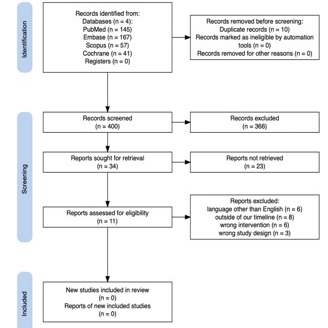
- Figures: PRISMA 2020 Flow Diagram template (to illustrate study selection).
- Quality Assessment Tools: Cochrane Risk of Bias Tool (for randomized controlled trials) and Newcastle-Ottawa Scale (for observational studies).
Safety warnings
- Limiting searches to English-only studies may introduce language bias.
- Reliance on self-reported dietary and acne severity data in included studies may increase risk of recall bias.
Heterogeneity in study design and dietary assessment tools may limit generalizability of conclusions.n/a
Before start
- All steps included on steps page
Define Research Question
Specify the research question: “What is the relationship between dietary factors (glycemic load, dairy intake, sugar/fat consumption) and acne vulgaris?”
Define Population, Intervention/Exposure, Comparator, and Outcomes (PICO framework).
Literature Search Strategy
Select databases: PubMed (MEDLINE), Scopus, Embase, and Cochrane Library.
Use search terms: “acne,” “diet,” “nutrition,” “glycemic index,” “dairy,” and “food.”
Apply filters:
Language: English
Publication date: January 2010 – December 2024
Export all search results and remove duplicates.
Eligibility Criteria
Inclusion criteria:
Human studies only
Randomized controlled trials, cohort studies, case-control studies, cross-sectional studies
Clearly defined acne assessment methods
Exclusion criteria:
Case reports, reviews, animal studies
Studies focused solely on supplements or non-dietary interventions
Study Screening and Selection
Title and abstract screening by reviewers.
Full-text review of potentially eligible articles.
Apply inclusion/exclusion criteria consistently.
Record numbers at each stage in a PRISMA flow diagram.
Data Extraction
Extract study characteristics:
Author, year, country, design, sample size, population
Dietary exposures studied
Acne assessment methods
Main findings and statistical results
Enter data into a unified summary table (Supplemental Material).
Quality Assessment
Assess study quality using appropriate tools (e.g., Cochrane Risk of Bias for RCTs, Newcastle-Ottawa Scale for observational studies).
Record bias/limitations in data extraction sheet.
Data Synthesis
Summarize findings qualitatively across included studies.
Report effect sizes/meta-analyses from published literature where available (no new meta-analysis performed).
Group results by dietary factor:
Glycemic index/load
Dairy intake
High sugar/fat consumption
Reporting
Present study selection process in a PRISMA flowchart.
Summarize evidence in tables/figures.
Discuss strengths, limitations, and implications for dietary guidance in acne management.
Follow PRISMA 2020 checklist for reporting.
Protocol references
[1] Sakhaei, R., & Mohsenpour, M. A. (2020). Low glycemic load or index diet in association with acne vulgaris: A systematic review and meta-analysis. Critical Comments in Biomedicine, 1(1), e10001.
[2] Meixiong, J., Ricco, C., Vasavda, C., & Ho, B. K. (2022). Diet and acne: A systematic review. JAAD International, 7, 95–112. https://doi.org/10.1016/j.jdin.2022.02.012
[3] Aghasi, M., Golzarand, M., Shab-Bidar, S., Aminianfar, A., Omidian, M., & Taheri, F. (2019). Dairy intake and acne development: A meta-analysis of observational studies. Clinical Nutrition, 38(3), 1067–1075. https://doi.org/10.1016/j.clnu.2018.04.015
[4] Penso, L., Touvier, M., Deschasaux, M., Szabo de Edelenyi, F., Hercberg, S., Ezzedine, K., & Sbidian, E. (2020). Association between adult acne and dietary behaviors: Findings from the NutriNet-Santé prospective cohort study. JAMA Dermatology, 156(8), 854–862. https://doi.org/10.1001/jamadermatol.2020.1602
[5] Baldwin, H., & Tan, J. (2021). Effects of diet on acne and its response to treatment. American Journal of Clinical Dermatology, 22(1), 55–65. https://doi.org/10.1007/s40257-020-00542-y