Aug 18, 2022
Diagnostic Restriction Digest (Instructor Protocol)
This protocol is a draft, published without a DOI.
- 1University of Wisconsin - Stout
- Yeast ORFans CURE



Protocol Citation: Brian Teague 2022. Diagnostic Restriction Digest (Instructor Protocol). protocols.io https://dx.doi.org/
License: This is an open access protocol distributed under the terms of the Creative Commons Attribution License, which permits unrestricted use, distribution, and reproduction in any medium, provided the original author and source are credited
Protocol status: Working
We use this protocol and it's working
Created: August 18, 2022
Last Modified: August 18, 2022
Protocol Integer ID: 68807
Keywords: instructor protocol, diagnostic restriction digest, protocol
Abstract
Materials
- 700 µL or 1.7 mL tubes for aliquots
- CutSmart® BufferNew England BiolabsCatalog #B7204S
- PvuII-HF - 5,000 unitsNew England BiolabsCatalog #R3151S
- Diluent B - 5.0 mlNew England BiolabsCatalog #B8002S
Protocol materials
CutSmart® BufferNew England BiolabsCatalog #B7204S
PvuII-HF - 5,000 unitsNew England BiolabsCatalog #R3151S
Diluent B - 5.0 mlNew England BiolabsCatalog #B8002S
Safety warnings
None of the materials are hazardous.
HOWEVER, we are shedding nucleases -- enzymes that degrade DNA -- all the time. Wear lab coats and gloves to keep your samples nuclease-free.
Setup
Aliquot the CutSmart® BufferNew England BiolabsCatalog #B7204S : 20 µL ul aliquots, 1 per 4 students
Aliquot the PvuII-HF - 5,000 unitsNew England BiolabsCatalog #R3151S enzyme: 4 µL of enzyme in 16 µL of Diluent B - 5.0 mlNew England BiolabsCatalog #B8002S , 1 per 4 students.
Instructor Tips & Common Student Errors
Instructor Tips
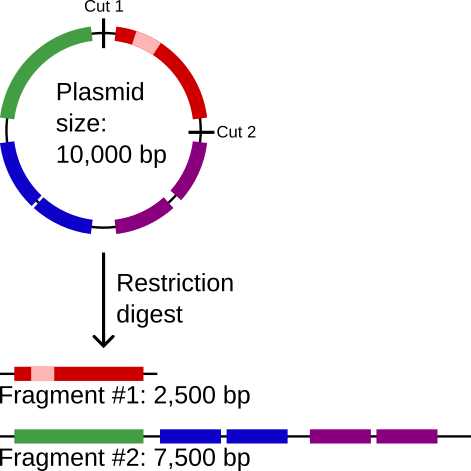
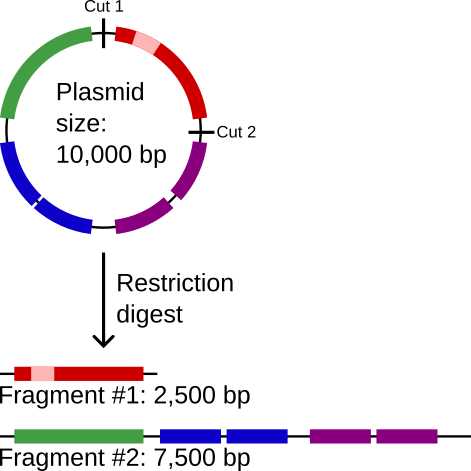
- In a more advanced course, I would let students select which enzyme to use (chosen from the ones in the freezer.) In an intro course, I choose the enzyme for them. PvuII is a good choice because it has two cut sites in the backbone and one in the GFP insert. This makes it easy to distinguish between the correct plasmid and one with a GFP still present (maybe not glowing because of a mutation? Or some other error?)
- PvuII is a little on the expensive side -- but if you're giving the digest a full hour, diluting down to 2 units per ul gives two advantages: it decreases the amount used, and increases the volume of the pipetting step. Make sure you use the correct diluent, though.
- I used to include a heat-inactivation step. I don't any more because the SDS in the purple loading dye denatures the enzyme.
- Sometimes a student's miniprep isn't concentrated enough to get a full microgram of DNA into the digest. As long as they can get at least 500 ng in the digest, that should be enough to see on a gel. It's more acceptable to decrease the mass of DNA than it is to increase the volume -- contaminants in the miniprep often get in the way of the digest, particularly leftover ethanol.
- I don't have a positive control in this experiment as written. Maybe add one?
Common Student Errors
- Not mixing the reaction well.
- Not loading the entire reaction onto the gel. (Because the first one they did was a PCR, it's easy to assume that you just need 1-2 ul without reading the protocol carefully.)