Mar 16, 2026
Determination of Ascorbate Peroxidase (APX) Activity in the Cnidarian Symbiont Dinoflagellate Symbiodinium microadriaticum Using Spectrophotometric Detection of Ascorbate Oxidation
- Yuliana Villanueva-Bado1,
- Gabriela Ibarra-Cedillo2,
- Marco A. Villanueva2,
- Tania Islas-Flores2
- 1Universidad Politécnica de Quintana Roo;
- 2Unidad Académica de Sistemas Arrecifales, Instituto de Ciencias del Mar y Limnología, Universidad Nacional Autónoma de México-UNAM, Prol. Avenida Niños Héroes S/N, Puerto Morelos, Quintana Roo 77580, México. UASA-ICML-UNAM



Protocol Citation: Yuliana Villanueva-Bado, Gabriela Ibarra-Cedillo, Marco A. Villanueva, Tania Islas-Flores 2026. Determination of Ascorbate Peroxidase (APX) Activity in the Cnidarian Symbiont Dinoflagellate Symbiodinium microadriaticum Using Spectrophotometric Detection of Ascorbate Oxidation. protocols.io https://dx.doi.org/10.17504/protocols.io.3byl44deolo5/v1
License: This is an open access protocol distributed under the terms of the Creative Commons Attribution License, which permits unrestricted use, distribution, and reproduction in any medium, provided the original author and source are credited
Protocol status: Working
We use this protocol and it's working
Created: March 06, 2026
Last Modified: March 16, 2026
Protocol Integer ID: 270741
Keywords: Ascorbate peroxidase, APX activity assay, dinoflagellate, cnidarian symbiosis, oxidative stress, antioxidant enzymes, spectrophotometric enzyme assay, reactive oxygen species, photosynthetic symbiosis, hydrogen peroxide, Symbiodinium microadriaticum, determination of ascorbate peroxidase, ascorbate peroxidase, spectrophotometric detection of ascorbate oxidation, activity in the cnidarian symbiont dinoflagellate symbiodinium microadriaticum, cnidarian symbiont dinoflagellate symbiodinium microadriaticum, apx activity in other photosynthetic organism, oxidation of ascorbate, dinoflagellate symbiodinium microadriaticum, enzymatic conversion of ascorbate, ascorbate oxidation, reproducible quantification of apx activity, apx assay, presence of hydrogen peroxide, other photosynthetic organism, hydrogen peroxide, plant tissue, enzymatic conversion, protein extract, apx activity
Funders Acknowledgements:
PAPIIT
Grant ID: IN208426
Abstract
This protocol describes the preparation of crude protein extracts from the dinoflagellate Symbiodinium microadriaticum and the determination of ascorbate peroxidase (APX) activity by monitoring the oxidation of ascorbate at 290 nm. The assay is based on the decrease in absorbance resulting from the enzymatic conversion of ascorbate to monodehydroascorbate in the presence of hydrogen peroxide. The APX assay is based on the spectrophotometric method originally described for plant tissues and has been widely applied to measure APX activity in other photosynthetic organisms. The protocol described here has been adapted and optimized for protein extracts from dinoflagellate S. microadriaticum cultures grown under controlled laboratory conditions and allows reproducible quantification of APX activity in their total soluble protein homogenates.
Materials
**Equipment**
- Spectrophotometer capable of measuring at 290 nm**
- Refrigerated centrifuge
- Bead beater
**Consumables**
- 1.6 mL screw-cap tubes for bead beating
- 1.6 mL microcentrifuge tubes
- 0.6 mL microcentrifuge tubes
- 50 mL centrifuge tubes
- 425–600 μm glass beads
- 0.35 mL quartz cuvette
**Stock Solutions**
Prepare all solutions using ultrapure water.
- 1 M K₂HPO₄
- 1 M KH₂PO₄
- 1 M H₂O₂
- 0.5 M EDTA
- 0.4 M L-ascorbic acid
**Extraction Buffer**
Prepare fresh and keep on ice.
- 50 mM Potassium phosphate pH 7
- 0.2 mM EDTA
- 5 mM L-Ascorbic acid
**Reaction Buffer**
Prepare fresh immediately before use.
- 50 mM Potassium phosphate pH 7
- 0.2 mM L-Ascorbic acid
- 0.2 mM H₂O₂
Troubleshooting
Problem
No decrease in absorbance
Solution
Possible cause: Enzyme inactivation
Solution: Keep samples on ice and minimize extraction time
Problem
High background absorbance
Solution
Possible cause: Oxidized ascorbate
Solution: Prepare fresh reaction buffer
Problem
Non-linear reaction curve
Solution
Possible cause: Excess protein extract
Solution: Reduce protein volume
Problem
Low activity values
Solution
Possible cause: Incomplete cell lysis
Solution: Increase bead-beating cycles
Safety warnings
Critical Steps
• Maintain low temperatures during extraction to prevent enzyme degradation.
• The bead beating should be performed at 4 °C in four cycles of 1 min each to prevent overheating of the sample.
• Prepare solutions fresh before each assay.
• Mix samples immediately after adding protein extract to ensure consistent reaction initiation.
• Ensure the quartz cuvette is clean and dry before each measurement.
Notes
• Ascorbate is highly susceptible to oxidation; therefore solutions should be freshly prepared and protected from prolonged exposure to air.
• Protein extracts should ideally be used immediately after preparation.
• If multiple samples are analyzed, prepare fresh reaction buffer periodically to maintain reagent stability.
Procedure
1w 4d
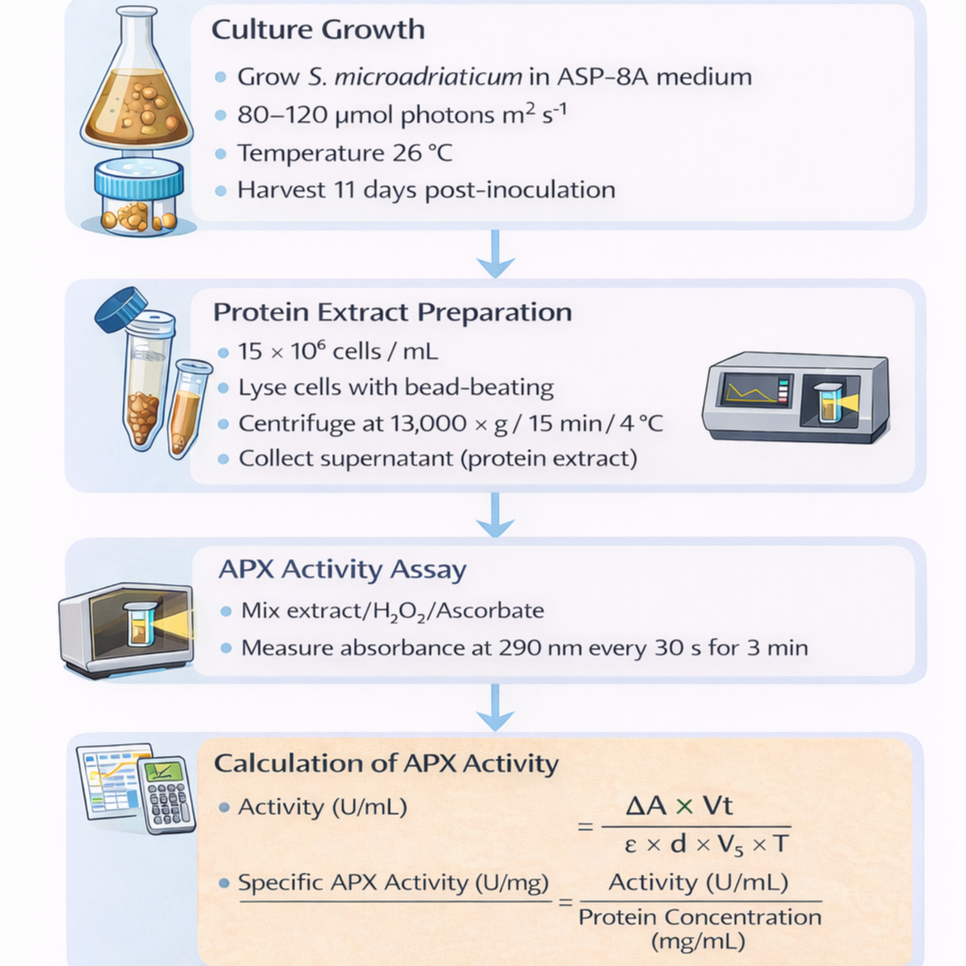
Inoculate Symbiodinium microadriaticum in ASP-8A medium at 5 × 10^4^ cells mL^-1^.
Incubate cultures at 26 °C under a 12 h light / 12 h dark photoperiod with a light intensity of 80–120 μmol photons m^-2^ s^-1^.
1w 4d
At 10 days post-inoculation (dpi), determine cell density with a Neubauer-Hauser chamber.
Harvest 15 × 10^6^ cells by centrifugation at 2,600 × g for 3 min at 4 °C.
Discard the supernatant and resuspend the pellet in 200 μL ice-cold extraction buffer.
Transfer the suspension to a pre-chilled screw-cap "bead-beating" tube containing 0.2 g glass beads (425–600 μm).
Lyse cells using a bead beater for four cycles of 1 min, maintaining samples at 4 °C between cycles.
Centrifuge the lysate at 13,000 × g for 15 min at 4 °C.
Carefully transfer the supernatant to a pre-chilled 0.6 mL microcentrifuge tube.
Proceed to APX assay, keep protein extracts on ice.
Set the spectrophotometer to 290 nm.
Prepare the blank: Add 200 μL of reaction buffer to the quartz cuvette.
Use this mixture to zero the spectrophotometer.
Rinse and dry the quartz cuvette.
Prepare the reaction mixture: 180 μL reaction buffer (room temperature)
20 μL cold protein extract
Immediately mix by gentle pipetting.
Measure absorbance at 290 nm every 30 s for 3 min.
Repeat the assay for each protein extract.
Include a negative controls containing reaction buffer without H2O2 and boiled protein extract.
Determination of Enzyme Activity
Determine the protein concentration of each extract using the Bradford assay or an equivalent method.
Calculate APX activity from the rate of decrease in absorbance at 290 nm.
Use the extinction coefficient for ascorbate: ε = 2.8 mM^-1^ cm^-1^ at 290 nm.
Enzyme activity can be expressed as: μmol ascorbate oxidized min^-1^ mg^-1^ protein.
Expected Results
Under the described culture conditions, crude protein extracts from Symbiodinium microadriaticum typically show a progressive decrease in absorbance at 290 nm, reflecting the oxidation of ascorbate catalyzed by APX.
Representative absorbance traces show a linear decrease during the first 2–3 minutes of the reaction. The slope of this decrease corresponds to APX enzymatic activity.
Activity Calculation
Activity (U/mL) = (ΔA × Vt) / (ε × d × Vs × T)
ΔA: Change in absorbance per minute
Vt: Total reaction volume (mL)
ε: Extinction coefficient (2.8 mM^-1^ cm^-1^)
d: Light path length (cm)
Vs: Sample volume
T: Time (min)
Critical Notes
Prepare ascorbate fresh every time before the assay.
Keep samples on ice during extraction.
Measure absorbance immediately after adding the extract to the reaction buffer.
Protocol references
Nakano & Asada (1981). Hydrogen peroxide is scavenged by ascorbate‑specific peroxidase in spinach chloroplasts. Plant and Cell Physiology 22:867–880. DOI: 10.1093/oxfordjournals.pcp.a076232.
Kumar, P. (2022). Measurement of Ascorbate Peroxidase Activity in Sorghum. Bio-protocol 12(20): e4531. DOI:
10.21769/BioProtoc.4531.
Hartmann J, Asch F. Extraction, Storage Duration, and Storage Temperature Affect the Activity of Ascorbate Peroxidase, Glutathione Reductase, and Superoxide Dismutase in Rice Tissue. Biology. 2019; 8(4):70. DOI: 10.3390/biology8040070.
Acknowledgements
We acknowledge financial support from the Programa de Apoyo a Proyectos de Investigación e Innovación Tecnológica (PAPIIT) of the Universidad Nacional Autónoma de México through projects IF201126 and IN208426, under which this protocol was developed and optimized.