Mar 27, 2026
Density-Based Fractionation of Soil Organic Matter
- Veronica Vasilica1,
- Hanna Schöpf1,
- Ilse Thaufelder1,
- Andreas Wild1,
- Johanna Pausch1
- 1Agroecology, Bayreuth Centre for Ecology and Environmental Research, University of Bayreuth



Protocol Citation: Veronica Vasilica, Hanna Schöpf, Ilse Thaufelder, Andreas Wild, Johanna Pausch 2026. Density-Based Fractionation of Soil Organic Matter. protocols.io https://dx.doi.org/10.17504/protocols.io.5jyl8q386l2w/v1
License: This is an open access protocol distributed under the terms of the Creative Commons Attribution License, which permits unrestricted use, distribution, and reproduction in any medium, provided the original author and source are credited
Protocol status: Working
We use this protocol and it's working
Created: June 25, 2025
Last Modified: March 27, 2026
Protocol Integer ID: 221004
Keywords: Soil organic matter, density fractionation, particulate organic matter, mineral-associated organic matter, based fractionation of soil organic matter, soil organic matter, fractionation of soil, organic matter, associated organic matter, soil, detailed description for density, based fractionation, density, particulate, maom, mineral
Funders Acknowledgements:
European Research Council (Starting Grant)
Grant ID: 101039716
Abstract
This protocol provides a detailed description for density-based fractionation of soil into particulate organic matter (POM) and mineral-associated organic matter (MAOM).
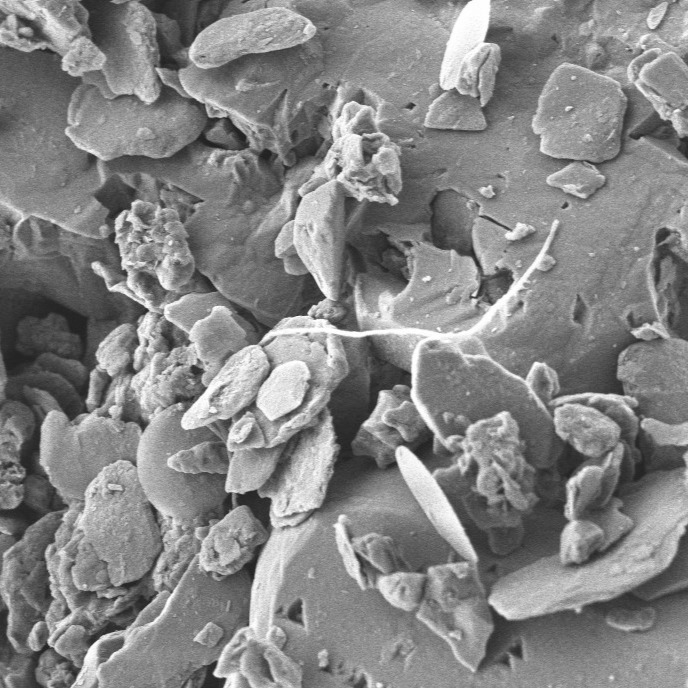
Image Attribution
BPI Bay. Polymerinstitut
Rasterelektronenmikroskopie
Martina Heider
Materials
1 SPT Preparation
- SPT-0 from TC-Tungsten Compounds GmbH (or equivalent)
- deionized water
- density hydrometer
2 Ultrasonication
- 5.00 g of soil
- 25 mL of SPT
- 50 mL test tubes
- scale (± 0.001 g)
- ultrasonic generator Sonoplus HD 4100, ultrasonic converter UW 100 with sonotrode TS 106, Bandelin, Berlin, Germany - or equivalent
- cooling system for test tube (→ e.g. insert it in bigger bottle with cool running water through it)
3 POM and MAOM Separation
- small glass beads (ca. 4 mm diameter)
- scale (± 0.001 g)
- vortex
- centrifuge 5810 R, Eppendorf, Hamburg, Germany - or equivalent
- 10 mL pipette or automated setup for transferring POM
4 POM Filtration
- vacuum filtration system
- filter: GVWP04700 Millipore Durapore membrane, PVDF, hydrophilic, 0.22 μm, 47 mm, white, smooth
- conductivity meter
- low-frequency ultrasonic bath
- clean 50 mL test tube
- freezer
5 MAOM Washing
- centrifuge
- conductivity meter
- freezer
6 Freeze-Drying and Grinding POM & MAOM
- freeze-drying machine
- scale (± 0.001 g)
- roll-mixer
- vibration mill with microtube adapter
- 2 mL round-bottom Eppendorf microtubes
- metal beads (ca. 4 mm diameter)
- agate mortar and pestle
Safety warnings
Caution:
GHS05
GHS07
Before start
 Ultrasonication Time Determination.pdf232.4KB
 1 SPT Preparation
Add the previously weighed SPT to the mixing water.
Measure the density of the solution.
| A | B | C | D | |
| Solution [mL] | H2O [mL] | SPT [g] | Density [g mL-1] at 21.5°C | |
| 1000 | 799 | 1051 | 1.86 |
2 Ultrasonication
Weigh each test tube and record it.
Add 25 mL of SPT.
Add 5.0 g of soil sample.
Ultrasonicate
Setting of the test tube in the ultrasonicator.
Sonicator settings:
- Amplitude = 70%
- Time = determined through calibration (see attachment)
→ e.g. 7 min 46 sec in our case
- Pulsation = off
- Set alarm & stop at 60°C
→ to avoid carbon loss
Tips:
- Mark the insertation depth of your sonotrode (keep it constant).
- Make sure the sonotrode never touches the test tube.
- Rinse the sonotrode after each use. First with SPT into your test tube, then with deionized water and discard.
3 POM and MAOM Separation
Weigh glass beads and add them to the ultrasonicated samples.
→ e.g. 15 glass beads per test tube.
Balance the test tubes (from round II on).
→ Fill all up to 35 mL with SPT.
Shake samples using a Vortex.
Centrifuge the samples for 20 minutes at 4000 rpm.
Transfer the floating particulate organic matter (POM) to a different container
(Schott bottle or similar).
In the first three rounds, remove only floating POM.
Automatized setup example.
Tips:
- The supernatant can be removed more efficiently with a system of Schott bottles with hoses, connected to a pump (vacuum).
- Your goal here is to remove as much POM and as little SPT possible each round. The more SPT is used here, the longer the next steps will be.
Repeat (Step 8-11) the balancing of the test tubes, shaking, centrifugation, and supernatant removal for another 3 times.
| A | B | C | |
| Centrifugation round | Centrifugation time [min] | Remove supernatant | |
| I | 20 | superficial | |
| II | 20 | superficial | |
| III | 20 | superficial | |
| IV | 30 | all |
Final step with only MAOM.
End products:
a. a test tube or Schott bottle with the transferred POM floating in SPT.
b. the initial test tube with only MAOM
→ You can now store the separated MAOM and POM in the fridge and continue the next day!
4 POM Filtration
Pour the separated POM on the filter.
Filtration setup with multiple filters and vacuum pump.
Let the SPT solution drain and dispose of it.
Wash the POM with deionized water until the filtrate reaches a low conductivity (e.g. 15 μS cm-1).
→ You will need circa 300 mL of water per sample, depending on the amount of SPT used.
Transfer the filter with POM into a beaker, cover with deionized water, and ultrasonicate for a couple of minutes in a low-frequency ultrasonic bath.
Ultrasonic bath setup.
Remove filter and rinse all POM into the beaker.
Rinsing filter after ultrasonic bath.
Tips:
- In the final step, keep the water volume below 45 mL, as samples will then be frozen in 50 mL test tubes.
Transfer sample to test tube, close, and freeze.
5 MAOM Washing
Add deionized water to test tube containing MAOM.
Shake with Vortex.
Centrifuge.
Dispose of water column.
Repeat until the water column after centrifugation reaches a low conductivity (e.g. 150 μS cm-1).
The following table shows an example of centrifugation rounds. The conductivity of the water column is measured in the last step to verify that the value is below the defined threshold.
| A | B | C | D | E | |
| Round | Add deionized water [mL] | Centribugation time [min] | Measure conductivity | Dispose of water column | |
| I | 45 | 30 | no | yes | |
| II | 45 | 30 | no | yes | |
| III | 45 | 40 | no | yes | |
| IV | 40 | 30 | yes | no |
After multiple rounds of washing, the water column will show some turbidity even after centrifugation.
Tips:
- Add enough water to wash the MAOM, but leave some space (e.g. 45 mL). In the final step the sample will be frozen.
- The goal here is to wash out a sufficient amount of SPT while keeping MAOM loss to a minimum.
When the conductivity is below the established limit, keep the water column and freeze the sample.
→ This prevents an excessive loss of MAOM during washing. As the samples become cleaner from SPT and less dense, more MAOM stays in the water column after centrifugation.
6 Freeze-Drying and Grinding POM & MAOM
Freeze-dry the POM and MAOM samples at ca. 30°C.
→ A low temperature prevents carbon loss.
Freeze-drying setup (Martin-Christ RVC 2-25 rotary vacuum concentrator and CT 02-50 solvent-resistant cooling trap).
Weigh the dry samples and subtract the weight of the test tube – and the glass beads in MAOM samples – to calculate recovery.
Remove the glass beads from MAOM samples.
Use a roll-mixer to slowly mill MAOM.
Place POM samples in 2 mL round-bottom Eppendorf microtubes, add a couple of small metal beads, and mill the samples using a vibration mill with microtube adapter.
Tips:
- This choice of instruments is related to our larger MAOM samples and very small POM samples. This will depend on the soil type. Adapt the milling techniques accordingly.
- Use an agate mortar to manually grind very small samples. Agate helps reduce static electricity, which can be a hassle for very small samples
Protocol references
Just, C., Poeplau, C., Don, A., Van Wesemael, B., Kögel-Knabner, I., & Wiesmeier, M. (2021). A simple approach to isolate slow and fast cycling organic carbon fractions in central european soils - importance of dispersion method. Frontiers in Soil Science, 1:692583. doi: 10.3389/fsoil.2021.692583.
Kaiser, M., & Asefaw Berhe, A. (2014). How does sonication affect the mineral and organic constituents of soil aggregates? - A review. Journal of Plant Nutrition and Soil Science, 177(4), 479-495.
Schmidt, M., Rumpel, C., & Kögel-Knabner, I. (1999). Evaluation of an ultrasonic dispersion procedure to isolate primary organomineral complexes from soils. European Journal of Soil Science, 50(1), 87–94.