Jun 14, 2026
Cytoblot ImmunoAssay
- Rebekah Honce1
- 1University of Vermont



Protocol Citation: Rebekah Honce 2026. Cytoblot ImmunoAssay. protocols.io https://dx.doi.org/10.17504/protocols.io.81wgbw5q1gpk/v1
License: This is an open access protocol distributed under the terms of the Creative Commons Attribution License, which permits unrestricted use, distribution, and reproduction in any medium, provided the original author and source are credited
Protocol status: Working
We use this protocol and it's working
Created: September 21, 2025
Last Modified: June 14, 2026
Protocol Integer ID: 227833
Keywords: serology, seropositivity, viral surveillance, LCMV, arenavirus, cytoblot immunoassay, antibody response to viral infection, throughput the cytoblot immunoassay, specific antibody, antibody, antibody response, viral infection, mouse serum, lcmv, virus
Funders Acknowledgements:
NIH NIAID
Grant ID: R01AI171408
NIH NHLBI
Grant ID: T32HL076122
Disclaimer
DISCLAIMER – FOR INFORMATIONAL PURPOSES ONLY; USE AT YOUR OWN RISK
The protocol content here is for informational purposes only and does not constitute legal, medical, clinical, or safety advice, or otherwise; content added to protocols.io is not peer reviewed and may not have undergone a formal approval of any kind. Information presented in this protocol should not substitute for independent professional judgment, advice, diagnosis, or treatment. Any action you take or refrain from taking using or relying upon the information presented here is strictly at your own risk. You agree that neither the Company nor any of the authors, contributors, administrators, or anyone else associated with protocols.io, can be held responsible for your use of the information contained in or linked to this protocol or any of our Sites/Apps and Services.
Abstract
Understanding the antibody response to viral infection is essential for surveillance, diagnostics, and epidemiological research. However, current methods to detect virus-specific antibodies are often resource-intensive and impractical for deployment in outbreak settings or in field-based studies. This protocol presents an economical and high-throughput the cytoblot immunoassay (CBA) for detecting anti-lymphocytic choriomeningitis virus (LCMV) antibodies in mouse serum. The expected results include qualitative determination of seropositivity or the quantitative determination of endpoint titer.
Guidelines
All wash steps should be performed a minimum of 3 times to reduce background staining. Background staining will be higher at more concentrated serum samples due to the nature of polyclonal mouse serum, and can be further reduced by titrating the dilution of secondary antibody used and incubation time of the peroxidase substrate.
Materials
White 96-well TC plate (Fisher #12-566-02)
U-bottom 96-well plate (Fisher #08-772-5)
4% formaldehyde (54 mL 37% formaldehyde, 15 mL 30X PBS, 431 mL MQ water Sigma-Aldrich #252549)
0.1% PBS-T (1 mL Tween-20 into 1000 mL 1X PBS)
Antibody dilution buffer (5 g NFDM into 100 mL 0.1% PBS-T)
Positive control (LCMV 1-1-3 Antibody, 1:1000)
Goat anti-mouse HRP 2° Antibody (IgG – Fisher #50-672-05 (1:1000), IgM – Thermo #31440 (1:500))
Peroxidase Substrate (Seracare #5510-0030)
Safety warnings
Preparation of the antigen plate should be done in viral tissue culture BSC with appropriate PPE. All serum should be heat inactivated at 57°C for 20 minutes prior to use. After inactivation, all steps can be performed on the benchtop.
Ethics statement
For development of this protocol, all animal procedures (X2-022) were approved by the University of
Vermont Animal Care and Use Committee (IACUC) and complied with the Guide for the Care and Use of Laboratory Animals. All experiments were conducted in a biosafety level 3 laboratory. Investigators were required to wear appropriate respiratory equipment (Versaflo PAPR, 3M). Mice were housed in HEPA-filtered, negative pressure, vented isolation containers and handled only within class 2A biosafety cabinets.
Before start
This protocol assumes you have collected and inactivated mouse serum prior to start. Also, it assumes you have access to an LCMV stock virus of a known titer and susceptible cells (i.e., Vero E6) growing in culture.
Day 1 – Prepare Plate
Resuspend Vero E6 cells to a concentration of 30,000 cells per 50 µL (6.0x10^5^/mL) in growth media. Record passage number. Transport cells from clean tissue culture BSC to viral BSC.
Seed 50 µL of cells to each well of a white-bottomed tissue culture coated 96-well plate.
Dilute virus of interest to MOI=0.01 in 50 µL/well. Add viral antigen to columns 2-12. D
Add 50 µL blank media to column 1.
Place at 37°C for 24 hours.
Example plate layout with antigen negative wells in grey and antigen positive wells in purple.
| 1 | 2 | 3 | 4 | 5 | |
| Sample 1 | |||||
| Sample 2 | |||||
| Sample 3 | |||||
| Sample 4 | |||||
| Sample 5 | |||||
| Sample 6 | |||||
| Positive Control | |||||
| Negative Control |
| 6 | 7 | 8 | 9 | 10 | |
| Sample 1 | |||||
| Sample 2 | |||||
| Sample 3 | |||||
| Sample 4 | |||||
| Sample 5 | |||||
| Sample 6 | |||||
| Positive Control | |||||
| Negative Control |
| 11 | 12 | |
| Sample 1 | ||
| Sample 2 | ||
| Sample 3 | ||
| Sample 4 | ||
| Sample 5 | ||
| Sample 6 | ||
| Positive Control | ||
| Negative Control |
Day 2 – Fix and Block
After incubation, remove supernatant via aspiration and wash twice with PBS.
Add 200 µL of 4% paraformaldehyde to wells while working in the biosafety cabinet.
Wrap plates in plastic film, spray down with 70% EtOH and remove from biosafety cabinet to fume hood.
Let fix for 20 minutes at room temperature, then remove fixative and dispose into appropriate waste container.
Rinse wells 3X with PBS and dump in waste container. Remove from fume hood. Remaining steps can be performed on the bench top.
At this point, the plate can be stored for later use. If storing, add 100 uL of PBS to each well and wrap with plastic film or parafilm and store at 4°C.
Add 100 µL of 0.5% Triton X-100 in PBS to each well to permeabilize the monolayer and incubate at RT for 10-15 minutes.
Rinse wells 3X with PBS and dump down the drain.
Add 100-200 µL of blocking agent and place at 4°C overnight or at minimum for 1 hour.
Blocking agent and length will impact the sensitivity, specificity and background of the assay and should be optimized for each experimental sample type.
Day 3 – Stain and Image
Thaw sera samples on ice and dilute 10 µL heat-inactivated sera into 990 µL diluent to prep a 1:100 stock of diluted sera. This can be saved for future repeats of the assay.
Prep your sample plate. To an uncoated, 96-well assay plate, add 75 µL antibody dilution buffer to columns 2-12.
Into column 1 of the sample plate, add 150 µL of diluted sample to yield a 1:100 starting dilution.
Perform 1:2 dilutions, transferring 75 µL of sample to next well in series, changing tips each time.
Bring blocked plate from cold room and dump block. Tap dry on blotting paper.
Add 50 µL of dilute sera samples to plate. Can start from most dilute to least dilute and use same tips on multichannel.
Incubate at RT for 4 hours or 37°C for 1 hour with gentle rocking.
Dump samples and rinse 3X with PBS-T, making sure to let wash set for 3 minutes between each rinse to reduce background signal.
Add 50 µL 2° antibody diluted in antibody dilution buffer to each well. Incubate at RT for 1 hour.
Dump samples and rinse 3X with PBS-T, making sure to let wash set for 3 minutes between each rinse to reduce background signal.
Tap plates dry and allow to air-dry for 5 minutes.
Add 100 uL peroxidase substrate and incubate at room temperature in dark for 10 minutes, or until signal develops.
Dump samples and rinse (if needed).
Endpoint titer is last well with visible foci and is reported as the 1:X inverse dilution.
Expected result
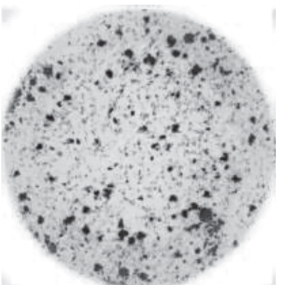
Expected results of the CBA, showing clear foci in columns 2-12, absence of foci in the antigen null column 1, and clear positive control staining (Row G, LCMV 1-1-3 antibody) and negative control staining (Row H, null serum). Endpoint titer corresponds to column with last positive signal, in this case is A=7, B=4, C=8, D=5, E=5, F=8, G=0.
Expected results of the CBA. Plate imaged on the CTL ImmunoSpot, but can be read by eye.
Protocol references
Scholer, L., V. T. K. Le-Trilling, M. Eilbrecht, D. Mennerich, O. E. Anastasiou, A. Krawczyk, A. Herrmann, U. Dittmer and M. Trilling (2020). "A Novel In-Cell ELISA Assay Allows Rapid and Automated Quantification of SARS-CoV-2 to Analyze Neutralizing Antibodies and Antiviral Compounds." Front Immunol 11: 573526.
Scholer, L., V. T. K. Le-Trilling, U. Dittmer, M. Fiedler and M. Trilling (2022). "Establishment and clinical validation of an in-cell-ELISA-based assay for the rapid quantification of Rabies lyssavirus neutralizing antibodies." PLoS Negl Trop Dis 16(5): e0010425.
Acknowledgements
Assay was developed with Jillian German, Emily Van Beek, Chloe Schiff, Allysen Henriksen, Akshay Neeli, Philip Eisenhauer, Inessa Manuelyan, and Jason Botten.