May 04, 2026
Cultivation of episymbiont-host co-cultures within a Bioreactor
- Jacey Weng1,
- Alex Grossman1
- 1ADA Forsyth Institute



Protocol Citation: Jacey Weng, Alex Grossman 2026. Cultivation of episymbiont-host co-cultures within a Bioreactor. protocols.io https://dx.doi.org/10.17504/protocols.io.14egn5r9yg5d/v1
License: This is an open access protocol distributed under the terms of the Creative Commons Attribution License, which permits unrestricted use, distribution, and reproduction in any medium, provided the original author and source are credited
Protocol status: Working
We use this protocol and it's working
Created: March 18, 2026
Last Modified: May 04, 2026
Protocol Integer ID: 313551
Keywords: bioreactor, Pioreactor, Saccharibacteria, Patescibacteria, CPR, symbiosis, Saccharimonadia, Patescibacteriota , cultivation of episymbiont, heterospecific bacterial host cells for growth, episymbiont lifecycle, naturalistic environment for episymbiont growth, episymbiont growth, pioreactor system, bioreactor abstract, phylum saccharibacteria, heterospecific bacterial host cell, ultrasmall bacteria from the phylum saccharibacteria, pioreactor, altered community population dynamics because the episymbiont lifecycle, powered pioreactor system, ultrasmall bacteria, interbacterial interactions from study, host cell growth, constant host cell growth, interbacterial interaction, obligate episymbiont, episymbiont, anaerobic chamber, cultivation, microaerophilic, fresh growth medium, adding fresh growth medium, ubiquitous in the mammalian oral cavity
Funders Acknowledgements:
NIH National Institute of Dental & Craniofacial Research
Grant ID: R25DE034582
NIH National Institute of Dental & Craniofacial Research
Grant ID: 5-R01-DE023810
Abstract
Abstract:
Ultrasmall bacteria from the phylum Saccharibacteria are ubiquitous in the mammalian oral cavity and colon. These obligate episymbionts rely on heterospecific bacterial host cells for growth and reproduction, and as such are only cultivatable in co-cultures wherein they influence host cell growth, shape, and behavior. Approximately 4 serial passages are necessary to observe the altered community population dynamics because the episymbiont lifecycle is slower than its hosts; incongruent growth obscures interbacterial interactions from study. Thus, Bioreactors, like the Raspberry Pi powered Pioreactor system, can be used to provide a more naturalistic environment for episymbiont growth. Not only are they affordable, modular, and small enough to fit inside microaerophilic or anaerobic chambers, Pioreactors allow continuous culturing and data collection by periodically adding fresh growth medium to sustain constant host cell growth.
Image Attribution
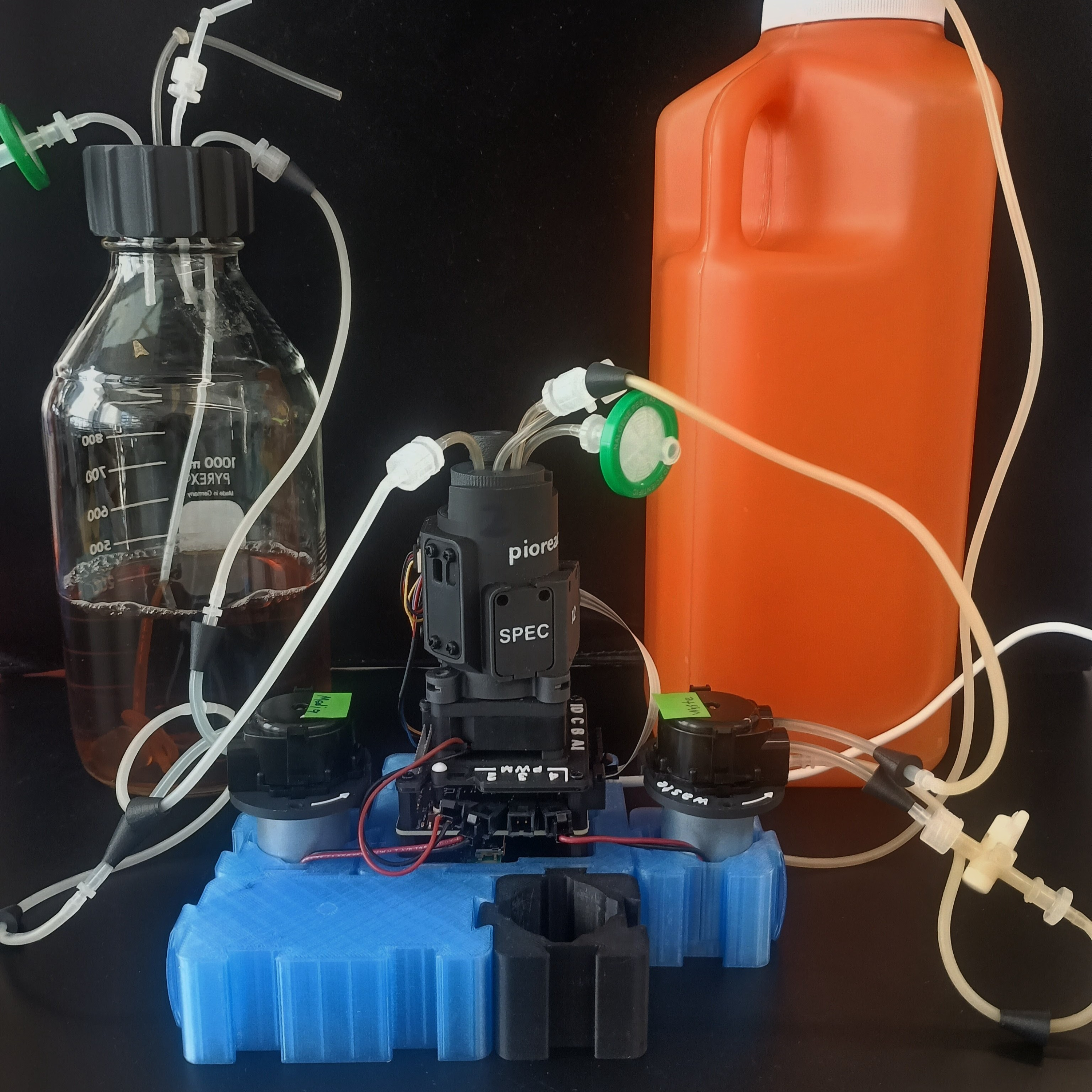
Photo by Alex Grossman, Somerville MA, 04/28/26
Guidelines
The described organisms are classified as BSL 2 and should never be handled in culture outside of a BSL2 approved workspace/laboratory.
Materials
Materials:
- Isogenic cultures of S. odontolytica XH001 and N. lyticus TM7x
- A controlled atmosphere chamber for microaerophilic conditions
- A wifi capable computer
- 20 mL Pioreactor kit (v1.0, v1.1, or v1.5)
- A compatable Raspberry Pi (Zero2 W)
- Two 500 mL GL45 bottles with ports for tubing and luer lock connectors
- Self-healing rubber plug for syringe sampling
- Seven tube sealers (see Figure 1)
- Autoclavable silicone tubing with 1/8th inch outer diameter and 1/16th inch inner diameter
- Three 0.22 μm luer lock/luer slip style filters
- Autoclavable sterilization pouches
- Sterile syringes and needles
- Kim wipes
- BHI medium
- Ultrapure water
- Deionized water
- 95% ethanol
Required bacterial cultures
Our model Saccharibacteria-host co-culture contains the episymbiont Nanosynbacter lyticus strain TM7x and the Actinomycete Schaalia odontolytica strain XH001 (1), originally co-isolated from healthy saliva
samples (2).
Episymbionts can be “isolated” from host-containing co-cultures using 0.45 μm filters for later host re-infections. All strains are stored in 15% glycerol at -80°C. All cultures were grown in Brain Heart Infusion medium (BHI) at 37°C within a Whitley A35 microaerophilic chamber (2% O2, 5% CO2, 93% N2).
System set up
Assemble seven port sealers (See figure 1)
Figure 1: To assemble tube sealers, cut 2-inch strips of tubing and tie an overhand knot in the middle. Next, attach the knotted strip to the pointed end of a male luer lock fixture. Utilize these to seal all redundant ports on the media bottle, waste bottle, and Bioreactor vial.
Attach the ported GL45 bottle caps to 500mL bottles.
Cut 11 short strips of silicone tubing (2-4 inches) and one long strip for medium uptake (the height of your 500 mL bottle).
Insert tubes into the bottles as shown in Figure 2.
Figure 2: Tubing assembly diagrams; A. Reaction chamber, B. Medium bottle, and C. Waste bottle
If the medium uptake tube curls in the autoclave, it can be weighted to stay on the bottom using glass weights.
Prepare 450 mL of BHI in the bottle with the medium uptake tube (16.54 g BHI powder, 450 mL Milli-Q water).
Ensure that the medium uptake port and 2 of the 3 remaining ports are sealed during autoclaving, or pressure changes will eject the medium.
Autoclave for 30 minutes on a liquid cycle.
After autoclaving the BHI, immediately place a 0.22 μm filter on the final port for air exchange.
Place the medium bottle in the microaerophilic/anaerobic chamber for 24 hours to equilibrate microaerophilic gas content (henceforth "Reduced medium").
In the reaction chamber, make sure that the waste collection tube is lowered to the max fill line/working volume, and the rest are slightly higher.
To optionally facilitate easy transportation into a controlled atmosphere chamber, 3D print these modular component stands.  pioholder.stl94.4KB piospacer.stl95.9KB pumpholder.stl127.2KB
pioholder.stl94.4KB piospacer.stl95.9KB pumpholder.stl127.2KB Warning: do not autoclave components printed with low melt-temperature thermoplastics!
Sterilization and assembly
Remove the peristaltic pump caps from their motors and remove the covers of the motor caps.
Take tubing out of motor caps and replace the caps on their motors.
This leaves just the bioreactor reaction chamber, the medium uptake tube, and the waste output tube. Place this assemblage into a sterilization pouch (Fisherbrand 01-812-54).
The washed waste bottle should be fitted with its ported cap, and 3 ports should be sealed using the sealing fixture shown in Figure 1.
Always autoclave bottles with one port open to facilitate air exchange.
Both the reaction chamber pouch and the waste bottle should be autoclaved for 20 minutes on a gravity cycle and dried completely.
Immediately after autoclaving, place a 0.22 μm filter on the waste bottle’s final port for air exchange.
Take the autoclaved pouch, autoclaved bottle of BHI, and a 0.22 μm filter into a sterilized biosafety hood, and run UV for 5 minutes to ensure sterility before assembly. After assembly the bioreactor should resemble figure 3.
Figure 3. Diagram of flow through an assembled Pioreactor system.
Open the sterile pouch with the reaction chamber.
Remove the tube sealer from the medium uptake tube of the medium bottle and connect the reaction chamber’s medium input luer lock to the port.
Remove a single tube sealer from the waste bottle and connect the reaction chamber’s waste output luer lock to the port.
Place the final 0.22 μm filter on the open reaction chamber port.
Attach 1-to-2-foot tubes to the opposite side of the air exchange filters on the reaction chamber and the waste chamber. Place the opposite ends of these tubes into an empty collection beaker.(These are emergency overflow tubes to prevent potential flooding in the event of a tube clog.)
Attach tube sealers to any remaining open ports.
Remove apparatus from the biosafety hood and insert the tubing into the peristaltic pumps according to Pioreactor instructions (3, 4)
Running an experiment
First, add 300 µL of isogenic S. odontolytica overnight culture axenically.
Transfer the inoculated bioreactor assembly into the appropriate controlled atmosphere chamber (2% O2 for these organisms).
Using the Pioreactor GUI, add 16mL of sterile BHI into the reaction chamber via the peristaltic pump.
Set medium dosing to 0.38 mL every 5 minutes (resulting in a dilution rate of 0.3);
Set internal temperature to 37oC; Set stirring to 500 rpm (default value); and Set OD600,
normalized OD600, growth rate, and temperature readings for continuous collection.
Allow S. odontolytica monoculture to grow for ~24-36 hours under these conditions in order to reach a steady-state OD600 value.
This steady-state OD value indicates the density at which the host is growing at the exact same rate as it is being diluted, and can be used to normalize between replicates.
After host stabilization, transport everything you will need for episymbiont inoculation into the controlled atmosphere chamber: including a small beaker of 95% ethanol, a Kim wipe, a sterile syringe, a sterile needle, and 200 μL of isolated N. lyticus TM7x at OD600 0.005 (≈4*107 cells)
Use the ethanol and Kim wipe to disinfect the self-healing plug on the reaction chamber.
Draw the isolated N. lyticus TM7x cells into the syringe and inject them through the self-healing plug.
Mark the time, this is your T0 or "Time of infection"
Using the Pioreactor GUI monitor culture turbidity until it reaches a new steady-state OD600, representing the new co-culture equilibrium point.
A typical episymbiont infection progresses through three phases as shown in figure 4.
1. Stable host population/episymbiont outgrowth
2. Host population crash/washout
3. Recovery to stable-symbiosis co-culture population
Figure 4. Typical cycle of episymbiont infection
Using the described settings, the Pioreactor will consume 109.44 mL of BHI every day.
If the device needs to run for longer than 4 days, additional media can be added mid-run by connecting a tube, a male luer lock fixture, and a 50 mL syringe to the air exchange filter on top of the fresh medium bottle and injecting reduced BHI through the filter.
Bioreactor sterilization (Performed at the end of every experiment to prepare for the next):
Prepare 50 mL of 2% bleach and add it into the empty media bottle.
Using the “cycle media” function of the Pioreactor, safely run the full volume through the vial and into the waste bottle.
Rinse the medium and waste bottles with deionized water (diH2O) and add 50 mL of diH2O to the media bottle.
Using the “cycle media” function of the Pioreactor, safely run the full volume through the vial and into the waste bottle.
Remove the media and waste bottles, then use the cycle media function for 60 seconds to remove residual water from the lines.
Sterilized materials can be safely stored for future experiments.
Protocol references
1. Bor B, Bedree JK, Shi W, McLean JS, He X. 2019. Saccharibacteria (TM7) in the human oral microbiome. J Dent Res 98:500–509.
2. He X, McLean JS, Edlund A, Yooseph S, Hall AP, Liu S-Y, Dorrestein PC, Esquenazi E, Hunter RC,
Cheng G, Nelson KE, Lux R, Shi W. 2015. Cultivation of a human-associated TM7 phylotype reveals a reduced genome and epibiotic parasitic lifestyle. Proceedings of the National Academy of Sciences 112:244–249.
3. Pioreactor Inc. 2024. Pioreactor: Affordable bioreactor for continuous culture and monitoring. Pioreactor Inc.
4. Pioreactor Inc. 2025. Pioreactor: Hardware and software for an accessible bioreactor platform. GitHub.
Acknowledgements
We extend our sincerest thanks to Cameron Davidson-Pilon for help troubleshooting Pioreactor assembly and operation.