Jun 22, 2023
Version 1
Copying Archived LTEE Samples V.1
- 1Michigan State University;
- 2The University of Texas at Austin
- the-ltee


External link: https://the-ltee.org
Protocol Citation: Zachary Blount, Jeffrey Barrick 2023. Copying Archived LTEE Samples . protocols.io https://dx.doi.org/10.17504/protocols.io.bp2l61yykvqe/v1
License: This is an open access protocol distributed under the terms of the Creative Commons Attribution License, which permits unrestricted use, distribution, and reproduction in any medium, provided the original author and source are credited
Protocol status: Working
We use this protocol and it's working
Created: June 09, 2022
Last Modified: June 22, 2023
Protocol Integer ID: 64296
Keywords: archived ltee sample, ltee sample, copies of freezer stock, homogeneous cell population, genetic diversity, making copy, representative copy, term evolution experiment, population samples versus clonal sample, new mutation, copy, population sample, clonal sample, fossil, freezer stock
Funders Acknowledgements:
National Science Foundation
Grant ID: DEB-1951307
Abstract
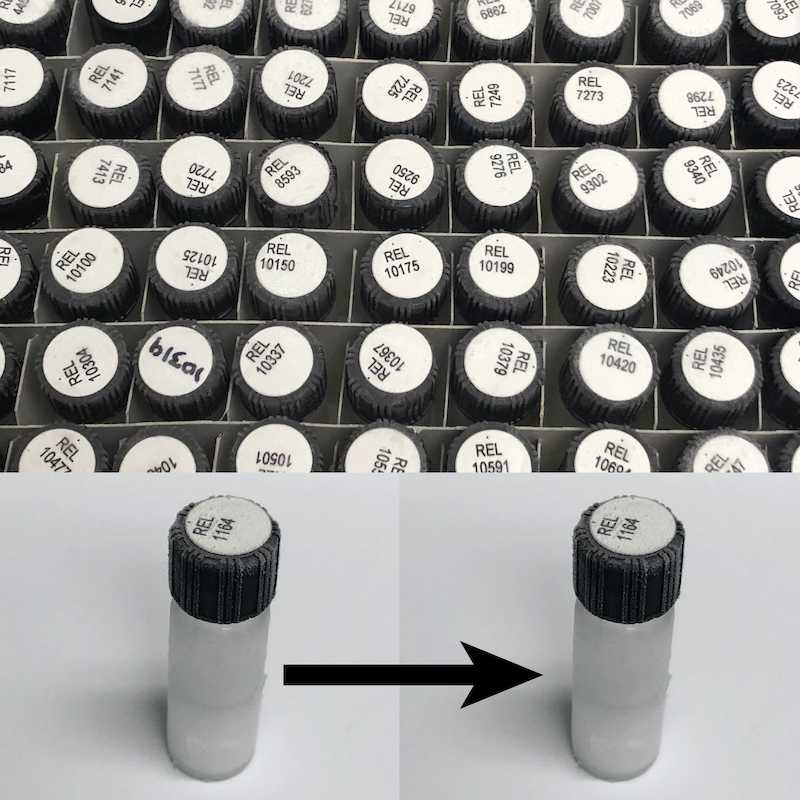
This protocol describes how to replenish the frozen "fossil" record of the E. coli Long-Term Evolution Experiment (LTEE) by making copies of freezer stocks. Different methods are used to copy population samples versus clonal samples. For the former, the goal is to make a representative copy that maintains the genetic diversity that is present in the population. For the latter, the goal is to make a copy of a homogeneous cell population without allowing it to evolve new mutations.
The culture media and supplies needed for this protocol are described here:
Copying Archived Population Samples
3d
Use this procedure to make copies of archived population samples from the LTEE that are as close as possible to exact copies of the original samples.
Note
Strictly speaking, making an exact copy of a bacterial population is impossible. Stored samples are frozen with glycerol as a cryoprotectant (which E. coli cells can metabolize), and are revived in DM1000. Thus, a frozen population that is being revived is exposed to a resource environment that contains both glycerol and a far higher glucose concentration than is found in DM25. As these conditions are very different than those the population experienced during the LTEE prior to archiving, outgrowth during revival is an unavoidable perturbation. However, this procedure has been designed to ameliorate and reduce the effects of this perturbation so as to maintain the representative genetic diversity within the population sample, minimize changes in the frequencies of different genotypes, and avoid further evolution caused by new mutations.
Disinfect the bench with 70 % (v/v) ethanol or 10 % (v/v) bleach and light a Bunsen burner to create an updraft, which will reduce the possibility of contaminants falling into materials during work.
Prepare an autoclaved 50-mL Erlenmeyer flask capped with a 20-mL beaker for each sample that will be revived, plus a blank. Fill each flask with 9.9 mL of DM1000.
Retrieve vials of frozen stock from –80°C storage, place in ice in an insulated ice bucket, and allow the stock to thaw completely.
Vortex each freezer vial and pipette 120 µL of the thawed stock into one of the flasks. Wipe off the micropipettor with a Kimwipe moistened with 70 % (v/v) ethanol before pipetting from each thawed stock to prevent cross-contaminating the archived samples.
Note
Normally 100 µL of culture is transferred each day in the LTEE to a new flask. Reviving 120 µL here accounts for the 1:5 volume of 80 % (v/v) glycerol added to the culture prior to freezing so that, at least nominally, we are preserving a normal sampling of the genetic diversity that would be present in the population of E. coli cells after an LTEE transfer.
Incubate flasks 120 rpm, 37°C Overnight
Disinfect bench with 70 % (v/v) ethanol or 10 % (v/v) bleach and light a Bunsen burner to create an updraft, which will reduce the possibility of contaminants falling into materials during work.
Prepare another set of the same number of flasks. Fill each flask with 9.9 mL of DM25.
Prepare one test tube filled with 9.75 mL of sterile saline for each sample.
Dilute the grown cultures 1:40 by pipetting 250 µL into a test tube filled with saline.
Note
This dilution attempts to match the initial density in the new DM25 cultures to what it would be after a normal daily transfer. It may not do so perfectly (especially for Cit+ populations), but it should work to reasonably preserve the representative genetic diversity within the population.
Thoroughly vortex each test tube three times before using a micropipettor to transfer 100 µL from it into one of the new flasks filled with DM25.
Incubate the flasks 120 rpm, 37°C for 24:00:00 .
1d
Add 2 mL of 80 % (v/v) glycerol to each flask. Swirl or gently vortex to mix. Pipette the culture-glycerol mix into glass vials that have been labeled with the appropriate sample information. A small glass vial (0.5 dram) can be filled with 1.25 mL each, while large glass vials (2 dram) can be filled with 6 mL each. Be careful not to overfill the vials, or they can break as the contents freeze and expand.
Copying Archived Clonal Samples
2d
Use this procedure to make copies of samples of clonal isolates from the LTEE.
Note
Clonal isolates were obtained by picking single colonies from agar plates after multiple rounds of purification by streaking. They should consequently have minimal genetic diversity. (Ideally, they should have no genetic diversity, but mutations occur during the growth of colonies, so low frequencies of genetic variants are unavoidable.) Unlike with the above case of copying samples of mixed populations, the principal concern with copying clonal samples is minimize the potential for further evolution caused by new mutations.
Disinfect the bench with 70 % (v/v) ethanol or 10 % (v/v) bleach and light a Bunsen burner to create an updraft, which will reduce the possibility of contaminants falling into materials during work.
Prepare an autoclaved 50-mL Erlenmeyer flask capped with a 20-mL beaker for each sample that will be revived, plus a blank. Fill each flask with 10 mL of DM1000.
Retrieve vials of frozen stock from –80°C storage, place in ice in an insulated ice bucket, and allow the stock to thaw completely.
Vortex each freezer vial and pipette 12 µL of the thawed stock into one of the flasks. Wipe off the micropipettor with a Kimwipe moistened with 70 % (v/v) ethanol before pipetting from each thawed stock to prevent cross-contaminating the archived samples.
Note
Alternatively, do not let the frozen stock melt. Scrape 2 µL – 10 µL of frozen culture from the freezer vial using a pipette tip attached to a pipettor and use it to inoculate the flask. The important point in this step is to inoculate with enough cells that it is unlikely that a low frequency genetic variant in the stock might be overrepresented in the inoculum.
Incubate the flasks 120 rpm, 37°C Overnight
Add 2 mL of 80 % (v/v) glycerol to each flask. Swirl or gently vortex to mix. Pipette the culture-glycerol mix into glass vials that have been labeled with the appropriate sample information. A small glass vial (0.5 dram) can be filled with 1.25 mL each, while large glass vials (2 dram) can be filled with 6 mL each. Be careful not to overfill the vials, or they can break as the contents freeze and expand.