Oct 06, 2025
Conjugation of Synthetic Peptides with 2,4,6-trinitrobenzenesulfonic acid (TNBS)
- Brian Andrich Pollo1,
- Ruby Anne King2,1,
- Fresthel Monica M. Climacosa3,1,
- Salvador Eugenio C. Caoili1
- 1Biomedical Innovations Research for Translational Health Science (BIRTHS) Laboratory, Department of Biochemisty and Molecular Biology, College of Medicine, University of the Philippines Manila;
- 2Department of Science and Technology - Philippine Council for Health Research and Development;
- 3Department of Medical Microbiology, College of Public Health, University of the Philippines Manila
- Brian Andrich Pollo: corresponding;



Protocol Citation: Brian Andrich Pollo, Ruby Anne King, Fresthel Monica M. Climacosa, Salvador Eugenio C. Caoili 2025. Conjugation of Synthetic Peptides with 2,4,6-trinitrobenzenesulfonic acid (TNBS). protocols.io https://dx.doi.org/10.17504/protocols.io.8epv5kjmjv1b/v1
Manuscript citation:
Climacosa, F. M. M., King, R. A. N., Santos, B. M. M., & Caoili, S. E. C. (2020). Development and Characterization of Polymeric Peptides for Antibody Tagging of Bacterial Targets. Protein and peptide letters, 27(10), 962–970. https://doi.org/10.2174/0929866527666200427212940
License: This is an open access protocol distributed under the terms of the Creative Commons Attribution License, which permits unrestricted use, distribution, and reproduction in any medium, provided the original author and source are credited
Protocol status: Working
We use this protocol and it's working
Created: August 10, 2025
Last Modified: October 06, 2025
Protocol Integer ID: 224405
Keywords: Amines/analysis, Proteins/chemistry, Peptides/chemistry, Colorimetry/methods, Spectrophotometry/methods, 6-Trinitrobenzenesulfonic Acid, Nitrobenzenes/chemistry, Trinitrophenylation, Extinction Coefficient, Protein Binding/methods, Buffers/chemistry, Sodium Bicarbonate/chemistry, HEPES/chemistry, Surface-Active Agents/chemistry, Calibration/methods, Temperature/methods, Reagent Kits, Diagnostic, Blood Coagulation/physiology, Fibrinolysis/physiology, Reproducibility of Results, trinitrophenylated peptide conjugate, conjugated peptide, conjugation of synthetic peptide, peptide conjugate, peptide, synthetic peptide, glycine standard, complete tnbs saturation of amine group, quantification of primary amine group, primary amine content, glycine quenching, tnbs assay, trinitrobenzenesulfonic acid, peptide stock, free primary amine, primary amine group, reaction between tnb, glycine standard curve, protein, diluted tnbs solution, chromogenic trinitrophenyl, sodium bicarbonate buffer, sodium bicarbonate, amine group, based assay, comple
Funders Acknowledgements:
DOST-PCHRD
Grant ID: Dissertation grant
Disclaimer
The procedures described herein were developed collaboratively by the BIRTHS Laboratory. Protocol details are provided “as is” and may require optimization depending on laboratory conditions, equipment, and reagent sources. Users should conduct pilot testing and risk assessments prior to full-scale implementation. The institution and authors disclaim liability for any consequence arising from use of this method.
Abstract
This protocol describes the quantification of primary amine groups in proteins and peptides using the 2,4,6-trinitrobenzenesulfonic acid (TNBS) assay, and the preparation of trinitrophenylated peptide conjugates (TNP-POPs) for downstream applications. The TNBS assay relies on the reaction between TNBS and free primary amines under mildly alkaline conditions to form a chromogenic trinitrophenyl (TNP) derivative with a characteristic absorbance at 450 nm. Glycine standards are prepared in 0.1 M sodium bicarbonate buffer for calibration, while peptides are dissolved in either sodium bicarbonate buffer or HEPES-buffered saline (HBS) to avoid precipitation. Reaction mixtures consist of the amine-containing sample, sodium bicarbonate (or HBS), and freshly diluted TNBS solution (1.7 mM final), incubated at 37 °C for 2 hours. Absorbance is measured in duplicate on a microplate reader, and primary amine content is calculated from the glycine standard curve or molar extinction coefficient. For TNP-POP conjugation, peptide stocks are reacted with TNBS in HBS with 0.008% Tween 20, without glycine quenching, using stoichiometric ratios to approximate complete TNBS saturation of amine groups. The resulting TNP-conjugated peptides are prepared fresh before clotting and fibrinolysis assays to ensure stability and solubility. This method is adapted from Thermo Scientific and Yi et al. (2008) with modifications for improved absorbance sensitivity and compatibility with peptide-based assays.
Image Attribution
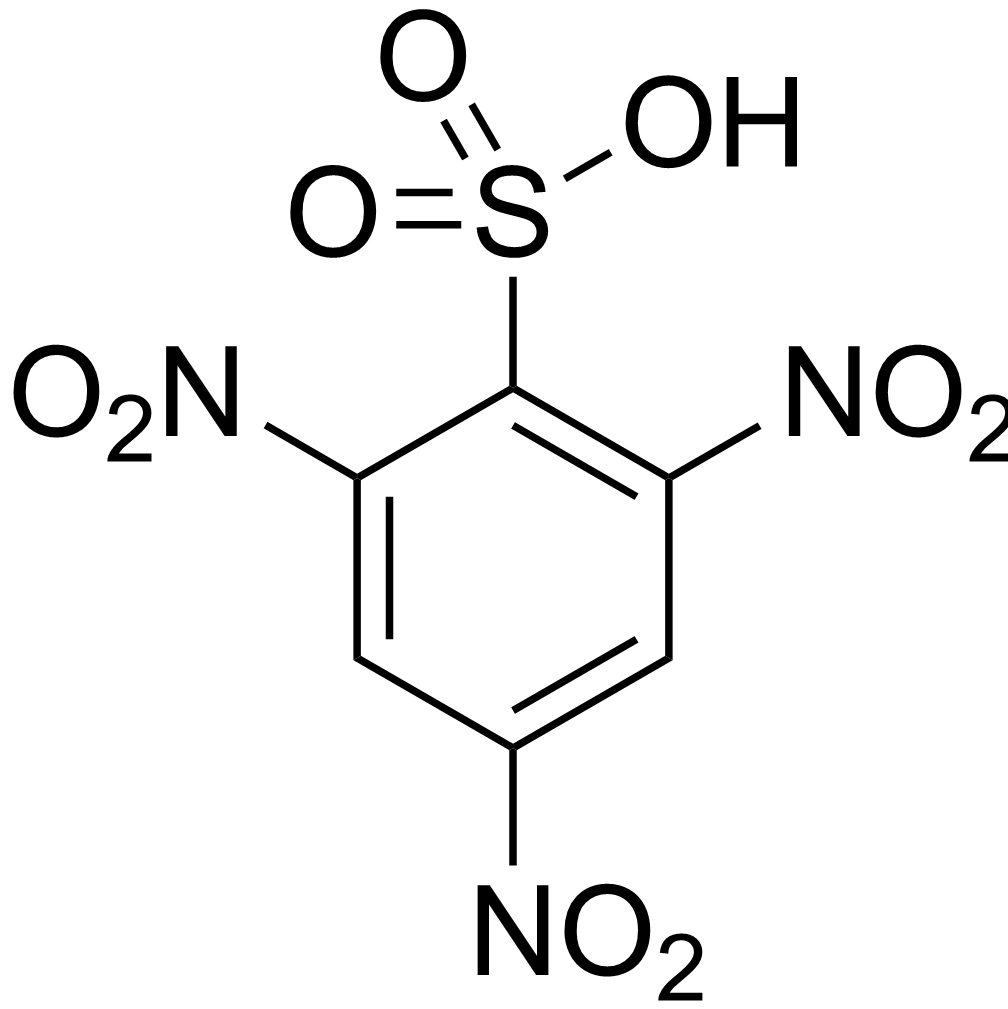
Edgar181, Public domain, via Wikimedia Commons
Materials
1. Sodium bicarbonate, 8.4% solution for IV injection, ~pH 7.8 (7.0 to 8.5), 84 mg/ml or 1 M (Hospira, Batch No. 79027EV, Exp July 1,2019, NC USA)
2. Sterile water for injection, parenteral (Euro-Med Laboratories, DR-XY14112, Lot 175821, Dasmariñas, Cavite, Philippines)
3. Protein, 20-200μg/ml or peptide 2-20μg/ml
4. Glycine 1 M stock in sterile water (0.75 g Glycine Himedia, RM1344-500G, Lot 0000104062, dissolved up to 10 ml with sterile water) – store at 4°C, in the dark
5. 5% w/v picrylsulfonic in H₂O, 170mM, MW: 293.17 g/mol, (Sigma, P2297-10 ml, Lot No. SLBT1675)
6. Dimethylsulphoxide, A.R. (RCI Labsacan Limited, AR1054-G2.5L)
7. Polypropylene tube, 0.2 ml
8. Polypropylene tube, 0.5 ml
9. micropipette tips – blue, yellow, white
10. micropipettes, 0.5 to 10 ul, 10 to 100 ul, 20-200 ul, 100-1000 ul
11. 10 ml volumetric flask
12. Conical tube, 15 ml
13. Parafilm
14. Vortex
15. Mini centrifuge
16. Flat bottom polystyrene plate
17. Microplate reader
18. Freezer (-20°C)
19. HEPES, 150 mM NaCl, pH 7.4 (HBS)
20. Thermomax microplate reader (Molecular Devices, Sunnyvale, CA)
21. Tween 20 (for TNP-POP preparation)
Safety warnings
Notes:
1. Adding DMSO prevents formation of precipitates when 0.1 M NaHCO₃ is mixed in with polymerized peptide stock.
2. Protocol adapted from ThermoFisher add 10% SDS and 125μL of 1N HCl to each sample to stop and stabilize reaction.
3. Absorbance had been measured at 335 nm (ThermoFisher) or 405 nm (Yi et al 2008), but 450 nm is used in our case because it gives higher absorbance readings.
Procedure
Prepare 0.1 M sodium bicarbonate reaction buffer by diluting 1 ml 1 M sodium bicarbonate up to 10 ml with sterile water in volumetric flask. Transfer to a 15 ml conical tube.
Prepare the glycine standard curve
Prepare 100 mM Gly by mixing 10 µl 1 M stock + 90 µl 0.1 M NaHCO₃
Prepare 2 mM Gly by mixing 10 µl 100 mM Gly + 490 µl 0.1 M NaHCO₃
In 0.2 ml PCR tubes, prepare 2-fold dilutions of the glycine standard or samples in reaction buffer, e.g. 50 ul 2 mM + 50 ul 0.1 M NaHCO₃ in PCR tubes. Mix well by vortexing. Change tips after each dilution.
Dissolve the samples to be assayed directly in the reaction buffer.
For proteins at a concentration of 20-200 ug/ml.
For amino acids, should be dissolved in reaction buffer at 2-20 µg/ml (0.2 to 2 mM).
For peptides in 20% DMSO stock: 0.5 µl of peptide stock was added to 4.5 µl 100% DMSO in a PCR tube
Add 0.1 M NaHCO₃ incrementally (until the desired volume, to make 2 mM), then vortex after each addition. For example: For Peptide A (480 mM): Add 15 µl + 25 µl x 4, for final volume of 120 µl. For Peptide B (180 mM): Add 20 µl x 2, for final volume of 40 µl.
Using a multichannel pipette, add 160 ul of 0.1 M NaHCO₃ (80% v/v) to 20 ul (10% v/v) of the amino acid standard or peptide sample. Mix well.
Dilute supplied 5% TNBSA (170 mM) solution 100-fold (1.7 mM) in 0.1 M sodium bicarbonate buffer. Do not prepare this working solution in advance. Use immediately.
Add 20 ul (10% v/v) of TNBS 1.7 mM solution to the standard or sample solution in 0.1 M NaHCO₃. Mix well.
Incubate at 37°C for 2 hours.
Vortex tubes and spin down briefly.
Transfer 100 ul to flat bottom polystyrene plate x 2 wells for duplicate determinations.
Measure absorbance of solution at 450 nm, 37°C.
Determine concentration of primary amines by calculation from the extinction coefficient or by comparison to amino acid standards, e.g. glycine.
Store TNBS-labelled peptides at -20°C.
For the peptide solutions, mix 10 µl of approximately 2 mM peptide solution with 80 µl of 20 mM HEPES, 150 mM NaCl, pH 7.4 (HBS) and 10 µl of 1.7 mM TNBS solution in HBS. Incubate at 37°C for 2 hours. Measure absorbance at 450 nm using a Thermomax microplate reader. Use HBS as diluent due to the formation of precipitates when sodium bicarbonate is used. The development of an orange color in HBS, indicating a positive reaction, occurs more rapidly for peptides than for glycine. Use sodium bicarbonate for the glycine standard curve.
Peptide-TNP Conjugation
For every microliter of peptide stock needed to make 1 mg/ml of peptide solution, compute the amount of TNBS to add from the ratio of the primary amine group concentration to the TNBS concentration (17 mM). This calculation should approximate 100% TNBS saturation of primary amine groups for the polydisperse peptide solution.
Prepare TNP-POPs fresh before each assay using essentially the same protocol as the TNBS assay, with the following modifications: Glycine is not added to the TNP peptide conjugation reaction to quench unreacted TNBS, as glycine reacts slowly with TNBS at neutral pH. The diluent for TNP-POPs is HBS with 0.008% Tween 20, which is compatible with plasma clotting and fibrinolysis assays. This is done to overcome the poor solubility of TNP-POPs in the absence of surfactants.
Protocol references
TNBS (2,4,6 – Trinitrobenzene sulfonic acid). Thermo Scientific, adapted from Hermanson. Available from https://assets.thermofisher.com/TFS-Assets/BID/manuals/D00386~.pdf.
Yi X et al. 2008. Protein Conjugation with Amphiphilic Block Copolymers for Enhanced Cellular Delivery. Bioconjug Chem. 2008 May; 19(5): 1071–1077. https://www.ncbi.nlm.nih.gov/pubmed/18447367
S. A. Smith et al., 2006.