Jan 23, 2024
CompDuplex: Accurate detection of somatic mutations by duplex-seq with comprehensive genome coverage
- 1Department of Molecular and Human Genetics, Baylor College of Medicine
- SMaHT



Protocol Citation: Muchun Niu, Chenghang Chuck Zong 2024. CompDuplex: Accurate detection of somatic mutations by duplex-seq with comprehensive genome coverage. protocols.io https://dx.doi.org/10.17504/protocols.io.kxygx3x4og8j/v1
License: This is an open access protocol distributed under the terms of the Creative Commons Attribution License, which permits unrestricted use, distribution, and reproduction in any medium, provided the original author and source are credited
Protocol status: Working
We use this protocol and it's working
Created: January 17, 2024
Last Modified: January 23, 2024
Protocol Integer ID: 93708
Keywords: Duplex-seq, Somatic mutation, Accurate mutation calling, comprehensive genome coverage somatic mutation, seq with comprehensive genome coverage somatic mutation, comprehensive genome coverage of compduplex, accurate detection of somatic mutation, comprehensive genome coverage, method with comprehensive genome coverage, whole genome characterization of somatic mosaicism, accuracy of somatic mutation, somatic mutation, limited genome coverage, whole genome characterization, sequencing method, whole genome, sequencing, human genome, genome, sequencing platform, whole genome scale, end sequencing, streamlined chemistry of compduplex assay, complementary strands of dna, compduplex assay, dna, somatic mosaicism
Funders Acknowledgements:
SMaHT Network (NIH)
Grant ID: UG3NS132132
Disclaimer
Patent application covering CompDuplex chemistry has been filed by Baylor College of Medicine.
Abstract
Somatic mutations continuously accumulate in the human genome, posing vulnerabilities towards aging and increased risk of various diseases. However, accurate detection of somatic mutations at the whole genome scale is still challenging. By tagging and independently sequencing the two complementary strands of DNA, the recent development of duplex-sequencing methods has greatly improved the detection accuracy, however, the limited genome coverage and the compromised compatibility with existing sequencing platforms have constrained the broad applications of these methods.
To overcome these technical challenges, here we developed a duplex sequencing method with comprehensive genome coverage, which we refer to as CompDuplex-seq. The streamlined chemistry of CompDuplex assay allows efficient generation of libraries readily compatible with standard Illumina 2x150 paired-end sequencing. In addition, we validated the accuracy of somatic mutation calling and comprehensive genome coverage of CompDuplex by profiling a single-cell expanded clone. To summarize, CompDuplex chemistry supports genome-wide coverage while maintaining high accuracy, which we believe will facilitate the whole genome characterization of somatic mosaicism in various biological systems.
Protocol materials
Ampure XP beadsBeckmanCatalog #A63881
Tn5 transposase, unloadedDiagenodeCatalog #C01070010-20
GlycerolMerck MilliporeSigma (Sigma-Aldrich)Catalog #G5516
Tagmentation Buffer 1Illumina, Inc.Catalog #20015171
WaterInvitrogen - Thermo FisherCatalog #46-2224
NEBNext UltraII Q5 Master MixNew England BiolabsCatalog #M0544X
rCutSmart BufferNew England BiolabsCatalog #B6004S
BtgZI - 500 unitsNew England BiolabsCatalog #R0703L
0.5M EDTAMerck MilliporeSigma (Sigma-Aldrich)Catalog #E7889-100ML
10% Triton X-100Merck MilliporeSigma (Sigma-Aldrich)Catalog #93443-100ML
1M Tris-HCl, pH 8.0Invitrogen - Thermo FisherCatalog #15568025
ProteaseQiagenCatalog #19155
T4 Polynucleotide Kinase Reaction BufferNew England BiolabsCatalog #B0201S
StickTogether DNA Ligase BufferNew England BiolabsCatalog #B0535S
T7 DNA Ligase - 750,000 unitsNew England BiolabsCatalog #M0318L
iTaq Universal SYBR Green SupermixBio-Rad LaboratoriesCatalog #172-5112
5M NaClInvitrogen - Thermo FisherCatalog #AM9760G
WaterInvitrogen - Thermo FisherCatalog #46-2224
Custom Tn5 transposase assembly
1h
Prepare 500 µL of 2X Annealing Buffer.
40 µL 1M Tris-HCl, pH 8.0Invitrogen - Thermo FisherCatalog #15568025
10 µL 5M NaClInvitrogen - Thermo FisherCatalog #AM9760G
450 µL WaterInvitrogen - Thermo FisherCatalog #46-2224
2m
Transposon annealing.
Prepare the following mix in a PCR tube.
20 µL 2X Annealing Buffer
10 µL 200 micromolar (µM) ME_REV
10 µL 200 micromolar (µM) T_BtgZ1_ME
Oligonucleotides sequences
ME_REV: /5Phos/CTGTCTCTTATACACATCT
T_BtgZ1_ME: ATGTGTGGAGCGATG AGATGTGTATAAGAGACAG
Mix up the reaction, spin down, and perform the following reactions on a thermal cycler.
95 °C 5 min
65 °C 5 min, Ramp rate 0.1ºC/s
4 °C Hold, Ramp rate 0.1ºC/s
This results in a 50 micromolar (µM) transposon mix .
27m
Custom Tn5 assembly.
Prepare the following mix in a 1.5 mL tube.
20 µL Tn5 transposase, unloadedDiagenodeCatalog #C01070010-20
20 µL 50 micromolar (µM) transposon mix
Gently pipet to mix, and incubate at 23 °C for 30 min.
Add 20 µL GlycerolMerck MilliporeSigma (Sigma-Aldrich)Catalog #G5516 to the tube, mix well, aliquot, label as “Tn5_BtgZ1”, and store at -20 °C .
31m
CompDuplex Procedure
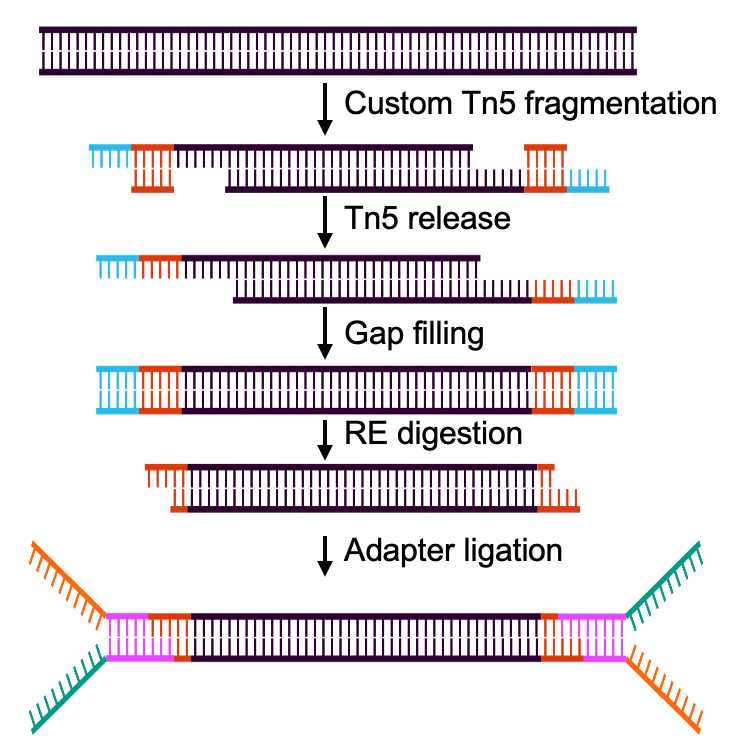
1. Re-purification of genomic DNA
Dilute 20 ng Sample to 10 µL nucleus-free water in a PCR tube. Add 5 µL Ampure XP beadsBeckmanCatalog #A63881 (0.5X) to the tube, mix well, and incubate at Room temperature for 5 min.
Put the tube on the magnetic stand. When the aqueous phase becomes transparent, remove the supernatant, wash twice with 120 µL 80 % volume Ethanol . Air-dry the beads.
2. On-bead custom Tn5 tagmentation
Prepare the following tagmentation mix.
2 µL Tagmentation Buffer 1Illumina, Inc.Catalog #20015171
0.48 µL 1:30 diluted Tn5_BtgZ1
7.52 µL WaterInvitrogen - Thermo FisherCatalog #46-2224
Resuspend the air-dried beads with 10 µL tagmentation mix.
Incubate on a thermal cycler using the following program: 20 °C for 5 min, 55 °C for 15 min.
Quench the reaction by adding 3 µL of 0.2M EDTA.
Incubate on a thermal cycler at 50 °C for 30 min.
3. Gap filling
Add 3 µL of 0.2M MgCl2 to the tube.
Add 16 µL NEBNext UltraII Q5 Master MixNew England BiolabsCatalog #M0544X to the tube.
Incubate on a thermal cycler at 65 °C for 3 min.
Quench the reaction by adding 2 µL of 0.5M EDTA.
Perform double size selection with 0.48X/0.75X Ampure XP beadsBeckmanCatalog #A63881 , elute in 7.5 µL water.
4. Restriction enzyme digestion
Prepare the following restriction enzyme digestion mix (Total 15 µL ).
7.5 µL Gap filling product
1.5 µL rCutSmart BufferNew England BiolabsCatalog #B6004S
0.7 µL BtgZI - 500 unitsNew England BiolabsCatalog #R0703L
5.3 µL Water
Incubate on a thermal cycler with the following program: 25 °C for 10 min, 37 °C for 3 h, 10 °C for 12 h.
5. Restriction enzyme release
Prepare the following restriction enzyme release mix (Total 500 µL ).
15 µL 1M Tris-HCl, pH 8.0Invitrogen - Thermo FisherCatalog #15568025
12 µL 0.5M EDTAMerck MilliporeSigma (Sigma-Aldrich)Catalog #E7889-100ML
10 µL 1M KCl
5 µL 10% Triton X-100Merck MilliporeSigma (Sigma-Aldrich)Catalog #93443-100ML
18 µL 10% NP40
420 µL Water
20 µL 20 mg/mL ProteaseQiagenCatalog #19155
Add 15 µL restriction enzyme release mix to the sample.
Incubate on a thermal cycler with the following program: 50 °C for 45 min, 25 °C for 2 h.
Purify with 0.85X Ampure XP beadsBeckmanCatalog #A63881 , elute in 10 µL water.
6. Y-shape ligation adapter annealing
Prepare the following 15 micromolar (µM) T1T2_TCTT ligation adapter .
1 µL T4 Polynucleotide Kinase Reaction BufferNew England BiolabsCatalog #B0201S
10.5 µL 100 micromolar (µM) T1_BtgZ1_ME
7.5 µL 100 micromolar (µM) Rev_T2_BtgZ1
31 µL Water.
Oligonucleotides sequences
T1_BtgZ1_ME: TCGTCGGCAGCGTC AGATGTGTAT
Rev_T2_BtgZ1: /5Phos/ TCTT ATACACATCT CCGAGCCCACGAGAC
Mix up the reaction, spin down, and perform the following reactions on a thermal cycler.
65 °C 5 min
20 °C Hold, Ramp rate 0.1ºC/s
7. Y-shape ligation adapter ligation
Prepare the following ligation mix (Total 50 µL ).
10 µL Sample from Step 8
25 µL StickTogether DNA Ligase BufferNew England BiolabsCatalog #B0535S
3 µL 15 micromolar (µM) T1T2_TCTT ligation adapter
3 µL T7 DNA Ligase - 750,000 unitsNew England BiolabsCatalog #M0318L
9 µL Water
Incubate at 25 °C for 30 min.
Purify with 0.8X Ampure XP beadsBeckmanCatalog #A63881 , elute in 51 µL water.
8. Quantification of library complexity
Dilute 1 µL of ligation product with 9 µL water. Use the 1:10 diluted product to quantify library complexity using qPCR. Any Illumina Nextera libraries with known concentration can be used as a standard. An example qPCR procedure is shown below.
5 µL iTaq Universal SYBR Green SupermixBio-Rad LaboratoriesCatalog #172-5112
0.25 µL 10 micromolar (µM) T1ME
0.25 µL 10 micromolar (µM) T2ME
3.5 µL water
1 µL template
Oligonucleotides sequences
T1ME: TCGTCGGCAGCGTC AGATGTGTATAAGAGACAG
T2ME: GTCTCGTGGGCTCGG AGATGTGTATAAGAGACAG
94 °C 2 min
30 cycles of
94 °C 20s
68 °C 20s
72 °C 1 min, fluorescence scanning
Melting curve
9. Library amplification
We recommend to amplify 14 cycles for a library with 20 million DNA fragments.
25 µL NEBNext UltraII Q5 Master MixNew England BiolabsCatalog #M0544X
2.5 µL 10 micromolar (µM) Illumina Nextera N5XX index primer
2.5 µL 10 micromolar (µM) Illumina Nextera N7XX index primer
20 µL ligation product and water
Oligonucleotides sequences
Illumina Nextera N5XX index primer: AATGATACGGCGACCACCGAGATCTACAC NNNNNNNN TCGTCGGCAGCGTC
Illumina Nextera N7XX index primer: CAAGCAGAAGACGGCATACGAGAT NNNNNNNN AGATGTGTATAAGAGACAG
PCR cycles:
98 °C 30s
14 cycles of
98 °C 10s
63 °C 30s
72 °C 1 min
72 °C 3 min
Purify with 0.8X Ampure XP beadsBeckmanCatalog #A63881 , elute in 20 µL water.