Aug 10, 2024
Collagen extraction from pretreated bone/tooth samples
- Maciej Krajcarz1,2,
- Dorothée . Drucker3,
- Magdalena Krajcarz2,4,
- Hervé ocherens2,3
- 1Institute of Geological Sciences, Polish Academy of Sciences (Warsaw, Poland);
- 2Department of Geosciences, Biogeology, University of Tübingen (Tübingen, Germany);
- 3Senckenberg Centre for Human Evolution and Palaeoenvironment, University of Tübingen (Tübingen, Germany);
- 4Institute of Archaeology, Nicolaus Copernicus University in Toruń (Toruń, Poland)


Protocol Citation: Maciej Krajcarz, Dorothée . Drucker, Magdalena Krajcarz, Hervé ocherens 2024. Collagen extraction from pretreated bone/tooth samples. protocols.io https://dx.doi.org/10.17504/protocols.io.8epv5rrp4g1b/v1
License: This is an open access protocol distributed under the terms of the Creative Commons Attribution License, which permits unrestricted use, distribution, and reproduction in any medium, provided the original author and source are credited
Protocol status: Working
We use this protocol and it's working
Created: June 05, 2024
Last Modified: August 10, 2024
Protocol Integer ID: 101253
Keywords: bone collagen, dentine collagen, collagen extraction, stable isotopes, radiocarbon dating, ZooMS proteomics, fossil bones, paleontology, archaeology, bone, dentine, tooth, collagen extraction from pretreated bone, extracting collagen, high pureness of the resulted collagen, collagen yield, high efficiency of collagen yield, collagen, dry collagen, resulted collagen, tooth samples this protocol, tooth sample, pretreated bone, stable isotope analysis, stable isotope labs of the institute, proteomic identification, bone, stable isotope lab, extraction
Abstract
This protocol presents the procedure of extracting collagen from a sample of bone or tooth, prior to stable isotope analysis, radiocarbon dating, and/or proteomic identification. The sample is assumed to be pre- treated (cut off from the specimen, cleaned, defatted, crushed). The procedure follows the ABA methodology (Acid-Base-Acid treatment) and enables high pureness of the resulted collagen along still-high efficiency of collagen yield. Basic health safety practices are also provided.
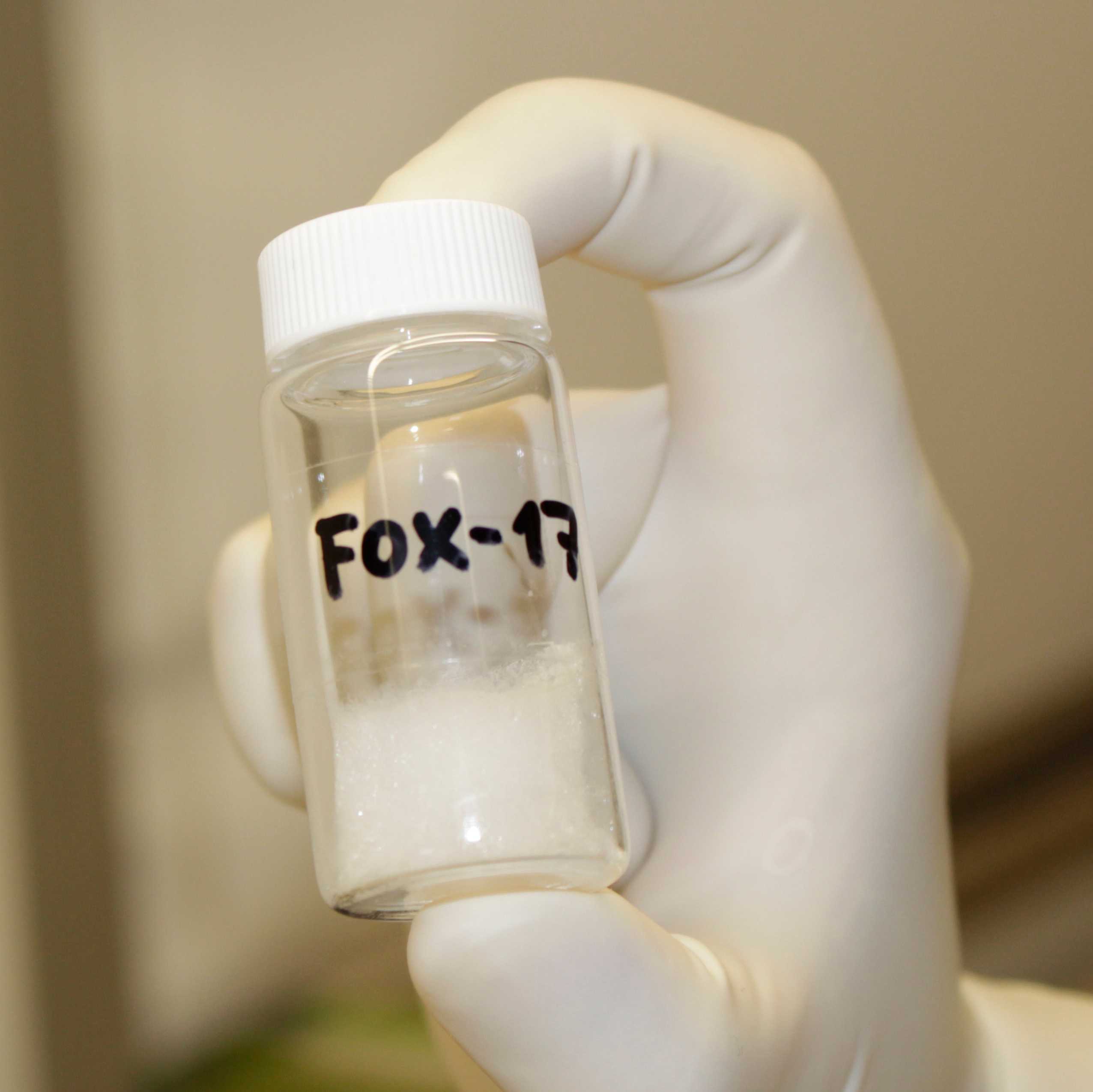
The expected result is around 20 mg of pure and dry collagen, ready for further analyses. The collagen resulting from this protocol is fluffy and cotton-like.
This protocol has been established and tested in the Biogeology working group of the Department of Geosciences, University of Tübingen (Tübingen, Germany) and the Bioindicator and Stable Isotope labs of the Institute of Geological Sciences of the Polish Academy of Sciences (Warsaw, Poland).
Attachments

Image Attribution
Bone collagen in a glass LSC vial. This photo shows how the final collagen extract resulting from this protocol should look like. The amount of collagen is 23.6 mg, which was extracted from 119.3 mg of bone powder. For more info about this sample see publications 10.1016/j.palaeo.2017.11.044 and 10.1002/rcm.8471. Photo by Maciej T. Krajcarz.
Guidelines
General notes
This is an instruction for extracting collagen from fossil, subfossil, or modern bone or tooth, that is of quality recommended for stable isotope analysis. The extracted collagen is also suitable for radiocarbon dating (but it is widely recommended to add an additional step of ultrafiltration) and proteomic ZooMS taxon identification. This protocol is for treating samples that have been already pre-treated, which means: i) cut off from the specimen; ii) cleaned of sediment, soil, mineral precipitates, and/or other tissues; iii) defatted; iv) crushed to <0.7 mm fraction; and v) dry.
This procedure follows the ABA methodology (Acid-Base-Acid treatment) by Longin (1971) and DeNiro & Epstein (1981), with modifications according to Bocherens et al. (1988, 1991, 1997). Daniel Billiou (Sorbonne University, Paris, France) contributed to the start of the establishment of this protocol from 1989 to 2001.
In brief, the procedure includes:
- 1M HCl treatment (room temp., 20 min) followed by filtration and residuum collection. This step is to remove mineral fraction, including bone/dentine apatite and diagenetic carbonates, fulvic acids, and other acid-soluble contaminants. The reaction conditions (acid concentration, time, temperature) have been tested to provide efficient decomposition of the mineral fraction, but to prevent collagen hydrolysis.
- 0.125M NaOH treatment (room temp., 20 h) followed by filtration and residuum collection. This step is to remove non-protein organic matter, such as humic acids and lipids, and other alkali-soluble contaminants.
- pH=2 HCl treatment (temp. 100°C, 17 h) followed by filtration and supernatant (filtrate) collection. This step is to gelatinize the collagen, i.e., to turn it into water-soluble colloid through partial hydrolysis.
- Freezing and lyophilization. This step is to dry the collagen. Drying through lyophilization is recommended over the high-temperature oven drying due to two reasons: i) it is far more efficient in water removal; ii) there is no risk of collagen degradation by overheating.
The procedure has been tested for years at the Biogeology working group of the Department of Geosciences, University of Tübingen (Tübingen, Germany) and the Stable Isotope labs of the Institute of Geological Sciences of the Polish Academy of Sciences (Warsaw, Poland). It has been found ensuring high pureness of the resulted collagen (i.e., high repeatability of stable isotope measurement results) along still high efficiency (collagen yield often >10%).
Sample number
This instruction is adjusted for one batch that includes 18 samples and 2 internal lab standards. This number is recommended based on the experience of the Biogeology working group of the Department of Geosciences, University of Tübingen (Tübingen, Germany) and the Stable Isotope labs of the Institute of Geological Sciences of the Polish Academy of Sciences (Warsaw, Poland). The protocol can be adjusted for another number of samples and/or internal standards. However, please note that:
- lower number of standards will exclude the reliable control over the potential impact of the extraction procedure (e.g., due to mistakes in the procedure execution) on the isotope values;
- lower number of samples will shorten the total time, but will consume more internal standard material per sample;
- higher number of samples will allow for more samples to be extracted at once, but will enlarge the total time, which can be physically and psychologically exhausting for an operator due to prolonged focusing and standing.
It is recommended to use as internal lab standards a set of the bone/dentine <0.7 mm powder derived from at least two modern specimens that represent extreme high and extreme low stable isotope signals.
Time taken
The entire procedure takes 7 days. The real engagement time for the operator is much shorter. The operator’s activity takes around 3 h on Day 1, around 2 h on Day 2, around 3 h on Day 3, at least 3 h (with at least 2 h break) on Day 5, and around 1 h on Day 7. Each day may take ~1 h more for an unexperienced operator. The fourth and sixth days of the procedure do not require any activity. Most of activities, especially during days Day 1–Day 3, must be executed strictly in provided time intervals. Long breaks (several days) are possible between steps 48 and 49 and between steps 67 and 68.
Anticipated results
The expected result is a set of pure, fluffy (cotton-like) collagen samples ready for analyses. Please note that the most of analyses requires the collagen quality check, such as nitrogen content, carbon content, and C:N ratio measurements.
Troubleshooting
The procedure is demanding and can be physically and psychologically exhaustive. The operator must stay extremely focused, especially during the Day 1, Day 2, and Day 3. The most common problems are as follow:
- The filter is blocked and the pump does not suck the liquid off (steps 17, 34). Possible reason: Sample size is too large, or sample fraction is too fine, or the collagen in the sample is of bad quality and already become gelatinized, or there is sediment contamination (clay) in the sample. Solution: Switch off the pump, place all the powder from the filter back in its the beaker, replace the filter, switch on the pump and continue filtering, placing small portions of the sample on the filter – next one when the previous one is sucked off. Another possibility is to set up a second filtration device, remove gently the liquid above the blocked filter with a pipette and filter it on the second filter placed on the second device. If the collagen started to gelatinize, the sample is not suitable for extraction.
- The filter is not positioned correctly (steps 13, 20, 31, 39, 50, 63). Possible reason: It was not hold properly with the tweezers or the filter slides apart. Solution: Add a slight amount of Milli-Q water on the filter to create an “aquaplaning effect” and gently pull the filter with a cleaned spatula to position it correctly.
- The filter got damaged by metal spatula (steps 19, 35). Possible reason: Too much force used when collecting the powder. Solution: Switch off the pump, place all the powder back in its beaker, replace the filter, switch on the pump and continue filtering.
- The filter is too fragile and breaks unexpectedly (steps 13, 19, 20, 31, 35, 39, 50, 63). Possible reason: The package of filters has been store for too long time and/or in a place in contact with chemicals. Solution: Keep the filters away from the chemical containers and order smaller quantities to avoid letting them in the lab for over 6 months before use.
- The filter is blocked and the pump does not suck the liquid off (step 53). Possible reason: There is sediment contamination (clay) in the sample. Solution: Set up a second filtration device, remove gently the liquid above the blocked filter with a pipette and filter it on the second filter placed on the second device. Alternatively, try to pour the liquid from the tube very slowly, making sure most of the “clay” stays in the beaker and filter only “pure liquid”.
- The LSC vial broke when freezed (step 68). Possible reason: Too much water in the vial, or the vials are made of poor quality glass. Solution: Place the vial in the clean beaker, let all the ice melt down, remove the cap and all glass pieces (rinse them with Milli-Q water over the beaker), transfer all the liquid to new LSC vial (let it partially evaporate to reduce the volume, or divide it between two LSC vials), freeze the sample again. Use vials from another company.
- The collagen is blown out of the vials when the air is filling the freeze-dryer chamber (step 81). Possible reason: The vials are not well secured with the aluminum foil, or the air is allowed into the freeze-dryer too fast. Solution: Insert the air into the freeze-dryer very slowly; pay attention to execute step 70 carefully – the aluminum foil must close the vial tightly!
Materials
Equipment
- Twenty around 50-mL glass beakers (or similar size; 100-mL ones work as well)
- Twenty 15-mL temperature-resistant glass test tubes with a 100°C-resistant plastic (PP) tight twisted caps
- Metal (or another 100°C-resistant material) rack for twenty test tubes
- Three glass or plastic jugs, at least 600-mL each, marked: “1M HCl”, “0.125M NaOH” and “pH=2.00 HCl”
- Three glass or plastic wash bottles, around 500-mL each, marked “0.125M NaOH”, “pH=2.00 HCl” and “water”
- Set of four magnetic stirrers
- Twenty PTFE-coated (Teflon-coated) magnetic stir bars
- Magnetic rod for retrieving the magnetic stir bars
- Set of four alarm stopwatches with 20 minutes (±1 sec.) countdown ability
- Plastic 47-mm (or similar) diameter membrane filter holder with a detachable bottle, with a side opening for connection with water jet pump or vacuum air pump
- Water jet pump / Vacuum air pump
- Rubber pipe/hose fitting to the membrane filter holder’s side opening and to the pump
- Shaking plate with speed adjustment, around 100–150 rpm speed range (optional)
- Oven with 100°C ability
- Freezer with at least -30°C ability
- Freeze-dryer with at least -50°C on a condenser ability and +20°C heated shelves
- Laboratory balance, at least 0.01 mg accuracy
- Desiccator cabinet
- Clock
- Two plastic trays
- Acid-resistant steel spatula(s)
- Acid-resistant metal lancet with narrow blade / Acid-resistant metal awl
- Acid-resistant steel tweezers
- Water-proof marker (black, M or F size)
Reagents
- Milli-Q water (<0.055 μS or >18.2 MOhm; around 1L)
- 1M HCl (around 600 mL)
- pH=2.00(±0.01) HCl (around 100 mL)
- 0.125M NaOH (around 800 mL)
- Acetone (small quantity for cleaning)
Other consumables
- Twenty 10-mL low temperature-resistant glass vials (LSC vials) with plastic tight twisted caps
- Plastic container for twenty LSC vials
- At least sixty 5-µm nitrocellulose membrane filters, diameter 47 mm (or another diameter, fitting to your membrane filter holder); 5-µm mixed cellulose ester (MCE) membrane filters work as well
- Printed Collagen extraction protocol form and pencil (or a computer with the editable Collagen extraction protocol form file open)
- Parafilm, around 5×5 cm pieces, 1 piece per sample (or silicone lids fitting to your glass beakers, 1 piece per sample)
- Aluminum foil, around 2×2 cm pieces, 1 piece per sample
- Transparent plastic scotch, around 1 cm wide, around 2-cm long pieces, 1 piece per sample
- Lab paper
- 2 samples of collagen internal standards (for stable isotope purpose), around 100 mg each
Safety warnings
Health safety issues
Health security issues must be considered, such as:
- hand protection (against sharp tools) – particularly at step 71;
- hand protection (against corrosive chemicals: HCl and NaOH) – particularly at steps 6–7, 11–12, 15–17, 19–22, 24, 26, 30, 33–37, 39–40, 43–44, 52–53, 55–58, 61, 65, 67, 69–72, 75, 77–78;
- eye protection (against irritant chemicals: acetone, and corrosive chemicals: HCl and NaOH) – particularly at steps 6–7, 11–12, 15–17, 19–22, 24, 26, 30, 33–37, 39–40, 43–44, 52–53, 55–58, 61, 65, 67, 69–72, 75, 77–78;
- skin protection (against contact with biological tissues; possible biological hazard!) – all steps;
- cloth protection (against corrosive chemicals: HCl and NaOH) – 6–7, 11–12, 15–17, 19–22, 24, 26, 30, 33–37, 39–40, 43–44, 52–53, 55–58, 61, 65, 67, 69–72, 75, 77–78;
- breath protection (against volatile chemicals: HCl, acetone) – particularly at steps 6, 11–17, 0, 36–37, 39–40, 43;
- risk of contact with chemicals (acetone, hydrochloric acid HCl, sodium hydroxide NaOH) – particularly at steps 6–7, 11–12, 15–17, 19–22, 24, 26, 30, 33–37, 39–40, 43–44, 52–53, 55–58, 61, 65, 67, 69–72, 75, 77–78;
- risk of electric shock (especially when electric devices and water are used at the same time) – particularly at steps 11–12, 14, 15, 18, 32, 34, 42, 47, 51, 54, 76–79, 81;
- risk of thermic burns (by the oven) – particularly at steps 42, 47–48.
It is necessary to use gloves, thermoresistant gloves, googles, anti-dust mask, lab coats, well-ventilated hood, and good illumination.
Bio-hazard!
Modern and fossil bones and teeth are biological material and as so they constitute biological hazard! Avoid direct contact with skin, eyes, and clothes; avoid inhalation of dust; no eating or drinking in the same room; use disinfectants to clean the working station and all surfaces around.
Before start
Day 1: The next step starts after 20 h, so it is recommended to start the first step around early afternoon. It is recommended to do this procedure for 18 samples and 2 internal standards, however, deviation from this number is allowed and needs adjustment of the protocol.
Day 2: Start step 33 exactly 20 h after adding NaOH to the first beaker (after step 22 for the first sample).
Day 3: Start step 47 exactly 17 h after placing the test tubes in the oven.
Day 5+: Start this step at least 2 days after placing the vials in the fridge. It is recommended to proceed this step when you have as many series of frozen samples as the number of shelves in your freeze-dryer.
Day 7+: This step starts when the freeze-drying program is over, which depends on the freeze-dryer manufacturer and the program details, but usually takes around 50-55 h.
Day 1 – Demineralization (the first A step of the ABA method)
3h
Prepare twenty 50-mL (or similar size) glass beakers, one per sample and one per each internal standard. Label them with respective sample IDs (or internal standard IDs with a date of the extraction starting day) symbols using a water-proof marker.
Weigh each beaker using the lab balance (±0.01 mg); note the weight in the Collagen extraction protocol form.
Place samples (previously cleaned, defatted and crushed to <0.7 mm powder) and internal standards (pre-treated likewise) into their respective beakers. Carefully check the ID of each sample and internal standard and each beaker to not misplace the samples nor the standards.
Weigh each beaker with a sample using the lab balance (±0.01 mg); note the weight in the Collagen extraction protocol form.
Place one magnetic stir bar inside each beaker.
Fill the “1M HCl” jug with 1M HCl (600 mL); fill the “0.125M NaOH” jug with 0.125M NaOH (600 mL).
Fill the “0.125M NaOH” wash bottle with 0.125M NaOH (usually around 200 mL is enough); fill the “water” wash bottle with Milli-Q water (usually around 200 mL is enough).
Join the membrane filter holder (with bottle attached) with the pump via the rubber pipe; make sure that the set is working.
Place each of 4 stopwatches near each of 4 magnetic stirrers; make sure that all stopwatches are ready to count down 20 minutes.
Switch on the magnetic stirrers.
Add 30 ml of 1M HCl from the “1M HCl” jug to the first beaker, place the beaker immediately on the magnetic stirrer and switch the stopwatch on for 20 minutes.
20m
In the meantime, observe the reaction, note in the Collagen extraction protocol form the color of the residuum and the color, transparency, and any unusual characteristics (such as bubbling) of the liquid.
In the meantime, place the 5-µm nitrocellulose filter on the membrane filter holder using clean metal tweezers (must be cleaned with Milli-Q water anytime it touched anything else than the filter). Wet the filter slightly with the Milli-Q water using the "water" wash bottle. OPTIONAL: note the alternative workflow in step 20.
Switch on the pump. Make sure that the filter adheres well to the holder (it is hold well by the vacuum).
When 20 minutes counting down is over, immediately take off the beaker from the magnetic stirrer, remove the magnetic stir bar from the beaker using the magnetic rod; if any bone powder has stacked to the bar, rinse it back to the beaker with 0.125M NaOH using the “0.125M NaOH” wash bottle.
Carefully pour out the liquid and the powder from the beaker on the filter; wash down any powder which stayed in the beaker with 0.125M NaOH using the “0.125M NaOH” wash bottle; all steps 15-17 should take no longer than 30 seconds.
Wait several seconds until the pump has sucked off all the liquid; the sample powder should still seem wet, in other case it can jump out with easy; if powder seems dry, wet it by careful rinsing it with 0.125M NaOH using the “0.125M NaOH” wash bottle.
Switch off the pump.
Collect the remaining powder using the clean metal spatula and place it again in its glass beaker. It is recommended to place the filter on the beaker’s inner wall and scratch down all the powder into the beaker. Any ripped-off fragments of the filter should also go to the beaker.
Remove and dispose the filter using the tweezers or a spatula (use clean tools for each sample - replace them or clean them with Milli-Q water between each samples); you may immediately place a new 5-µm filter on the membrane filter holder using clean tweezers or clean spatula and wet it slightly with Milli-Q water using the "water" wash bottle; if so, you will skip step 13 for the next sample.
If the bottle attached to the membrane filter holder is full, dispose the liquid (follow the local regulations for disposing chemicals).
Add ml of 0.125 M NaOH from the “0.125M NaOH” jug to the beaker and tightly secure the beaker’s opening with a piece of parafilm (it is to prevent the absorption of atmospheric CO2 by the NaOH solution). Note the time and date in a Collagen extraction protocol form.
Repeat steps 11-22 for all samples and internal standards. It is recommended to do the procedure for each sample in 5-minute intervals: start the next sample’s procedure when the previous sample’s stopwatch shows exactly 15 minutes left). In this way, you will effectively use all four stirring stations. It is possible to do it in 4-minute intervals, but this needs more experience. It is also possible to do it >5-minute intervals, which is recommended for beginners; however, the total procedure will take then more time.
1h 50m
Leave the beakers for 20 h.
OPTIONAL: The beakers may be placed on a shaking plate. If so, make sure that all beakers are placed safely. Switch the shaking plate on and adjust the speed. The shaking speed depends on the beaker size and amount of NaOH, and should ensure good mixing of NaOH. Usually the proper speed is between 100 rpm and 150 rpm. The shaking plate is to be switched off before the step 33.
20h
Switch off the magnetic stirrers and the pump.
Wash the equipment (the membrane filter holder, the spatula, the tweezers, the jugs, magnetic stir bars); you may use tap water, but at the end rinse all tools with Milli-Q water several time; leave them for drying.
Clean up the working space.
Day 2 – Removal of NaOH-soluble contaminants (the B step of the ABA method)
2h
Note in the Collagen extraction protocol form the color of the residuum and the color, transparency, and any unusual characteristics (such as bubbling) of the liquid for each beaker.
Mark 15-mL glass test tubes with your sample IDs and internal standard IDs.
Fill the “pH=2.00 HCl” wash bottle with pH=2.00 HCl, and fill the “water” wash bottle with Milli-Q water.
Start this step exactly 20 h after the first beaker was filled with NaOH.
Join the membrane filter holder (with bottle attached) with the pump via the robber pipe; make sure that the set is working; place the 5-µm filter on the membrane filter holder using the clean tweezers. Wet the filter slightly with the Milli-Q water using the "water" wash bottle.
Switch on the pump. Make sure that the filter adheres well to the holder (it is hold well by the vacuum).
Pour out the liquid and the bone powder from the beaker (follow the previous day’s order of samples) on the filter; use the “water” wash bottle with Milli-Q water to rinse the beaker and to wash down any powder which stacked in the beaker.
Wait several seconds until the pump has sucked off all the liquid; bone powder should still seem wet, in other case it can jump out with easy; if bone powder seems dry, wet it by careful rinsing with Milli-Q water using the “water” wash bottle. Switch the pump off.
Collect the remaining powder using the clean metal spatula and place it in a relevant 15-mL glass test tube (OPTIONAL: if some powder has stacked to the filter, place also the entire filter in the test tube); make sure that the sample ID or internal standard ID on the beaker matches that on the test tube.
Add around 5 mL of a pH=2.00 HCl to the test tube (it can be more, but not more than a half of the tube’s height) using the “pH=2.00 HCl” wash bottle (it is recommended to check the 5-mL level on a test tube using a pipette and then mark it at the same elevation on all tubes); make sure the all the powder (OPTIONAL: and the filter, if inserted) is covered by the liquid; if not, shake the tube carefully until all the powder (OPTIONAL: and the filter, if inserted) has dropped into the liquid.
Close the test tube tightly with a cup.
Place the closed test tube with the powder on a test tubes’ metal rack.
Remove and dispose the filter (if remained on the holder) using the tweezers, and place new 5 µm filter on the membrane filter holder.
If the bottle attached to the membrane filter holder is full, dispose the liquid (follow the local regulations for disposing chemical reagents).
Repeat steps 32-40 until all samples and internal standards are inside the test tubes; try to keep ~5 minutes interval (or the interval that you kept on the previous day) between starts of samples, so that each sample starts ~20 h after it has been placed on the shaking plate.
Place the rack with test tubes in an oven, switch on the oven and set the temperature to 100°C for 17 h; note the time and date in a Collagen extraction protocol form.
17h
Wash off the symbols from the beakers using lab paper and acetone.
Clean up the working space; wash the membrane filter holder and its bottle, the beakers, the tweezers, and the jugs; you may use tap water, but at the end rinse all tools with Milli-Q water several time; leave them for drying.
Day 3 – Gelatin filtering (the second A step of the ABA method) and freezing
3h
Prepare twenty 10-mL LSC vials, one per sample and one per each internal standard. Label them with respective sample IDs (or internal standard IDs with a date of the extraction starting day) symbols using a water-proof marker; write each symbol twice: once at the side of the vial and separately at the cap; secure the symbol on the glass with a piece of a transparent scotch.
Weigh each LSC vial (without a cap) using the lab balance (±0.01 mg); note the weight in the Collagen extraction protocol form.
Start this step exactly 17 h after placing the tubes in the oven.
shaking plateSwitch off the oven and take the rack with the test tubes out (be careful; the oven door, the oven interior, the rack, and the test tubes are hot!).
Let the test tubes cool down to the room temperature. OPTIONAL: if needed, samples can be stored in a freezer for several days before proceeding to the next step.
Clean well the bottle of the membrane filter holder by rinsing it several times with Milli-Q water.
Join the membrane filter holder (with bottle attached) with the pump via the rubber pipe; make sure that the set is working; make sure that the bottle is clean and is attached (important! The bottle will collect the sample); place the 5-µm filter on the membrane filter holder using the tweezers.
OPTIONAL: if the size of the filter holder allows, the LSC vial may be attached to the holder instead of the holder's bottle. If so, you will collect the supernatant right away in its final LSC vial, not in the bottle. The step 56 is then modified accordingly.
Switch on the pump.
Pour out the liquid from the test tube on the filter; use the “water” wash bottle with Milli-Q water to wash down carefully any remaining liquid – pour all the liquid from the test tube onto the filter (OPTIONAL: if you placed the filter into the test tube on the previous day, rinse this old filter with Milli-Q water holding it above the membrane filter holder with tweezers).
Wait several seconds until the pump has sucked off all the liquid.
Switch off the pump.
Carefully detach the bottle from the membrane filter holder.
Collect all the liquid from the bottle into the relevant 10-mL LSC glass vial (make sure that the sample ID or internal standard ID on the test tube matches that on the LSC vial); use "water" wash bottle with Milli-Q water to wash out carefully any remaining liquid, but try not to add too much water – the entire collected liquid should not exceed a half of the 10-mL LSC vial’s volume (OPTIONAL: if there is drastically more liquid than around a half of a LSC vial, then you need to split the liquid down into two vials as follow: take a new LSC vial, mark it with the same ID adding "part b", protect the ID symbol with a piece of transparent scotch, weigh the vial (without a cap) and note its weight in the "notes" cell of the Collagen extraction protocol form; transfer an excessing portion of a liquid into this vial; notice that "the extract placed in two (or more) vials, numbers … (note both IDs)" in the "notes" cell of the Collagen extraction protocol form).
Close the LSC vial(s) tightly with a relevant cap (each time check if the ID on the vial matches that on the cap).
Clean the bottle of the membrane filter holder well by rinsing it at least 3 times with Milli-Q water (using the “water” wash bottle).
Remove all the water from the bottle (you may use compressed air if necessary; small amount of water left inside is acceptable).
Note any observed changes to the filter, such as its color, in the "notes" cell of the Collagen extraction protocol form. Remove and dispose the filter using the tweezers.
Clean the membrane holder and the funnel (if you used it) by rinsing it at least 3 times with Milli-Q water (using the “water” wash bottle).
Attach the clean bottle to the clean membrane filter holder.
Place new 5-µm filter on the membrane filter holder.
Repeat steps 51-63 until all samples and internal standards are inside their 10-mL LSC vials.
Place the LSC vials in a plastic container; check again if all vials are tightly closed.
Place the plastic container with the vials in a freezer, set the temperature at -30°C (or lower, if possible); make sure that the freezer is working; note the time and date in a Collagen extraction protocol form. Leave the vials in the freezer for at least 2 days.
2d
Clean up the working space; wash the membrane filter holder and its bottle, the tweezers and the jugs; you may use tap water, but at the end rinse all tools with Milli-Q water several time; leave them for drying.
Day 5+ – Collagen freeze-drying
3h
Take the container with the vials out from the freezer. Make sure that all samples are frozen (only ice is visible, no liquid water) – if not, place them again in the freezer for another 1 day.
Take off all the caps; place the caps on a clean plastic tray and keep in a safe and clean place (it is recommended to cover the tray with a large piece of aluminum foil, or to use a plastic box with a lid instead of a tray).
Cover tightly the opening of each LSC vial with around 2 cm by 2 cm piece of aluminum foil (keep the foil pieces on another clean plastic tray).
Use a clean metal lancet or awl to make several holes in the aluminum foil (to allow the air and vapor escaping from the vial during drying).
Place the vials again in the container and place the container with the vials again in the freezer; try to execute all steps 68-72 quickly, to not allow the liquid melting down.
Leave the vials in the freezer at -30°C for at least 2 h, to ensure that the liquids are completely frozen and cold.
2h
Switch the freeze-dryer on and set up the 48-h collagen drying program, following the freeze-dryer’s instruction (minimum requirements for the program include: -55°C or lower condenser temperature; 0.01 mBar or lower pressure; these conditions kept for at least 48 h; heating the shelves at +20°C, starting not earlier than the -55°C and 0.01 mBar conditions are obtained).
When freeze-dryer is ready to work and its program is in “loading” phase, take the container with the vials off from the freezer.
Immediately place vials on the freeze-dryer’s shelf (shelves).
OPTIONAL: Repeat steps 75-76 for any other series of samples ready for freeze-drying.
Place a freeze-dryer’s cylinder over freeze-dryer’s chamber and shelves; make sure that the cylinder adheres well to the rubber gasket; lock all external valves of the freeze-dryer (such as an air-valve and a water-drain-valve).
Switch the freeze-dryer to the next phase of drying, following the freeze-dryer’s instruction; try to execute all steps 75-79 quickly, to not allow the ice melting down. Make sure that the freeze-dryer follows the program; follow the freeze-dryer’s instruction in the case of problems.
2d
Day 7+ – Finishing the collagen freeze-drying and storing
1h
When freeze-drying is over, follow the freeze-dryer’s instruction to switch the freeze-dryer off, to open the cylinder and to drain the water off.
Make sure that the samples and internal standards look fluffy and cotton-like (if not, you need to add few mL of Milli-Q water to a vial and shake it carefully for few minutes to allow all the collagen dissolve, freeze the sample again and repeat the entire freezing and freeze-drying procedure).
Immediately take the vials off of the freeze-dryer.
Immediately remove the aluminum foil covers and dispose them; be careful to not lose any collagen.
Quickly close the vials tightly with their relevant caps (each time check if the ID on the vial matches that on the cap); be careful to not lose any collagen. Use a mouth-covering mask (such as an anti-dust mask) to prevent breathing into the vials, to not contaminate nor blow out the collagen.
Immediately place the vials in the plastic container.
OPTIONAL: Repeat steps 83-86 for any series of samples which was freeze-dried.
Weigh each vial (without a cap) with the collagen inside, using the lab balance (±0.01 mg); note the weight in the Collagen extraction protocol form. Do the weighing fast to minimize the time of collagen exposure to the atmosphere, to avoid contamination and absorbing the water vapor by the collagen. It is recommended to do this step during a sunny, low-humidity day.
Immediately after the weighing close the vial tightly with its cap and place it in its plastic container.
Place the container with the samples in the desiccator cabinet. Upon dry and cool conditions (room temperature or below, humidity <5%) the sample can be stored for years.
Calculate the collagen yield using the Collagen extraction protocol form (yield [in %] = [weight of LSC vial with freeze-dried collagen – weight of empty LSC vial] / [weight of beaker with bone powder – weight of empty beaker] * 100%). If the attached Collagen extraction protocol form file is used, it will calculate the yield automatically.
Protocol references
Bocherens H., Billiou D., Patou-Mathis M., Bonjean D., Otte M., Mariotti A. 1997. Paleobiological Implications of the Isotopic Signatures (13C, 15N) of Fossil Mammal Collagen in Scladina Cave (Sclayn, Belgium). Quaternary Research 48:370–380. https://doi.org/10.1006/qres.1997.1927
Bocherens H., Fizet M., Cuif J.-P., Jaeger J.-J., Michard J.-C., Mariotti A. 1988. Premières mesures d’abondances isotopiques naturelles en 13C et en 15N de la matière organique fossile de Dinosaure. Application à l’étude du régime alimentaire du genre Anatosaurus (Ornithischia, Hadrosauridae). C. R. Acad. Sci. Paris 306: 1521-1525.
Bocherens H., Fizet M., Mariotti A., Lange-Badré B., Vandermeersch B., Borel J. P., Bellon G. 1991. Isotopic biogeochemistry (13C, 15N) of fossil vertebrate collagen: implications for the study of fossil food web including Neandertal Man. Journal of Human Evolution 20: 481–492. https://doi.org/10.1016/0047-2484(91)90021-M
DeNiro M. J., Epstein S. 1981. Influence of diet on the distriburion of nitrogen isotopes in animals. Geochimica et Cosmochimica Acta 45: 341–351. https://doi.org/10.1016/0016-7037(81)90244-1
Longin R. 1971. New method of collagen extraction for radiocarbon dating. Nature 230: 241–242. https://doi.org/10.1038/230241a0