Aug 14, 2025
Version 2
Closing bacterial genomes using the Rapid Sequencing Kit (SQK-RBK114) from Oxford Nanopore Technologies (ONT) V.2
- 1FDA;
- 2US FDA
- GenomeTrakrTech. support email: [email protected]



Protocol Citation: Narjol Gonzalez-Escalona, Maria Hoffmann 2025. Closing bacterial genomes using the Rapid Sequencing Kit (SQK-RBK114) from Oxford Nanopore Technologies (ONT). protocols.io https://dx.doi.org/10.17504/protocols.io.3byl49yyogo5/v2Version created by Narjol Gonzalez-Escalona
License: This is an open access protocol distributed under the terms of the Creative Commons Attribution License, which permits unrestricted use, distribution, and reproduction in any medium, provided the original author and source are credited
Protocol status: Working
We use this protocol and it's working
Created: August 08, 2025
Last Modified: August 14, 2025
Protocol Integer ID: 224350
Keywords: ONT, nanopore, long-read sequencing, rapid kit, RBK114, whole genome sequencing of pure bacteria isolate, closing bacterial genome, bacterial genome, rapid sequencing kit, latest oxford nanopore technology, oxford nanopore technology, pure bacteria isolate, whole genome sequencing, read sequencing, pathogen, bacteria, dna extraction, foodborne pathogen, genome, latest ont chemistry, rapid barcoding kit v14
Funders Acknowledgements:
FDA
Grant ID: Foods Program
Abstract
This protocol is intended for whole genome sequencing of pure bacteria isolates (mainly foodborne pathogens) using the latest Oxford Nanopore Technologies (ONT) long-read sequencing. The library
preparation and high accuracy sequencing are achieved using the latest ONT chemistry (V14
chemistry and R10.4.1 flow cells). In this protocol a complete procedure from DNA extraction to sequencing is described in detail for the Rapid Barcoding Kit V14 (either for 24 or 96 samples).It
is an adaptation of the NO-MISS protocol from ONT.
Overall workflow
Materials
Recommended equipment.
| A | B | C | |
| Equipment | Product Number | Manufacturer | |
| Centrifuge (e.g., Eppendorf max speed 15,000rpm) | 15881635 | Fisher Scientific | |
| MinION or GridION sequencer | Oxford Nanopore Technologies (ONT) | ||
| Plate centrifuge | Fisherbrand™ Mini Plate Spinner Centrifuge | Fisher Scientific | |
| Thermomixer (e.g., Eppendorf F2.0 Model) | 15356551 | Fisher Scientific | |
| PCR machine (e.g., T100 Thermal Cycler) | Any | Any | |
| Maxwell RSC instrument | AS4500 | Promega | |
| Magnetic rack Invitrogen‱ DynaMag‱-2 Magnet | 10723874 | Fisher Scientific | |
| Optional: Hula mixer | 10548425 | Fisher Scientific | |
| Qubit 4 fluorometer with wifi | 16223001 | Fisher Scientific | |
| Vortex (e.g., Fisherbrand mini vortexer) | 16343196 | Fisher Scientific |
Consumables.
| Consumables | Product Number | Manufacturer | |
| Eppendorf DNA lo bind tubes 1.5ml (250) | EP0030108051-250EA | Sigma Aldrich | |
| Eppendorf DNA lo bind tubes 2ml (250) | EP0030108078 | Sigma Aldrich | |
| 96-well PCR plate semi-skirted (10) | AB0900 | ThermoFisher Scientific | |
| Adhesive PCR Plate Seals (100) | AB0558 | ThermoFisher Scientific | |
| Qubit Assay Tubes (500) | 12037609 | Fisher Scientific | |
| R10.4.1 Flowcell | FLO-MIN114 | ONT |
Reagents.
| A | B | C | |
| Reagents | Product Number | Manufacturer | |
| Nuclease-Free H2O | W4502-10x50ml | Sigma Aldrich | |
| Qubit 1x dsDNA HS Assay Kit (100) | Q33230 | Fisher Scientific | |
| Rapid Barcoding Kit 24 V14 or Rapid Barcoding Kit 96 V14 | SQK-RBK114.24 or SQK-RBK114.96 | Oxford Nanopore Technologies (ONT) | |
| Maxwell RSC cultured cells DNA kit | AS1620 | Promega | |
| Ethanol, absolute (e.g., Fisher Bioreagents) | 16606002 | Fisher Scientific | |
| Optional: Bovine Serum Albumin (BSA) (50 mg/ml) | AM2616 | ThermoFisher Scientific | |
| Optional: Wizard HMW DNA Extraction Kit | A2920 | Promega | |
| Optional: Monarch HMW DNA Extraction Kit | T3060S or T3050L | New England Biolabs | |
| Optional: Nanobinds HMW | 102-301-900 | PacBio | |
| Optional: Flow cell wash kit | EXP-WSH004 | Oxford Nanopore Technologies (ONT) |
Safety warnings
Recommendations before starting a sequencing run and library preparation:
- We recommend loading a minimum of 12 barcoded samples per run or a total of 2400 ng per flow cell. Underloading of a flow cell will result in reduced sequencing speed and accelerates flow cell degradation.
- If fewer than 12 samples are to be run then we suggest loading samples across multiple barcodes e.g., for a three-samples run, add each sample to four separate barcodes and combine the data after sequencing.
- If using DNA extracted with other DNA extraction kits, unknown kits, or procedure, we recommend performing a DNA clean up (Annex 2) before nanopore sequencing.
Before start
This protocol will show step-by-step instructions on how to perform the ONT rapid kit (RBK114) complete workflow (from DNA library preparation to starting the sequencing run) for foodborne bacterial isolates.
QC an R10.4.1 flow cell (Flow Cell Check. Minimum 800 pores required).
Note
If below 800 pores it will still sequence but the yield and performance might not be adequate. Proceed with caution on those situations.
We also recommend loading the full concentration of library.
Nucleic acid extraction and DNA quantification
2m 5s
(1) Gram negative bacteria (i.e. Escherichia coli, Klebsiella pneumoniae, Pseudomonas
aeruginosa, Serratia marcescens, Enterococcus faecalis, Bacillus subtilis)
DNA is extracted using the Maxwell RSC cultured cells DNA kit with a Maxwell RSC instrument (Promega, Madison, WI) following the manufacturer’s protocols for Gram-negative bacteria with
additional RNase treatment. The protocol for the Maxwell RSC cultured cells DNA kit is in annex 1. You could alternatively use your own DNA extraction method as long as your DNA quality has the correct metrics (OD260/280 > 1.8, OD260/230 >2, and Concentration > 12 Mass Percent ).
DNA concentration is determined by Qubit 4 Fluorometer (Invitrogen, Carlsbad, CA) according to
manufacturer’s instructions. DNA quality is determined using a Nanodrop (Thermo Fisher Scientific, MA).
Note
Place the extracted DNA at4-8 °C until needed. This step is required to avoid further shearing from freezing and thawing.
(2) Gram positive bacteria (i.e. Staphylococcus aureus, Staphylococcus epidermidis, Clostridium botulinum, among others)
pre-lysis treatment of the cells to rupture the wall (according to your own protocols for Gram positive bacteria)
Continue as described for Gram negative bacteria above.
Note
Place the extracted DNA at 4-9 °C until needed. This step is required to avoid further shearing from freezing and thawing.
DNA quantification (Qubit HS Assay kit and Qubit fluorometer)
a. Using 1x dsDNA high sensitivity qubit reagents, aliquot 198 198 µL per samples and 2 x 190 µL per standard.
b. Add 10 µL of each standard to 190 µL of qubit reagent.
c. Add 2 µL of DNA extract to 198 µL of qubit reagent.
d. Vortex for 00:00:05 then incubate at Room temperature for 00:02:00 .
e. Read on the Qubit.
f. Expected yield ~20-50 Mass Percent (optimum input concentration for library preparation is 200ng total)
Yield will vary by organism but > 11 Mass Percent is sufficient for 200 ng in 18.5 µL barcoding reactions.
2m 5s
Protocol – Library preparation SQK-RBK114.24
4m
To a thin-walled PCR tube/plate add 1.5 µL Fragmentation Mix RB01-24 dependent on sample number (maximum of one sample per barcode)
Add 18.5 µL of extracted DNA (200ng total) and pipette mix 10 times and spin down.
Note
The increased reaction size from the official RBK protocol allows for lower sample inputs without compromising sequencing yield. Do not alter the input based on sample number. A run will not be underloaded if 12x 200ng barcode mixes are loaded. If using the RBK114.96 barcode kit load a maximum of barcoded samples per run.
Incubate at 30 °C for 00:02:00 , then at 80 °C 80°C for 00:02:00 in a thermocycler and cool to 10 °C .
4m
1X bead wash – details shown for a 24-plex run.
- Spin down the plate to collect the liquid at the bottom of the wells.
- Pool all the barcoded samples in a 1.5 mL Eppendorf LoBind tube (for runs with < 48 samples a 1.5ml Eppendorf LoBind tube will be sufficient).
Note
Vortex the AMPure beads for at least 00:01:00 before adding it to the pooled samples.
3. Add an equal amount of AMPure XP beads for the number of samples pooled and mix by pipetting (for a 24-plex run: 480 µL of pooled samples add 480 µL AMPure XP beads)
4. Incubate at Room temperature for 00:05:00 5min (optional: on a hula mixer)
5. Spin down and pellet on a magnetic rack for 00:02:00 . Keep the tube on the magnet and pipette off the supernatant.
6. Keep the tube on the magnet and wash the beads with 1ml of freshly prepared 80% ethanol in nuclease-free water without disturbing the pellet. Remove the ethanol using a pipette and discard.
7. Repeat the previous step.
8. Briefly spin down the sample and pellet the beads on the magnet.
9. Pipette off any residual ethanol using a P20 and a 20 µL tip. Allow to dry for 00:00:30 , but do not dry the pellet to the point of cracking.
10. Remove the tube from the magnet and resuspend the pellet in 15 µL of EB and incubate for 00:02:00 at Room temperature .
11. Pellet the beads on a magnet until the eluate is clear and colourless, for at least 00:02:00 .
12. Remove and retain 12 µL of eluate in a fresh 1.5 mL Eppendorf DNA LoBind tube.
Note
Optional: Quantify 1 µL of eluted sample using the Qubit 1x dsDNA BR assay
Expected: ~ 150 Mass Percent for 24x samples assuming 70% wash retention.
11m 30s
Addition of RAP adapter
- Add 1 µL of RA + ADB mix (Combine 1.5 µL of RA and 3.5 µL of ADB) to 11 µL of barcoded DNA.
- Gently mix by flicking the tube and spin down.
- Incubate the reaction for 00:05:00 at Room temperature .
5m
Final library and sequencing using MinION or GridION
1. Make up the priming mix: add 30 µL of FCT and 5 µL of BSA (50 mg/mL ) to a whole tube of FCF (1170 µL ) and mix. This is your FB reagent.
Note
Important: For optimal sequencing performance and improved output on MinION R10.4.1 flow cells
(FLO-MIN114), ONT recommend adding BSA to the flow cell priming mix.
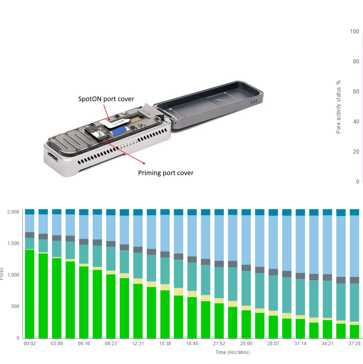
2. Open the priming port (keep SpotON port closed) and draw back any air bubbles by dialling up 30 µL approximately using a P1000 and discard the tip.
Flow cell configuration
Priming port opening
3. Using a P1000 and a new 1000 µL tip, load 800 µL of priming mix (FB reagent) slowly through the priming port. Save the FB for a next step below.
4. Leave to stand for 5 min.
5. In the meantime, prepare the final library to load.
| A | B | |
| Reagent | Volume per flow cell (µl) | |
| Sequencing Buffer (SB), red cap | 37.5 | |
| Library Beads (LIB), pink cap | 25.5 | |
| DNA library | 12 | |
| Total | 75 |
Final library mix for loading.
Note
Vortex the LIB at lest 00:00:30 before mixing with the other reagents.
6. Open the SpotON port and with a P1000 and a new 1000 µL tip, load 200 µL of FB through the priming port again dialling down (not SpotON port).
9. Immediately load the well mixed final library (75 µL ) in a dropwise fashion through the SpotON port, waiting for each drop to be taken up first.
10. Close the SpotON port and then the priming port. Place the light shield onto the flow cell and start sequencing.
Data acquisition and basecalling
Double-click the MinKNOW icon on the desktop to open the MinKNOW GUI and log in with nanopore community credentials or guest. In the case of the GridION click on the Minknow icon.
Note
Data acquisition is carried out by the MinKNOW software and basecalling can be done in real-time.
With the MinION connected to the computer select the sequencing device connected. The GridION will display all available flow cell spaces. You should have already performed the flow cell checking initial step to determine the pore availability on the flow cell to be used and that it passed QC (>800 pores).
On the Start homepage, select ‘Start Sequencing’ and complete the running parameters for the experiment.
Provide an experiment name, sample ID (At HFP/OLOAS/OAMT/DFSG/GDAB we assign the flow cell barcode number to both experiment and sample ID to facilitate downstream analysis and record keeping). Then continue to Kit Selection.
Select the kit used to prepare the libraries e.g., SQK-RBK114.24.
Note
In order to facilitate finding the correct kit, you could select sample type (DNA), if PCR was or was not used (PCR-free), and whether it was multiplexed or not.
Select Continue to Basecalling. Select Super-accurate for running live basecalling (as shown below) along with barcoding on. Select barcoding Trim on. Select minimum read length at 200 bp. On the Advance sequencing options turnoff the Reserve Pores option.
By default, Data targets conditions are 72 hours run length and -180mV bias voltage. Change to 48 hours.
Select the output data location, format and filtering options. Output data is typically saved as POD5 and/or FASTQ (we select it by default as Fastq and POD5). You can change the collection of fastq files per sample based on time or by read numbers, this is optional depending on your application. For our application we choose end point for fastq creation because it will generate a single fastq sample per sample. Which facilitate the downstream analysis.
Tun the barcoding option on, selecting split files by barcode and for the Fastq options select compression and raw reads as .POD5 as mentioned above.
Click the green Start and this will start the run.
Navigate to Sequencing Overview to monitor the run.
Example of a successful run:
R10.4.1 and RBK114.24 (rapid sequencing kit):
a) Pore activity (occupancy)
Pore occupancy for RBK114.24 should be around 75-80%.
b) Pore scan
Starting live pores: 1450 at 0 hr and decrease steadily to ~100 after 48 hrs.
c) Reads passing filter
Passing filter reads have to be ~ 80% of total reads, and failed should be very minor and below the reads passing filter.
Running metrics.
Do not use a flow cell that have less than 800 live pores.
Sequencing output or expected yield for bacterial runs:
Quality Scores according to DNA library kit preparation
Pore occupancy:
Pore occupancy must decrease steadily during the run. An abrupt decline over time indicates problems in the run (probably low DNA quality).
Pores die-0ff: The availability of live pores must decrease steadily during the run. An abrupt decline over time indicates problems in the run (probably low DNA quality).
Reads passing filter: The reads passing the filter (green line) must be higher than the reads not passing the filter (read line). This can be observed in the reads tab in the MinKNOW software.
Example of a bad run:
Low pore occupancy and low pore scan:
low pore occupancy
pores dying very fast, the availability of live pores must decrease steadily during the run. An abrupt decline over time indicates problems in the run (probably low DNA quality)
Troubleshooting/FAQ:
Low sequencing yield
Note
i. Concentrate the DNA with a 0.4x wash to remove potential inhibitors.
ii. Check the DNA concentration and quality. RNA presence may affect quantification of total DNA.
Rapid reduction in available pores
Note
Ensure sufficient DNA is loaded onto the flow cell. Use a minimum of 12 barcoded samples at 200ng per reaction. Check that the library is not being lost in the post-barcoding wash.
Low pore occupancy
Note
i. Ensure sufficient DNA is loaded onto the flow cell. Use a minimum of 12 barcoded samples at 200ng per reaction. Check that the library is not being lost in the post-barcoding wash step.
ii. Check that the DNA is of high quality (DIN 8.5+)
Poor recovery after flow cell wash
Note
A flow cell wash can occasionally lead to blockages that damage the flow cell. Perform the wash carefully, avoiding the introduction of bubbles by twisting the pipette dial rather than using the
plunger.