Jan 12, 2025
Chelex-based DNA extraction protocol for insect museum vouchers
- Morgan Brown1,
- Sara Ottati2,
- Valeria Trivellone1
- 1University of Illinois at Urbana-Champaign, United States of America;
- 2Institute for Sustainable Plant Protection (IPSP), National Research Council, Italy



Protocol Citation: Morgan Brown, Sara Ottati, Valeria Trivellone 2025. Chelex-based DNA extraction protocol for insect museum vouchers. protocols.io https://dx.doi.org/10.17504/protocols.io.bp2l6x54rlqe/v1
License: This is an open access protocol distributed under the terms of the Creative Commons Attribution License, which permits unrestricted use, distribution, and reproduction in any medium, provided the original author and source are credited
Protocol status: Working
We use this protocol and it's working
Created: January 31, 2024
Last Modified: January 12, 2025
Protocol Integer ID: 94500
Keywords: microorganisms, voucher, museum, acid nucleic extraction, DNA, next-generation sequencing, phytoplasma, bacteria, leafhoppers, bleaching, chelex, Column-based extraction, qPCR, insect, insect museum vouchers museum biorepository, insect museum, voucher specimen, taxonomic status, dna extraction, borne pathogens detection, taxonomic status of the associate, based dna extraction protocol, microbiome association, pathogens detection, museum specimen, tracking insect, insect, diverse community of microorganism, specimen, biodiversity, species, species on earth, phylogenetics, pathogen, high quality nucleic acid, dna, microorganism, described species, inferring evolutionary pathway, documenting association, nucleic acid, catalog record
Funders Acknowledgements:
U.S. National Science Foundation
Grant ID: DEB-2244871
Abstract
Museum biorepositories preserve precious material for scientific research in several fields such as biodiversity, phylogenetics, population genetics, toxicology, environmental monitoring and pathology.
About half of the 8.7 million described species on Earth are insects and harbor a diverse community of microorganisms representing different association types, such as parasitic, mutualistic, and commensal.
Voucher specimens may play an important role in tracking insect-microbiome associations.
Catalog records and voucher specimens are the primary source for: (1) tracking past associations and inferring evolutionary pathways; (2) documenting associations in no longer accessible collection sites; (3) revising the taxonomic status of the associates; (4) resampling the associations over time when new technologies become available.
Here we present a non-destructive, fast, inexpensive, non-toxic protocol for DNA extraction from insect museum specimens with the aim to obtain high quality nucleic acid and sufficient yield for vector-borne pathogens detection, quantification and characterization.
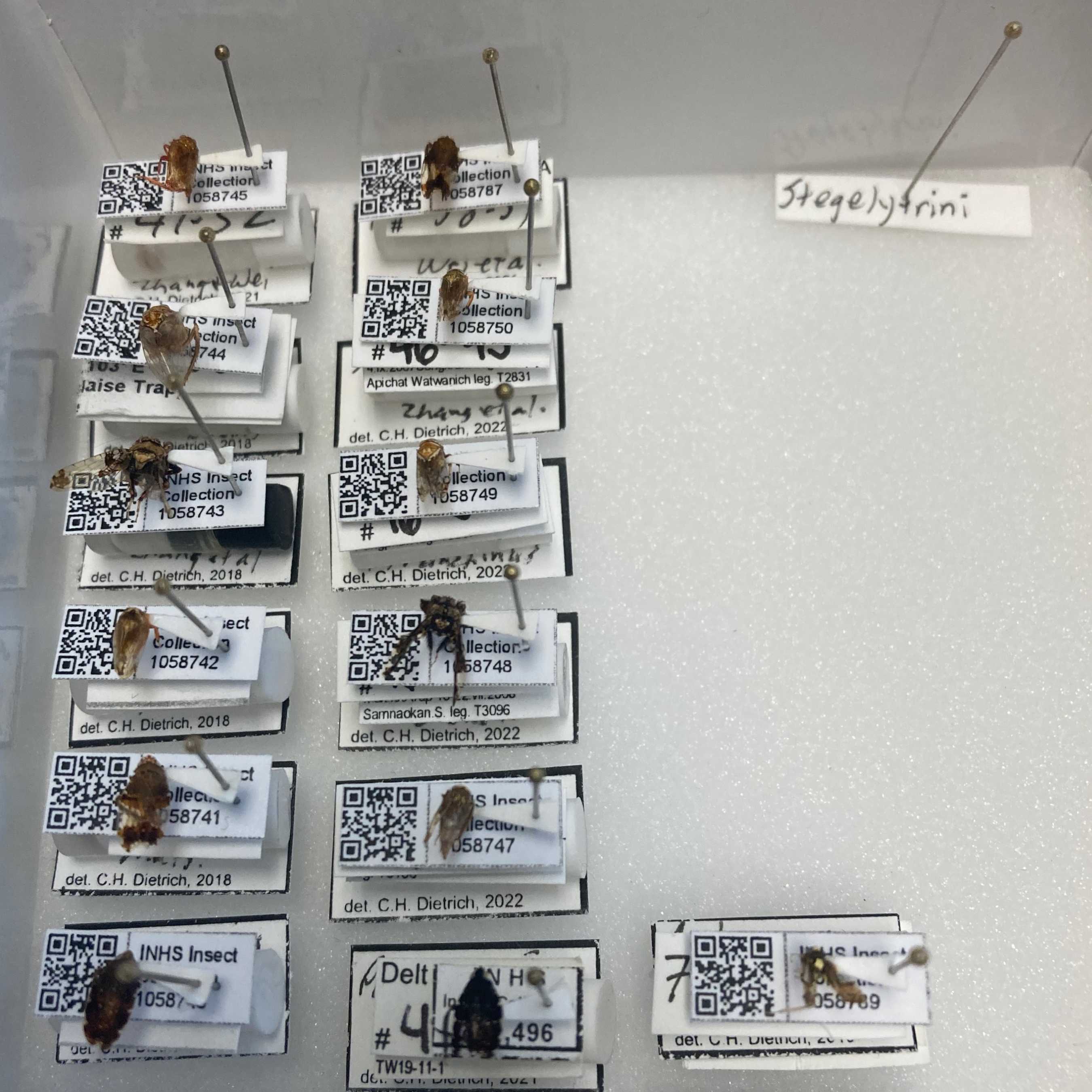
Image Attribution
Image source: Christopher H. Dietrich (University of Illinois at Urbana-Champaign)
Materials
UltraPure™ SDS Solution, 10%Thermo FisherCatalog #24730020 Chelex-100 resinBio-Rad Laboratories
95% EtOH
1M Tris-HCl, pH 8.0Invitrogen - Thermo FisherCatalog #15568025 EDTA (0.5 M), pH 8.0Life TechnologiesCatalog #AM9260G
Insect specimen selection and preparation
9m
Transfer the the ethanol-preserved insect specimen on a piece of paper towel to allow the ethanol to evaporate for a few minutes.
Note
For dry insect voucher, re-hydrate the insect specimen in a humidifying chamberOvernight
2m
Place insect specimen in a 1.5 mL centrifuge tube containing 500 µL ethanol 90 % (v/v) for 00:02:00 .
2m
Discard the ethanol and add 500 µL bleach 2.5 % (v/v) (NaOCl - The Clorox Co., Oakland, CA, USA) for 00:05:00 at 7.5 °C .
Note
The insect body must be fully immersed in the bleach solution.
5m
Discard bleach solution and rinse 3 X with 250 µL of sterile water, discard the water each time.
10m
DNA Extraction
19h 19m
Place the insect specimen into a fresh 1.5 mL centrifuge tube.
5m
Pipet 50 µL TES buffer and 2 µL Proteinase K (10 mg/mL , Qiagen) into the tube.
Note
Prepare TES buffer (Tris-HCl 20 millimolar (mM) pH 8.0 , EDTA 10 millimolar (mM) , SDS 0.5 % (v/v) )
For 10 mL TES add 0.2 mL EDTA 0.5 Molarity (M) , 0.5 mL SDS 10 % (v/v) , 0.2 mL Tris-HCl 1 Molarity (M) , 9.1 mL water (MilliQ)
2m
Incubate 55 °C Overnight ;
18h
Centrifugate the sample for a few seconds to spin down the liquid. With a pipet, transfer 50 µL of the liquid sample into a fresh tube.
Store the insect specimen as appropriate for further morphological studies.
2m
Prepare 25 Mass / % volume Chelex 100 suspension.
Note
Add 2.5 g Chelex 100 resin into 10 mL water (MilliQ or NANOpure)
15m
Place a flask containing a 25 Mass / % volume Chelex 100 suspension on a magnetic agitator and mix.
2m
Pipet 40 µL of Chelex directly from the agitator into the tube with the sample.
2m
Incubate the tube at 55 °C for 00:30:00 . Do not shake the tube.
30m
Gently invert the tube 5 times.
2m
Allow the solution to cool down to Room temperature .
15m
Centrifugate at14000 rpm for 00:01:00 .
2m
Transfer the supernatant into a fresh 1.5 mL centrifuge tube.
Safety information
The present protocol do not include toxic chemicals
2m
Protocol references
1. Bleaching step
Arora, A. K., Pesko, K. N., Quintero-Hernández, V., Possani, L. D., Miller, T. A., & Durvasula, R. V. (2018). A paratransgenic strategy to block transmission of Xylella fastidiosa from the glassy-winged sharpshooter Homalodisca vitripennis. BMC biotechnology, 18, 1-10.
Greenstone, M. H., Weber, D. C., Coudron, T. A., Payton, M. E., & Hu, J. S. (2012). Removing external DNA contamination from arthropod predators destined for molecular gut‐content analysis. Molecular Ecology Resources, 12(3), 464-469.
2. Chelex protocol modified from
Casquet, J., Thebaud, C., & Gillespie, R. G. (2012). Chelex without boiling, a rapid and easy technique to obtain stable amplifiable DNA from small amounts of ethanol‐stored spiders. Molecular ecology resources, 12(1), 136-141.
Lienhard, A., & Schäffer, S. (2019). Extracting the invisible: obtaining high quality DNA is a challenging task in small arthropods. PeerJ, 7, e6753.