Aug 09, 2025
CAMbank: Environmental Swabbing in Flight (v1)
- 1University of Austin (UATX);
- 2Weill Cornell Medicine;
- 3BioAstra


Protocol Citation: Eliah Overbey, Jaume Puig, Jeremy Wain Hirschberg, JangKeun Kim, Christopher Mason 2025. CAMbank: Environmental Swabbing in Flight (v1). protocols.io https://dx.doi.org/10.17504/protocols.io.bp2l6z9r5gqe/v1
Manuscript citation:
Overbey, E.G., Ryon, K., Kim, J. et al. Collection of biospecimens from the inspiration4 mission establishes the standards for the space omics and medical atlas (SOMA). Nat Commun 15, 4964 (2024). https://doi.org/10.1038/s41467-024-48806-z
License: This is an open access protocol distributed under the terms of the Creative Commons Attribution License, which permits unrestricted use, distribution, and reproduction in any medium, provided the original author and source are credited
Protocol status: Working
We use this protocol and it's working
Created: August 08, 2025
Last Modified: August 09, 2025
Protocol Integer ID: 224372
Keywords: environmental swab, microbial profiling, spaceflight, astronaut, CAMbank, SOMA, Dragon Capsule, environmental microbial sample, using sterile swab, sterile swab, rna swab, standardized collection of environmental microbial sample, potential pathogenicity in the spacecraft environment, environmental swab, cornell aerospace medicine biobank, sterile dna, downstream microbial community analysis, representative surfaces inside the dragon capsule, swab, containing dna, microbial composition, rna shield, standardized environmental biospecimen protocol, track microbe, developing standardized environmental biospecimen protocol, nucleic acid, dragon capsule, ambient temperature during flight, spacecraft environment, potential pathogenicity
Funders Acknowledgements:
WorldQuant Foundation
Grant ID:
WayPaver Foundation
Grant ID:
NASA
Grant ID: NNX14AH50G
NASA
Grant ID: NNX17AB26G
NASA
Grant ID: 80NSSC22K0254
NASA
Grant ID: NNH18ZTT001N-FG2
NASA
Grant ID: NNX16AO69A
NASA
Grant ID: 80NSSC21K0316
Abstract
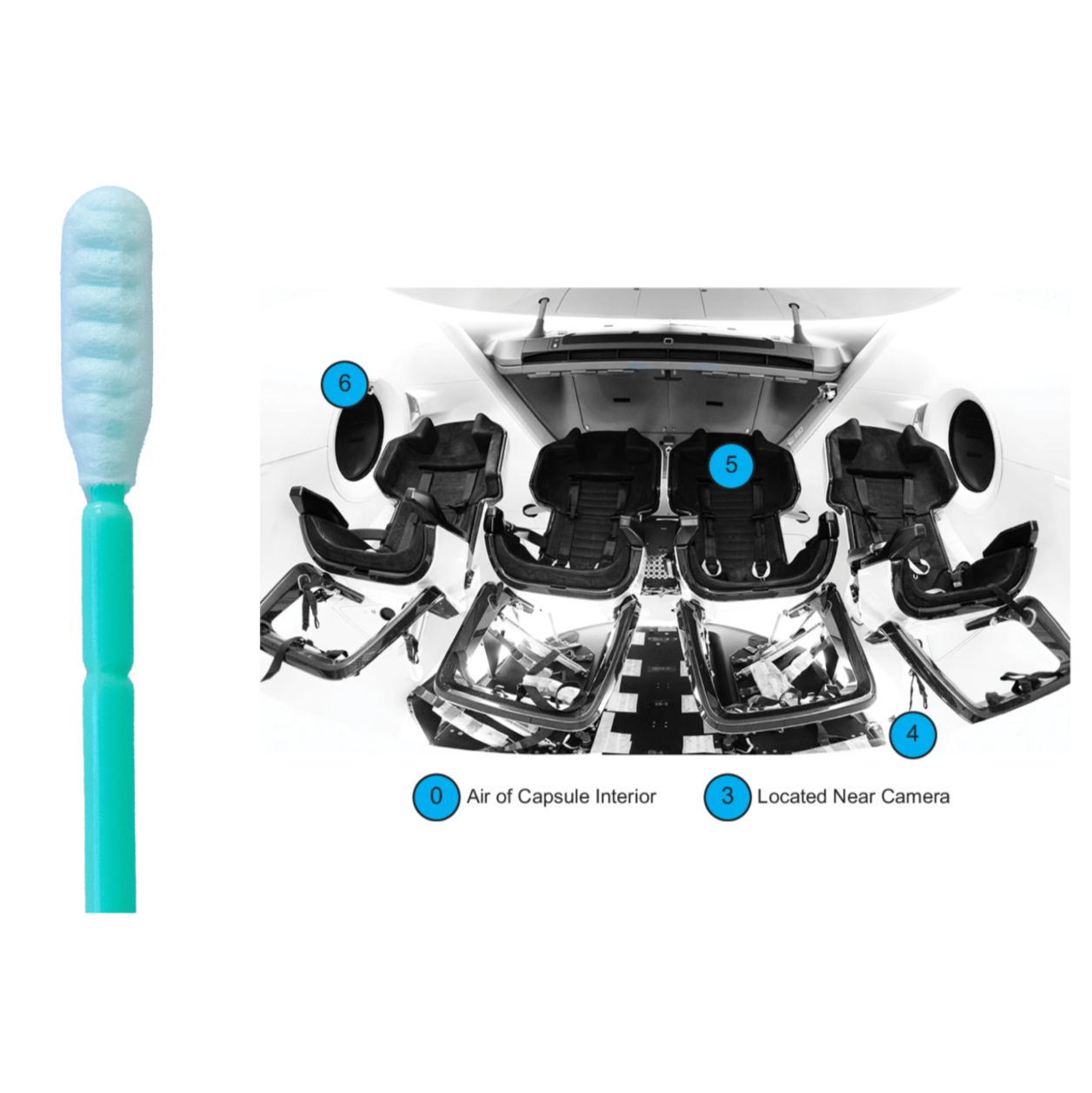
This protocol details the standardized collection of environmental microbial samples from spacecraft interiors during flight, using sterile swabs and nucleic acid preservative to enable downstream microbial community analyses. During the SpaceX Inspiration4 mission, environmental swabs were collected from predetermined high-contact and representative surfaces inside the Dragon capsule on Flight Days 1 and 2, as well as from a crew training capsule pre-flight. Ten locations were sampled at each timepoint, including control surfaces, instrument panels, viewing ports, waste locker lid, hatch handles, and crew seat headrests. For each site, sterile DNA/RNA swabs were pre-moistened with nuclease-free water (in-flight: hydrogen-infused water) and applied with firm pressure for 30 seconds, ensuring maximum surface coverage. Swabs were then placed in 2D matrix tubes containing DNA/RNA Shield preservative and stored at ambient temperature during flight. After return to Earth, samples were transferred to −80°C storage in the Cornell Aerospace Medicine Biobank (CAMbank). This method is compatible with metagenomic, metatranscriptomic, and targeted qPCR assays to characterize microbial composition, diversity, and potential pathogenicity in the spacecraft environment. The approach supports the Space Omics and Medical Atlas (SOMA) initiative’s objective of developing standardized environmental biospecimen protocols to enable cross-mission comparisons and track microbe–crew–habitat interactions over time.
Materials
Sterile swabs (Isohelix DNA/RNA Swabs) (in-flight)
Pre-labeled 2D matrix tubes with Zymo DNA/RNA Shield (400 µL per tube/sample) (in-flight)
Sterile nitrile gloves (in-flight)
70% Ethanol in a spray bottle (ground)
VWR KimWipes (ground)
Cryogenic Freezer (ground)
Preparation
Locate all flight materials in the space capsule.
Put on nitrile gloves to ensure sterile handling of the samples.
Sample Collection
Swab pre-selected areas of the space capsule cabin by matching the IDs on the tubes to the areas of the capsule.
- Wet each swab with sterile water.
- Swab each area for 30 seconds. Use both sides of the swab.
- Open the 2D matrix tube and deposit the swab in the Zymo DNA/RNA Shield preservative.
Return tubes to ambient cabin storage.
Storage
After landing, transfer samples to science team.
Science team performs an inventory and inspection of the samples.
Tube exteriors are sterlized with 70% EtOH and a KimWipe.
Science team stores samples at +4°C (if processing imminently) or at -80°C (for long-term storage).