May 03, 2023
Bleach extraction protocol: damaged or degraded DNA recovery from bone or tooth powder.
- 1Smurfit Institute of Genetics, Trinity College Dublin, Dublin 2, Ireland



Protocol Citation: Valeria Mattiangeli, cassidl , Kevin Daly, Victoria Mullin 2023. Bleach extraction protocol: damaged or degraded DNA recovery from bone or tooth powder. . protocols.io https://dx.doi.org/10.17504/protocols.io.8epv5j88nl1b/v1
License: This is an open access protocol distributed under the terms of the Creative Commons Attribution License, which permits unrestricted use, distribution, and reproduction in any medium, provided the original author and source are credited
Protocol status: Working
We use this protocol and it's working
Created: April 28, 2023
Last Modified: May 03, 2023
Protocol Integer ID: 81129
Keywords: Ancient DNA, extraction, DNA extraction, degraded DNA, degraded dna recovery from bone, dna extract, libraries from the dna extract, degraded dna recovery, degraded dna molecule, implementation of the bleach wash, retrieval of endogenous dna molecule, powder with dilute bleach, bleach wash, dilute bleach, dna molecule, teeth powder, dna, tooth powder, extraction protocol, endogenous dna molecule, elements of the extraction protocol, dsdna, historic bone, teeth
Funders Acknowledgements:
Science Foundation Ireland
Grant ID: 21/PATH-S/9515
European Research Council
Grant ID: 885729-AncestralWeave
Abstract
This protocol describes the steps to extraction degraded DNA molecules from ancient or historic bone and teeth powder, first washing the powder with dilute bleach (0.5% sodium hypochlorite) to improve the retrieval of endogenous DNA molecules.
It is an implementation of the bleach washes reported in (Boessenkool et al, 2017) and (Dabney et al, 2019), combined with elements of the extraction protocols described by (Yang et al, 1998), (MacHugh et al, 2000), and (Gamba et al, 2014).
We combine the low g centrifugation steps described in (Rohland et al, 2018), and the use of a low pH modified PB buffer used in (Allentoft et al, 2015).
Within our group, we typically construct double stranded (dsDNA) libraries from the DNA extract, as per (Meyer and Kircher, 2010).
Materials
Sodium Hypochlorite (14%, dilute to 0.5%)
Water (Laboratory grade)
EDTA (0.5M, pH 8)
Tris-HCl (1M, pH 7.4)
Sodium acetate (3M, pH 5.2)
Sodium Chloride (5M)
N-Lauroylsarcosine
Proteinase K (2.5 U/mg or 50U/mL)
Tween (20%)
Qiagen PB, PE, and EB Buffers
EBT buffer: 7.5 ul of 20% Tween in 15ml EB buffer
1.5 ml Eppendorf tubes
Parafilm
Thermomixer
Standard bench centrifuge
Bench centrifuge with a swing bucket rotor for 50ml tubes
Optional: Incubated tube rotator, H2020 Plus (Benchmark Scientific)
Protocol materials
PE buffer QiagenCatalog #19065
High Pure Viral Nucleic Acid Large Volume KitRocheCatalog #05114403001
Safety warnings
The described protocol should be performed in dedicated ancient DNA facilities. Workers should wear full-body PPE (gloves x2, body suits, masks) to avoid contamination of material. Extra care must be made to avoid cross-contamination of low concentration material typical of ancient/historical DNA projects.
Before start
A major consideration to make is whether the specimen are appropriate for the bleach pre-wash step. We have found that samples with low (<2%) endogenous DNA from other extraction protocols do not usually show improved endogenous values with this approach and can often decrease.
If a sample is particularly important, old, or comes from a site/region without prior aDNA results (to provide a reference for DNA preservation), you should consider also utilizing a non-bleach wash protocol. Additionally, take care to retain the BEDTA (EDTA used in bone wash prior to extraction), which may retain endogenous DNA molecules and can be themselves extracted for DNA library construction.
Finally, DNA libraries produced from DNA extracts of this method frequently have lower DNA concentrations than non-bleach wash protocols. Libraries may require additional cycles of amplification in PCR steps to reach sequencing concentrations., which may impact duplication rates on sequencing. To improve molecular diversity in the final sequencing data, consider:
-increasing the number of individual PCRs per sample when sequencing
-increasing the amount the DNA used in library construction
-increasing the amount of dsDNA library used in amplifcation
-performing duplicate extractions of the same bone powder specimen, to increase the number of amount of DNA available for above
Extraction Day 1: Preparation
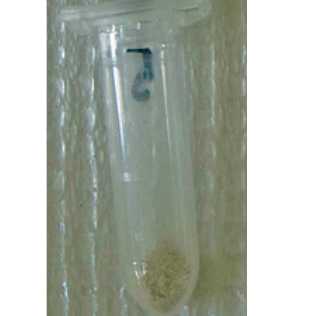
Prior to extraction, prepare sample tubes and controls. Per sample, 80-120 mg of bone powder should be stored in 2 mL Eppendorf tubes. Prepare an additional empty tube as an extraction control.
Due to the limitations of the bench centrifuge required to spin down the high volume columns (see below), a maximum of 16 samples + controls are extracted per batch.
In advance of extraction, ensure sufficient labratory-grade water ( n x 3 mL , where n is the number of samples and controls plus one) and 0.5 Molarity (M) EDTA ( n x 1 mL , where n is the number of samples and controls plus one) are subject to 00:30:00 UV light.
30m
Prepare the extraction buffer, where n is the number of sample and control tubes plus one (for pipetting error). In the example below 15 sample tubes and one extraction control tube are used (15 + 1 + 1 = 17).
When preparing the extraction buffer and prior to the addition of proteinase K, subject the buffer to 00:30:00 (30 minutes) of UV light.
| A | B | C | D | |
| Reagent | x 1 ( µL ) | x 17 ( µL ) | x n ( µL ) | |
| N-Laurylsarcosine | 17 | 289 | ||
| Tris-HCl, 1M | 20 | 340 | ||
| EDTA, 0.5M | 940 | 15,980 | ||
| *** UV buffer for 30m prior to addition of proteinase K *** | ||||
| Proteinase K (50 U/mL) | 13 | 221 |
30m
Extraction Day 1: Bleach treatment
Add 990 µL of 0.5 % (v/v) sodium hypochlorite solution to each sample tube.
Vortex and incubate at Room temperature for 00:15:00 a rotator (H2020plus Incubated tube rotator from Benchmark Scientific, speed 35) or in thermomixer at 900 rpm .
15m
Using a bench centrifuge, spin down the tubes until the centrifuge reaches maximum speed 17000 x g / 13300 rpm , then stop the centrifuge. Remove sample tubes from the centrifuge and discard the supernatant using a pipette, taking care to avoid disturbing the pellet.
To each tube, add 1 mL of pre-UVed, labratory-grade water. Briefly vortex each tube, ensuring the bone powder pellet goes into solution.
Using a bench centrifuge, spin down the tubes until the centrifuge reaches maximum speed 17000 x g / 13300 rpm , then stop the centrifuge. Remove sample tubes from the centrifuge and discard the supernatant using a pipette.
Repeat the previous two steps twice (1ml water, vortexing, spin down, removal of supernatant: a total of 3 times).
Extraction Day 1: Pre-extraction EDTA rinse
Add 990 µL of UVed EDTA 0.5 Molarity (M) to each bone powder tube
Briefly vortex to ensure the powder enters solution, then incubate on a thermomixer 900 rpm, 37°C, 00:30:00 (or rotor speed 20 using H2020plus Incubated tube rotator from Benchmark Scientific). At 10 minute intervals, pause the thermomixer and briefly vortex each sample tube (not required if on rotor).
Using a bench centrifuge, spin down the tubes until the centrifuge reaches maximum speed 17000 x g / 13300 rpm , then stop the centrifuge. Carefully transfer the EDTA supernatant to new tubes without disturbing the pellet, with each tube labeled with "sample-BEDTAx", where x is the number of bleach extractions performed (e.g. first extraction for sample X, "sampleX-BEDTA1" ). Freeze the BEDTA tubes; these can be used to recover DNA if the final extract gives very low endogenous.
To recover DNA from the BEDTA aliquots, incubate 900 rpm, 37°C, 24:00:00 after adding the remaining components of the extraction buffer (see below) directly to the EDTA. Then follow the instruction for Extraction Day 2.
Extraction Day 1: Extraction
If the extraction buffer has not already been prepared, prepare it now. Take care to add proteinase after the rest of the buffer components have been combined and exposed to UV light for 30 minutes.
Add 990 mL of extraction buffer (containing proteinase K) to each tube.
Cover each tube in parafilm and vortex until the bone pellet is completely in solution.
Incubate Overnight (15-24h) using a thermomixer 900 rpm, 37°C (or 37 °C on rotor speed 18 H2020plus Incubated tube rotator from Benchmark Scientific).
Extraction Day 2: Preparation
Prepare modified PB (binding) buffer; 13ml is required per tube. Typically the modified buffer is prepared directly in 500ml PB tubes, as pre-prepared bulk reagent.
| A | B | C | D | |
| Reagent | x 1 ( mL) | To add directly to 500 mL of Qiagen PB buffer ( mL ) | Final concentration ( M ) | |
| Sodium acetate, 3M | 0.42 | 16 | 0.1 | |
| Sodium chloride, 5M | 0.33 | 13.2 | 0.12 | |
| PB Buffer (Qiagen) | 12.25 | 500 |
Using a pH strip, check that the modified PB buffer is 5-5.5 pH. If not, increase the amount of sodium acetate and sodium chloride.
Label an appropriate number (1 per sample tube) of Roche High Pure Extender Assembly spin columnsHigh Pure Viral Nucleic Acid Large Volume KitRocheCatalog #05114403001
Extraction Day 2: Purification
10m
Remove each tube from incubation, then spin each sample tube using a bench centrifuge for 00:10:00 (10min) at max speed 13300 rpm / 17000 x g .
10m
To labeled Roche column reservoirs, add 13 mL of modified PB buffer.
Add 1 mL of supernatant from each tube to the appropriate labeled Roche column.
Take care that no powder is in the supernatant when transferred into the column.
The remaining pellet, if any, can be frozen or used for a second round of extraction starting from the extraction buffer addition in the previous day.
Spin for 700 x g, 00:02:00 ( 2 min ) in a centrifuge with a swing bucket rotor for 50ml tubes. After the 2 min spin, rotate each tube 90 degrees, and spin for another two minutes 700 x g, 00:02:00 (speed can be reduced to 600 g)
4m
Check that all liquid is gone through. If liquid is still present, spin for one more min.
Remove the extension reservoir containing the silica filter from the falcon tube and place it into a clean collection tube. Remove the side flaps, and snap tabs of the the big reservoir to remove it from the falcon tube.
Dry-spin the collection columns for 3000 x g, 00:01:00 (or 6000 rpm ) using a bench-top centrifuge.
1m
Add 750 µL of PE buffer QiagenCatalog #19065 to each silica filter and collection column. Spin the columns for 3000 x g, 00:01:00 (1 min, 6000 rpm ). Discard the flow-through. Repeat for a total of 2 times.
1m
Dry-spin the columns for 3000 x g, 00:01:00 (1 min, 6000 rpm ). Place each column in a fresh 1.5 mL labeled collection Eppendorf tube. Labels should be formated "sample-MBEXx", where x is the number of bleach extractions performed using this protocol. These are the final tubes and will contain the purified DNA.
1m
Heat EBT (50 µL x n, where n is the number of tubes plus one; see materials for receipe) to 65 °C using a thermomixer.
Using a pipette, add 25 µL of EBT (see material) to the filter of each spin column. Wait 00:02:00 (2 min), and spin down columns at maximum speed 13300 rpm / 17000 x g . Collection tube lids should be angled away from the direction of spin.
Repeat this step for a total of two spins and 50 µL elution.
2m
Sample tubes containing the purified DNA extract should be stored in a -20 °C freezer.
Protocol references
Yang, D. Y., Eng, B., Waye, J. S., Dudar, J. C., & Saunders, S. R. (1998). Technical note: improved DNA extraction from ancient bones using silica-based spin columns. American Journal of Physical Anthropology, 105(4), 539–543. https://doi.org/10.1002/(SICI)1096-8644(199804)105:4<539::AID-AJPA10>3.0.CO;2-1
MacHugh, D. E., Edwards, C. J., Bailey, J. F., Bancroft, D. R., & Bradley, D. G. (2000). The extraction and analysis of ancient DNA from bone and teeth: a survey of current methodologies. Ancient Biomolecules, 3(2), 81–103.
Gamba, C., Cristina, G., Jones, E. R., Teasdale, M. D., McLaughlin, R. L., Gloria, G.-F., Valeria, M., László, D., Ivett, K., Ildikó, P., Alexandra, A., Alasdair, W., János, D., Pál, R., Higham, T. F. G., Michael, H., Bradley, D. G., & Ron, P. (2014). Genome flux and stasis in a five millennium transect of European prehistory. Nature Communications, 5, 5257. https://doi.org/10.1038/ncomms6257
Boessenkool, S., Hanghøj, K., Nistelberger, H. M., Der Sarkissian, C., Gondek, A. T., Orlando, L., Barrett, J. H., & Star, B. (2017). Combining bleach and mild predigestion improves ancient DNA recovery from bones. Molecular Ecology Resources, 17(4), 742–751. https://doi.org/10.1111/1755-0998.12623
Dabney, J., & Meyer, M. (2019). Extraction of Highly Degraded DNA from Ancient Bones and Teeth. Methods in Molecular Biology , 1963, 25–29. https://doi.org/10.1007/978-1-4939-9176-1_4
Rohland, N., Glocke, I., Aximu-Petri, A., & Meyer, M. (2018). Extraction of highly degraded DNA from ancient bones, teeth and sediments for high-throughput sequencing. Nature Protocols, 13(11), 2447–2461. https://doi.org/10.1038/s41596-018-0050-5
Allentoft, M. E., Sikora, M., Sjögren, K.-G., Rasmussen, S., Rasmussen, M., Stenderup, J., Damgaard, P. B., Schroeder, H., Ahlström, T., Vinner, L., Malaspinas, A.-S., Margaryan, A., Higham, T., Chivall, D., Lynnerup, N., Harvig, L., Baron, J., Della Casa, P., Dąbrowski, P., … Willerslev, E. (2015). Population genomics of Bronze Age Eurasia. Nature, 522(7555), 167–172. https://doi.org/10.1038/nature14507
Meyer, M., & Kircher, M. (2010). Illumina sequencing library preparation for highly multiplexed target capture and sequencing. Cold Spring Harbor Protocols, 2010(6), db.prot5448. https://doi.org/10.1101/pdb.prot5448