Feb 26, 2026
Biston betularia protocols: Assembly trapping
- Ivy Whiteford1,
- Carl Yung1,
- Amy Corthine1,
- Ilik Saccheri1
- 1University of Liverpool
- Saccheri Lab



Protocol Citation: Ivy Whiteford, Carl Yung, Amy Corthine, Ilik Saccheri 2026. Biston betularia protocols: Assembly trapping. protocols.io https://dx.doi.org/10.17504/protocols.io.8epv51odjl1b/v1
Manuscript citation:
Ilik J. Saccheri, François Rousset, Phillip C. Watts, Paul M. Brakefield, Laurence M. Cook (2008). "Selection and gene flow on a diminishing cline of melanic peppered moths". PNAS. 105 (42), 16212-16217.
License: This is an open access protocol distributed under the terms of the Creative Commons Attribution License, which permits unrestricted use, distribution, and reproduction in any medium, provided the original author and source are credited
Protocol status: Working
We use this protocol and it's working
Created: May 05, 2020
Last Modified: February 26, 2026
Protocol Integer ID: 36605
Keywords: Lepidoptera, Trapping, Fieldwork, Field studies, Biston betularia, Peppered moth, biston betularia, biston betularia protocol, peppered moth, trapping wild male, reared female, textbook example of industrial melanism, industrial melanism, wild male,
Abstract
The peppered moth, Biston betularia, is a textbook example of industrial melanism. Here we describe the procedures associated with trapping wild males using laboratory-reared females.
Safety warnings
Be mindful of surroundings whilst in the field. If working alone, make sure to take a charged mobile phone, and notify at least one other person of the exact location you are travelling to. If possible, arrange to call another person by a specific time, so that they will become aware if something has happened.
Planning
The collection of wild males is performed either to provide population samples or genetic variation for laboratory stocks. Virgin females release pheremones, which can attract large numbers of males, depending on the local density of Biston betularia. This is called assembly trapping. Currently, there is no effective synthetic pheromone available for this species, which could be used to replace virgin females.
The phenology of Biston betularia varies across its geographical range and with altitude. It is therefore important to be aware of the local phenology at a given trapping location. For optimal results, females need to have eclosed very recently, therefore timing of adult eclosion and planning is important (see "Biston betularia protocols: Rearing").
Prior to travel
1m
Before travelling to field sites, virgin females should be placed singly in double-sided "calling pots". The pre-assembled calling pots containing virgin females are needed when traps are set up in a new location for the first time, or when females within traps need to be replaced. Once placed in a calling pot, females should be transported in a cool bag/box to keep them in good condition.
Important points:
- Double check that the seals around the calling pot are secure and females cannot escape.
- Ensure that the associated label (including eclosion date) is also placed in the calling pot, so that females can be identified.
1m
In the field
2m
When arriving at a field site for the first time, traps need to be assembled. First a dowel is inserted for rigidity. Second, one of the blue conical vents is placed in the trap. Third, one or two pre-assembled female calling pots are attached to the internal velcro strip. Fourth, the second blue conical vent is placed in the trap. The trap is now ready to be positioned.
2m
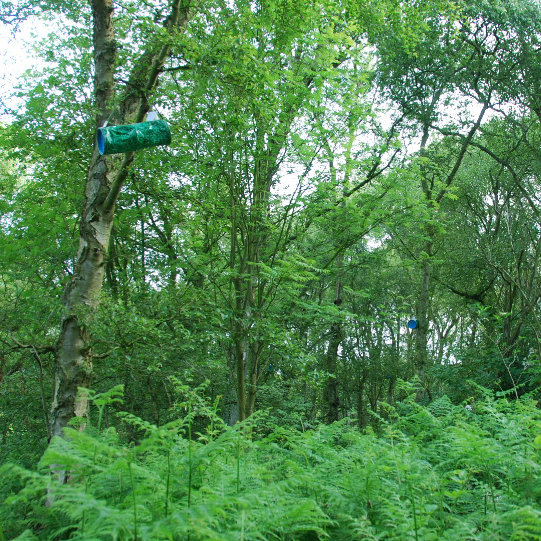
Biston betularia favour mixed deciduous woodland (birch, willow, oak) and successional habitats. Placement of assembly traps is critical. The objective is to position them in such a way that pheromone can easily diffuse from the trap and be carried for long distances on air currents. Traps should therefore be placed > 5m above ground level, usually hanging from a broken branch, resting against the tree trunk, so that it does not move in the wind. This can be achieved with extendable poles, climbing or a portable ladder. Make sure that no branches are blocking the entrances. If on a hill side, it is better to find a location higher up the slope than in the valley. It is also important to choose a position that is not going to receive direct sunlight.
Try to avoid placing traps near ant colonies - they will eat all your moths. Small birds can also be a problem, but the funnel entrance has been designed to be just about too small.
1m
Traps should be checked every day, if possible in the morning when the males are least active. Males should be transferred from the trap either individually into pill boxes (with site and trap number label), or when there are many in a trap, into a larger cage (with site and trap number label). If there are several males, we recommend doing this under a sheet of netting, so males do not become agitated and escape. Males from a trap should be kept together with a note of the trapping site and the date. At all times try not to agitate the males (e.g. by placing them in direct sunlight) so as to avoid further wing wear before they have been scored for morph type.
The single most important determinant of whether a trap is attractive is the freshness of the virgin females held within it. Females are at their best from day 1-4 after eclosion but, if no fresher females are available, may be used up to day 7. Females that are not in traps should be stored in a fridge (5-7°C) or other cool place. We prefer to use two females per trap, replacing the older female of a pair with a fresher individual every two days.
10m
Sorting & storage
Once trapped males are returned to the laboratory or field station, they must be recorded and stored. The most efficient and effective way to preserve the sample for DNA and wing pattern is to euthanise and store the moths at -20°C. Once a specimen has been frozen, it should not be allowed to thaw as this will lead to DNA damage. Therefore, where moths have been euthanised at -20°C prior to recording and storage, the transfer to the envelope and back to a -20°C freezer must happen quickly (in small batches). Similarly, if only one freezer is available, the repeated opening and closing of a freezer should be minimised to maintain -20°C.
Spreadsheet template:
 Biston_storage_2020_v2.xlsx