


Protocol Citation: Livia Hecke Morais, Anastasiya Moiseyenko 2025. Beam traversal. protocols.io https://dx.doi.org/10.17504/protocols.io.kxygx4znzl8j/v1
License: This is an open access protocol distributed under the terms of the Creative Commons Attribution License, which permits unrestricted use, distribution, and reproduction in any medium, provided the original author and source are credited
Protocol status: Working
We use this protocol and it's working
Created: July 30, 2025
Last Modified: August 01, 2025
Protocol Integer ID: 223732
Keywords: beam traversal this test, time for mice, beam traversal, meter plexiglass beam, mice, meter plexiglass beam with segment, beam, maximum time, hindlimb, second, trial, institutional animal care, animal models of parkinson, parkinson, assessment of gross motor function, gross motor function, assessment, test
Funders Acknowledgements:
ASAP
Grant ID: ASAP-020495
ASAP
Grant ID: ASAP-000375
Heritage Medical Research Institute
Abstract
This test measures the time for mice to cross a 1-meter plexiglass beam with segments decreasing
in width. Time to traverse and number of slips off the beam can be recorded for an assessment of gross motor function in animal models of Parkinson's disease.
Information
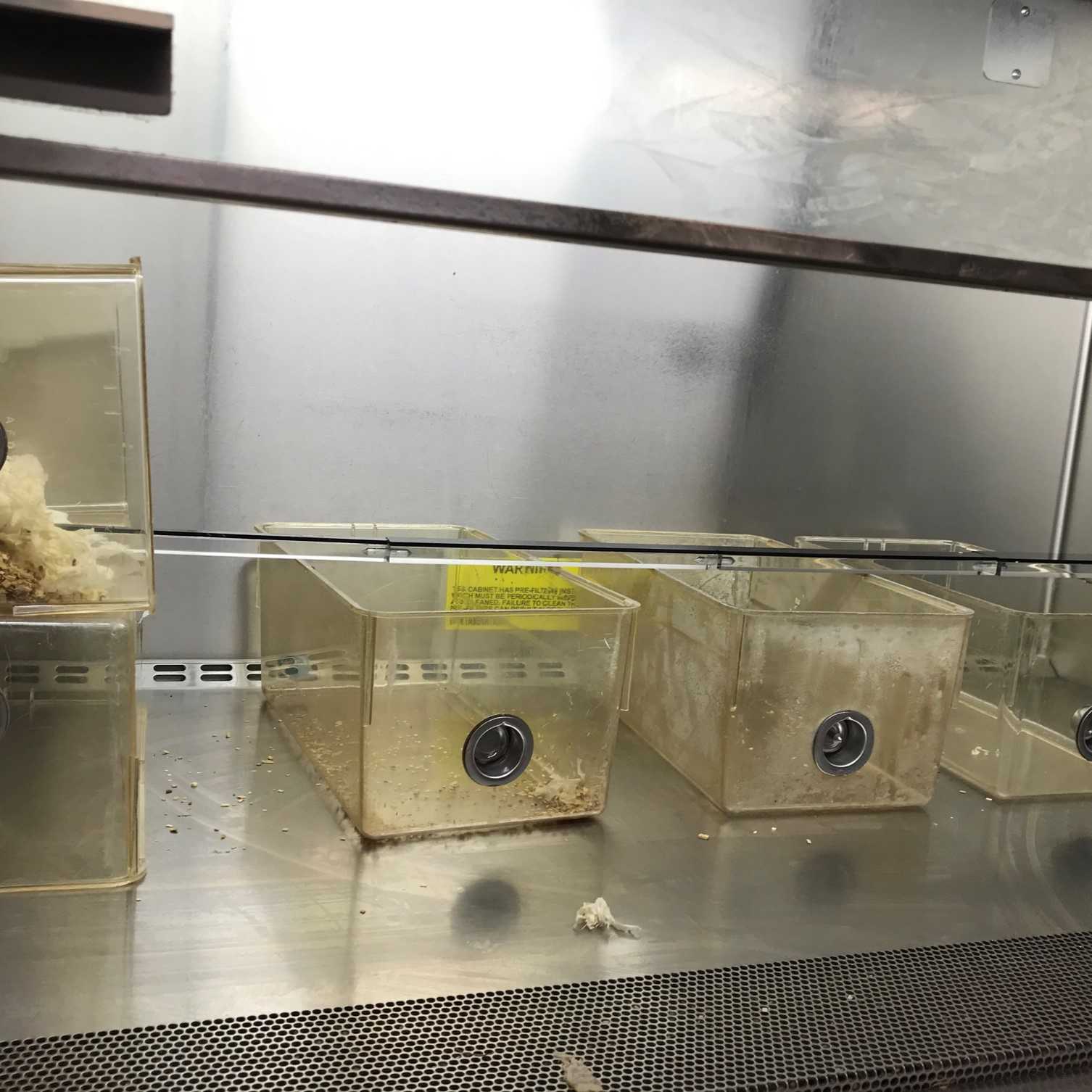
Training and testing is done on two consecutive days. Animals are placed onto the widest section of the beam and trained to run across towards their home cage. Mice are given 3 trails on the training day and 2 trials on testing day. Experiments can be done inside a biosafety cabinet for animals with sensitive microbiomes.
Set-up
Habituate animals to behavior testing room for 1 hour prior to assay start.
The Beam transversal consists of a 1-meter plexiglass beam with segments decreasing in width (3.5 cm, 2.5 cm, 1.5 cm, 0.5 cm).
Connect beam segments in order of decreasing width and place on top of 3 empty standard size mouse cages with the open sides facing up.
Wipe down the set up with animal-safe cleaning agent before beginning any trials and between each cage.
Remove nest material, and place animal home cage sideways at the end of the most narrow section of the beam, with the open-side facing towards the right.
Allow animals ~2 minutes to explore the new arrangement of the cage.
Training Day
On training day, animals receive 3 trails each.
The 1st trial is guided, with the home cage being brought close and moved along with the animal to encourage forward progress.
Trial 1: Place the mouse at the beginning of the 3.5 cm segment, bring the home cage close to the animal and encourage forward progress on the beam by moving the cage along with the animal. Use gentle touch on the tail if animal will not move or turns around away from the cage. Continue until the end of the beam and allow animal to enter home cage.
Trial 2: Place the mouse at the beginning of the 3.5 cm segment again and perform another trial similarly to Trial 1 but with less guidance and encouragement - i.e. less tail-touches and home cage slightly further away from the animal than the previous trial.
Trial 3: Return the home cage to the end of the beam. Place the mouse at the beginning of the 3.5 cm segment and allow it to traverse the beam with limited assistance - only using tail-touches if the animal will not move or turns around away from the home cage.
Test Day
On the next day, set up the apparatus the same way as for training day.
For testing, animals receive 2 trials to traverse the beam, with a maximum time of 60 seconds.
Timing begins once the mouse crosses a forelimb into the second (2.5cm) section of the beam and stops once one of the forelimbs is inside the home cage.
Test day trials can be videotaped and later assessed in slow motion for number of steps and slips that occurred during the traversal. Slips are counted if at least ¾ of any limb leaves the beam.
Place animal onto the first section of the beam and let traverse to the home cage at the end of the beam freely.
Repeat step 13 for second trial, cycling through all animals for trial 1, then continuing to trial 2 to allow animals rest time in between trials.
After each mouse completes 2 trials, move onto the next cage. Clean entire area of bedding, feces, and odors before starting next cage.
Protocol references
1. Sampson, T. R. et al. Gut Microbiota Regulate Motor Deficits and Neuroinflammation in a Model of Parkinson’s Disease. Cell 167, 1469-1480.e12 (2016).
2. Fleming, S. M., Ekhator, O. R. & Ghisays, V. Assessment of Sensorimotor Function in Mouse Models of Parkinson’s Disease. J Vis Exp 50303 (2013) doi:10.3791/50303.