Aug 08, 2024
Beam traversal
- 1California Institute of Technology



Protocol Citation: Livia Hecke Morais 2024. Beam traversal. protocols.io https://dx.doi.org/10.17504/protocols.io.e6nvw1212lmk/v1
License: This is an open access protocol distributed under the terms of the Creative Commons Attribution License, which permits unrestricted use, distribution, and reproduction in any medium, provided the original author and source are credited
Protocol status: Working
We use this protocol and it's working
Created: August 08, 2024
Last Modified: August 08, 2024
Protocol Integer ID: 105014
Keywords: beam traversal this test, time for mice, beam traversal, meter plexiglass beam, mice, meter plexiglass beam with segment, beam, maximum time, hindlimb, second, trial, institutional animal care
Funders Acknowledgements:
ASAP
Grant ID: ASAP-020495
Abstract
This test measures the time for mice to cross a 1-meter plexiglass beam with segments decreasing
in width (3.5 cm, 2.5 cm, 1.5 cm, 0.5 cm). Mice were trained for two days
before testing. On testing day, mice were placed at the start of the 3.5 cm
segment for three trials and time to cross the beam was recorded. Time was
recorded when hindlimbs reached the home cage, with a maximum time of 60
seconds.
Protocol has been approved by the California Institute of Technology’s Institutional Animal Care
and Use Committee (IACUC).
Information
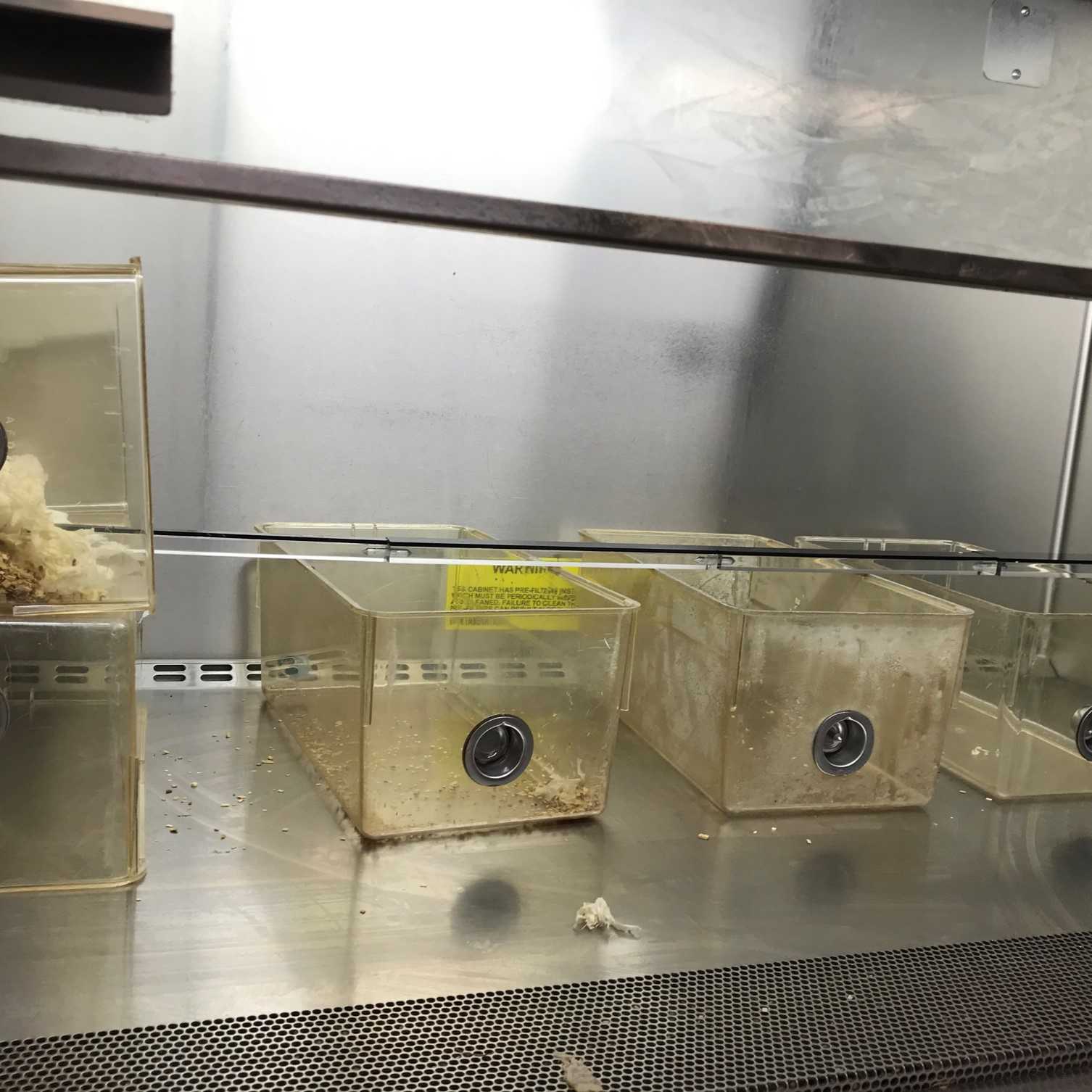
Experiments involving GF and GF x SPF comparisons were conducted inside germ-free isolators. For comparisons involving only SPF animals, experiments were completed in a biological safety cabinet. All experiments were performed between ZT6 and ZT10 of the light phase and started at the same time each day.
Beam traversal set-up
The Beam transversal consist in 1-meter
plexiglass beam with segments decreasing in width (3.5 cm, 2.5 cm, 1.5 cm, 0.5
cm).
All the beam segments are connected (from larger to smaller) and placed on top of 4 empty mouse cages.
Mice are transferred to a new cage, and their home cage containing the used bedding will be used for training and testing (see image at description for set up).
Wipe the beam and empty cages with 70% EtOH before beginning any trials and between each mouse.
Acclimation
On each training and assessment day bring the mice up from the vivarium to the behavior room at least 1h prior to assessment to allow for acclimation to the environment prior to assessment.
Training Day 1
Determine the order of assessment that you will use for the length of the training and assessment, record this in lab notebook.
Mice are transferred to a new cage, and their home cage containing the used bedding is placed at the end of the 0.5 cm segment (see image at description).
Training day 1 will then consist of five trials for each mouse.
Trial 1: Place the mouse at the beginning of the 3.5 cm segment, with the home cage positioned at the end of this segment. Allow the mice to freely move from the beginning of the segment to the home cage.
Trial 2: Place the mouse at the beginning of the 2.5 cm segment, with the home cage positioned at the end of this segment. Allow the mice to freely move from the beginning of the segment to the home cage.
Trial 3: Place the mouse at the beginning of the 1.5 cm segment, with the home cage positioned at the end of this segment. Allow the mice to freely move from the beginning of the segment to the home cage.
Trial 4: Place the mouse at the beginning of the 0.5 cm segment, with the home cage positioned at the of this segment. Allow the mice to freely move from the beginning of the segment to the home cage.
Trial 5: Place the mouse at the beginning of the 3.5 cm segment, with the home cage positioned at the end of this segment of 0.5 cm segment. Allow the mice to freely move from the beginning of the segment to the home cage.
Training Day 2
Determine the order of assessment that you will use for the length of the training and assessment, record this in lab notebook.
Mice are transferred to a new cage, and their home cage containing the used bedding is placed at the end of the 0.5 cm segment (see image at description).
Place the mouse at the beginning of the 3.5 cm segment, with the home cage positioned at the end of this segment of 0.5 cm segment. Allow the mice to freely move from the beginning of the segment to the home cage.
Test Day
Determine the order of assessment that you will use for the length of the training and assessment, record this in lab notebook.
Mice are transferred to a new cage, and their home cage containing the used bedding is placed at the end of the 0.5 cm segment (see image at description).
Place the mouse at the beginning of the 3.5 cm segment, with the home cage positioned at the end of this segment of 0.5 cm segment. Allow the mice to freely move from the beginning of the segment to the home cage.
Begin the stopwatch/timer as soon as you place the mouse at the beginning of the 3.5 cm segment. Stop timing once all 4 paws are touching the home cage.
Repeat this 2 more times (total of 3 trials) for each mouse.
Allow the mouse to rest for 30 sec between trials.
After each mouse complete 3 trials they are moved to a new cage.
Clean the beam and cages with 70% EtOH between each mice.
After all mice that belong to the same cage complete 3 trials, they are moved back to their home cage.